ignition CHRYSLER 300 LX 2005 User Guide
[x] Cancel search | Manufacturer: CHRYSLER, Model Year: 2005, Model line: 300 LX, Model: CHRYSLER 300 LX 2005Pages: 374, PDF Size: 7.09 MB
Page 22 of 374
To unlock the trunk:
Press the trunk button on the transmitter two times to
unlatch the trunk.
NOTE:The transmitter can be programmed to unlatch
the trunk by pressing the trunk button only one time by
performing the following procedure:
1. Press and hold the Unlock button on the transmit-
ter.
2. Continue to hold the Unlock button, wait at least 4
but no longer than 10 seconds, then press the trunk
button.
3. Release both buttons.
Using The Panic Alarm:
To turn the panic alarm feature ON or OFF, press and
hold the PANIC button on the transmitter for at least one
second and release. When the panic alarm is on, the
headlights and park lights will flash, the horn will pulse
on and off and the interior lights will turn on.The panic alarm will stay on for 3 minutes unless you
turn it off by pressing the PANIC button a second time or
if the vehicle speed is 15 mph (24 km/h) or greater.
NOTE:The interior lights will turn off when the
ignition is switched to the ACC or ON position after the
panic alarm is activated. However, the exterior lights and
horn will remain on.
NOTE:When you turn off the panic alarm by pressing
the PANIC button a second time, you may have to be
closer to the vehicle due to the radio frequency noises of
the system.
To Turn Off ªFlash Lights On Lock/Unlockº
NOTE:
The ªFlash Lights On Lock/Unlockº feature can
be turned on and off by referring to ªPersonal Settingsº
in the Electronic Vehicle Information Center (EVIC) sec-
tion of this manual, or by following these steps:
1. Press the LOCK button for 4 to 10 seconds.
2. While the LOCK button is pressed, (after 4 seconds)
press the UNLOCK button. Release both buttons.
22 THINGS TO KNOW BEFORE STARTING YOUR VEHICLE
ProCarManuals.com
Page 24 of 374
2. Remove and replace the battery. Avoid touching the
new battery with your fingers. Skin oils may cause
battery deterioration. If you touch a battery, clean it with
rubbing alcohol.
3. To reassemble the transmitter case, join the two halves
of the case together. Install and tighten the screw until
snug. Make sure there is an even ªgapº between the two
halves. Test transmitter operation.
VEHICLE THEFT ALARM Ð IF EQUIPPED
This system monitors the vehicle doors and ignition
switch for unauthorized entry or operation. When the
alarm is activated, the system provides both audible and
visual signals. The horn will pulse, headlights/park
lights will flash, the Vehicle Theft Alarm/Immobilizer
light, located on the instrument panel below the Elec-
tronic Vehicle Information Center buttons will flash, and
the vehicle will not start. If the alarm is triggered and no
action is taken to disarm it, the system will turn off the
horn after three minutes and after 15 minutes of light
only operation the system will then rearm itself.To arm the system:Remove the key from the ignition
switch and either:
1. Press a power door lock switch while the driver's or
passenger's door is open.
2. Press the LOCK button on the keyless entry transmit-
ter.
After the last door is closed, or if all doors are closed, the
system will arm itself in about 16 seconds. During that
time, the Vehicle Theft Alarm/Immobilizer light will
flash. If it does not illuminate, the system is not arming.
If you open a door during this arming period, the system
will cancel the arming process. You must repeat one of
the previously described arming sequences to rearm the
system.
To disarm the system:Press the UNLOCK button on the
keyless entry transmitter. Also, using a valid sentry key
and moving the ignition switch to the ON/START posi-
tion will disarm the system. If something has triggered
the system in your absence, the horn will sound three
times when you disarm the system. Check the vehicle for
tampering.
24 THINGS TO KNOW BEFORE STARTING YOUR VEHICLE
ProCarManuals.com
Page 25 of 374
NOTE:
²
The driver's door key cylinder and the trunk button on
the keyless entry transmitter cannot arm or disarm the
system.
²The system remains armed during trunk entry. Press-
ing the trunk button will not disarm the system. If
someone enters the vehicle through the trunk and
opens any door the alarm will sound.
²When the system is armed, the doors can not be
unlocked from the interior power door lock switches.
The Vehicle Theft Alarm system is designed to protect
your vehicle, however, you can create conditions where
the system will give you a false alarm. If one of the
previously described arming sequences has occurred, the
system will arm regardless of whether you are in the
vehicle or not. If you remain in the vehicle and open a
door, the alarm will sound. If this occurs, disarm the
system.
The alarm system will be activated when the battery is
connected if the system was previously armed. Theexterior lights will flash, the horn will sound, and the
ignition will not start the vehicle. If this occurs, disarm
the system.
WINDOWS
Power Windows
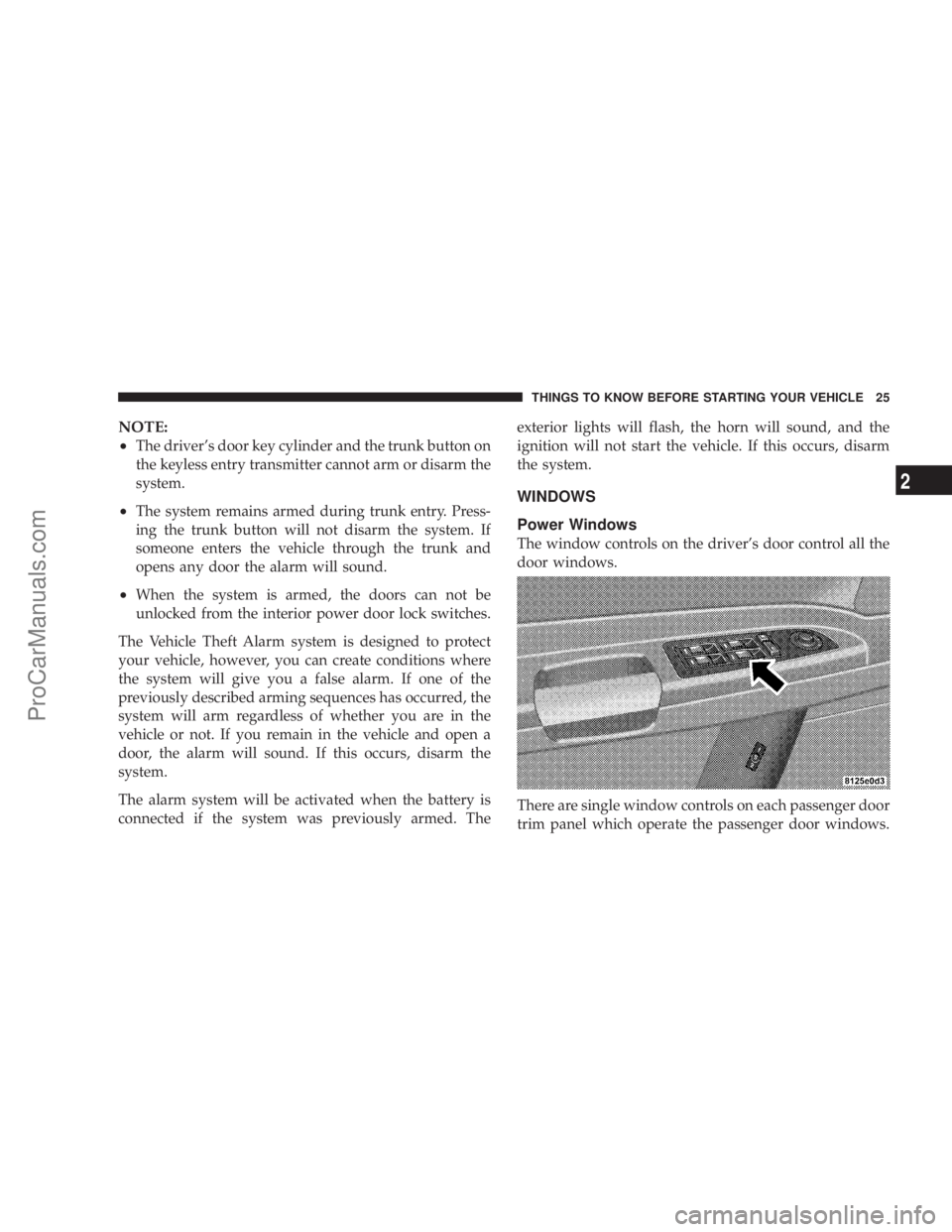
The window controls on the driver's door control all the
door windows.
There are single window controls on each passenger door
trim panel which operate the passenger door windows.
THINGS TO KNOW BEFORE STARTING YOUR VEHICLE 25
2
ProCarManuals.com
Page 26 of 374
The window controls will operate only when the ignition
switch is in the ON or ACCESSORY position.
The window lock switch on the driver's door allows you
to disable the window controls on the passenger doors.
When the lock switch is pressed the window controls on
the passenger doors will not illuminate and the passen-
ger windows will be disabled.
Auto Down Feature
The driver door power window switch, and some model
passenger door power window switches have an auto
down feature. Press the window switch to the second
detent, release, and the window will go down automati-
cally.
To open the window part way, press the window switch
to the first detent and release it when you want the
window to stop.
To stop the window from going all the way down during
the auto-down operation, pull up on the switch briefly.
The power window switches remain active for 10 min-
utes after the ignition switch has been turned off. Open-
ing either front door will cancel this feature. The time iscustomer programmable through the Electronic Vehicle
Information Center (EVIC) Ð If Equipped. Refer to
ªDelay Power Off to Accessories Until Exitº under ªPer-
sonal Settingsº in the Electronic Vehicle Information
Center section of this manual for details.
Auto Up Feature with Anti±Pinch ProtectionÐIf
Equipped
Lift the window switch to the second detent, release, and
the window will go up automatically.
To stop the window from going all the way up during the
auto-up operation, push down on the switch briefly.
To close the window part way, lift the window switch to
the first detent and release when you want the window to
stop.
The power window switches remain active for 10 min-
utes after the ignition switch has been turned off. The
time is customer programmable through the electronic
vehicle information center (EVIC)Ðif equipped. Refer to
ªDelay Power Off to Accessories Until Exitº in the
Electronic Vehicle Information Center section for details.
Opening either front door will cancel this feature.
26 THINGS TO KNOW BEFORE STARTING YOUR VEHICLE
ProCarManuals.com
Page 28 of 374

TRUNK LOCK AND RELEASE
Use the Remote Keyless Entry Transmitter to open the
trunk from outside the vehicle. The trunk lid can be
released from inside the vehicle by pressing the Trunk
Release Button located on the instrument panel to the left
of the steering wheel. The transmission must be in Park
before the switch will operate.With the ignition ON, the trunk open symbol will be
displayed in the instrument cluster indicating that the
trunk is open. The odometer display will reappear once
the trunk is closed.
With the key in lock position or key out, the trunk open
symbol will be displayed until the trunk is closed.
TRUNK SAFETY WARNING
WARNING!
Do not allow children to have access to the trunk,
either by climbing into the trunk from outside, or
through the inside of the vehicle. Always close the
trunk lid when your vehicle is unattended. Once in
the trunk, young children may not be able to escape,
even if they entered through the rear seat. If trapped
in the trunk, children can die from suffocation or
heat stroke.
28 THINGS TO KNOW BEFORE STARTING YOUR VEHICLE
ProCarManuals.com
Page 35 of 374
Enhanced Driver Seat Belt Reminder System
(BeltAlert)
If the driver's seat belt has not been buckled within 60
seconds of starting the vehicle and if the vehicle speed is
greater than 5 mph (8 km/h), the Enhanced Warning
System (BeltAlert) will alert the driver to buckle their seat
belt. The driver should also instruct all other occupants to
buckle their seat belts. Once the warning is triggered, the
Enhanced Warning System (BeltAlert) will continue to
chime and flash the Seat Belt Warning Light for 96
seconds or until the driver's seat belt is buckled. The
Enhanced Warning System (BeltAlert) will be reactivated
if the driver's seat belt is unbuckled for more than 10
seconds and the vehicle speed is greater than 5 mph (8
km/h).
The Enhanced Warning System (BeltAlert) can be en-
abled or disabled by your authorized dealer or by
following these steps:
NOTE:The following steps must occur within the first
60 seconds of the ignition switch being turned to the ONor START position. DaimlerChrysler does not recom-
mend deactivating the Enhanced Warning System
(BeltAlert).
1. Turn the ignition switch to the LOCK position and
buckle the driver's seat belt.
2. Start the engine and wait for the Seat Belt Warning
Light to turn off.
3. Within 60 seconds of starting the vehicle, unbuckle
and then re-buckle the driver's seat belt at least three
times within 10 seconds, ending with the seat belt
buckled.
NOTE:Watch for the Seat Belt Warning Light to turn on
while unbuckling and off while re-buckling the seat belt.
It may be necessary to retract the seat belt.
4. Turn off the engine. A single chime will sound to
signify that you have successfully completed the pro-
gramming.
The Enhanced Warning System (BeltAlert) can be reacti-
vated by repeating this procedure.
THINGS TO KNOW BEFORE STARTING YOUR VEHICLE 35
2
ProCarManuals.com
Page 41 of 374
The side curtain airbag system, on vehicles so equipped,
consists of the following:
²Airbag Control Module
²AIRBAGReadiness Light
²Left and Right Side Curtain Airbags Above Side
Windows
²Left and Right Side Impact Sensors
²Interconnection Wiring
How The Airbag System Works
²
The airbag control module determines if a frontal
collision is severe enough to require the airbags to
inflate. The control module receives the level of colli-
sion severity, determines the proper level of airbag to
be deployed. The frontal airbag inflators are designed
to provide three different rates of airbag inflation.
²The airbag control module will not detect a rollover.
²The airbag control module also monitors the readiness
of the electronic parts of the system whenever the
ignition switch is in the START or ON positions. Theseinclude all of the items listed above except the knee
bolster, the instrument panel, and the steering wheel
and column. If the key is in the ªLOCKº position, in
the ACC position, or not in the ignition, the airbags are
not on and will not inflate.
²The airbag control module also turns on the
AIRBAGlight, and thePassenger Airbag
Disable (PAD) Indicator Lightin the instru-
ment panel for 6 to 8 seconds when the
ignition is first turned on, then turns the light off. If it
detects a malfunction in any part of the system, it turns
on the light either momentarily or continuously.
WARNING!
Ignoring the AIRBAG light in your instrument panel
could mean you won't have the airbags to protect
you in a collision. If the light does not come on, stays
on after you start the vehicle, or if it comes on as you
drive, have the airbag system checked right away.
THINGS TO KNOW BEFORE STARTING YOUR VEHICLE 41
2
ProCarManuals.com
Page 43 of 374
²As the airbags deflate you may see some smoke-like
particles. The particles are a normal by-product of the
process that generates the nontoxic gas used for airbag
inflation. These airborne particles may irritate the skin,
eyes, nose, or throat. If you have skin or eye irritation,
rinse the area with cool water. For nose or throat
irritation, move to fresh air. If the irritation continues,
see your doctor. If these particles settle on your
clothing, follow the garment manufacturer's instruc-
tions for cleaning.
²It is not advisable to drive your vehicle after the
airbags have been deployed. If you are involved in
another collision, the airbags will not be in place to
protect you.
WARNING!
Deployed airbags can't protect you in another colli-
sion. Have the airbags replaced by an authorized
dealer as soon as possible.
Enhanced Accident Response Feature
If the airbags deploy after an impact and the electrical
system remains functional, vehicles equipped with
power door locks will unlock automatically. In addition,
approximately 5 seconds after the vehicle has stopped
moving, the interior lights will illuminate to aid visibility.
NOTE:The interior lights can only be deactivated if the
key is removed from the ignition switch or the vehicle is
driven.
Side Airbag System
The airbag control module determines if a side collision is
severe enough to require the airbag to inflate. The control
module receives the level of collision severity from the
side impact sensors. The airbag control module will not
detect rollover or rear impacts.
The side impact SRS Airbags are designed to activate
only in certain side collisions. When the airbag control
module detects a collision requiring the side curtain
airbags to inflate, it signals the inflators on the crash side
of the vehicle. A quantity of nontoxic gas is generated to
inflate the side curtain airbags. The inflating side curtain
airbag pushes the outside edge of the headliner out of the
THINGS TO KNOW BEFORE STARTING YOUR VEHICLE 43
2
ProCarManuals.com
Page 48 of 374

²TheOccupant Classification Module (OCM)is lo-
cated beneath the front passenger seat. The OCM
classifies the occupant into categories based on the
measurements made by the seat weight sensors. The
OCM communicates with the Occupant Restraint Con-
troller (ORC). The ORC uses the occupant category to
determine whether the front passenger airbag should
be turned off. It also determines the rate of airbag
inflation during a collision.
²ThePassenger Airbag Disabled (PAD) Indicator
Lightindicates to the driver and passenger when the
airbag is turned OFF. In the presence of a properly
seated occupant, when the PAD indicator light is
illuminated, the airbag is OFF. Also, when the Occu-
pant Classification System detects either an empty seat
or a weight less than the predetermined threshold, the
ORC will not illuminate the PAD indicator light even
though the airbag is turned OFF.
²Your vehicle has fourWeight Sensorslocated between
the seat and the floor pan. The weight sensors measure
applied weight and transfers that information to the
OCM.
Airbag Light
You will want to have the airbags ready for your protec-
tion in an impact. While the airbag system is designed to
be maintenance free, if any of the following occurs, have
an authorized dealer service the system promptly:
²TheAIRBAGlight does not come on or flickers during
the 6 to 8 seconds when the ignition switch is first
turned on.
²The light remains on or flickers after the 6 to 8 second
interval.
²The light flickers or comes on and remains on while
driving.
Event Data Recorder (EDR)
In the event of an airbag deployment, your vehicle is
designed to record up to 2-seconds of specific vehicle
data parameters (see list below) in an event data recorder
prior to the moment of airbag deployment. Please note
that such data are ONLY recorded if an airbag deploys,
and are otherwise unavailable. In conjunction with other
data gathered during a complete accident investigation,
the electronic data may be used by DaimlerChrysler and
48 THINGS TO KNOW BEFORE STARTING YOUR VEHICLE
ProCarManuals.com
Page 49 of 374
others to learn more about the possible causes of crashes
and associated injuries in order to assess and improve
vehicle performance. In addition to crash investigations
initiated by DaimlerChrysler, such investigations may be
requested by customers, insurance carriers, government
officials, and professional crash researchers, such as those
associated with universities, and with hospital and insur-
ance organizations.
In the event that an investigation is undertaken by
DaimlerChrysler (regardless of initiative), the company
or its designated representative will first obtain permis-
sion of the appropriate custodial entity for the vehicle
(usually the vehicle owner or lessee) before accessing the
electronic data stored, unless ordered to download data
by a court with legal jurisdiction (i.e., pursuant to a
warrant). A copy of the data will be provided to the
custodial entity upon request. General data that does not
identify particular vehicles or crashes may be released for
incorporation in aggregate crash databases, such as those
maintained by the US government and various states.
Data of a potentially sensitive nature, such as would
identify a particular driver, vehicle, or crash, will betreated confidentially. Confidential data will not be dis-
closed by DaimlerChrysler to any third party except
when:
1. Used for research purposes, such as to match data
with a particular crash record in an aggregate database,
provided confidentiality of personal data is thereafter
preserved
2. Used in defense of litigation involving a
DaimlerChrysler product
3. Requested by police under a legal warrant
4. Otherwise required by law
Data Parameters that May Be Recorded:
²Diagnostic trouble code(s) and warning lamp status
for electronically-controlled safety systems, including
the airbag system
²Airbag disable lamp status (if equipped)
²9Time9of airbag deployment (in terms of ignition
cycles and vehicle mileage)
²Airbag deployment level (if applicable)
THINGS TO KNOW BEFORE STARTING YOUR VEHICLE 49
2
ProCarManuals.com