maintenance CHRYSLER 300 LX 2005 User Guide
[x] Cancel search | Manufacturer: CHRYSLER, Model Year: 2005, Model line: 300 LX, Model: CHRYSLER 300 LX 2005Pages: 374, PDF Size: 7.09 MB
Page 203 of 374

Winter Operation
Use of the air Recirculation mode during winter months
is not recommended because it may cause window
fogging.
NOTE:See Operating Tips chart (for Manual A/C
Control) at the end of this section for suggested control
settings in different weather conditions.
Vacation Storage
Anytime you store your vehicle, or keep it out of service
(i.e. vacation) for two weeks or more, run the air condi-
tioning system at idle for about five minutes in the fresh
air and high blower setting. This will insure adequate
system lubrication to minimize the possibility of com-
pressor damage when the system is started again.
Window Fogging
Interior fogging on the windshield can be quickly re-
moved by turning the mode selector to Defrost. The
Defrost/Floor mode can be used to maintain a clear
windshield and provide sufficient heating. If side win-
dow fogging becomes a problem increase blower speed.
Vehicle windows tend to fog on the inside in mild but
rainy or humid weather.
NOTE:Recirculate without A/C should not be used for
long periods as fogging may occur.
Outside Air Intake
Make sure the air intake, located directly in front of the
windshield, is free of obstructions such as leaves. Leaves
collected in the air intake may reduce airflow and if they
enter the plenum they could plug the water drains. In
winter months make sure the air intake is clear of ice,
slush and snow.
A/C Air Filter Ð If Equipped
The climate control system filters outside air containing
dust, pollen and some odors. Strong odors cannot be
totally filtered out. Refer to ªMaintenance Proceduresº in
your Owner's Manual for filter replacement instructions.
UNDERSTANDING YOUR INSTRUMENT PANEL 203
4
ProCarManuals.com
Page 244 of 374

NOTE:For vehicles with optional wheel/tire sizes and
significantly different tire placard pressures, the placard
pressure value and the low-pressure threshold value is
re-programmable at your authorized dealer to accommo-
date the customer selected wheel/tire combinations rec-
ommended by DaimlerChrysler.
CAUTION!
The TPM system has been optimized for the original
equipment tires and wheels. TPM system pressures
have been established for the tire size equipped on
your vehicle. Undesirable system operation or sen-
sor damage may result when using replacement
equipment that is not of the same size, type, and/or
style. After-market wheels can cause sensor damage.
Do not use tire sealant from a can, or balance beads
if your vehicle is equipped with a TPM system, as
damage to the sensors may result.
CAUTION!
After inspecting or adjusting the tire pressure al-
ways reinstall the valve stem cap. This will prevent
moisture and dirt from entering the valve stem,
which could damage the wheel rim sensor.
NOTE:
²
The TPM system can inform the driver of a low tire
pressure condition.
²The TPM system is not intended to replace normal tire
care and maintenance, nor to provide warning of a tire
failure or condition.
²The TPM system should not be used as a tire pressure
gauge while adjusting your tire pressure.
244 STARTING AND OPERATING
ProCarManuals.com
Page 247 of 374

CAUTION!
The TPM system has been optimized for the original
equipment tires and wheels. TPM system pressures
have been established for the tire size equipped on
your vehicle. Undesirable system operation or sen-
sor damage may result when using replacement
equipment that is not of the same size, type, and/or
style. After-market wheels can cause sensor damage.
Do not use tire sealant from a can, or balance beads
if your vehicle is equipped with a TPM system, as
damage to the sensors may result.
CAUTION!
After inspecting or adjusting the tire pressure al-
ways reinstall the valve stem cap. This will prevent
moisture and dirt from entering the valve stem,
which could damage the wheel rim sensor.
NOTE:
²
The TPM system can inform the driver of a low tire
pressure condition.
²The TPM system is not intended to replace normal tire
care and maintenance, nor to provide warning of a tire
failure or condition.
²The TPM system should not be used as a tire pressure
gauge while adjusting your tire pressure.
General Information
This device complies with part 15 of the FCC rules and
RSS 210 of Industry Canada. Operation is subject to the
following conditions:
²This device may not cause harmful interference.
²This device must accept any interference received,
including interference that may cause undesired op-
eration.
STARTING AND OPERATING 247
5
ProCarManuals.com
Page 250 of 374
Follow the recommended tire rotation frequency for your
type of driving found in the ªMaintenance Schedulesº
Section of this manual. More frequent rotation is permis-
sible if desired. The reasons for any rapid or unusual
wear should be corrected prior to rotation being per-
formed.
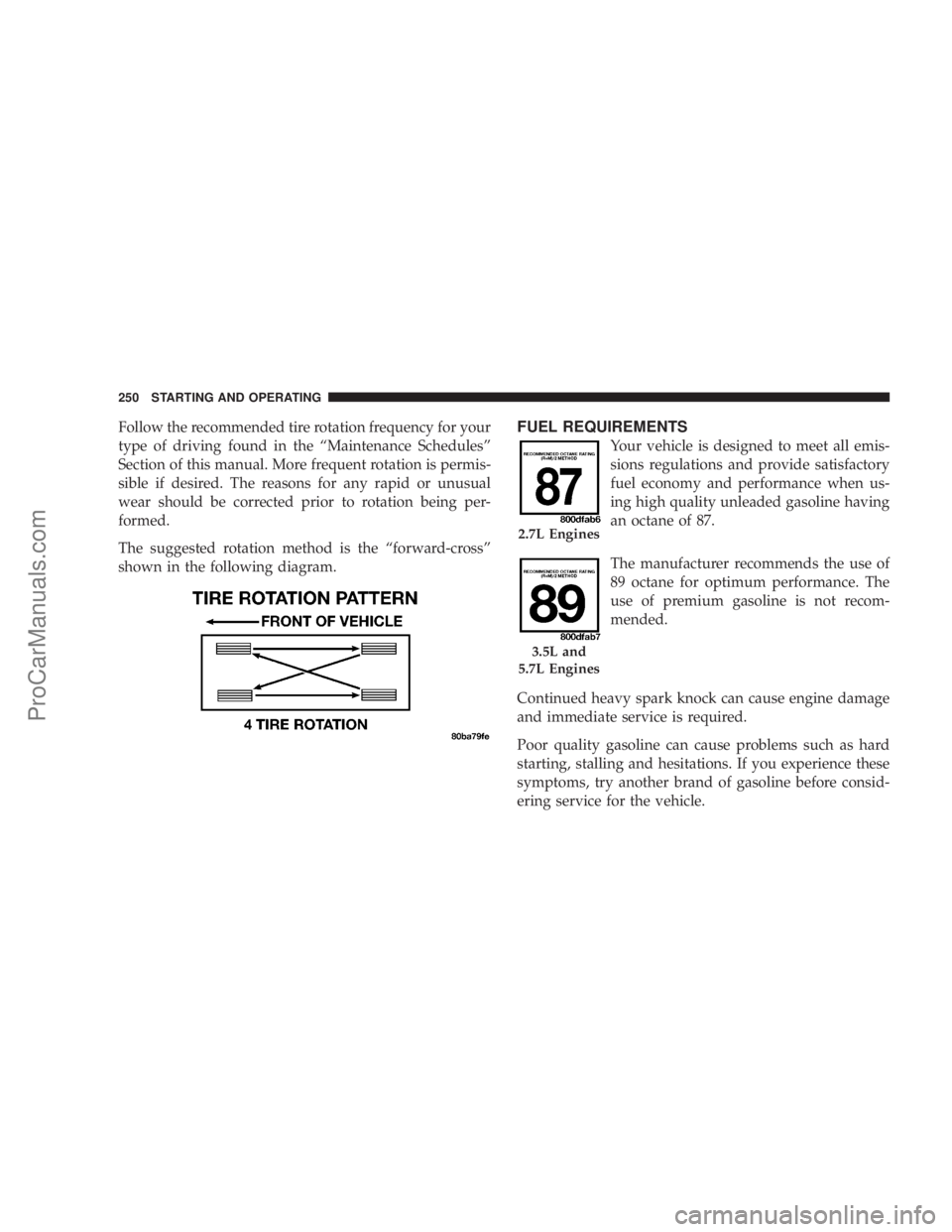
The suggested rotation method is the ªforward-crossº
shown in the following diagram.FUEL REQUIREMENTS
Your vehicle is designed to meet all emis-
sions regulations and provide satisfactory
fuel economy and performance when us-
ing high quality unleaded gasoline having
an octane of 87.
The manufacturer recommends the use of
89 octane for optimum performance. The
use of premium gasoline is not recom-
mended.
Continued heavy spark knock can cause engine damage
and immediate service is required.
Poor quality gasoline can cause problems such as hard
starting, stalling and hesitations. If you experience these
symptoms, try another brand of gasoline before consid-
ering service for the vehicle.
2.7L Engines
3.5L and
5.7L Engines
250 STARTING AND OPERATING
ProCarManuals.com
Page 259 of 374
TRAILER TOWING
In this section you will find safety tips and information
on limits to the type of towing you can reasonably do
with your vehicle. Before towing a trailer carefully re-
view this information to tow your load as efficiently and
safely as possible.
To maintain warranty coverage, follow the requirements
and recommendations in this manual concerning ve-
hicles used for trailer towing.
Perform maintenance services as prescribed in the main-
tenance schedules manual. When your vehicle is used for
trailer towing, never exceed the gross axle weight rating
(GAWR) by the addition of:
²The tongue weight of the trailer.
²The weight of any other type of cargo or equipment
put in or on your vehicle.
²Remember that everything put in or on the trailer adds
to the load on your vehicle.
Warranty Requirements
The Manufacturer's Passenger Vehicle Warranty will
apply to vehicles used to tow trailers for non-commercial
use. However the following conditions must be met:
²The maximum frontal area of the trailer cannot exceed
32 square feet (2.97 square meters).
²The trailer tongue load must be considered as part of
the combined weight of occupants and cargo, and
should never exceed the weight referenced on the Tire
and Loading Information placard. Refer to the Tire±
Safety Information Section in this manual.
²The ªDº range can be selected when towing. However,
if frequent shifting occurs while in this range, the ª3º
range must be selected.
NOTE:Using the ª3º range while operating the vehicle
under heavy operating conditions will improve perfor-
mance and extend transmission life by reducing exces-
sive shifting and heat build up.
STARTING AND OPERATING 259
5
ProCarManuals.com
Page 265 of 374
NOTE:There are steps that you can take to slow down
an impending overheat condition. If your air conditioner
is on, turn it off. The air conditioning system adds heat to
the engine cooling system and turning off the A/C
removes this heat. You can also turn the Temperature
control to maximum heat, the Mode control to floor, and
the fan control to High. This allows the heater core to act
as a supplement to the radiator and aids in removing heat
from the engine cooling system.
CAUTION!
Driving with a hot cooling system could damage
your vehicle. If temperature gauge reads ªHº, pull
over and stop the vehicle. Idle the vehicle with the
air conditioner turned off until the pointer drops
back into the normal range. If the pointer remains on
the ªHº, turn the engine off immediately, and call for
service.
WARNING!
A hot engine cooling system is dangerous. You or
others could be badly burned by steam or boiling
coolant. You may want to call a service center if your
vehicle overheats. If you decide to look under the
hood yourself, see Section 7, Maintenance, of this
manual. Follow the warnings under the Cooling
System Pressure Cap paragraph.
JACKING AND TIRE CHANGING
WARNING!
Do not attempt to change a tire on the side of the
vehicle close to moving traffic. Pull far enough off
the road to avoid the danger of being hit when
operating the jack or changing the wheel.
WHAT TO DO IN EMERGENCIES 265
6
ProCarManuals.com
Page 281 of 374

MAINTAINING YOUR VEHICLE
CONTENTS
m2.7L Engine..........................284
m3.5L Engine..........................285
m5.7L Engine..........................286
mOnboard Diagnostic System Ð OBD II......287
mEmissions Inspection And Maintenance
Programs
............................288
mReplacement Parts.....................289
mDealer Service........................289
mMaintenance Procedures.................290
NEngine Oil..........................290
NEngine Oil Filter......................295NDrive Belts Ð Check Condition And
Tensioner...........................295
NSpark Plugs.........................295
NEngine Air Cleaner Filter................295
NFuel Filter..........................296
NCatalytic Converter....................296
NMaintenance-Free Battery................297
NAir Conditioner Maintenance.............299
NA/C Air Filter.......................300
NPower Steering Ð Fluid Check............300
NFront & Rear Suspension Ball Joints........301
7
ProCarManuals.com
Page 288 of 374
EMISSIONS INSPECTION AND MAINTENANCE
PROGRAMS
In some localities, it may be a legal requirement to pass
an inspection of your vehicle's emissions control system.
Failure to pass could prevent vehicle registration.
For states which have an I/M (Inspection and
Maintenance) requirement, this check verifies the
following: the MIL (Malfunction Indicator Lamp)
is functioning and is not on when the engine is running,
and that the OBD (On Board Diagnostic) system is ready
for testing.
Normally, the OBD system will be ready. The OBD
system maynotbe ready if your vehicle was recently
serviced, if you recently had a dead battery, or a battery
replacement. If the OBD system should be determined
not ready for the I/M test, your vehicle may fail the test.
Your vehicle has a simple ignition key actuated test
which you can use prior to going to the test station. To
check if your vehicle's OBD system is ready, you must do
the following:
1. Insert your ignition key into the ignition switch.2. Turn the ignition to the ON position, but do not crank
or start the engine.
3. If you crank or start the engine, you will have to start
this test over.
4. As soon as you turn your key to the ON position, you
will see your MIL symbol come on as part of a normal
bulb check.
5. Approximately 15 seconds later, one of two things will
happen:
a. The MIL will flash for about 10 seconds and then
return to being fully illuminated until you turn off
the ignition key or start the engine. This means that
your vehicle's OBD system isnot readyand you
shouldnotproceed to the I/M station.
b. The MIL will not flash at all and will remain fully
illuminated until you turn off the ignition key or
start the engine. This means that your vehicle's OBD
system isreadyand you can proceed to the I/M
station.
288 MAINTAINING YOUR VEHICLE
ProCarManuals.com
Page 289 of 374
If your OBD system isnot ready,you should see your
authorized dealer or repair facility. If your vehicle was
recently serviced or had a battery failure or replacement,
you may need to do nothing more than drive your
vehicle as you normally would in order for your OBD
system to update. A recheck with the above test routine
may then indicate that the system is now ready.
Regardless of whether your vehicle's OBD system is
ready or not ready, if the MIL symbol is illuminated
during normal vehicle operation, you should have your
vehicle serviced before going to the I/M station. The I/M
station can fail your vehicle because the MIL symbol is on
with the engine running.
REPLACEMENT PARTS
Use of genuine Mopartparts for normal/scheduled
maintenance and repairs is highly recommended to in-
sure the designed performance. Damage or failures
caused by the use of non-Mopartparts for maintenance
and repairs will not be covered by the manufacturer's
warranty.
DEALER SERVICE
Your dealer has the qualified service personnel, special
tools and equipment to perform all service operations in
an expert manner. Service Manuals are available which
include detailed service information for your vehicle.
Refer to these manuals before attempting any procedure
yourself.
NOTE:Intentional tampering with emissions control
systems can result in civil penalties being assessed against
you.
WARNING!
You can be badly injured working on or around a
motor vehicle. Do only that service work for which
you have the knowledge and the proper equipment.
If you have any doubt about your ability to perform
a service job, take your vehicle to a competent
mechanic.
MAINTAINING YOUR VEHICLE 289
7
ProCarManuals.com
Page 290 of 374
MAINTENANCE PROCEDURES
The pages that follow contain therequiredmaintenance
services determined by the engineers who designed your
vehicle.
Besides the maintenance items for which there are fixed
maintenance intervals, there are other items that should
operate satisfactorily without periodic maintenance.
However, if a malfunction of these items does occur, it
could adversely affect the engine or vehicle performance.
These items should be inspected if a malfunction is
observed or suspected.
Engine Oil
Checking Oil Level Ð 2.7L, 3.5L Engines
To assure proper engine lubrication, the engine oil must
be maintained at the correct level. Check the oil level at
regular intervals, such as every fuel stop.
The best time to check the engine oil level is about 5
minutes after a fully warmed engine is shut off or before
starting the engine after it has sat overnight.
Checking the oil while the vehicle is on level ground will
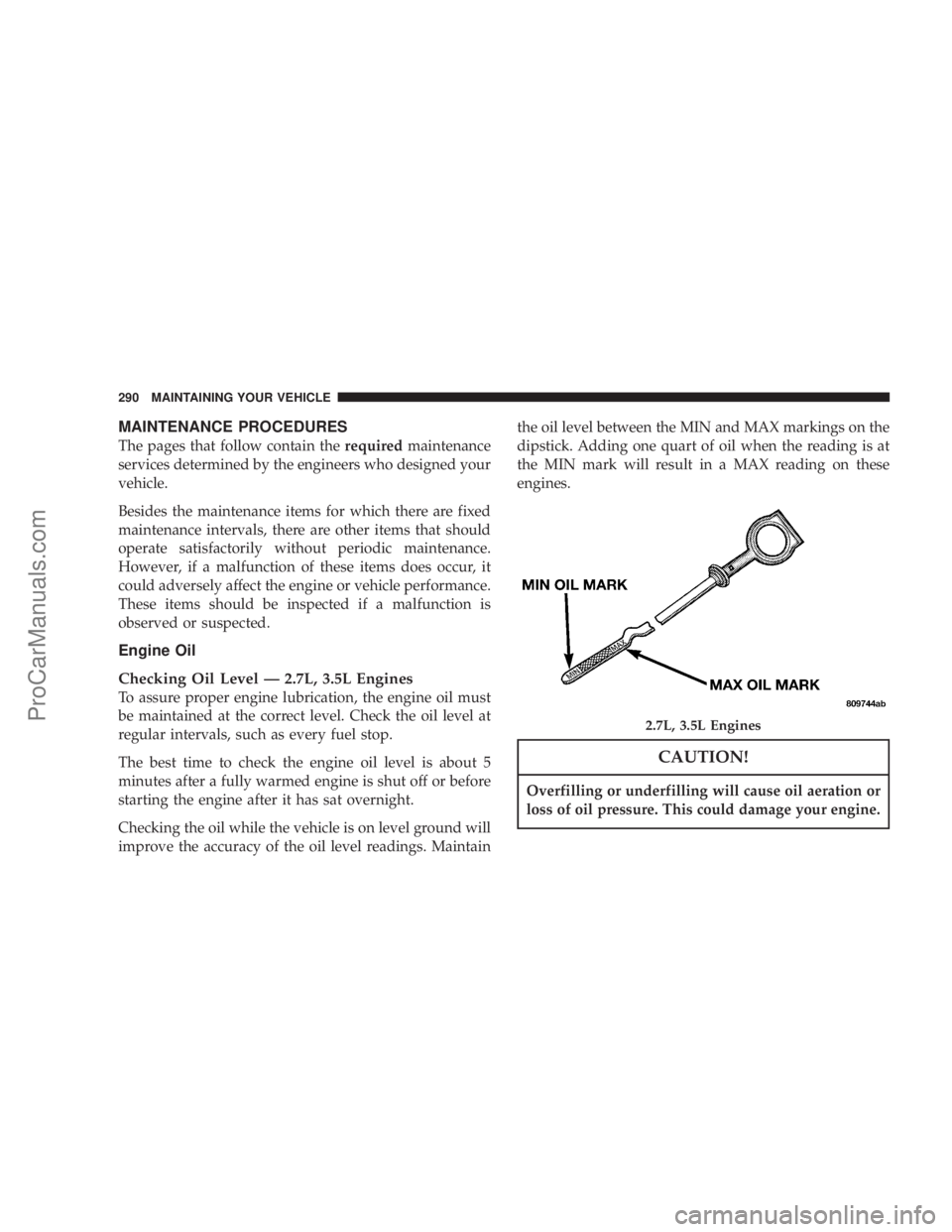
improve the accuracy of the oil level readings. Maintainthe oil level between the MIN and MAX markings on the
dipstick. Adding one quart of oil when the reading is at
the MIN mark will result in a MAX reading on these
engines.
CAUTION!
Overfilling or underfilling will cause oil aeration or
loss of oil pressure. This could damage your engine.
2.7L, 3.5L Engines
290 MAINTAINING YOUR VEHICLE
ProCarManuals.com