wheel CHRYSLER 300 LX 2005 Service Manual
[x] Cancel search | Manufacturer: CHRYSLER, Model Year: 2005, Model line: 300 LX, Model: CHRYSLER 300 LX 2005Pages: 374, PDF Size: 7.09 MB
Page 269 of 374

²Remove the fastener securing the spare tire.
Jacking and Changing a Tire
1. Block the wheel diagonally
opposite the flat tire. Passengers
should not remain in the vehicle
when the vehicle is being jacked.
2. Remove the spare tire, jack and lug wrench.3. Before raising the vehicle, use lug wrench to carefully
pry off wheel cover (if equipped with steel wheels) or
center cap (if equipped with aluminum wheels).WARNING!
To avoid possible personal injury, handle the wheel
covers with care to avoid contact with the metal
edges and retention teeth.
WHAT TO DO IN EMERGENCIES 269
6
ProCarManuals.com
Page 270 of 374
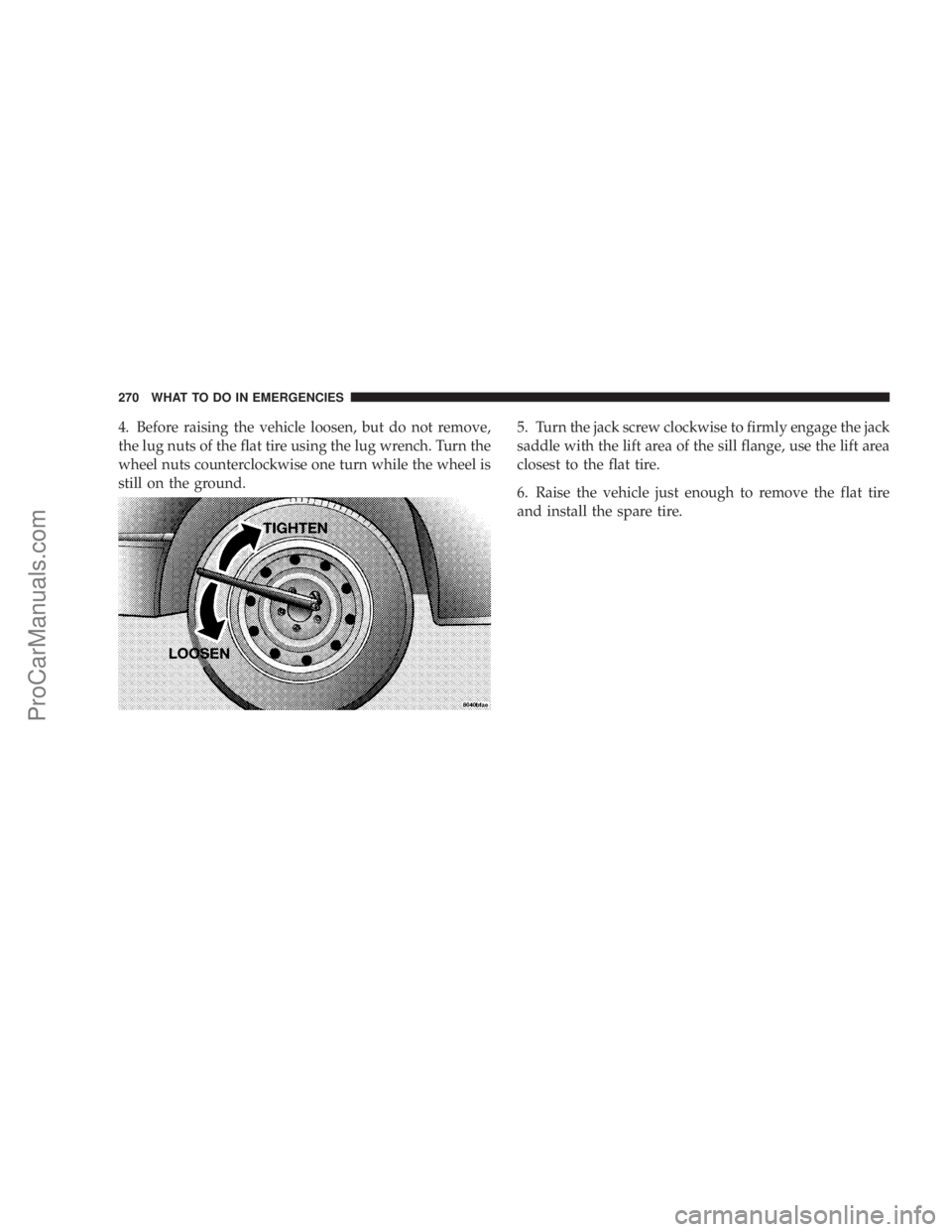
4. Before raising the vehicle loosen, but do not remove,
the lug nuts of the flat tire using the lug wrench. Turn the
wheel nuts counterclockwise one turn while the wheel is
still on the ground.5. Turn the jack screw clockwise to firmly engage the jack
saddle with the lift area of the sill flange, use the lift area
closest to the flat tire.
6. Raise the vehicle just enough to remove the flat tire
and install the spare tire.
270 WHAT TO DO IN EMERGENCIES
ProCarManuals.com
Page 272 of 374

7. Remove the lug nuts, wheel cover (if equipped) and
tire. Remove the cover by hand, do not pry off.
8. Mount the spare tire. For vehicles equipped with
wheel covers, see the wheel cover installation instruc-
tions. Do not attempt to install a wheel cover on a
compact spare.
9. Tighten all the lug nuts on the mounting studs.
10. Lower the vehicle to the ground by turning the jack
handle counterclockwise.
11. Fully tighten the lug nuts. Torque the wheel lug nuts
to 100 ft/lb. (135N. m).
12. Store the flat tire, jack and tools.
WARNING!
Raising the vehicle higher than necessary can make
the vehicle less stable. It could slip off the jack and
hurt someone near it. Raise the vehicle only enough
to remove the tire.
WARNING!
A loose tire or jack thrown forward in a collision or
hard stop could endanger the occupants of the ve-
hicle. Always stow the jack parts and the spare tire in
the places provided.
Compact Spare Tire
The compact spare tire is for temporary emergency use
with radial tires. It is engineered to be used on your style
vehicle only. Since this tire has limited tread life, the
original tire should be repaired (or replaced) and rein-
stalled at the first opportunity.
²Keep tire inflated to 60 PSI (414 KPa) Cold Inflation
Pressure.
²Avoid driving more than 50 miles (80 km) before
replacing tire and wheel.
²This tire is designed as an emergency spare only-do
not exceed 50 MPH (80 km/h) speed.
272 WHAT TO DO IN EMERGENCIES
ProCarManuals.com
Page 273 of 374

Wheel Cover Installation (If Required)
1. Tighten the two lug nuts on the mounting studs on
each side of the stud which is in alignment with the valve
stem.
2. Align the valve notch in the wheel cover with the
valve stem on the wheel.3. Install the cover by hand, snapping the cover over the
two lug nuts. Do not use a hammer or excessive force to
install the cover.
4. Return to Changing a Tire Section, Item #9 above.
JUMP-STARTING PROCEDURES IF BATTERY IS
LOW
WARNING!
Take care to avoid the radiator cooling fan whenever
the hood is raised. It can start anytime the ignition
switch is on. You can be hurt by the fan.
WHAT TO DO IN EMERGENCIES 273
6
ProCarManuals.com
Page 276 of 374
DRIVING ON SLIPPERY SURFACES
Acceleration
Rapid acceleration on snow covered, wet, or other slip-
pery surfaces may cause the rear wheels to pull errati-
cally to the right or left. This phenomenon occurs when
there is a difference in the surface traction under the rear
(driving) wheels.
WARNING!
Rapid acceleration on slippery surfaces is danger-
ous. Unequal traction can cause sudden pulling of
the rear wheels. You could lose control of the vehicle
and possibly have an accident. Accelerate slowly and
carefully whenever there is likely to be poor traction
(ice, snow, wet mud, loose sand, etc.).
Traction
When driving on wet or slushy roads, it is possible for a
wedge of water to build up between the tire and road
surface. This is known as hydroplaning and may cause
partial or complete loss of vehicle control and stopping
ability. To reduce this possibility, the following precau-
tions should be observed:
1. Slow down during rainstorms or when roads are
slushy.
2. Slow down if road has standing water or puddles.
3. Replace tires when tread wear indicators first become
visible.
4. Keep tires properly inflated.
5. Maintain sufficient distance between your vehicle and
the vehicle in front to avoid a collision in a sudden stop.
276 WHAT TO DO IN EMERGENCIES
ProCarManuals.com
Page 277 of 374
FREEING A STUCK VEHICLE
If your vehicle becomes stuck in mud, sand or snow, it
can often be moved by a rocking motion. Turn your
steering wheel right and left to clear the area around the
front wheels. Then shift back and forth between Reverse
and Drive. Usually the least accelerator pedal pressure to
maintain the rocking motion without spinning the
wheels is most effective.
NOTE:Turn off the Electronic Stability Program (ESP)
Ð if equipped, or Traction Control System (TCS) Ð if
equipped before rocking the vehicle. Refer to Electronic
Stability Program, or Traction Control System in your
Owner's Manual for Details.
WARNING!
Fast spinning tires can be dangerous. Forces gener-
ated by excessive wheel speeds may cause tire dam-
age or failure. A tire could explode and injure
someone. Do not spin your vehicle's wheels faster
than 35 mph (55 km/h) when you are stuck. And
don't let anyone near a spinning wheel, no matter
what the speed.
CAUTION!
Racing the engine or spinning the wheels too fast
may lead to transmission overheating and failure. It
can also damage the tires. Do not spin the wheels
above 35 mph (55 km/h).
WHAT TO DO IN EMERGENCIES 277
6
ProCarManuals.com
Page 279 of 374
Without The Ignition Key
Special care must be taken when the vehicle is towed
with the ignition in the LOCK position. The only ap-
proved method of towing with out the ignition key is
with a flat bed truck. Proper towing equipment is neces-
sary to prevent damage to the vehicle.
TOWING THIS VEHICLE BEHIND ANOTHER
VEHICLE (Flat towing with all four wheels on the
ground)
Flat towing of vehicles equipped with an automatic
transmission, is only permitted within the limitations
described in this section.
TOWING THIS VEHICLE BEHIND ANOTHER
VEHICLE WITH A TOW DOLLEY
The manufacturedoes not recommendthat you tow this
vehicle on a tow dolley. Vehicle damage may occur.
WHAT TO DO IN EMERGENCIES 279
6
ProCarManuals.com
Page 282 of 374
NSteering Linkage......................301
NDrive Shaft Universal Joints..............301
NBody Lubrication.....................301
NWindshield Wiper Blades................301
NWindshield Washers...................302
NExhaust System......................302
NCooling System.......................303
NHoses And Vacuum/Vapor Harnesses.......307
NBrakes.............................307
NBrake Fluid Level Check................309
NFuel System Hoses....................310
NAutomatic Transmission................310
NFront And Rear Wheel Bearings...........311
NAppearance Care And Protection From
Corrosion...........................311NCleaning The Center Console Cup
Holders Ð 300.......................315
NCleaning The Center Console Cup Holders Ð
300C, 300 Touring.....................315
mPower Distribution Centers...............315
NFront Power Distribution Center...........315
NRear Power Distribution Center...........318
mVehicle Storage........................321
mReplacement Light Bulbs................322
mBulb Replacement......................323
NLow Beam Headlamp, High Beam Headlamp,
Park/Turn Lamp, Inner Park Lamp, And Outer
Park Lamp ± 300......................323
NLow Beam Headlamp, High Beam Headlamp,
And Park/Turn Lamp ± 300C.............324
NBackup Lamp, Side Marker Lamp, And
Tail/Stop Turn Lamp Ð 300..............326
282 MAINTAINING YOUR VEHICLE
ProCarManuals.com
Page 311 of 374
CAUTION!
The fluid level is preset at the factory and does not
require adjustment under normal operating condi-
tions. If a transmission fluid leak occurs, visit your
authorized dealer immediately. Severe damage to the
transmission may occur. Your authorized dealer has
the proper tools to accurately adjust the fluid level.
Fluid and Filter Changes
Automatic transmission fluid and filter should be
changed as follows:
Maintenance schedule ªAºÐ No change necessary.
Maintenance schedule ªBº±Every 60,000 miles (96 000
km) change fluid and filter under the following condi-
tions:
²Police, taxi, limousine, commercial type operation, or
trailer towing where the vehicle is drivenregularlyfor
more than 45 minutes of continuous operation.
If the transmission is disassembled for any reason, the
fluid and filter should be changed.
Front And Rear Wheel Bearings
Front and rear wheel bearings are permanently sealed.
No regular maintenance is required for these compo-
nents.
Appearance Care and Protection from Corrosion
Protection of Body and Paint from Corrosion
Vehicle body care requirements vary according to geo-
graphic locations and usage. Chemicals that make roads
passable in snow and ice, and those that are sprayed on
trees and road surfaces during other seasons, are highly
corrosive to the metal in your vehicle. Outside parking,
which exposes your vehicle to airborne contaminants,
road surfaces on which the vehicle is operated, extreme
hot or cold weather and other extreme conditions will
have an adverse effect on paint, metal trim, and under-
body protection.
The following maintenance recommendations will enable
you to obtain maximum benefit from the corrosion
resistance built into your vehicle.
MAINTAINING YOUR VEHICLE 311
7
ProCarManuals.com
Page 313 of 374
²If your vehicle is damaged due to an accident or
similar cause which destroys the paint and protective
coating have your vehicle repaired as soon as possible.
The cost of such repairs is considered the responsibil-
ity of the owner.
²All wheels and wheel trim, especially aluminum and
chrome plated wheels should be cleaned regularly
with mild soap and water to prevent corrosion. To
remove heavy soil, select a nonabrasive, non-acidic
cleaner. Do not use scouring pads, steel wool, a bristle
brush or metal polishes. Only Mopar cleaners are
recommended. Do not use oven cleaner. Avoid auto-
matic car washes that use acidic solutions or harsh
brushes that may damage the wheels' protective fin-
ish.
²If you carry special cargo such as chemicals, fertilizers,
de-icer salt, etc., be sure that such materials are well
packaged and sealed.
²If a lot of driving is done on gravel roads, consider
mud or stone shields behind each wheel.
²Use Mopar touch up paint on scratches as soon as
possible. Your dealer has touch up paint to match the
color of your vehicle.
Interior Care
Use Mopar Fabric Cleaner to clean fabric upholstery and
carpeting.
Interior Trim should be cleaned starting with a damp
cloth, a damp cloth with a mild detergent, then MOPAR
Vinyl Cleaner if absolutely necessary. Do not use harsh
cleaners or Armorall. Use Mopar Vinyl Cleaner to clean
vinyl upholstery.
Mopar Total Clean is specifically recommended for
leather upholstery.
Your leather upholstery can be best preserved by regular
cleaning with a damp soft cloth. Small particles of dirt
can act as an abrasive and damage the leather upholstery
and should be removed promptly with a damp cloth.
Stubborn soils can be removed easily with a soft cloth
and Mopar Total Clean. Care should be taken to avoid
soaking your leather upholstery with any liquid. Please
MAINTAINING YOUR VEHICLE 313
7
ProCarManuals.com