seat CHRYSLER 300 M 2004 1.G User Guide
[x] Cancel search | Manufacturer: CHRYSLER, Model Year: 2004, Model line: 300 M, Model: CHRYSLER 300 M 2004 1.GPages: 277, PDF Size: 5.69 MB
Page 32 of 277
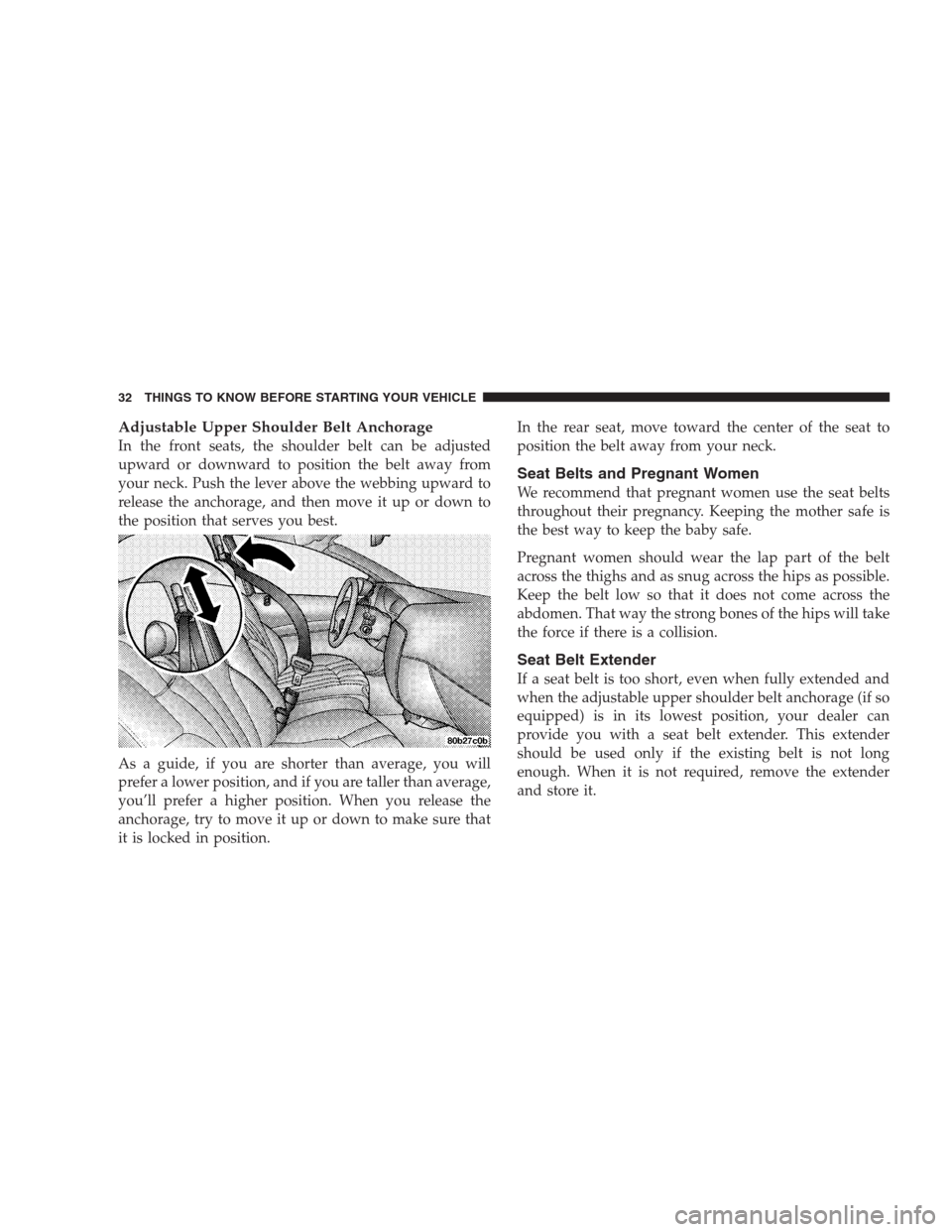
Adjustable Upper Shoulder Belt Anchorage
In the front seats, the shoulder belt can be adjusted
upward or downward to position the belt away from
your neck. Push the lever above the webbing upward to
release the anchorage, and then move it up or down to
the position that serves you best.
As a guide, if you are shorter than average, you will
prefer a lower position, and if you are taller than average,
you’ll prefer a higher position. When you release the
anchorage, try to move it up or down to make sure that
it is locked in position.In the rear seat, move toward the center of the seat to
position the belt away from your neck.
Seat Belts and Pregnant Women
We recommend that pregnant women use the seat belts
throughout their pregnancy. Keeping the mother safe is
the best way to keep the baby safe.
Pregnant women should wear the lap part of the belt
across the thighs and as snug across the hips as possible.
Keep the belt low so that it does not come across the
abdomen. That way the strong bones of the hips will take
the force if there is a collision.
Seat Belt Extender
If a seat belt is too short, even when fully extended and
when the adjustable upper shoulder belt anchorage (if so
equipped) is in its lowest position, your dealer can
provide you with a seat belt extender. This extender
should be used only if the existing belt is not long
enough. When it is not required, remove the extender
and store it.
32 THINGS TO KNOW BEFORE STARTING YOUR VEHICLE
Page 33 of 277
WARNING!
Using a seat belt extender when not needed can
increase the risk of injury in a collision. Only use the
extender when the lap belt is not long enough when
it is worn low and snug, and in the recommended
seating positions. Remove and store the extender
when not needed.
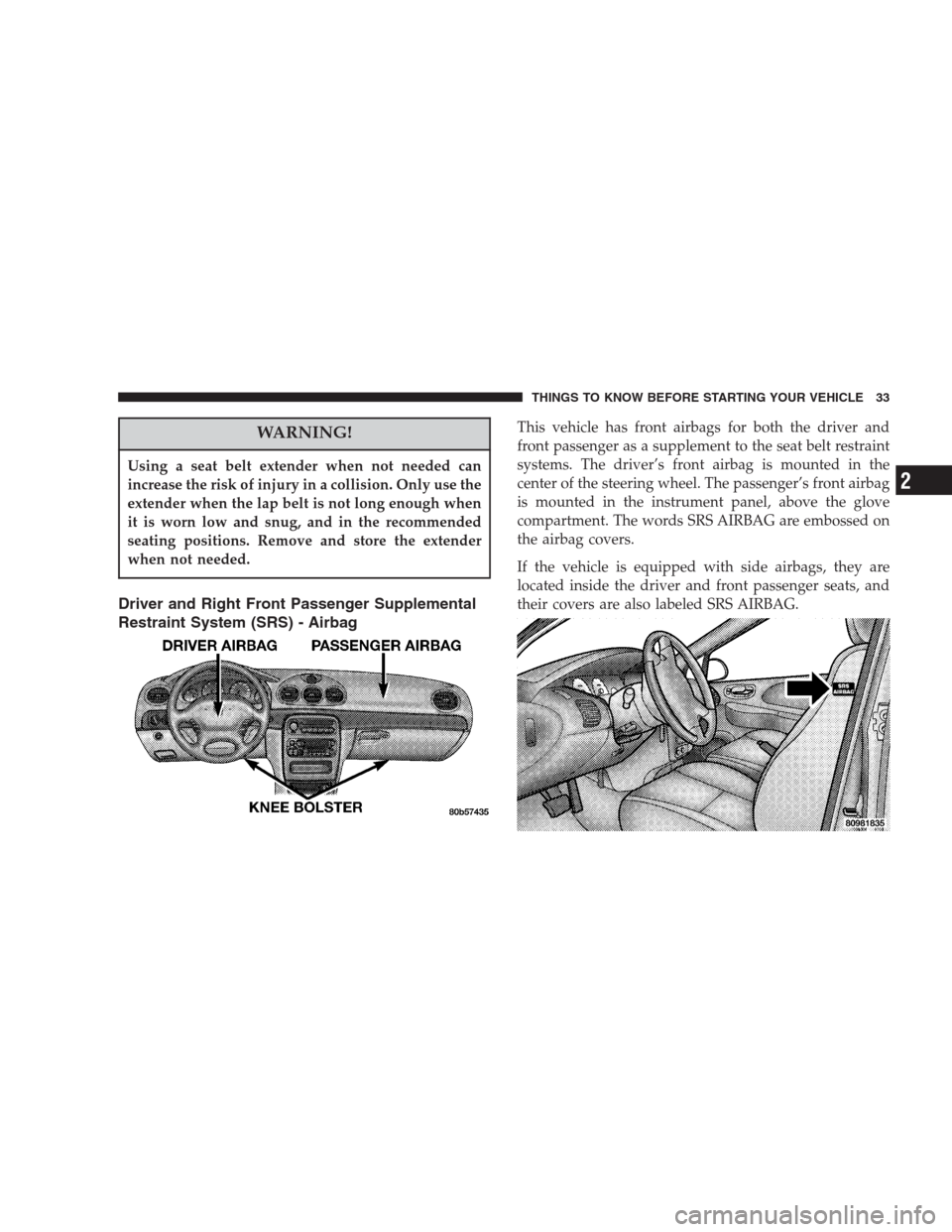
Driver and Right Front Passenger Supplemental
Restraint System (SRS) - Airbag
This vehicle has front airbags for both the driver and
front passenger as a supplement to the seat belt restraint
systems. The driver’s front airbag is mounted in the
center of the steering wheel. The passenger’s front airbag
is mounted in the instrument panel, above the glove
compartment. The words SRS AIRBAG are embossed on
the airbag covers.
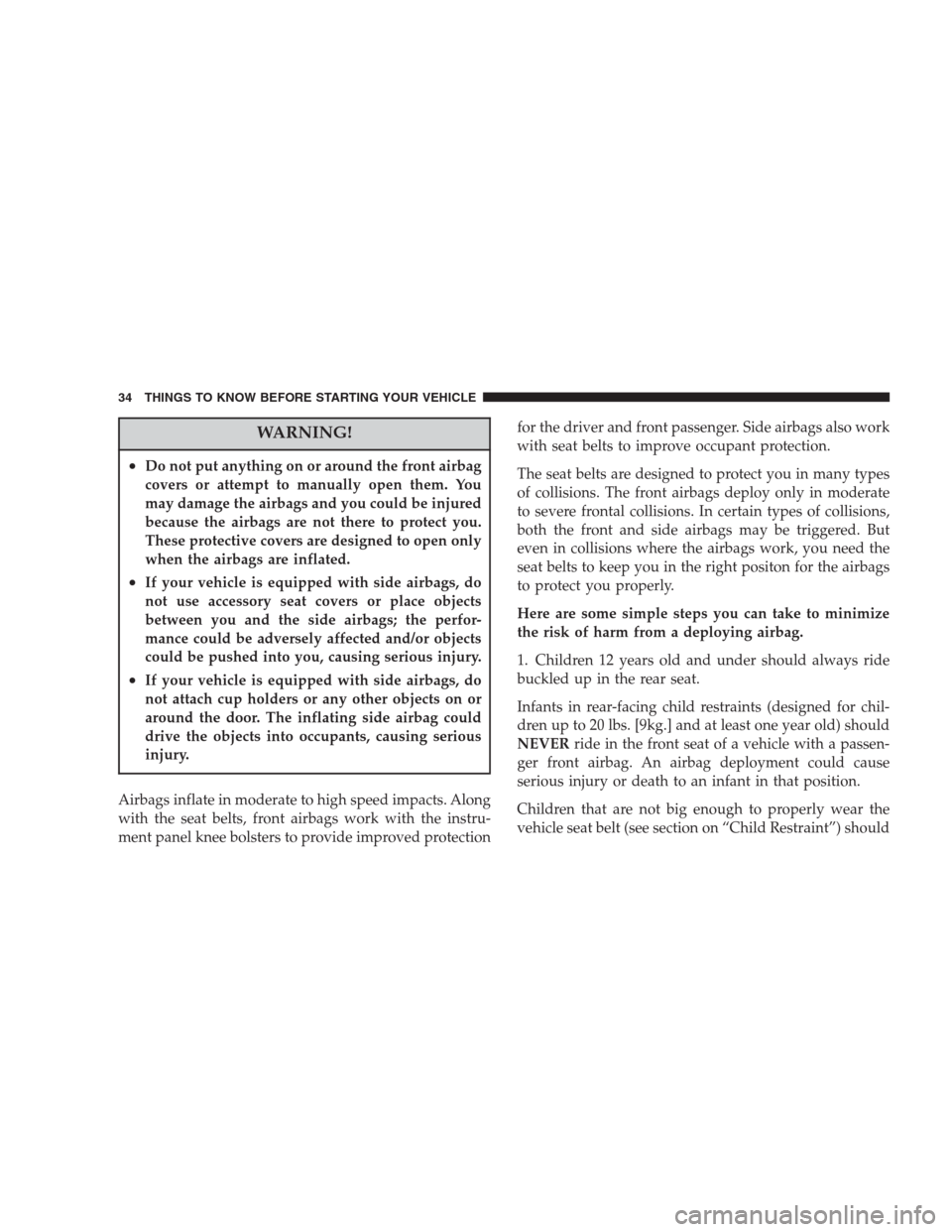
If the vehicle is equipped with side airbags, they are
located inside the driver and front passenger seats, and
their covers are also labeled SRS AIRBAG.
THINGS TO KNOW BEFORE STARTING YOUR VEHICLE 33
2
Page 34 of 277
WARNING!
•Do not put anything on or around the front airbag
covers or attempt to manually open them. You
may damage the airbags and you could be injured
because the airbags are not there to protect you.
These protective covers are designed to open only
when the airbags are inflated.
•If your vehicle is equipped with side airbags, do
not use accessory seat covers or place objects
between you and the side airbags; the perfor-
mance could be adversely affected and/or objects
could be pushed into you, causing serious injury.
•If your vehicle is equipped with side airbags, do
not attach cup holders or any other objects on or
around the door. The inflating side airbag could
drive the objects into occupants, causing serious
injury.
Airbags inflate in moderate to high speed impacts. Along
with the seat belts, front airbags work with the instru-
ment panel knee bolsters to provide improved protectionfor the driver and front passenger. Side airbags also work
with seat belts to improve occupant protection.
The seat belts are designed to protect you in many types
of collisions. The front airbags deploy only in moderate
to severe frontal collisions. In certain types of collisions,
both the front and side airbags may be triggered. But
even in collisions where the airbags work, you need the
seat belts to keep you in the right positon for the airbags
to protect you properly.
Here are some simple steps you can take to minimize
the risk of harm from a deploying airbag.
1. Children 12 years old and under should always ride
buckled up in the rear seat.
Infants in rear-facing child restraints (designed for chil-
dren up to 20 lbs. [9kg.] and at least one year old) should
NEVERride in the front seat of a vehicle with a passen-
ger front airbag. An airbag deployment could cause
serious injury or death to an infant in that position.
Children that are not big enough to properly wear the
vehicle seat belt (see section on “Child Restraint”) should
34 THINGS TO KNOW BEFORE STARTING YOUR VEHICLE
Page 35 of 277
be secured in the rear seat in child restraints or belt-
positioning booster seats appropriate for the size and age
of the child.
Older children who do not use child restraints or belt-
positioning booster seats should ride properly buckled
up in the rear seat. Never allow children to slide the
shoulder belt behind them or under their arm.
If a child from 1 to 12 years old must ride in the front
passenger seat because the vehicle is crowded, move the
seat as far back as possible, and use the proper child
restraint. See the section on “Child Restraint”.
You should read the instructions provided with your
child restraint to make sure that you are using it properly.
2. All occupants should wear their lap and shoulder belts
properly.
3. The driver and front passenger seats should be moved
back as far as practical to allow the front airbags room to
inflate.4. If your vehicle has side airbags, do not lean against the
door, airbags will inflate forcefully into the space be-
tween you and the door.
WARNING!
•Relying on the airbags alone could lead to more
severe injuries in a collision. The airbags work
with your seat belt to restrain you properly. In
some collisions the airbags won’t deploy at all.
Always wear your seat belts even though you
have airbags.
•Being too close to the steering wheel or instru-
ment panel during airbag deployment could cause
serious injury.
•Airbags need room to inflate. Sit back, comfort-
ably extending your arms to reach the steering
wheel or instrument panel.
•If the vehicle has side airbags, they also need
room to inflate. Do not lean against the door. Sit
upright in the center of the seat.
THINGS TO KNOW BEFORE STARTING YOUR VEHICLE 35
2
Page 36 of 277
Airbag System Components
The airbag system consists of the following:
•ACM (Airbag Control Module)
•AIRBAG Readiness Light
•Driver and Passenger Front Airbags
•Optional Driver and Passenger Side Airbags.
•Steering Wheel and Column
•Instrument Panel
•Interconnecting Wiring
•Crash Sensors
•Knee Impact Bolsters
The side airbag system, on vehicles so equipped, consists
of the following:
•AIRBAG Readiness Light
•Side Airbag in the Driver’s Seat
•Side Airbag in the Passenger’s Seat
•ACM (Airbag Control Module)
•SIACM (Side Impact Airbag Control Module)
•Interconnecting Wiring
How the Frontal Airbag System Works
•
The front airbag control module determines if a frontal
collision is severe enough to require the airbags to
inflate.
•The airbag control module will not detect side, roll
over, or rear collisions.
•The airbag control module also monitors the readiness
of the electronic parts of the system whenever the
ignition switch is in the START or RUN positions.
These include all of the items listed above except the
knee bolsters, the instrument panel, and the steering
wheel and column. If the key is in the OFF position, in
the ACC position, or not in the ignition, the airbags are
not on and will not inflate.
•The airbag control module also turns on the
AIRBAG light in the instrument panel for 6 to
8 seconds when the ignition is first turned on,
36 THINGS TO KNOW BEFORE STARTING YOUR VEHICLE
Page 39 of 277
•The side impact airbag control module monitors the
readiness of the electronic parts of the system when-
ever the ignition switch is in the “START” or “RUN”
positions. These include all of the items listed above
except for the AIRBAG light (which is controlled by
the frontal airbag system).
•In moderate to severe side collisions, the side airbag
inflator on the crash side of the vehicle is triggered,
releasing a quantity of nontoxic gas. The inflating side
airbag exits through the seat seam into the space
between the occupant and the door. The side airbag
moves at a very high speed and with such a high force,
that it could injure you if you are not seated properly,
or if items are positioned in the area where the side
airbag inflates. This especially applies to children.
Maintaining Your Airbag System
WARNING!
•Modifications to any part of the airbag system
could cause it to fail when you need it. You could
be injured because the airbag is not there to
protect you. Do not modify the components or
wiring, including adding any kind of badges or
stickers to the airbag covers. Do not modify the
front bumper or vehicle body structure.
•You need proper knee impact protection in a
collision. Do not mount or locate any aftermarket
equipment on or behind the knee impact bolsters.
•It is dangerous to try to repair any part of the
airbag system yourself. Be sure to tell anyone who
works on your vehicle that it has airbags.
THINGS TO KNOW BEFORE STARTING YOUR VEHICLE 39
2
Page 40 of 277
Airbag Light
You will want to have the airbags ready for your
protection in an impact. While the airbag system
is designed to be maintenance free, if any of the
following occurs, have an authorized dealer service the
system immediately.
•The AIRBAG light does not come on or flickers during
the 6 to 8 seconds when the ignition switch is first
turned on.
•The light remains on or flickers after the 6 to 8 second
interval.
•The light flickers or comes on and remains on while
driving.
Child Restraint
Everyone in your vehicle needs to be buckled up all the
time– babies and children too. Every state in the United
States and all Canadian provinces require that small
children ride in proper restraint systems. This is the law,
and you can be prosecuted for ignoring it.Children 12 years and under should ride properly buck-
led up in a rear seat. According to crash statistics,
children are safer when properly restrained in the rear
seat rather than the front.
WARNING!
In a collision, an unrestrained child, even a tiny
baby, can become a missile inside the vehicle. The
force required to hold even an infant on your lap
could become so great that you could not hold the
child, no matter how strong you are. The child and
others could be badly injured. Any child riding in
your vehicle should be in a proper restraint for the
child’s size.
There are different sizes and types of restraints for
children from newborn size to the child almost large
enough for an adult safety belt. Always check the child
seat owner’s manual to ensure you have the right seat for
your child. Use the restraint that is correct for your child:
40 THINGS TO KNOW BEFORE STARTING YOUR VEHICLE
Page 41 of 277
Infants and Child Restraints
•
Safety experts recommend that children ride
rearward-facing in the vehicle until they are at least
one year old and weigh at least 20 lbs (9 kg). Two types
of child restraints can be used rearward-facing: infant
carriers and “convertible” child seats.
•The infant carrier is only used rearward-facing in the
vehicle. It is recommended for children who weigh up
to about 20 lbs (9 kg). “Convertible” child seats can be
used either rearward-facing or forward-facing in the
vehicle. Convertible child seats often have a higher
weight limit in the rearward-facing direction than in-
fant carriers do, so they can be used rearward-facing by
children who weigh more than 20 lbs (9 kg) but are less
than one year old. Both types of child restraints are held
in the vehicle by the lap/shoulder belt or the LATCH
anchorage system. (See the LATCH — Child Seat An-
chorage System section for greater explanation.)
•Rearward-facing child seats mustNEVERbe used in
the front seat of a vehicle with a front passenger
airbag. An airbag deployment could cause severe
injury or death to infants in this position.
WARNING!
•A rearward facing infant restraint should only be
used in a rear seat. A rearward facing infant
restraint in the front seat may be struck by a
deploying passenger airbag which may cause se-
vere or fatal injury to the infant.
•Improper installation can lead to failure of an
infant or child restraint. It could come loose in a
collision. The child could be badly injured or
killed. Follow the manufacturer’s directions ex-
actly when installing an infant or child restraint.
Here are some tips on getting the most out of your child
restraint:
•Before buying any restraint system, make sure that it
has a label certifying that it meets all applicable Safety
Standards. We also recommend that you try a child
restraint in the vehicle seats where you will use it
before you buy it.
THINGS TO KNOW BEFORE STARTING YOUR VEHICLE 41
2
Page 42 of 277
•The restraint must be appropriate for your child’s
weight and height. Check the label on the restraint for
weight and height limits.
•Carefully follow the instructions that come with the
restraint. If you install the restraint improperly, it may
not work when you need it.
•Buckle the child into the seat according to the seat
manufacturer’s directions.
•When your child restraint is not in use, secure it in the
vehicle with the seat belt or remove it from the vehicle.
Do not leave it loose in the vehicle. In a sudden stop or
collision, it could strike the occupants or seat backs
and cause serious personal injury.
NOTE:For additional information, refer to
www.seatcheck.org or call 1–866–SEATCHECK.
Older Children and Child Restraints
Children who weigh more than 20 lbs (9 kg) and who are
older than one year can ride forward-facing in the
vehicle. Forward-facing child seats and convertible child
seats used in the forward-facing direction are for children
who weigh 20 to 40 lbs (9 to 18 kg) and who are olderthan one year. These child seats are also held in the
vehicle by the lap/shoulder belt or the LATCH anchor-
age system. (See the LATCH — Child Seat Anchorage
System Section.)
The belt-positioning booster seat is for children weighing
more than 40 lbs (18 kg), but who are still too small to fit
the vehicle’s seat belts properly. If the child cannot sit
with knees bent over the vehicle’s seat cushion while the
child’s back is against the seat back, they should use a
belt-positioning booster seat. The child and belt-
positioning booster seat are held in the vehicle by the
lap/shoulder belt.
Children Too Large For Booster Seats
Children who are large enough to wear the shoulder belt
comfortably, and whose legs are long enough to bend
over the front of the seat when their back is against the
seatback, should use the lap/shoulder belt in the rear
seat.
•Make sure that the child is upright in the seat.
•The lap portion should be low on the hips and as snug
as possible.
42 THINGS TO KNOW BEFORE STARTING YOUR VEHICLE
Page 43 of 277
•Check belt fit periodically. A child’s squirming or
slouching can move the belt out of position.
•If the shoulder belt contacts the face or neck, move the
child closer to the center of the vehicle. Never allow a
child to put the shoulder belt behind their back or
under their arm.
LATCH – Child Seat Anchorage System (Lower
Anchors and Tether for CH ildren)
Your vehicle’s rear seat is equipped with the child restraint
anchorage system called LATCH. The LATCH system
provides for the installation of the child restraints without
using the vehicle’s seat belts, instead securing the child
restraint using lower anchorages and upper tether straps
from the child restraint to the vehicle structure.
LATCH-compatible child restraint systems are now avail-
able. However, because the lower anchorages are to be
introduced over a period of years, child restraint systems
having attachments for those achorages will continue to
also have features for installation using the vehicle’s seat
belts. Child restraints having tether straps and hooks for
connection tot he top tether anchorages have been avail-
able for some time. For some older child restraints, manychild restraint manufacturers offer add-on tether strap
kits or retro-fit kits. You are urged to take advantage of all
the available attachments provided with your child re-
straint in any vehicle.
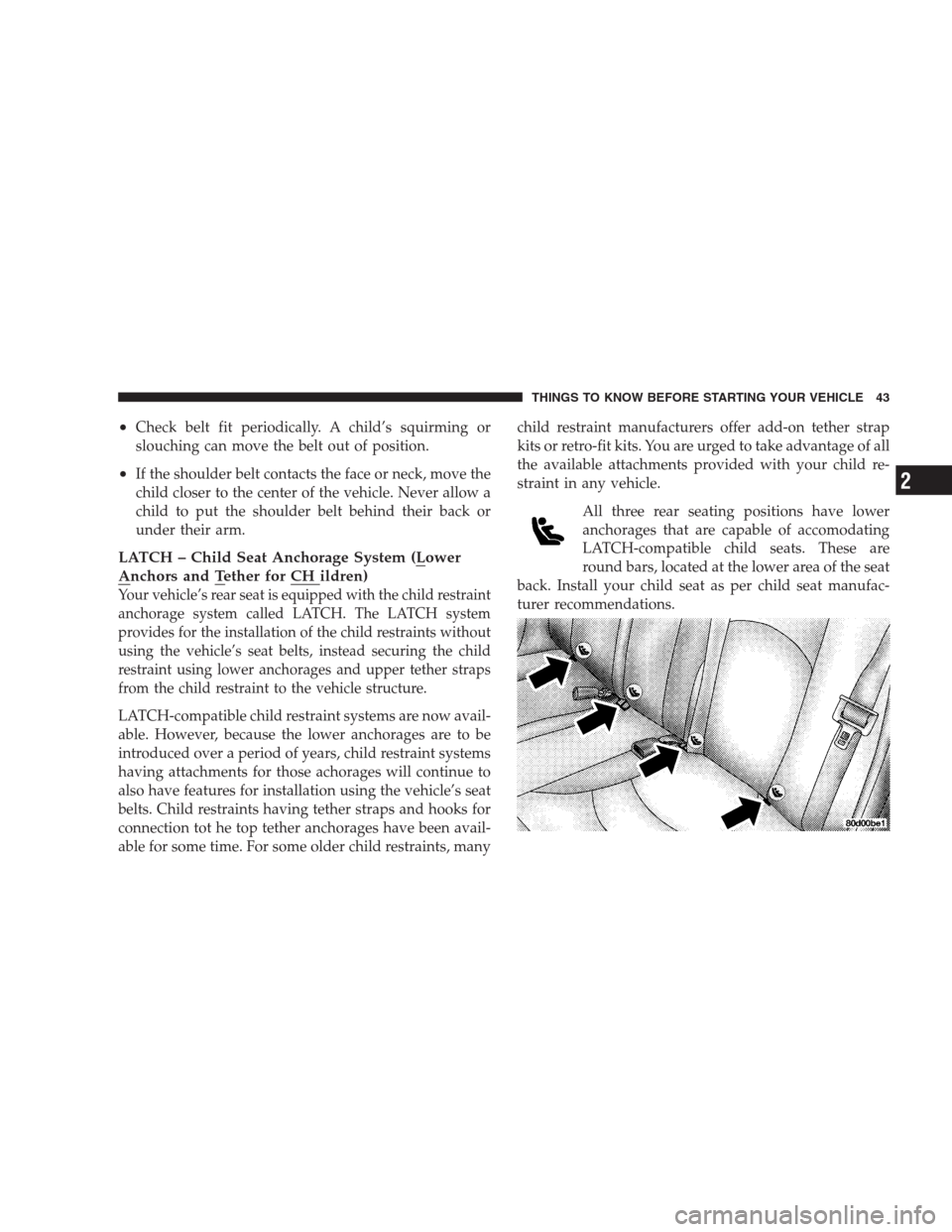
All three rear seating positions have lower
anchorages that are capable of accomodating
LATCH-compatible child seats. These are
round bars, located at the lower area of the seat
back. Install your child seat as per child seat manufac-
turer recommendations.
THINGS TO KNOW BEFORE STARTING YOUR VEHICLE 43
2