ECO mode CHRYSLER 300 M 2004 1.G Owner's Guide
[x] Cancel search | Manufacturer: CHRYSLER, Model Year: 2004, Model line: 300 M, Model: CHRYSLER 300 M 2004 1.GPages: 277, PDF Size: 5.69 MB
Page 160 of 277
Autostick General Information
•
The transmission will automatically upshift from first
to second gear and from second to third gear when
engine speed reaches about 6300 rpm.
•Downshifts from third to second gear above 85 mph
(137 km/h) and from second to first gear above 47
mph (76 km/h) will be ignored.
•You can start out in first, second, or third gear. Shifting
into fourth gear can occur only after vehicle speed
reaches 17 mph (27 km/h).
•The transmission will automatically downshift to first
gear when coming to a stop.
•Starting out in second or third gear is helpful in snowy
or icy conditions.
•While in the Autostick mode, Speed Control will only
function in third or fourth gear.
Downshifting out of third gear turns off speed control.
•If the system detects powertrain overheating, the
transmission will revert to the automatic shift mode
and remain in that mode until the powertrain cools off.
•If the system detects a problem it will disable the
Autostick mode and the transmission will return to the
automatic mode until the problem is corrected.
•The transmission will automatically downshift from
fourth to third gear at speeds between 15 mph (24
km/h and 50 mph (80 km/h) under certain conditions.
This is to avoid poor fourth gear performance with
accelerator pedal actuation at lower speeds.
160 STARTING AND OPERATING
Page 173 of 277
CAUTION!
Replacing original tires with tires of a different size
may result in false speedometer and odometer read-
ings. Check with your dealer before replacing tires
with a different size.
Tire Rotation Recommendations
Tires on the front and rear axles of vehicles operate at
different loads and perform different steering, driving
and braking functions. For these reasons, they wear at
unequal rates, and tend to develop irregular wear pat-
terns.
These effects can be reduced by timely rotation of tires.
The benefits of rotation are especially worthwhile with
aggressive tread designs such as those on all season type
tires. Rotation will increase tread life, help to maintain
mud, snow and wet traction levels, and contribute to a
smooth, quiet ride.Rotate your tires at intervals shown on the maintenance
schedules. More frequent rotation is permissible if de-
sired. The reasons for any rapid or unusual wear should
be corrected before rotating.
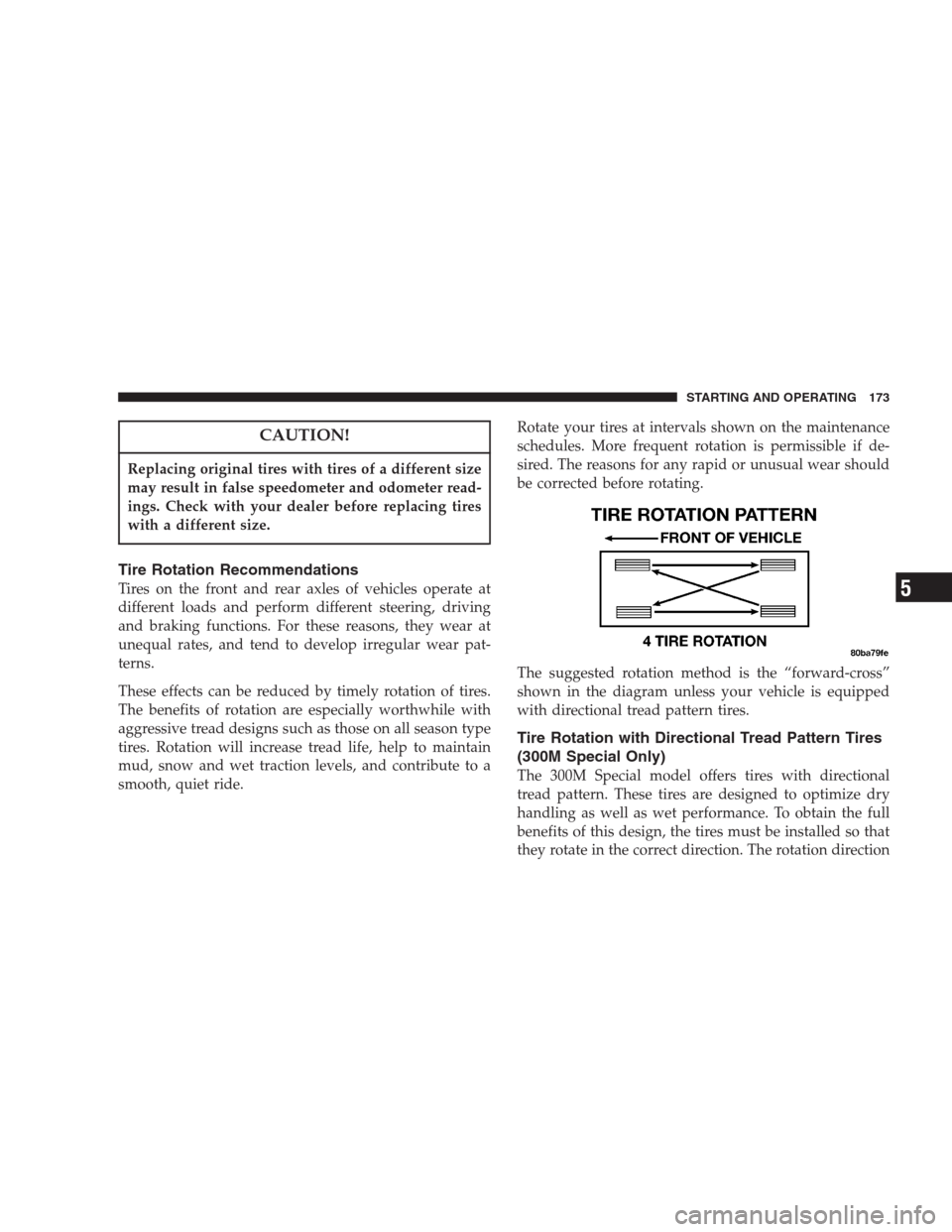
The suggested rotation method is the “forward-cross”
shown in the diagram unless your vehicle is equipped
with directional tread pattern tires.
Tire Rotation with Directional Tread Pattern Tires
(300M Special Only)
The 300M Special model offers tires with directional
tread pattern. These tires are designed to optimize dry
handling as well as wet performance. To obtain the full
benefits of this design, the tires must be installed so that
they rotate in the correct direction. The rotation direction
STARTING AND OPERATING 173
5
Page 182 of 277
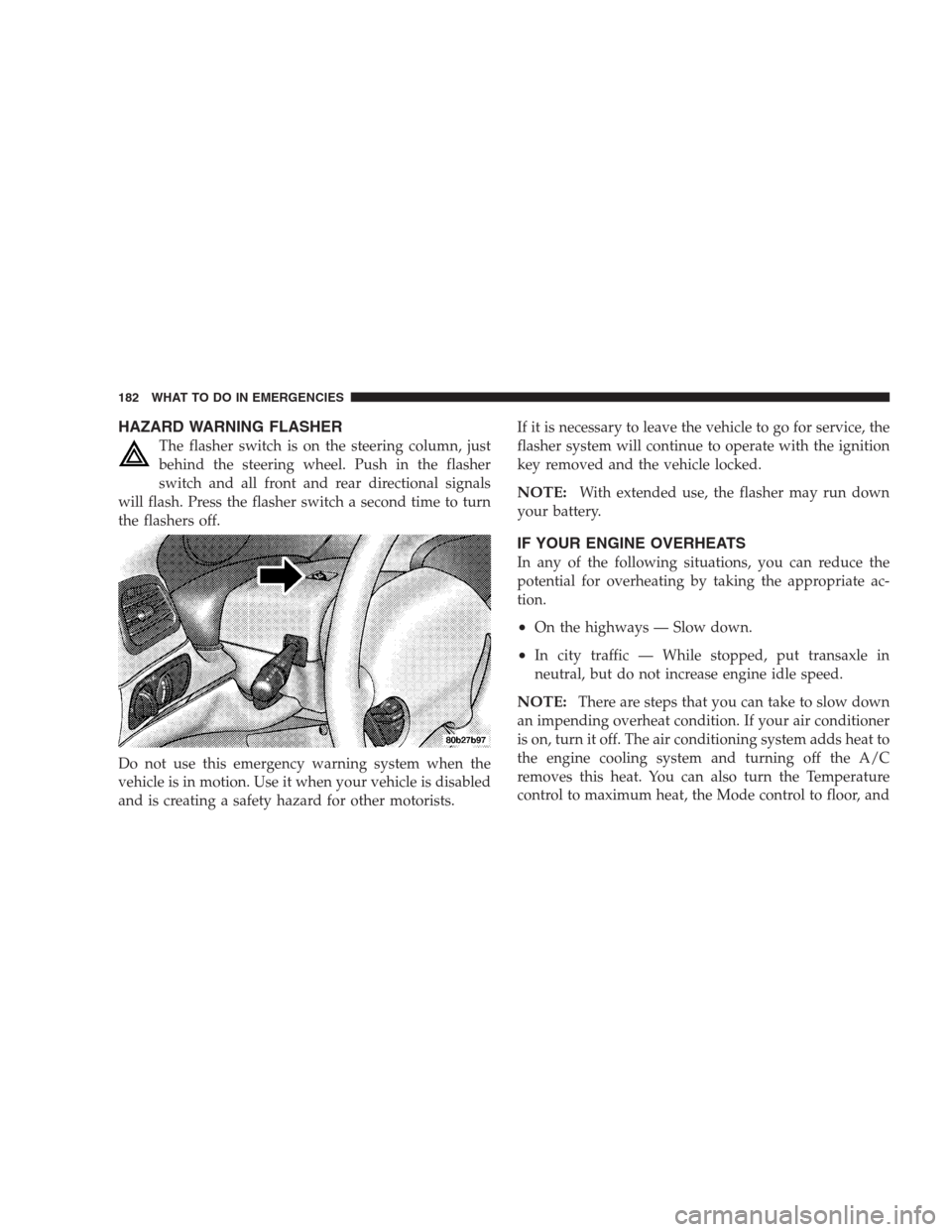
HAZARD WARNING FLASHER
The flasher switch is on the steering column, just
behind the steering wheel. Push in the flasher
switch and all front and rear directional signals
will flash. Press the flasher switch a second time to turn
the flashers off.
Do not use this emergency warning system when the
vehicle is in motion. Use it when your vehicle is disabled
and is creating a safety hazard for other motorists.If it is necessary to leave the vehicle to go for service, the
flasher system will continue to operate with the ignition
key removed and the vehicle locked.
NOTE:With extended use, the flasher may run down
your battery.
IF YOUR ENGINE OVERHEATS
In any of the following situations, you can reduce the
potential for overheating by taking the appropriate ac-
tion.
•On the highways — Slow down.
•In city traffic — While stopped, put transaxle in
neutral, but do not increase engine idle speed.
NOTE:There are steps that you can take to slow down
an impending overheat condition. If your air conditioner
is on, turn it off. The air conditioning system adds heat to
the engine cooling system and turning off the A/C
removes this heat. You can also turn the Temperature
control to maximum heat, the Mode control to floor, and
182 WHAT TO DO IN EMERGENCIES