warning CHRYSLER 300 M 2004 1.G Service Manual
[x] Cancel search | Manufacturer: CHRYSLER, Model Year: 2004, Model line: 300 M, Model: CHRYSLER 300 M 2004 1.GPages: 277, PDF Size: 5.69 MB
Page 155 of 277
STARTING PROCEDURES
WARNING!
Do not leave children or animals inside parked
vehicles in hot weather. Interior heat build up may
cause serious injury or death.
The gear selector must be in the NEUTRAL or PARK
position before you can start the engine. Apply the brakes
before shifting to any driving gear.
Normal Starting
Normal Starting of either a cold or a warm engine does
not require pumping or depressing the accelerator pedal.
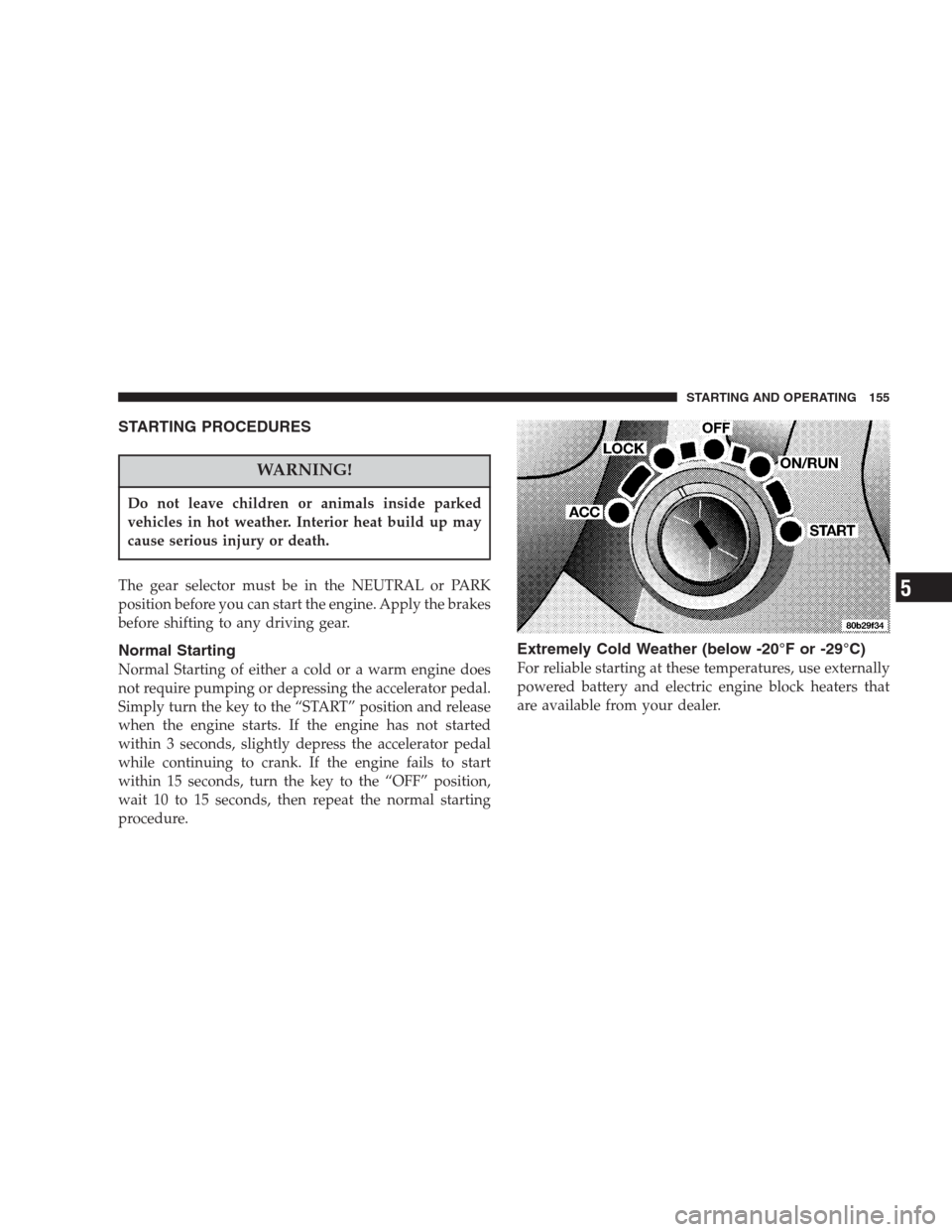
Simply turn the key to the “START” position and release
when the engine starts. If the engine has not started
within 3 seconds, slightly depress the accelerator pedal
while continuing to crank. If the engine fails to start
within 15 seconds, turn the key to the “OFF” position,
wait 10 to 15 seconds, then repeat the normal starting
procedure.
Extremely Cold Weather (below -20°F or -29°C)
For reliable starting at these temperatures, use externally
powered battery and electric engine block heaters that
are available from your dealer.
STARTING AND OPERATING 155
5
Page 156 of 277
If Engine Fails To Start
CAUTION!
Do not try to push or tow your vehicle to get it
started. Your vehicle cannot be started this way.
Pushing with another vehicle may damage the trans-
axle or the rear of your vehicle. See Section 6 of this
manual for the proper jump starting procedures.
WARNING!
Never pour fuel or other flammable liquid into the
throttle body air inlet opening in an attempt to start
the vehicle. This could result in flash fire causing
serious personal injury.
If the engine fails to start after following the Normal
Starting procedure, it may be flooded. Push the accelera-
tor pedal all the way to the floor and hold it there while
cranking the engine. This should clear any excess fuel in
case the engine is flooded.
CAUTION!
To prevent damage to the starter, do not crank the
engine for more than 15 seconds at a time. Wait 10 to
15 seconds before trying again.
If the engine has been flooded, it may start to run, but not
have enough power to continue running when the key is
released. If this occurs, continue cranking with the accel-
erator pedal pushed all the way to the floor. Release the
accelerator pedal and the key once the engine is running
smoothly.
If the engine shows no sign of starting after two 15
second periods of cranking with the accelerator pedal
held to the floor, the Normal Starting procedure should
be repeated.
156 STARTING AND OPERATING
Page 162 of 277
WARNING!
•Leaving children in a vehicle unattended is dan-
gerous for several reasons. A child or others could
be injured. Children should be warned not to
touch the parking brake or the gear selector. Don’t
leave the keys in the ignition. A child could
operate power windows, other controls, or move
the vehicle.
•Be sure the parking brake is fully disengaged
before driving; failure to do so can lead to brake
failure and an accident.
BRAKE SYSTEM
Your vehicle is equipped with power brakes as standard
equipment. In the event you lose power assist for any
reason (for example, repeated brake applications with the
engine off), the brakes will still function. The effort
required to brake the vehicle will be substantially in-
creased over that required with the power system oper-
ating.
If either of the two hydraulic systems lose normal capa-
bility, the remaining system will still function with some
loss of overall braking effectiveness. This will be evident
by increased pedal travel during application, greater
pedal force required to slow or stop, and activation of the
Brake Warning Lamp during brake use.
162 STARTING AND OPERATING
Page 163 of 277
Anti-Lock Brake System (ABS)
The ABS gives increased vehicle stability and brake
performance under most braking conditions. The system
automatically “pumps” the brakes during severe braking
conditions to prevent wheel lock-up.
All vehicle wheels and tires must be the same size and
tires must be properly inflated to produce accurate
signals for the ABS computer. However, the system will
compensate when the compact spare is in use.
During stops where ABS is activated, a vibration of the
brake pedal may be felt and associated system noises
may be heard.
WARNING!
Pumping of the brake pedal will diminish the effec-
tiveness of Anti-lock brakes and may lead to an
accident. Pumping makes the stopping distance
longer. Just press firmly on your brake pedal when
you need to slow down or stop.
POWER STEERING
Your vehicle is equipped with power assisted steering as
standard equipment. The power assisted steering system
of your vehicle provides mechanical steering capability
in the event power assist is lost.
If for some reason the hydraulic pressure is interrupted,
it will still be possible to steer your vehicle. Under these
conditions you will observe a substantial increase in
steering effort.
TRACTION CONTROL
The Traction Control System reduces wheel slip and
maintains traction at the driving (front) wheels. The
system reduces wheel slip by engaging the brake on the
wheel that is losing traction while spinning. The traction
system operates at speeds below 35 mph (56 km/h).
The system is always in the “stand by” mode unless:
•The Traction Control switch has been used to turn the
system off;
•There is a Anti-Lock Brake System malfunction;
•There is a Traction Control System malfunction;
STARTING AND OPERATING 163
5
Page 164 of 277
•The system has been deactivated to prevent damage to
the brake system due to overheated brake tempera-
tures.
NOTE:Extended heavy use of Traction Control may
cause the system to deactivate and turn on the Traction
Control OFF Light, indicated byTRAC OFF, located in
the instrument cluster.
This is to prevent overheating of the brake system and is
a normal condition. After cooling, the system will auto-
matically reactivate and turn off theTRAC OFFlight.
If your vehicle becomes stuck in mud, ice, or snow, turn
the Traction Control System Off before attempting to
“rock” the vehicle free.
TIRES
Proper tire inflation pressure is essential to the safe and
satisfactory operation of your vehicle. Three primary
areas are affected by improper tire pressure:
1. Safety—
WARNING!
•Improperly inflated tires are dangerous and can
cause accidents.
•Under inflation increases tire flexing and can
result in tire failure.
•Over inflation reduces a tire’s ability to cushion
shock. Objects on the road and chuck holes can cause
damage that results in tire failure.
•Unequal tire pressures can cause steering prob-
lems. You could lose control of your vehicle.
•Overinflated or under inflated tires can affect
vehicle handling and can fail suddenly, resulting in
loss of vehicle control.
•Always drive with each tire inflated to the recom-
mended pressure.
164 STARTING AND OPERATING
Page 168 of 277
CAUTION!
After inspecting or adjusting the tire pressure al-
ways reinstall the valve stem cap. This will prevent
moisture and dirt from entering the valve stem,
which could damage the wheel rim sensor.
WARNING!
Death or serious injury can occur if magnetically
sensitive devices are exposed to this magnet. Mag-
nets can affect pacemakers.
High Speed Operation
The manufacturer advocates driving at safe speeds
within posted speed limits. Where speed limits or condi-
tions are such that the vehicle can be driven at high
speeds, correct tire inflation pressure is very important.
WARNING!
High speed driving with your vehicle under load is
dangerous. The added strain on your tires could
cause them to fail. You could have a serious accident.
Don’t drive a vehicle loaded to the maximum capac-
ity at continuous speeds above 75 mph (120 km/h).
Radial-Ply Tires
WARNING!
Combining radial ply tires with other tires on your
vehicle will cause your vehicle to handle poorly. The
instability could cause an accident. Always use ra-
dial tires in sets of four. Never combine them with
other types of tires.
Cuts and punctures in radial tires are repairable only in
the tread area because of sidewall flexing. Consult your
tire dealer for radial tire repairs.
168 STARTING AND OPERATING
Page 169 of 277
Spare Tire Usage with Directional Tread Pattern
Tires (300M Special Only)
The 300M Special model offers tires with a directional
tread pattern. These tires are designed to optimize dry
handling as well as wet performance. To obtain the full
benefits of this design, the tires must be installed so that
they rotate in the correct direction. The rotation direction
of this type of tire is indicated by arrows on the side wall
of the tire. The full size spare tire is mounted as a direct
replacement for the right side of the vehicle. For road-
side replacement of a flat tire on the left side of the
vehicle, the full size spare can be used as mounted. If this
is required, correct the rotation as soon as possible to
restore optimum wet performance.
Compact Spare Tire
Maintain the compact spare tire inflation pressure at 60
psi [4.1 bars](414 kPa). Do not exceed 50 mph (80 km/h)
while the compact spare is installed on the vehicle.
Do not install a wheel cover or attempt to mount a
conventional tire on the compact spare wheel, since the
wheel is designed specifically for the compact spare.Because of the reduced ground clearance, do not take
your vehicle through an automatic car wash with the
compact spare installed.
WARNING!
Temporary-use spare tires are for emergency use
only. With the compact spare tire assembly installed
on your vehicle, do not exceed 50 mph (80 km).
Vehicle handling and braking performance will be
reduced. Also, do not drive more than 50 mph (80
km) with the compact spare installed. Failure to
follow compact spare tire warning may result in an
accident and/or fatal injury. Temporary-use spare
tires have a total tread life of 2,000 miles (3 200 km).
Be sure to follow the warnings, which apply to your
spare. Failure to do so could result in spare tire
failure and loss of vehicle control.
STARTING AND OPERATING 169
5
Page 170 of 277
Tire Spinning
When stuck in mud, sand, snow, or ice conditions, do not
spin your vehicle’s wheels above 30 mph. (48 km/h).
See the paragraph on Freeing A Stuck Vehicle in section 6
of this manual.
WARNING!
Fast spinning tires can be dangerous. Forces gener-
ated by excessive wheel speeds may cause tire dam-
age or failure. A tire could explode and injure
someone. Do not spin your vehicle’s wheels faster
than 30 mph (48 km/h) when you are stuck. And
don’t let anyone near a spinning wheel, no matter
what the speed.
Tire Chains
Due to limited clearance, tire chains are not recom-
mended.
CAUTION!
Damage to the vehicle may result if tire chains are
used.
Snow Tires
Some areas of the country require the use of snow tires
during winter. Standard tires are of the all season type
and satisfy this requirement as indicated by the M+S
designation on the tire sidewall.
The 300M Special offers a high performance three
season tire. The performance of this type of tire on
snow and ice is not equivalent to traditional all season
tires.
170 STARTING AND OPERATING
Page 171 of 277
WARNING!
The 300M Special is equipped with tires that are
optimized for driving in dry and wet weather con-
ditions. However, these tires have reduced traction
capability in snow and ice. When driving a 300M
Special in these conditions with these tires, you must
take special care to maintain control and avoid
accidents. We recommend that you equip your ve-
hicle with “SNOW” or “ALL SEASON” tires on all
four wheels for driving in snowy and icy conditions.
It is necessary to select tires equivalent in size and
load rating to the original equipment tires. “SNOW”
tires may have lower speed rating than factory
equipped tires and may not match the maximum
vehicle speed. Do not use tires or wheels other than
the size recommended by the manufacturer for this
vehicle.
If you need snow tires, select tires equivalent in size and
load rating to the original equipment tires. Refer to the
tire pressure label for inflation pressure.Snow tires may have a lower speed rating than factory
equipped tires and may not match the maximum vehicle
speed.
Snow tires should not be operated at sustained speeds
over 75 mph (120 km/h).
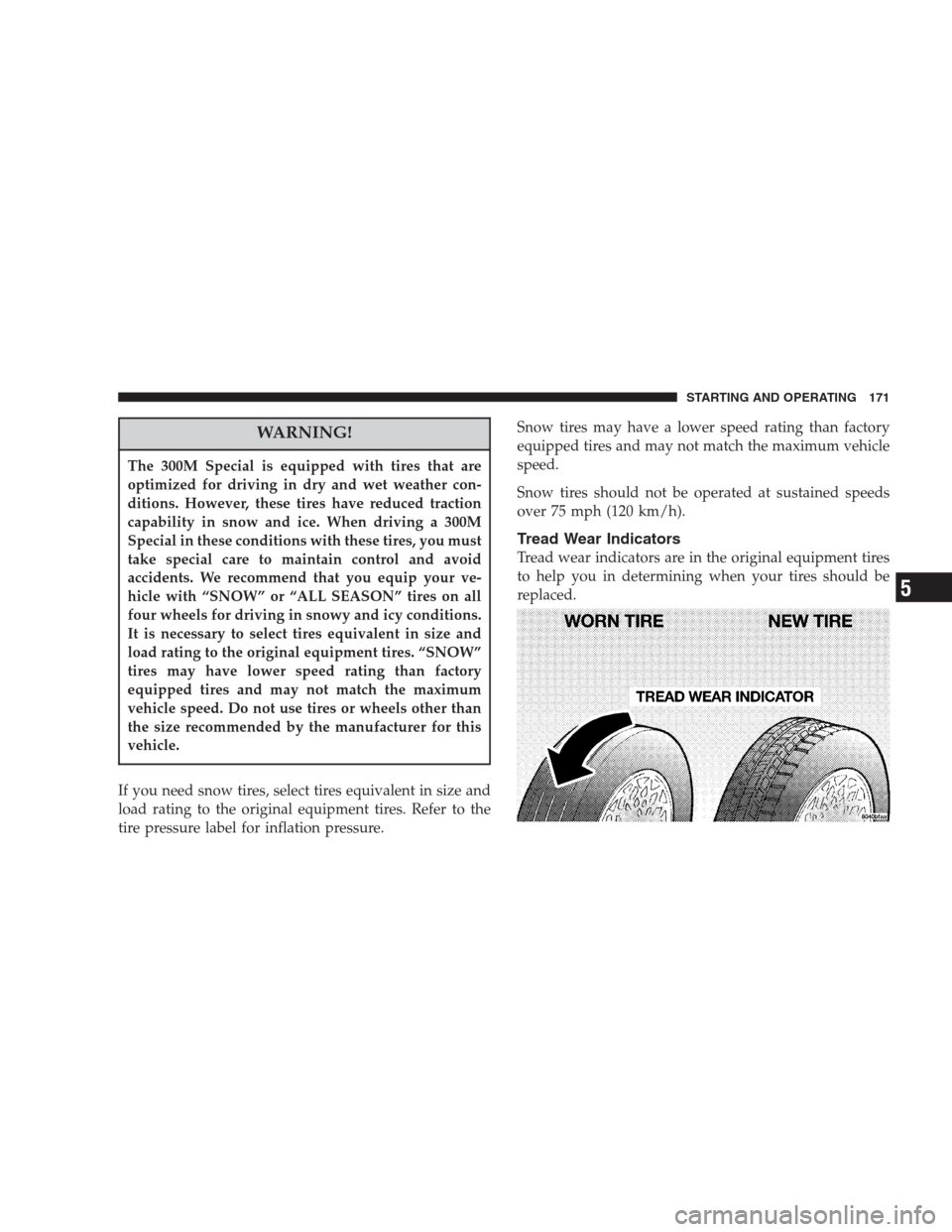
Tread Wear Indicators
Tread wear indicators are in the original equipment tires
to help you in determining when your tires should be
replaced.
STARTING AND OPERATING 171
5
Page 172 of 277
These indicators are molded into the bottom of the tread
grooves and will appear as bands when the tread depth
becomes 1/16 inch (2 mm). When the indicators appear
in 2 or more adjacent grooves, the tire should be replaced.
Many states have laws requiring tire replacement at this
point.
Replacement Tires
The tires on your new vehicle provide a balance of many
characteristics. They should be inspected regularly for
wear and correct inflation pressure. The manufacturer
strongly recommends that you use tires equivalent to the
originals in size, quality and performance when replace-
ment is needed (see the paragraph on tread wear indica-
tors). Failure to use equivalent replacement tires may
adversely affect the safety, handling, and ride of your
vehicle. We recommend that you contact your original
equipment dealer on any questions you may have on tire
specifications or capability.
WARNING!
•Do not use a tire, wheel size or rating other than
that specified for your vehicle. Some combina-
tions of unapproved tires and wheels may change
suspension dimensions and performance charac-
teristics, resulting in changes to steering, han-
dling, and braking of your vehicle. This can cause
unpredictable handling and stress to steering and
suspension components. You could lose control
and have an accident resulting in serious injury or
death. Use only the tire and wheel sizes with load
ratings approved for your vehicle.
•Never use a tire smaller than the minimum tire
size listed on your vehicle’s tire label located on
the driver’s door. Using a smaller tire could result
in tire overloading and failure. You could lose
control and have an accident.
•Failure to equip your vehicle with tires having
adequate speed capability can result in sudden
tire failure and loss of vehicle control.
•Overloading your tires is dangerous. Like under
inflation, overloading can cause tire failure. Use
tires of the recommended load capacity for your
vehicle and never overload them.
172 STARTING AND OPERATING