warning CHRYSLER 300 M 2004 1.G Repair Manual
[x] Cancel search | Manufacturer: CHRYSLER, Model Year: 2004, Model line: 300 M, Model: CHRYSLER 300 M 2004 1.GPages: 277, PDF Size: 5.69 MB
Page 206 of 277
Engine Air Cleaner Filter
Under normal driving conditions, replace the air filter at
the intervals shown on Schedule “A”. If, however, you
drive the vehicle frequently under dusty or severe con-
ditions, the filter element should be inspected periodi-
cally and replaced if necessary at the intervals shown on
Schedule “B”.
WARNING!
The air cleaner can provide a measure of protection
in the case of engine backfire. Do not remove the air
cleaner unless such removal is necessary for repair or
maintenance. Make sure that no one is near the
engine compartment before starting the vehicle with
the air cleaner removed. Failure to do so can result in
serious personal injury.
Engine Fuel Filter
A plugged fuel filter can cause hard starting or limit the
speed at which a vehicle can be driven. Should an
excessive amount of dirt accumulate in the fuel tank,
frequent replacement of the fuel filter which is mounted
in the fuel tank may be necessary. See your dealer for
service.
Catalytic Converter
The catalytic converter requires the use of unleaded fuel
only. Leaded gasoline will destroy the effectiveness of the
catalyst as an emission control device.
Under normal operating conditions, the catalytic con-
verter will not require maintenance. However, it is im-
portant to keep the engine properly serviced to assure
proper catalyst operation and prevent possible catalyst
damage. If the Malfunction Indicator light is flashing,
immediate service is required.
206 MAINTAINING YOUR VEHICLE
Page 207 of 277
CAUTION!
Damage to the catalytic converter can result if your
vehicle is not kept in proper operating condition. In
the event of engine malfunction, particularly involv-
ing engine misfire or other apparent loss of perfor-
mance, have your vehicle serviced promptly. Contin-
ued operation of your vehicle with a severe
malfunction could cause the converter to overheat,
resulting in possible damage to the converter and the
vehicle.
WARNING!
A hot exhaust system can start a fire if you park over
materials that can burn. Such materials might be
grass or leaves coming into contact with your ex-
haust system. Do not park or operate your vehicle in
areas where your exhaust system can contact any-
thing that can burn.
In unusual situations involving grossly malfunctioning
engine operation, a scorching odor may suggest severe
and abnormal catalyst overheating. If this occurs, stop
the vehicle, turn off the engine and allow it to cool.
Service, including a tune up to manufacturer’s specifica-
tions, should be obtained immediately.
To minimize the possibility of catalyst damage:
•Do not shut off the engine or interrupt the ignition
when the transaxle is in gear and the vehicle is in
motion.
•Do not try to start the engine by pushing or towing the
vehicle.
Engine Timing Belt
Replace the engine timing belt at the intervals described
in the appropriate maintenance schedule.
Crankcase Emission Control System
Proper operation of this system depends on freedom
from sticking or plugging due to deposits. As vehicle
mileage builds up, the PCV valve and passages may
accumulate deposits. If a valve is not working properly,
MAINTAINING YOUR VEHICLE 207
7
Page 208 of 277
replace it with a new valve. DO NOT ATTEMPT TO
CLEAN THE OLD PCV VALVE!
Check ventilation hose for indication of damage or
plugging deposits. Replace if necessary.
Maintenance-Free Battery
The top of the MAINTENANCE-FREE battery is perma-
nently sealed. You will never have to add water, nor is
periodic maintenance required.
NOTE:The battery is stored in a compartment in front
of the tire in the right front fender and is accessible
through the engine compartment. The tire and wheel
need not be removed to access the battery.
To access the battery:
1. Turn the steering wheel fully to the right.
2. Remove the battery access panel from the inner fender
shield.
3. Remove the air cleaner.
4. Remove the battery tie down bracket.
5. Move the battery into the opening and lift it out.
WARNING!
Battery fluid is a corrosive acid solution and can
burn or even blind you. Don’t allow battery fluid to
contact your eyes, skin or clothing. Don’t lean over a
battery when attaching clamps. If acid splashes in
eyes or on skin, flush the area immediately with
large amounts of water. Battery gas is flammable and
explosive. Keep flame or sparks away from the
battery. Don’t use a booster battery or any other
booster source with an output greater than 12 volts.
Don’t allow cable clamps to touch each other.
WARNING!
Battery posts, terminals and related accessories con-
tain lead and lead compounds. Wash hands after
handling.
208 MAINTAINING YOUR VEHICLE
Page 209 of 277
CAUTION!
It is essential when replacing the cables on the
battery that the positive cable is attached to the
positive post and the negative cable is attached to the
negative post. Battery posts are marked positive (+)
and negative (-) and identified on the battery case.
Cable clamps should be tight on the terminal posts
and free of corrosion. Apply grease to posts and
clamps after tightening. If a “fast charger” is used
while the battery is in the vehicle, disconnect both
vehicle battery cables before connecting the charger
to battery. Do not use a “fast charger” to provide
starting voltage as battery damage can result.
Air Conditioner
Check the air conditioning system at the start of the
warm weather season.
NOTE:If your air conditioning performance seems
lower than expected, check the front of the A/C con-
denser for an accumulation of dirt or insects. Clean with
a gentle water spray from behind the radiator andthrough the condenser as required. Fabric front fascia
protectors may reduce air flow to the condenser, reducing
air conditioning performance.
WARNING!
The air conditioning system contains refrigerant
under high pressure. To avoid risk of personal injury
or damage to the system, adding refrigerant or any
repair requiring lines to be disconnected should be
done by an experienced repairman.
Refrigerant Recovery and Recycling
The air conditioning system of your vehicle contains
R-134a, a refrigerant that does not deplete the ozone layer
in the upper atmosphere, the manufacturer recommends
that air conditioning service be done by facilities using
refrigerant recyling and recovery equipment that meets
SAE standard J1991.
MAINTAINING YOUR VEHICLE 209
7
Page 210 of 277
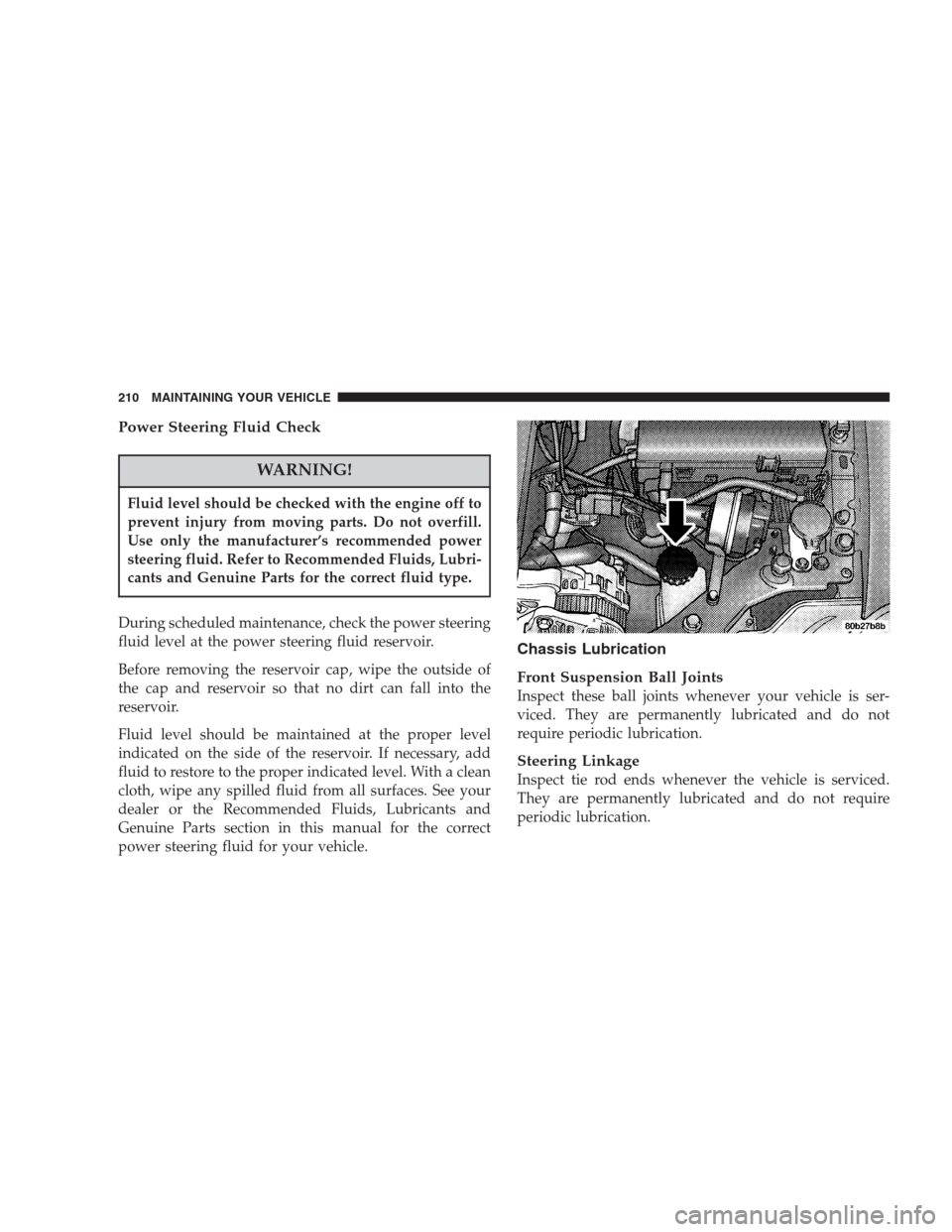
Power Steering Fluid Check
WARNING!
Fluid level should be checked with the engine off to
prevent injury from moving parts. Do not overfill.
Use only the manufacturer’s recommended power
steering fluid. Refer to Recommended Fluids, Lubri-
cants and Genuine Parts for the correct fluid type.
During scheduled maintenance, check the power steering
fluid level at the power steering fluid reservoir.
Before removing the reservoir cap, wipe the outside of
the cap and reservoir so that no dirt can fall into the
reservoir.
Fluid level should be maintained at the proper level
indicated on the side of the reservoir. If necessary, add
fluid to restore to the proper indicated level. With a clean
cloth, wipe any spilled fluid from all surfaces. See your
dealer or the Recommended Fluids, Lubricants and
Genuine Parts section in this manual for the correct
power steering fluid for your vehicle.
Chassis Lubrication
Front Suspension Ball Joints
Inspect these ball joints whenever your vehicle is ser-
viced. They are permanently lubricated and do not
require periodic lubrication.
Steering Linkage
Inspect tie rod ends whenever the vehicle is serviced.
They are permanently lubricated and do not require
periodic lubrication.
210 MAINTAINING YOUR VEHICLE
Page 213 of 277
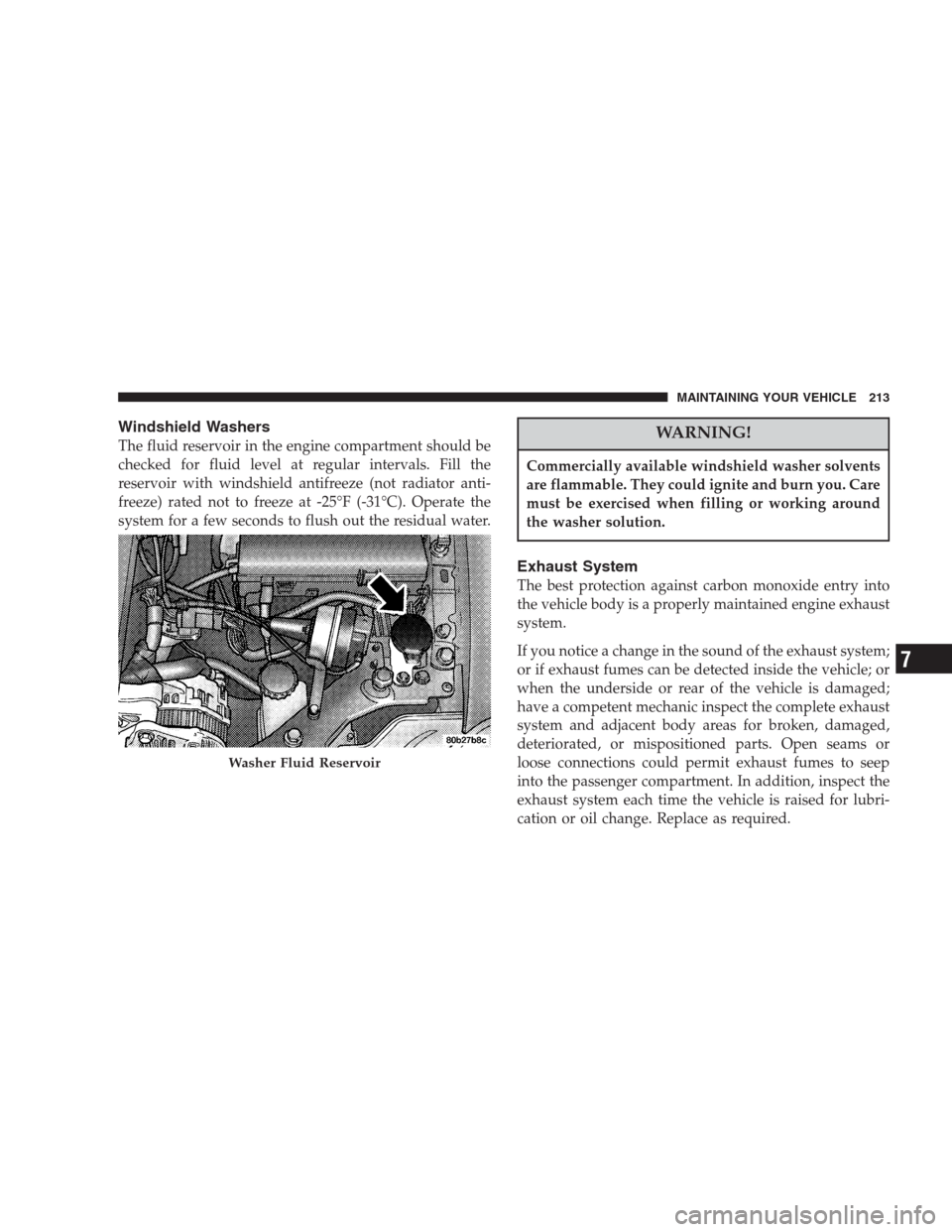
Windshield Washers
The fluid reservoir in the engine compartment should be
checked for fluid level at regular intervals. Fill the
reservoir with windshield antifreeze (not radiator anti-
freeze) rated not to freeze at -25°F (-31°C). Operate the
system for a few seconds to flush out the residual water.WARNING!
Commercially available windshield washer solvents
are flammable. They could ignite and burn you. Care
must be exercised when filling or working around
the washer solution.
Exhaust System
The best protection against carbon monoxide entry into
the vehicle body is a properly maintained engine exhaust
system.
If you notice a change in the sound of the exhaust system;
or if exhaust fumes can be detected inside the vehicle; or
when the underside or rear of the vehicle is damaged;
have a competent mechanic inspect the complete exhaust
system and adjacent body areas for broken, damaged,
deteriorated, or mispositioned parts. Open seams or
loose connections could permit exhaust fumes to seep
into the passenger compartment. In addition, inspect the
exhaust system each time the vehicle is raised for lubri-
cation or oil change. Replace as required.
Washer Fluid Reservoir
MAINTAINING YOUR VEHICLE 213
7
Page 214 of 277
WARNING!
Exhaust gases can injure or kill. They contain carbon
monoxide which is colorless and odorless. Breathing
it can make you unconscious and can eventually
poison you. Follow the above precautions to keep
your exhaust system as safe as possible.
Cooling System
WARNING!
•When working near the radiator cooling fan, dis-
connect the fan motor lead or turn the ignition key
to the OFF position. The fan is controlled by
engine coolant temperature and Air Conditioning
pressure. It can start at any time the ignition key is
in the ON position.
•You or others can be badly burned by hot coolant
or steam from your radiator. If you see or hear
steam coming from under the hood, don’t open
the hood until the radiator has had time to cool.
Never try to open a cooling system pressure cap
when the radiator or coolant bottle is hot.
Coolant Checks
Check coolant protection every 12 months (before the
onset of freezing weather, where applicable). If the cool-
ant is dirty or rusty in appearance, the system should be
drained, flushed and refilled with fresh coolant.
214 MAINTAINING YOUR VEHICLE
Page 216 of 277
Higher concentrations (not to exceed 70%) may be used if
temperatures below -37°F (-38°C) are anticipated.
Use only high purity water such as distilled or deionized
water when mixing the water/antifreeze solution. The
use of lower quality water will reduce the amount of
corrosion protection in the engine cooling system.
NOTE:Mixing coolant types will decrease the life of the
engine coolant and will require more frequent engine
coolant changes.
Please note that it is the owner’s responsibility to main-
tain the proper level of protection against freezing ac-
cording to the temperatures occurring in the area where
the vehicle is operated.
Cooling System Pressure Cap
The cap must be fully tightened to prevent loss of
coolant, and to insure that coolant will return to the
radiator from the coolant reserve tank.
The cap should be inspected and cleaned if there is any
accumulation of foreign material on the sealing surfaces.
WARNING!
The warning words “DO NOT OPEN HOT” on the
cooling system pressure cap are a safety precaution.
Never add coolant when the engine is overheated.
Do not loosen or remove the cap to cool an over-
heated engine. Heat causes pressure to build up in
the cooling system. To prevent scalding or injury, do
not remove the pressure cap while the system is hot
or under pressure.
WARNING!
Do not use a pressure cap other than the one speci-
fied for your vehicle. Personal injury or engine
damage may result.
216 MAINTAINING YOUR VEHICLE
Page 219 of 277
WARNING!
Riding the brakes can lead to brake failure and
possibly an accident. Driving with your foot resting
or riding on the brake pedal can result in abnormally
high brake temperatures, excessive lining wear, and
possible brake damage. You wouldn’t have your full
braking capacity in an emergency.
Brake and Power Steering System Hoses
When servicing the vehicle for scheduled maintenance,
inspect surface of hoses for evidence of heat and me-
chanical damage. Hard and brittle rubber, cracking,
checking, tears, cuts, abrasion, and excessive swelling
suggest deterioration of the rubber. Particular attention
should be made to examining those hose surfaces nearest
to high heat sources, such as the exhaust manifold.
Inspect all hose clamps and couplings to make sure they
are secure and no leaks are present.
NOTE:Often, fluids such as oil, power steering fluid,
and brake fluid are used during assembly plant opera-
tions to ease the assembly of hoses to couplings. There-
fore, oil wetness at the hose-coupling area is not neces-
sarily an indication of leakage. Actual dripping of hot
fluid when systems are under pressure (during vehicle
operation) should be noted before hose is replaced based
on leakage.
NOTE:Inspection of brake hoses should be done
whenever the brake system is serviced and every engine
oil change.
WARNING!
Worn brake hoses can burst and cause brake failure.
You could have an accident. If you see any signs of
cracking, scuffing, or worn spots, have the brake
hoses replaced immediately.
Brake Master CylinderThe fluid level in the master cylinder should be checked
when performing under hood services, or immediately if
the brake system warning lamp shows system failure.
MAINTAINING YOUR VEHICLE 219
7
Page 220 of 277
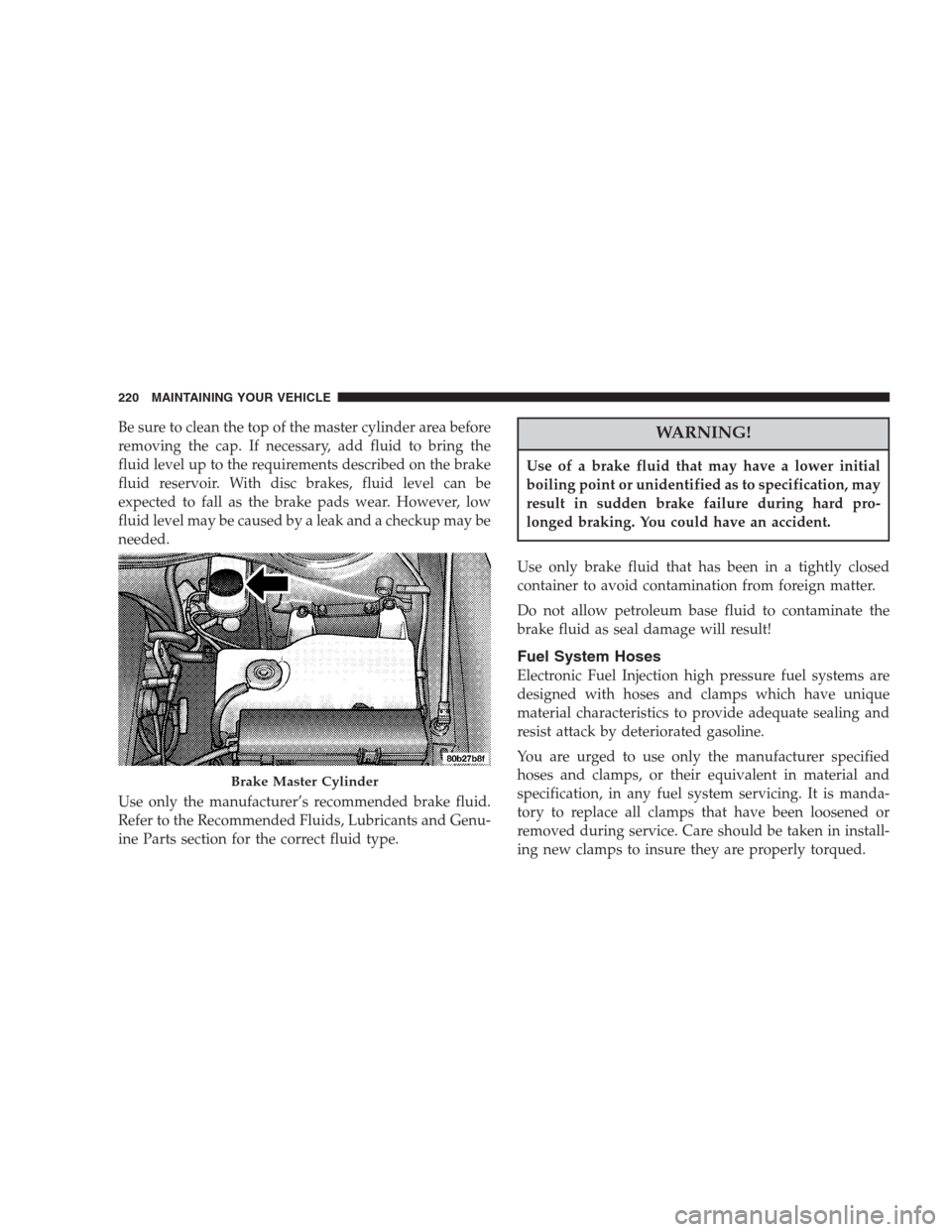
Be sure to clean the top of the master cylinder area before
removing the cap. If necessary, add fluid to bring the
fluid level up to the requirements described on the brake
fluid reservoir. With disc brakes, fluid level can be
expected to fall as the brake pads wear. However, low
fluid level may be caused by a leak and a checkup may be
needed.
Use only the manufacturer’s recommended brake fluid.
Refer to the Recommended Fluids, Lubricants and Genu-
ine Parts section for the correct fluid type.WARNING!
Use of a brake fluid that may have a lower initial
boiling point or unidentified as to specification, may
result in sudden brake failure during hard pro-
longed braking. You could have an accident.
Use only brake fluid that has been in a tightly closed
container to avoid contamination from foreign matter.
Do not allow petroleum base fluid to contaminate the
brake fluid as seal damage will result!
Fuel System Hoses
Electronic Fuel Injection high pressure fuel systems are
designed with hoses and clamps which have unique
material characteristics to provide adequate sealing and
resist attack by deteriorated gasoline.
You are urged to use only the manufacturer specified
hoses and clamps, or their equivalent in material and
specification, in any fuel system servicing. It is manda-
tory to replace all clamps that have been loosened or
removed during service. Care should be taken in install-
ing new clamps to insure they are properly torqued.
Brake Master Cylinder
220 MAINTAINING YOUR VEHICLE