engine CHRYSLER 300 M 2004 1.G Workshop Manual
[x] Cancel search | Manufacturer: CHRYSLER, Model Year: 2004, Model line: 300 M, Model: CHRYSLER 300 M 2004 1.GPages: 277, PDF Size: 5.69 MB
Page 210 of 277
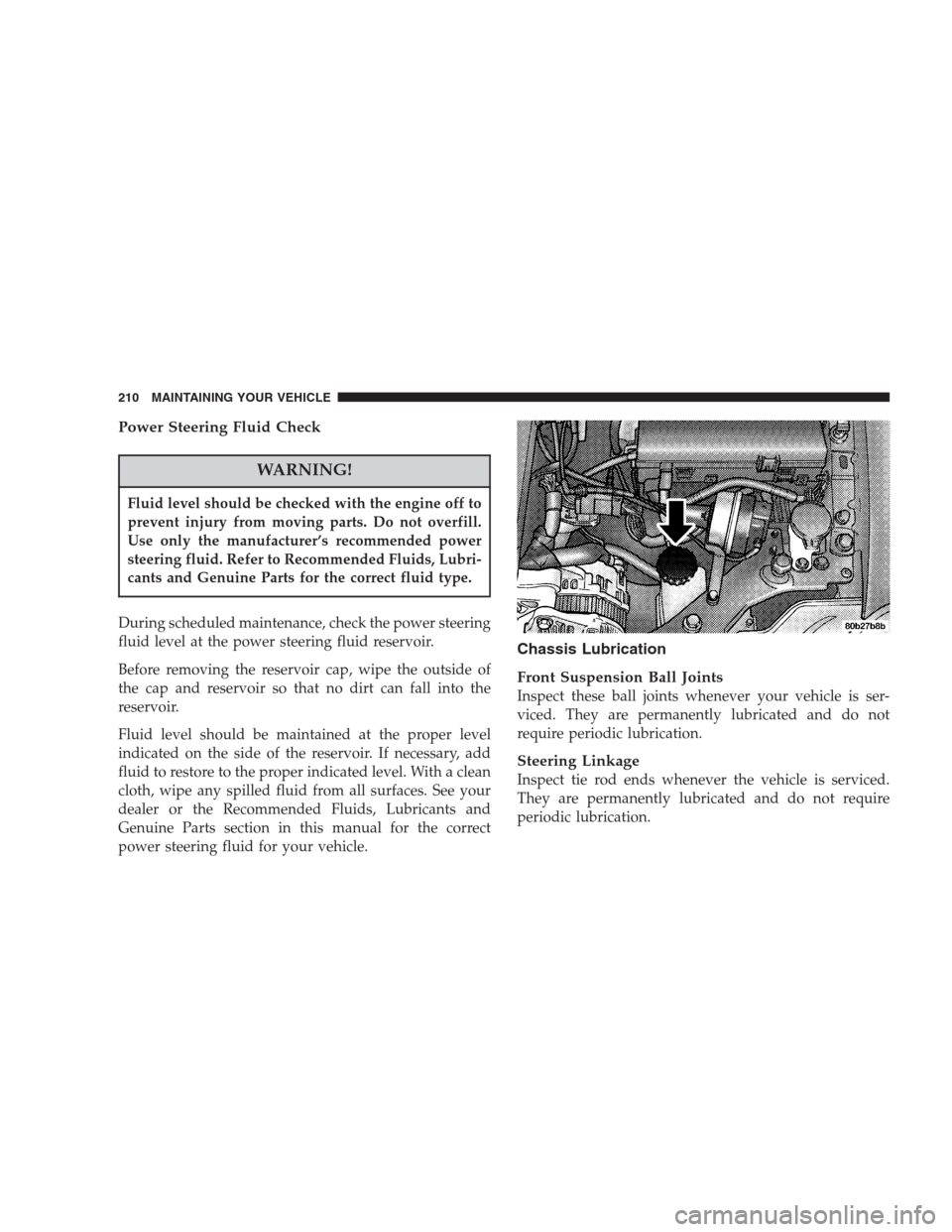
Power Steering Fluid Check
WARNING!
Fluid level should be checked with the engine off to
prevent injury from moving parts. Do not overfill.
Use only the manufacturer’s recommended power
steering fluid. Refer to Recommended Fluids, Lubri-
cants and Genuine Parts for the correct fluid type.
During scheduled maintenance, check the power steering
fluid level at the power steering fluid reservoir.
Before removing the reservoir cap, wipe the outside of
the cap and reservoir so that no dirt can fall into the
reservoir.
Fluid level should be maintained at the proper level
indicated on the side of the reservoir. If necessary, add
fluid to restore to the proper indicated level. With a clean
cloth, wipe any spilled fluid from all surfaces. See your
dealer or the Recommended Fluids, Lubricants and
Genuine Parts section in this manual for the correct
power steering fluid for your vehicle.
Chassis Lubrication
Front Suspension Ball Joints
Inspect these ball joints whenever your vehicle is ser-
viced. They are permanently lubricated and do not
require periodic lubrication.
Steering Linkage
Inspect tie rod ends whenever the vehicle is serviced.
They are permanently lubricated and do not require
periodic lubrication.
210 MAINTAINING YOUR VEHICLE
Page 212 of 277
then proceed as described above, to distribute the lubri-
cant within the lock cylinder. Pay attention to trunk
hinges, especially during cold weather, to ensure ease of
trunk operation.
Other Body Mechanisms
The following body mechanisms should be inspected
and, if necessary, all pivot and sliding contact areas of
these components should be lubricated with the lubricant
specified as follows:
Engine Oil
•
Door hinges
•Hood hinges
•Trunk hinges
Smooth White Body Lubricant - Such as Mopar
Spray White Lube:
•
Hood hinge springs and links
•Lock cylinders
•Parking brake mechanism
•Trunk latches
•Ash tray
•Door check straps
Windshield Wiper Blades
Clean the rubber edges of the wiper blades and the
windshield periodically with a sponge or soft cloth and a
mild non abrasive cleaner. This will remove accumula-
tions of salt or road film.
Operation of the wipers on dry glass for long periods
may cause deterioration of the wiper blades. Always use
washer fluid when using the wipers to remove salt or dirt
from a dry windshield. Avoid using the wiper blades to
remove frost or ice from the windshield. Keep the blade
rubber out of contact with petroleum products such as
engine oil, gasoline, etc.
212 MAINTAINING YOUR VEHICLE
Page 213 of 277
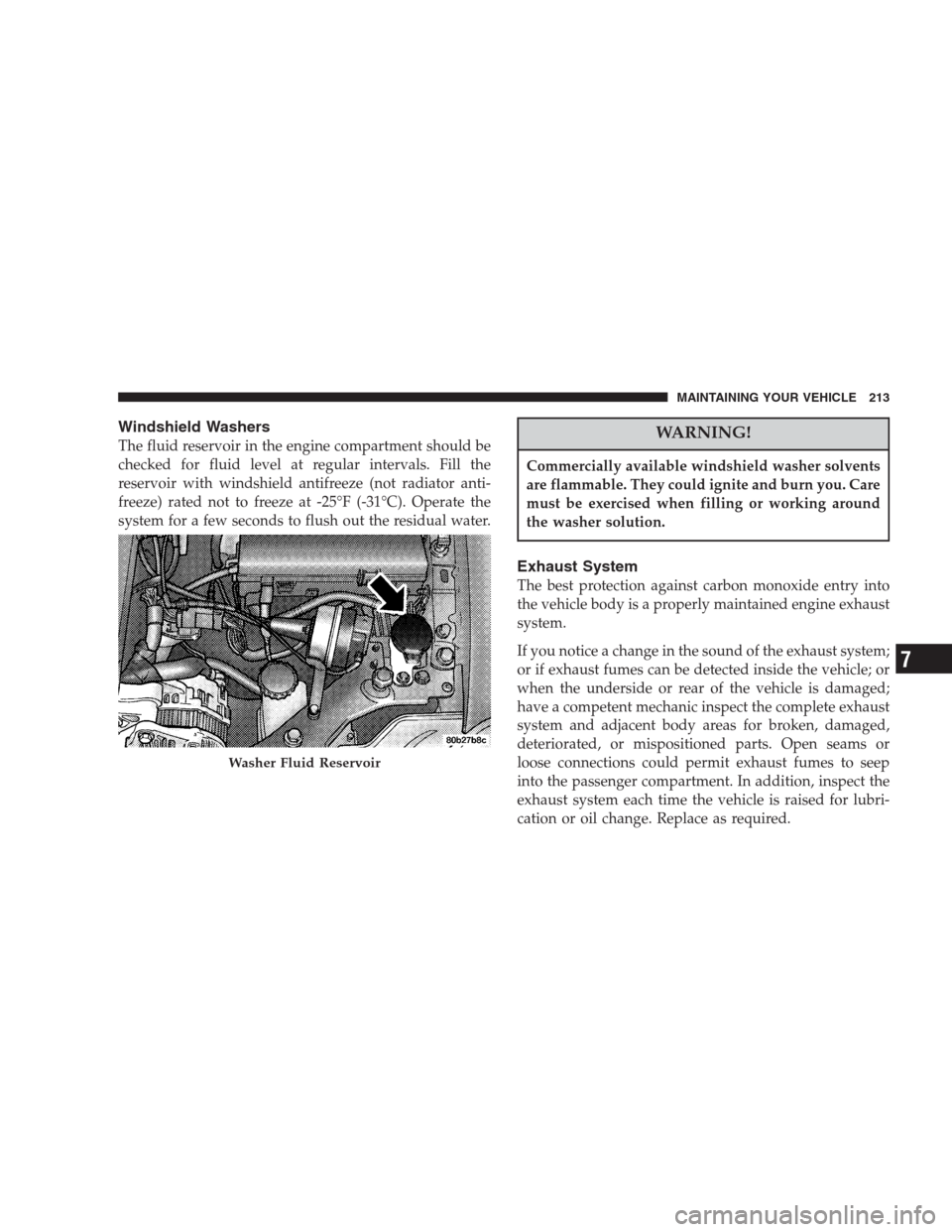
Windshield Washers
The fluid reservoir in the engine compartment should be
checked for fluid level at regular intervals. Fill the
reservoir with windshield antifreeze (not radiator anti-
freeze) rated not to freeze at -25°F (-31°C). Operate the
system for a few seconds to flush out the residual water.WARNING!
Commercially available windshield washer solvents
are flammable. They could ignite and burn you. Care
must be exercised when filling or working around
the washer solution.
Exhaust System
The best protection against carbon monoxide entry into
the vehicle body is a properly maintained engine exhaust
system.
If you notice a change in the sound of the exhaust system;
or if exhaust fumes can be detected inside the vehicle; or
when the underside or rear of the vehicle is damaged;
have a competent mechanic inspect the complete exhaust
system and adjacent body areas for broken, damaged,
deteriorated, or mispositioned parts. Open seams or
loose connections could permit exhaust fumes to seep
into the passenger compartment. In addition, inspect the
exhaust system each time the vehicle is raised for lubri-
cation or oil change. Replace as required.
Washer Fluid Reservoir
MAINTAINING YOUR VEHICLE 213
7
Page 214 of 277
WARNING!
Exhaust gases can injure or kill. They contain carbon
monoxide which is colorless and odorless. Breathing
it can make you unconscious and can eventually
poison you. Follow the above precautions to keep
your exhaust system as safe as possible.
Cooling System
WARNING!
•When working near the radiator cooling fan, dis-
connect the fan motor lead or turn the ignition key
to the OFF position. The fan is controlled by
engine coolant temperature and Air Conditioning
pressure. It can start at any time the ignition key is
in the ON position.
•You or others can be badly burned by hot coolant
or steam from your radiator. If you see or hear
steam coming from under the hood, don’t open
the hood until the radiator has had time to cool.
Never try to open a cooling system pressure cap
when the radiator or coolant bottle is hot.
Coolant Checks
Check coolant protection every 12 months (before the
onset of freezing weather, where applicable). If the cool-
ant is dirty or rusty in appearance, the system should be
drained, flushed and refilled with fresh coolant.
214 MAINTAINING YOUR VEHICLE
Page 215 of 277
Check the front of the radiator and condenser for any
accumulation of bugs, leaves, etc. Clean the radiator and
condenser by gently spraying water from a garden hose
at the back of the core.
Check the engine cooling system hoses for condition and
tightness of connection. Inspect the entire system for
leaks. Any hoses that show cuts or severe abrasion must
be replaced.
Cooling System — Drain, Flush and Refill
At the intervals shown on the Maintenance Schedules (5
years/100,000 miles), the system should be drained,
flushed and refilled.
If the solution is dirty and contains a considerable
amount of sediment, clean and flush with a reliable
cooling system cleaner. Follow with a thorough rinsing to
remove all deposits and chemicals.
Engine Coolant Disposal
Used ethylene glycol based engine coolant is a regulated
substance requiring proper disposal. Check with your
local authorities to determine the disposal rules for your
community. Do not store ethylene glycol based enginecoolant in open containers or allow it to remain in
puddles on the ground. Prevent ingestion by animals or
children. If ingested by a child, contact a physician
immediately.
Selection Of Coolant
Use only the manufacturer’s recommended coolant. Re-
fer to the Recommended Fluids, Lubricants and Genuine
Parts section for correct coolant type.
CAUTION!
Failure to use the proper antifreeze could cause
radiator plugging and engine overheating. Do not
mix antifreeze brands or types. Do not use plain
water alone or alcohol base antifreeze products. Do
not use additional rust inhibitors or antirust prod-
ucts, as they may not be compatible with the radiator
coolant and may plug the radiator.
Adding Coolant
When adding coolant, a minimum solution of 50% eth-
ylene glycol antifreeze coolant in water should be used.
MAINTAINING YOUR VEHICLE 215
7
Page 216 of 277
Higher concentrations (not to exceed 70%) may be used if
temperatures below -37°F (-38°C) are anticipated.
Use only high purity water such as distilled or deionized
water when mixing the water/antifreeze solution. The
use of lower quality water will reduce the amount of
corrosion protection in the engine cooling system.
NOTE:Mixing coolant types will decrease the life of the
engine coolant and will require more frequent engine
coolant changes.
Please note that it is the owner’s responsibility to main-
tain the proper level of protection against freezing ac-
cording to the temperatures occurring in the area where
the vehicle is operated.
Cooling System Pressure Cap
The cap must be fully tightened to prevent loss of
coolant, and to insure that coolant will return to the
radiator from the coolant reserve tank.
The cap should be inspected and cleaned if there is any
accumulation of foreign material on the sealing surfaces.
WARNING!
The warning words “DO NOT OPEN HOT” on the
cooling system pressure cap are a safety precaution.
Never add coolant when the engine is overheated.
Do not loosen or remove the cap to cool an over-
heated engine. Heat causes pressure to build up in
the cooling system. To prevent scalding or injury, do
not remove the pressure cap while the system is hot
or under pressure.
WARNING!
Do not use a pressure cap other than the one speci-
fied for your vehicle. Personal injury or engine
damage may result.
216 MAINTAINING YOUR VEHICLE
Page 217 of 277
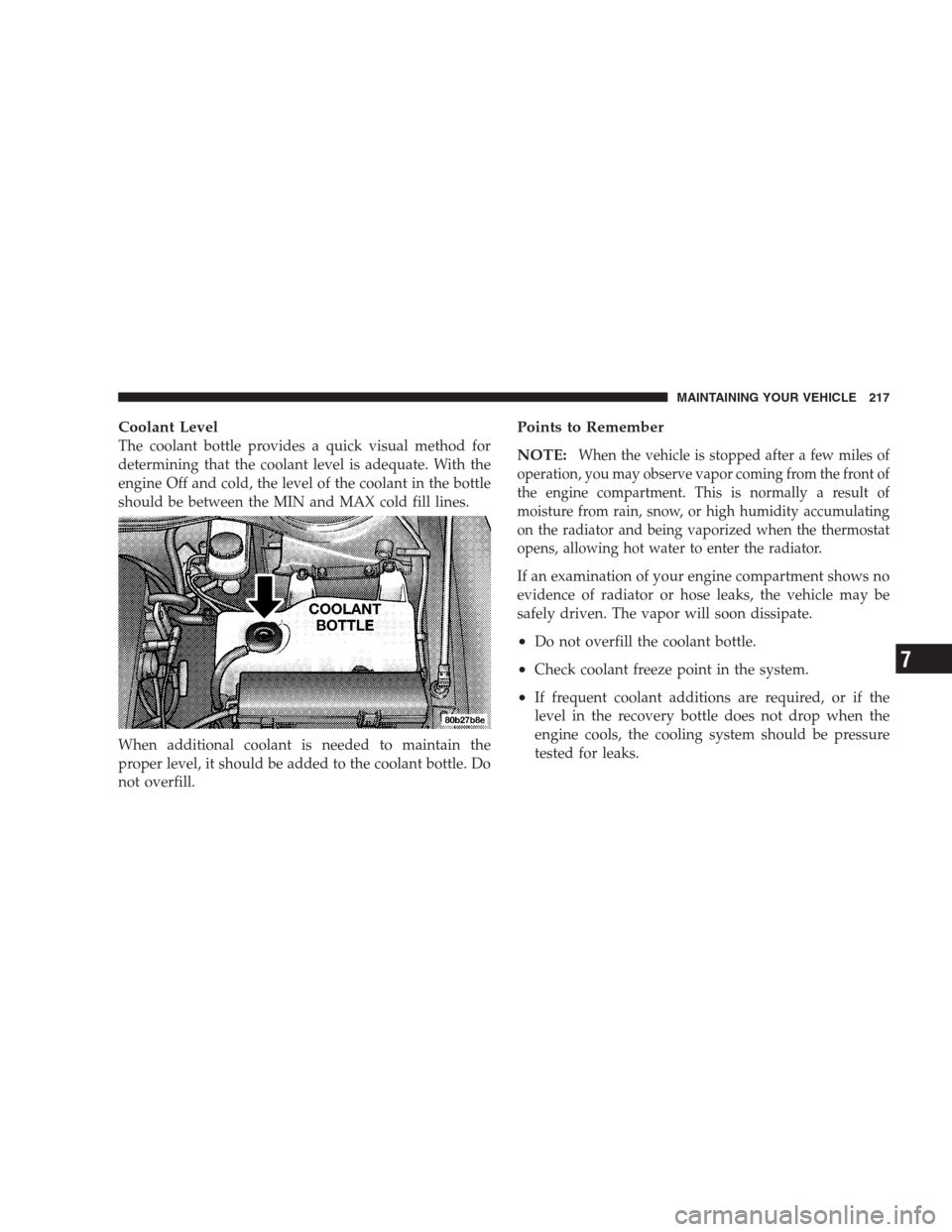
Coolant Level
The coolant bottle provides a quick visual method for
determining that the coolant level is adequate. With the
engine Off and cold, the level of the coolant in the bottle
should be between the MIN and MAX cold fill lines.
When additional coolant is needed to maintain the
proper level, it should be added to the coolant bottle. Do
not overfill.
Points to Remember
NOTE:
When the vehicle is stopped after a few miles of
operation, you may observe vapor coming from the front of
the engine compartment. This is normally a result of
moisture from rain, snow, or high humidity accumulating
on the radiator and being vaporized when the thermostat
opens, allowing hot water to enter the radiator.
If an examination of your engine compartment shows no
evidence of radiator or hose leaks, the vehicle may be
safely driven. The vapor will soon dissipate.
•Do not overfill the coolant bottle.
•Check coolant freeze point in the system.
•If frequent coolant additions are required, or if the
level in the recovery bottle does not drop when the
engine cools, the cooling system should be pressure
tested for leaks.
MAINTAINING YOUR VEHICLE 217
7
Page 218 of 277
•Maintain a coolant concentration of a minimum of 50%
ethylene glycol and high quality water with recom-
mended antifreeze for proper corrosion protection of
your engine cooling system that contains aluminum
components.
•Make sure that the radiator and coolant bottle hoses
are not kinked or obstructed.
•Keep the front of the radiator and air conditioning
condenser clean.
•Do not change the thermostat for summer or winter
operation. If replacement is ever necessary, install
ONLY the correct type thermostat. Other designs may
result in unsatisfactory engine cooling performance,
poor gas mileage, and increased emissions.
Hoses and Vacuum/Vapor Harnesses
Inspect surfaces of hoses and nylon tubing for evidence
of heat and mechanical damage. Hard or soft spots,
brittle rubber, cracking, checking, tears, cuts, abrasions,
and excessive swelling indicate deterioration of the rub-
ber.Pay particular attention to those hoses nearest to high
heat sources such as the exhaust manifold. Inspect hose
routing to be sure hoses do not touch any heat source or
moving component that may cause heat damage or
mechanical wear.
Insure nylon tubing in these areas has not melted or
collapsed. Inspect all hose connections such as clamps
and couplings to make sure they are secure and no leaks
are present. Components should be replaced immedi-
ately if there is any evidence of degradation that could
cause failure.
Brakes
In order to assure brake system performance, all brake
system components should be inspected periodically.
Suggested service intervals can be found in Section 8,
Maintenance Schedules.
218 MAINTAINING YOUR VEHICLE
Page 219 of 277
WARNING!
Riding the brakes can lead to brake failure and
possibly an accident. Driving with your foot resting
or riding on the brake pedal can result in abnormally
high brake temperatures, excessive lining wear, and
possible brake damage. You wouldn’t have your full
braking capacity in an emergency.
Brake and Power Steering System Hoses
When servicing the vehicle for scheduled maintenance,
inspect surface of hoses for evidence of heat and me-
chanical damage. Hard and brittle rubber, cracking,
checking, tears, cuts, abrasion, and excessive swelling
suggest deterioration of the rubber. Particular attention
should be made to examining those hose surfaces nearest
to high heat sources, such as the exhaust manifold.
Inspect all hose clamps and couplings to make sure they
are secure and no leaks are present.
NOTE:Often, fluids such as oil, power steering fluid,
and brake fluid are used during assembly plant opera-
tions to ease the assembly of hoses to couplings. There-
fore, oil wetness at the hose-coupling area is not neces-
sarily an indication of leakage. Actual dripping of hot
fluid when systems are under pressure (during vehicle
operation) should be noted before hose is replaced based
on leakage.
NOTE:Inspection of brake hoses should be done
whenever the brake system is serviced and every engine
oil change.
WARNING!
Worn brake hoses can burst and cause brake failure.
You could have an accident. If you see any signs of
cracking, scuffing, or worn spots, have the brake
hoses replaced immediately.
Brake Master CylinderThe fluid level in the master cylinder should be checked
when performing under hood services, or immediately if
the brake system warning lamp shows system failure.
MAINTAINING YOUR VEHICLE 219
7
Page 222 of 277
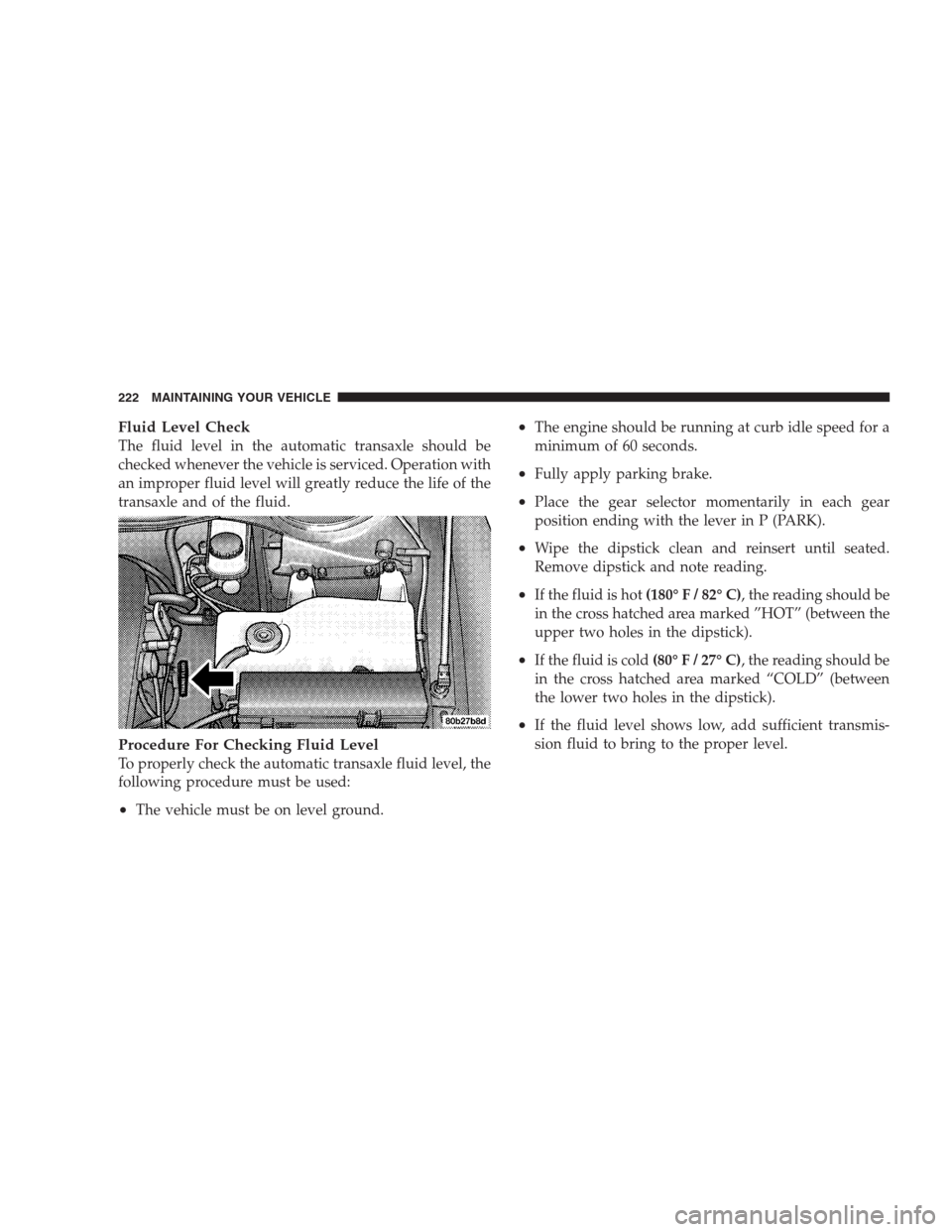
Fluid Level Check
The fluid level in the automatic transaxle should be
checked whenever the vehicle is serviced. Operation with
an improper fluid level will greatly reduce the life of the
transaxle and of the fluid.
Procedure For Checking Fluid Level
To properly check the automatic transaxle fluid level, the
following procedure must be used:
•The vehicle must be on level ground.
•The engine should be running at curb idle speed for a
minimum of 60 seconds.
•Fully apply parking brake.
•Place the gear selector momentarily in each gear
position ending with the lever in P (PARK).
•Wipe the dipstick clean and reinsert until seated.
Remove dipstick and note reading.
•If the fluid is hot(180° F / 82° C), the reading should be
in the cross hatched area marked ”HOT” (between the
upper two holes in the dipstick).
•If the fluid is cold(80° F / 27° C), the reading should be
in the cross hatched area marked “COLD” (between
the lower two holes in the dipstick).
•If the fluid level shows low, add sufficient transmis-
sion fluid to bring to the proper level.
222 MAINTAINING YOUR VEHICLE