run flat CHRYSLER 300 SRT 2010 1.G Owners Manual
[x] Cancel search | Manufacturer: CHRYSLER, Model Year: 2010, Model line: 300 SRT, Model: CHRYSLER 300 SRT 2010 1.GPages: 465, PDF Size: 9.19 MB
Page 43 of 465
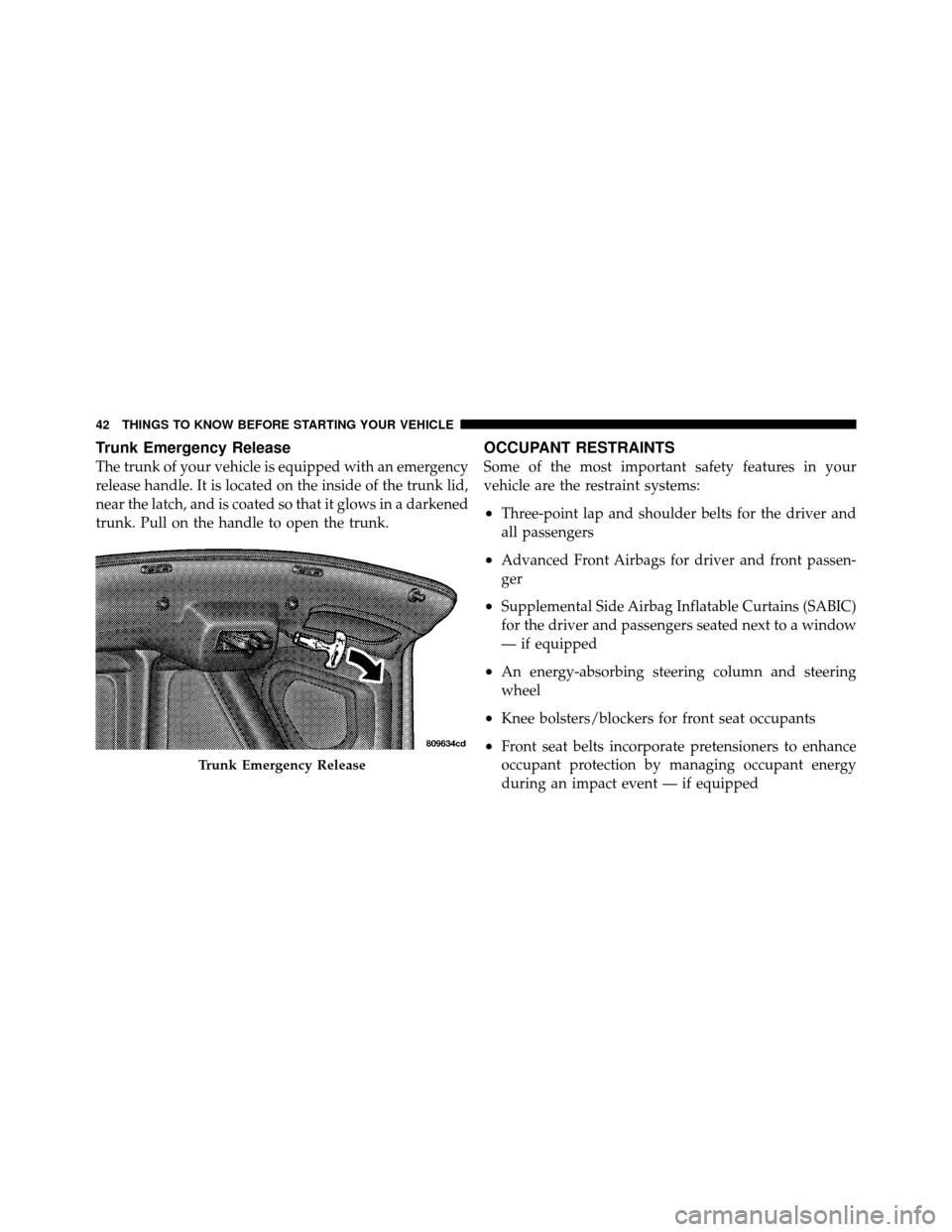
Trunk Emergency Release
The trunk of your vehicle is equipped with an emergency
release handle. It is located on the inside of the trunk lid,
near the latch, and is coated so that it glows in a darkened
trunk. Pull on the handle to open the trunk.
OCCUPANT RESTRAINTS
Some of the most important safety features in your
vehicle are the restraint systems:
•Three-point lap and shoulder belts for the driver and
all passengers
•Advanced Front Airbags for driver and front passen-
ger
•Supplemental Side Airbag Inflatable Curtains (SABIC)
for the driver and passengers seated next to a window
— if equipped
•An energy-absorbing steering column and steering
wheel
•Knee bolsters/blockers for front seat occupants
•Front seat belts incorporate pretensioners to enhance
occupant protection by managing occupant energy
during an impact event — if equipped
Trunk Emergency Release
42 THINGS TO KNOW BEFORE STARTING YOUR VEHICLE
Page 62 of 465
The side airbags will not deploy in all side collisions. Side
airbag deployment will depend on the severity and type
of collision.
Because airbag sensors measure vehicle deceleration over
time, vehicle speed and damage by themselves are not
good indicators of whether or not an airbag should have
deployed.
Seat belts are necessary for your protection in all colli-
sions, and also are needed to help keep you in position,
away from an inflating airbag.
The ORC monitors the readiness of the electronic parts of
the airbag system whenever the ignition switch is in the
START or RUN position. If the key is in the OFF position,
in the ACC position, or not in the ignition, the airbag
system is not on and the airbags will not inflate.The ORC contains a backup power supply system that
may deploy the airbags even if the battery loses power or
it becomes disconnected prior to deployment.
Also, the ORC turns on the Airbag Warning
Light in the instrument panel for approxi-
mately six to eight seconds for a self-check
when the ignition is first turned on. After the
self-check, the Airbag Warning Light will turn off. If the
ORC detects a malfunction in any part of the system, it
turns on the Airbag Warning Light, either momentarily
or continuously. A single chime will sound if the light
comes on again after initial startup.
It also includes diagnostics that will illuminate the instru-
ment cluster Airbag Warning Light if a malfunction is
noted that could affect the airbag system. The diagnostics
also record the nature of the malfunction.
2
THINGS TO KNOW BEFORE STARTING YOUR VEHICLE 61
Page 67 of 465
WARNING! (Continued)
•Do not attempt to modify any part of your ad-
vanced airbag system. The airbag may inflate
accidentally or may not function properly if modi-
fications are made. Take your vehicle to an autho-
rized dealer for any advanced airbag system ser-
vice. If your seat, including your trim cover and
cushion, needs to be serviced in any way (includ-
ing removal or loosening/tightening of seat attach-
ment bolts), take the vehicle to your authorized
dealer. Only manufacturer approved seat accesso-
ries may be used. If it is necessary to modify the
airbag system for persons with disabilities, contact
your authorized dealer.
Airbag Warning Light
You will want to have the airbags ready to
inflate for your protection in a collision. While
the airbag system is designed to be mainte-
nance free, if any of the following occurs, have
an authorized dealer service the system immediately.
•The Airbag Warning Light does not come on for
approximately six to eight seconds when the ignition
switch is first placed into the RUN position.
•The Airbag Warning Light remains on after the ap-
proximate six to eight-second interval.
•The Airbag Warning Light comes on intermittently or
remains on while driving.
66 THINGS TO KNOW BEFORE STARTING YOUR VEHICLE
Page 197 of 465
turn off. If the light remains lit with the engine running,
your vehicle will usually be drivable. However, see an
authorized dealer for service as soon as possible.
If the light is flashing when the engine is running,
immediate service is required. In this case, you may
experience reduced performance, an elevated/rough idle
or engine stall, and your vehicle may require towing.
Also, have the system checked by an authorized dealer if
the light does not come on during starting.
22. Tire Pressure Monitoring Telltale LightEach tire, including the spare (if provided),
should be checked monthly, when cold and
inflated to the inflation pressure recommended
by the vehicle manufacturer on the vehicle
placard or tire inflation pressure label. (If your vehicle
has tires of a different size than the size indicated on the
vehicle placard or tire inflation pressure label, you should
determine the proper tire inflation pressure for those
tires.) As an added safety feature, your vehicle has been
equipped with a Tire Pressure Monitoring System
(TPMS) that illuminates a low tire pressure telltale when
one or more of your tires is significantly under-inflated.
Accordingly, when the low tire pressure telltale illumi-
nates, you should stop and check your tires as soon as
possible, and inflate them to the proper pressure. Driving
on a significantly under-inflated tire causes the tire to
overheat and can lead to tire failure. Under-inflation also
reduces fuel efficiency and tire tread life, and may affect
the vehicle’s handling and stopping ability.
Please note that the TPMS is not a substitute for proper
tire maintenance, and it is the driver ’s responsibility to
maintain correct tire pressure, even if under-inflation has
not reached the level to trigger illumination of the TPMS
low tire pressure telltale.
196 UNDERSTANDING YOUR INSTRUMENT PANEL
Page 287 of 465
When parking on a flat surface, place the shift lever in the
PARK position first, and then apply the parking brake.
When parking on a hill, it is important to set the parking
brake before placing the shift lever in PARK, otherwise
the load on the transmission locking mechanism may
make it difficult to move the shift lever out of PARK. As
an added precaution, turn the front wheels toward the
curb on a downhill grade and away from the curb on an
uphill grade.
WARNING!
Never use the PARK position as a substitute for the
parking brake. Always apply parking brake fully
when parked to guard against vehicle movement and
possible injury or damage.
The following indicators should be used to ensure that
you have engaged the shift lever in the PARK position:
•When shifting into PARK, move the shift lever all the
way forward and left until it stops and is fully seated.
•Look at the shift indicator display on the instrument
panel to ensure it is in the PARK position.
CAUTION!
Damage to the shift lever could result if the shift
lever is moved out of PARK before the ignition
switch is turned from the LOCK (OFF position with
Keyless Go™) to the ON position (RUN position
with Keyless Go™).
REVERSE
This range is for moving the vehicle backward. Use only
after the vehicle has come to a complete stop.
286 STARTING AND OPERATING
Page 292 of 465
Traction
When driving on wet or slushy roads, it is possible for a
wedge of water to build up between the tire and road
surface. This is known as hydroplaning and may cause
partial or complete loss of vehicle control and stopping
ability. To reduce this possibility, the following precau-
tions should be observed:
1. Slow down during rainstorms or when the roads are
slushy.
2. Slow down if the road has standing water or puddles.
3. Replace tires when tread wear indicators first become
visible.
4. Keep tires properly inflated.
5. Maintain sufficient distance between your vehicle and
the vehicle in front of you to avoid a collision in a sudden
stop.
DRIVING THROUGH WATER
Driving through water more than a few inches/
centimeters deep will require extra caution to ensure
safety and prevent damage to your vehicle.
Flowing/Rising Water
WARNING!
Do not drive on or across a road or path where water
is flowing and/or rising (as in storm run-off). Flow-
ing water can wear away the road or path’s surface
and cause your vehicle to sink into deeper water.
Furthermore, flowing and/or rising water can carry
your vehicle away swiftly. Failure to follow this
warning may result in injuries that are serious or
fatal to you, your passengers, and others around you.
5
STARTING AND OPERATING 291
Page 313 of 465
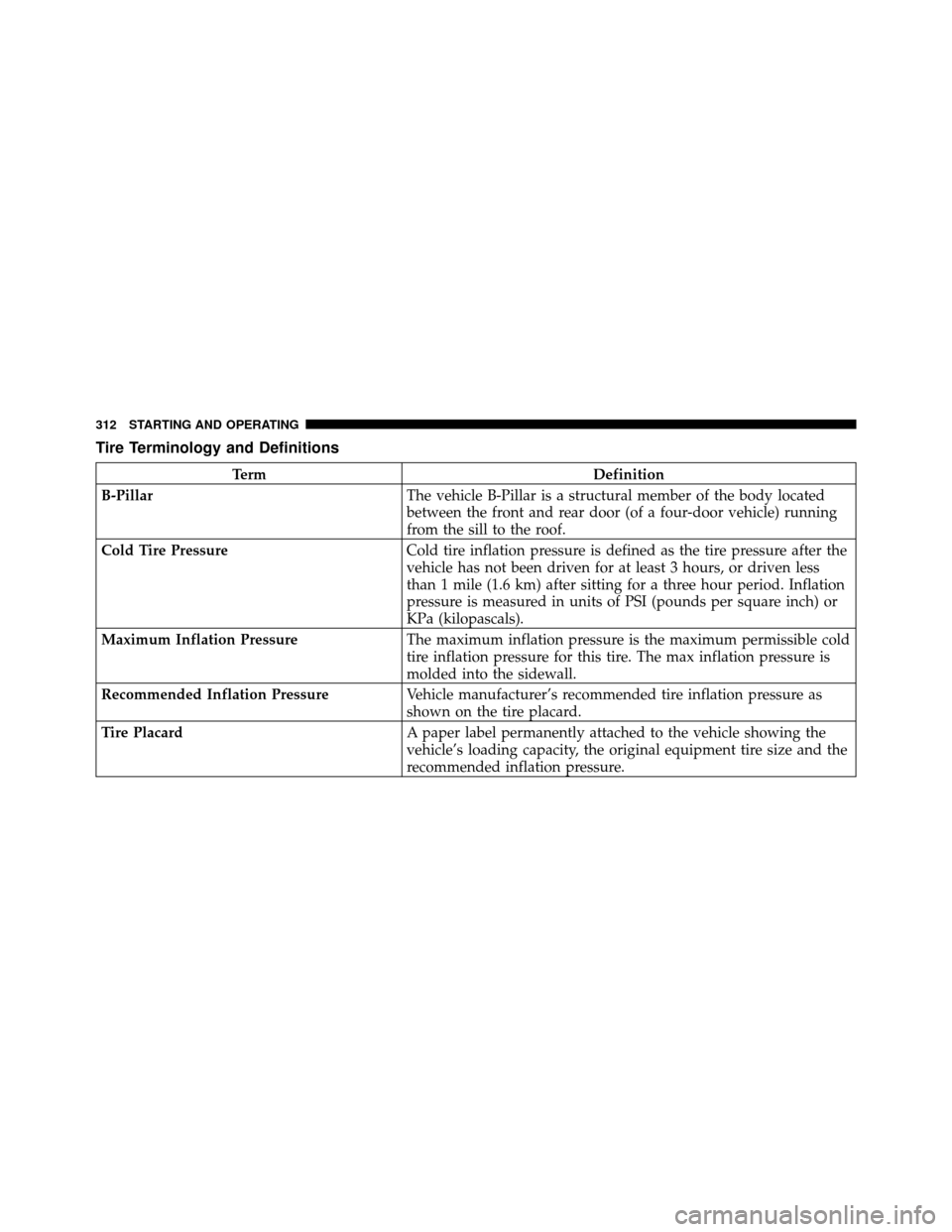
Tire Terminology and Definitions
TermDefinition
B-Pillar The vehicle B-Pillar is a structural member of the body located
between the front and rear door (of a four-door vehicle) running
from the sill to the roof.
Cold Tire Pressure Cold tire inflation pressure is defined as the tire pressure after the
vehicle has not been driven for at least 3 hours, or driven less
than 1 mile (1.6 km) after sitting for a three hour period. Inflation
pressure is measured in units of PSI (pounds per square inch) or
KPa (kilopascals).
Maximum Inflation Pressure The maximum inflation pressure is the maximum permissible cold
tire inflation pressure for this tire. The max inflation pressure is
molded into the sidewall.
Recommended Inflation Pressure Vehicle manufacturer’s recommended tire inflation pressure as
shown on the tire placard.
Tire Placard A paper label permanently attached to the vehicle showing the
vehicle’s loading capacity, the original equipment tire size and the
recommended inflation pressure.
312 STARTING AND OPERATING
Page 347 of 465
This kit will provide a temporary tire seal, allowing you
to drive your vehicle up to 100 miles (160 km) with a
maximum speed of 55 mph (88 km/hr).
TIREFIT Storage
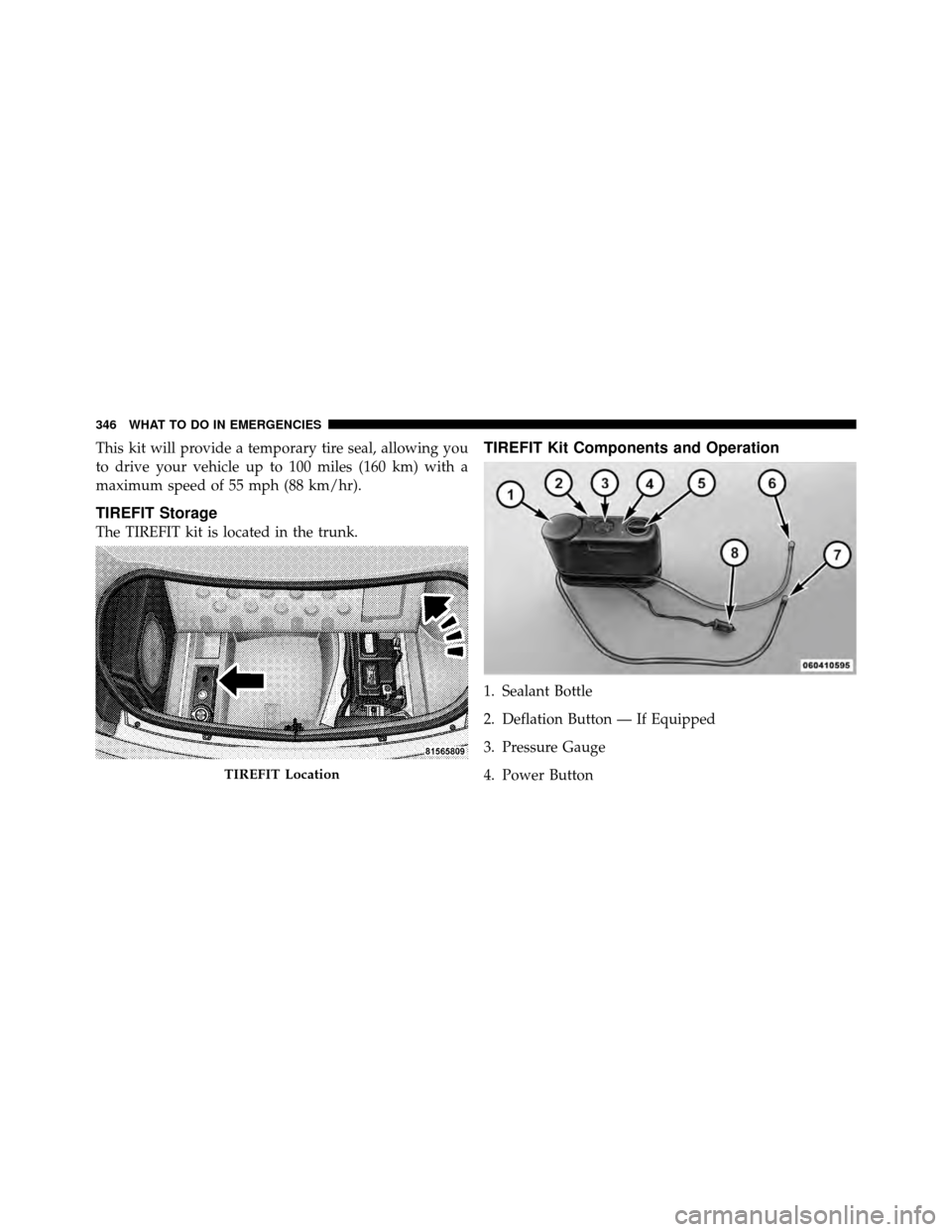
The TIREFIT kit is located in the trunk.
TIREFIT Kit Components and Operation
1. Sealant Bottle
2. Deflation Button — If Equipped
3. Pressure Gauge
4. Power Button
TIREFIT Location
346 WHAT TO DO IN EMERGENCIES
Page 351 of 465
WARNING! (Continued)
•TIREFIT Sealant solution contains latex. In case of
allergic reaction or rash, consult a physician im-
mediately. Keep TIREFIT out of reach of children.
If swallowed, rinse mouth immediately with
plenty of water and drink plenty of water. Do not
induce vomiting! Consult a physician immedi-
ately.
•Use the gloves provided in the Accessory Storage
Compartment (located on the bottom of the air
pump) when operating the TIREFIT kit.
Sealing a Tire with TIREFIT
(A) Whenever You Stop to Use TIREFIT:
1. Pull over to a safe location and turn ON the vehicle’s
Hazard Warning flashers.2. Verify that the valve stem (on the wheel with the
deflated tire) is in a position that is near to the ground.
This will allow the TIREFIT Hoses (6) and (7) to reach the
valve stem and keep the TIREFIT kit flat on the ground.
This will provide the best positioning of the kit when
injecting the sealant into the deflated tire and running the
air pump. Move the vehicle as necessary to place the
valve stem in this position before proceeding.
3. Place the transmission in PARK (auto transmission) or
in Gear (manual transmission) and turn OFF the ignition.
4. Set the parking brake.
(B) Setting Up to Use TIREFIT:
1. Remove the gloves from the Accessory Storage Com-
partment (located on the bottom of the air pump) and
place them on your hands.
2. Turn the Mode Select Knob (5) to the Sealant Mode
position.
350 WHAT TO DO IN EMERGENCIES
Page 353 of 465
2. Connect the Power Plug (8) to a different 12 Volt
power outlet in your vehicle or another vehicle, if avail-
able. Make sure the engine is running before turning ON
the TIREFIT kit.
3. The Sealant Bottle (1) may be empty due to previous
use. Call for assistance.
NOTE:If the Mode Select Knob (5) is on air mode and
pump is operating, air will dispense from the Air Pump
Hose (7) only, not the Sealant Hose (6).
If the sealant (white fluid) does flow through the
Sealant Hose (6):
1. Continue to operate pump until sealant is no longer
flowing through hose (typically takes 30 - 70 seconds). As
the sealant flows through the Sealant Hose (6), the
Pressure Gauge (3) can read as high as 70 psi (5 Bar). The
Pressure Gauge (3) will decrease quickly from approxi-
mately 70 psi (5 Bar) to the actual tire pressure when the
Sealant Bottle (1) is empty. 2. The pump will start to inject air into the tire immedi-
ately after the Sealant Bottle (1) is empty. Continue to
operate pump and inflate the tire to the pressure indi-
cated on the tire pressure label on the driver-side latch
pillar (recommended pressure). Check the tire pressure
by looking at the Pressure Gauge (3).
If the tire does not inflate to at least 26 psi (1.8 Bar)
pressure within 15 minutes:
•The tire is too badly damaged. Do not attempt to drive
the vehicle further. Call for assistance.
NOTE: If the air pump is equipped with a Deflation
Button and the tire becomes over-inflated, press the
Deflation Button to reduce the tire pressure to the
recommended inflation pressure before continuing.
If the tire inflates to the recommended pressure or is at
least 26 psi (1.8 Bar) pressure within 15 minutes:
1. Press the Power Button (4) to turn off the TIREFIT kit.
352 WHAT TO DO IN EMERGENCIES