steering CHRYSLER 300 SRT 2014 2.G Repair Manual
[x] Cancel search | Manufacturer: CHRYSLER, Model Year: 2014, Model line: 300 SRT, Model: CHRYSLER 300 SRT 2014 2.GPages: 590, PDF Size: 4.08 MB
Page 477 of 590
6. Once the engine is started, remove the jumper cablesin the reverse sequence:
Disconnecting The Jumper Cables
1. Disconnect the negative (-)jumper cable from the
remote negative (-)post of the vehicle with the dis-
charged battery.
2. Disconnect the negative end (-)of the jumper cable
from the negative (-)post of the booster battery.
3. Disconnect the positive (+)jumper cable from the
positive (+)post of the booster battery.
4. Disconnect the positive (+)end of the jumper cable
from the remote positive (+)post of the discharged
vehicle.
If frequent jump-starting is required to start your vehicle
you should have the battery and charging system in-
spected at your authorized dealer.CAUTION!
Accessories plugged into the vehicle power outlets
draw power from the vehicle’s battery, even when not
in use (i.e., cellular phones, etc.). Eventually, if
plugged in long enough without engine operation,
the vehicle’s battery will discharge sufficiently to
degrade battery life and/or prevent the engine from
starting.
FREEING A STUCK VEHICLE
If your vehicle becomes stuck in mud, sand, or snow, it
can often be moved using a rocking motion. Turn the
steering wheel right and left to clear the area around the
front wheels. Then shift back and forth between DRIVE
and REVERSE while gently pressing the accelerator. Use
the least amount of accelerator pedal pressure that will
maintain the rocking motion, without spinning the
wheels or racing the engine.6
WHAT TO DO IN EMERGENCIES 475
Page 481 of 590
CAUTION!
•Do not use sling type equipment when towing.
Damage to the fascia will occur.
• When securing the vehicle to a flatbed truck, do not
attach to the front or rear suspension components.
Damage to your vehicle may result from improper
towing.
• Do not push or tow this vehicle with another
vehicle as damage to the bumper fascia and trans-
mission may result.
• The ignition switch must be in the ON/RUN posi-
tion, not in the OFF or ACC position.
• If the vehicle being towed requires steering, the
ignition switch must be in the ON/RUN position,
not in the OFF or ACC position.
•
The manufacturer does not recommend towing this
vehicle using a tow dolly. Vehicle damage may occur.
The manufacturer recommends towing your vehicle with
all four wheels OFF the ground using a flatbed.
If flatbed equipment is not available, and the transmis-
sion is operable, this vehicle may be towed (with rear
wheels on the ground) under the following conditions:
• The transmission must be in NEUTRAL.
• The towing speed must not exceed 30 mph (48 km/h).
• The towing distance must not exceed 15 miles (24 km).
6
WHAT TO DO IN EMERGENCIES 479
Page 485 of 590
ENGINE COMPARTMENT — 6.4L
1 — Remote Jump Start (Positive Battery Post)6 — Air Cleaner Filter
2 — Engine Oil Dipstick 7 — Power Steering Fluid Reservoir
3 — Engine Oil Fill 8 — Power Distribution Center (Fuses)
4 — Brake Fluid Reservoir 9 — Washer Fluid Reservoir
5 — Engine Coolant Reservoir
7
MAINTAINING YOUR VEHICLE 483
Page 489 of 590
MAINTENANCE PROCEDURES
The pages that follow contain therequiredmaintenance
services determined by the engineers who designed your
vehicle.
Besides those maintenance items specified in the fixed
“Maintenance Schedule”, there are other components
which may require servicing or replacement in the future.
CAUTION!
• Failure to properly maintain your vehicle or per-
form repairs and service when necessary could
result in more costly repairs, damage to other
components or negatively impact vehicle perfor-
mance. Immediately have potential malfunctions
examined by an authorized dealer or qualified
repair center.
(Continued)
CAUTION! (Continued)
•Your vehicle has been built with improved fluids
that protect the performance and durability of your
vehicle and also allow extended maintenance inter-
vals. Do not use chemical flushes in these compo-
nents as the chemicals can damage your engine,
transmission, power steering or air conditioning.
Such damage is not covered by the New Vehicle
Limited Warranty. If a flush is needed because of
component malfunction, use only the specified
fluid for the flushing procedure.
Engine Oil
Checking Oil Level
To assure proper engine lubrication, the engine oil must
be maintained at the correct level. Check the oil level at
7
MAINTAINING YOUR VEHICLE 487
Page 519 of 590
FUSES
WARNING!
•When replacing a blown fuse, always use an appro-
priate replacement fuse with the same amp rating as
the original fuse. Never replace a fuse with another
fuse of higher amp rating. Never replace a blown
fuse with metal wires or any other material. Failure
to use proper fuses may result in serious personal
injury, fire and/or property damage.
• Before replacing a fuse, make sure that the ignition
is off and that all the other services are switched off
and/or disengaged.
• If the replaced fuse blows again, contact an autho-
rized dealer.
(Continued)
WARNING! (Continued)
•If a general protection fuse for safety systems (air
bag system, braking system), power unit systems
(engine system, gearbox system) or steering system
blows, contact an authorized dealer.
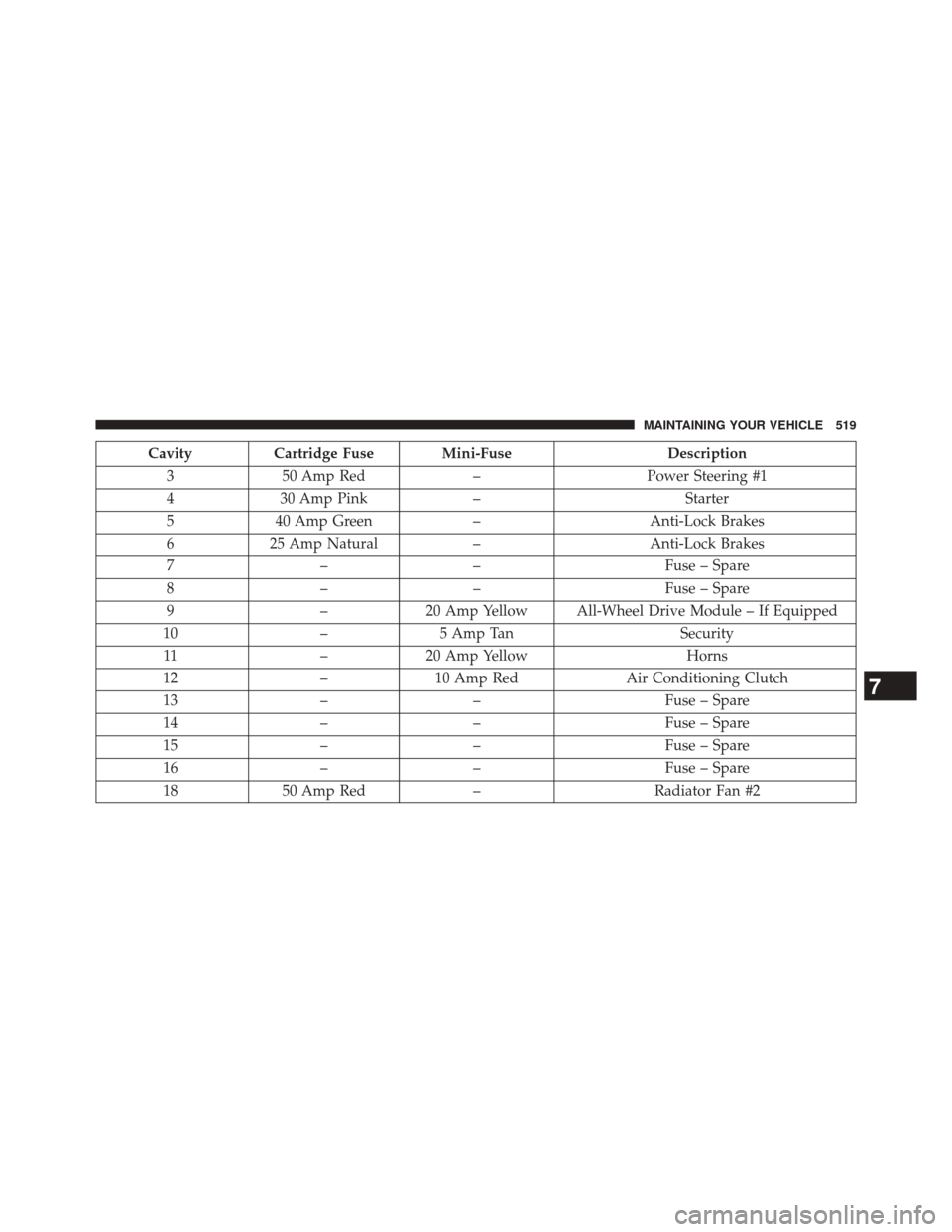
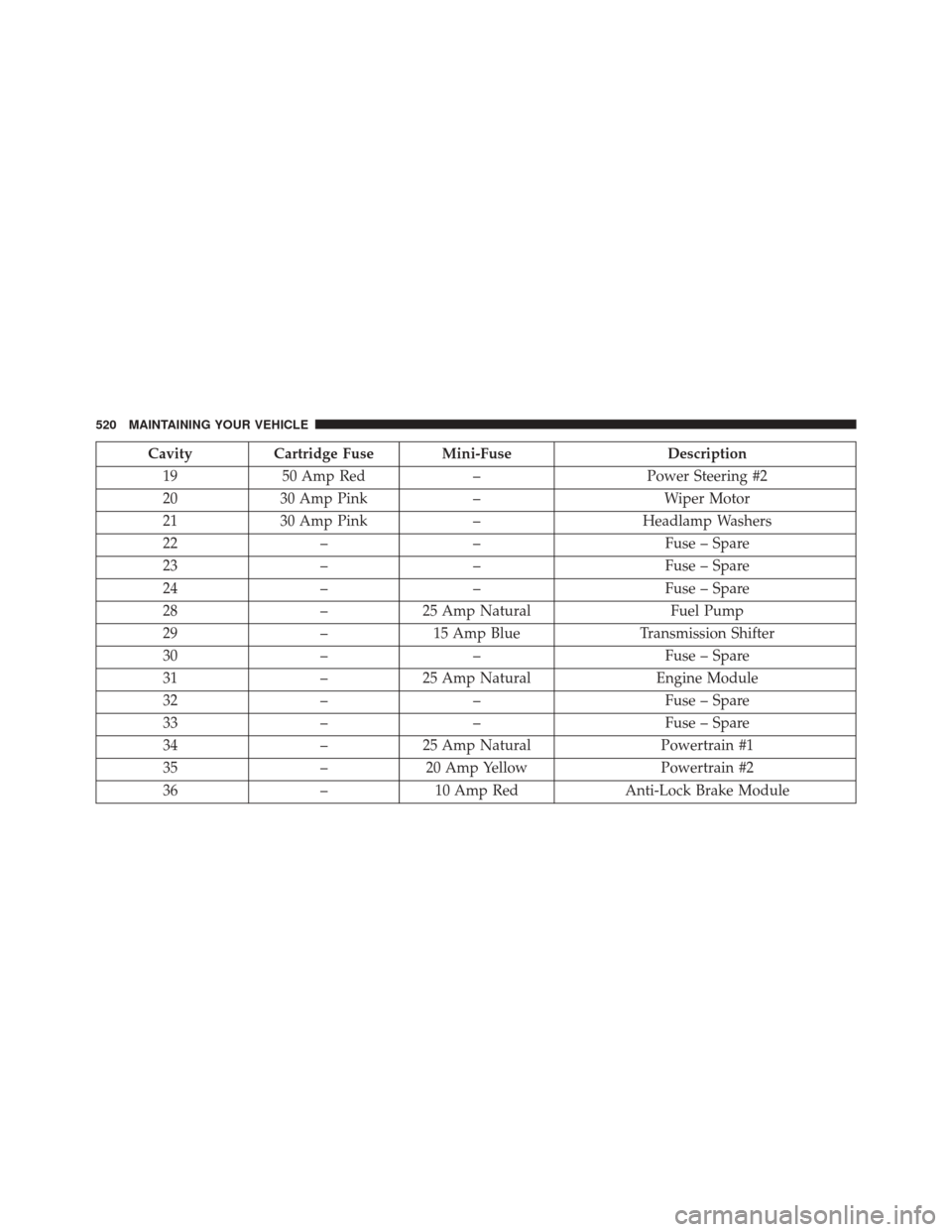
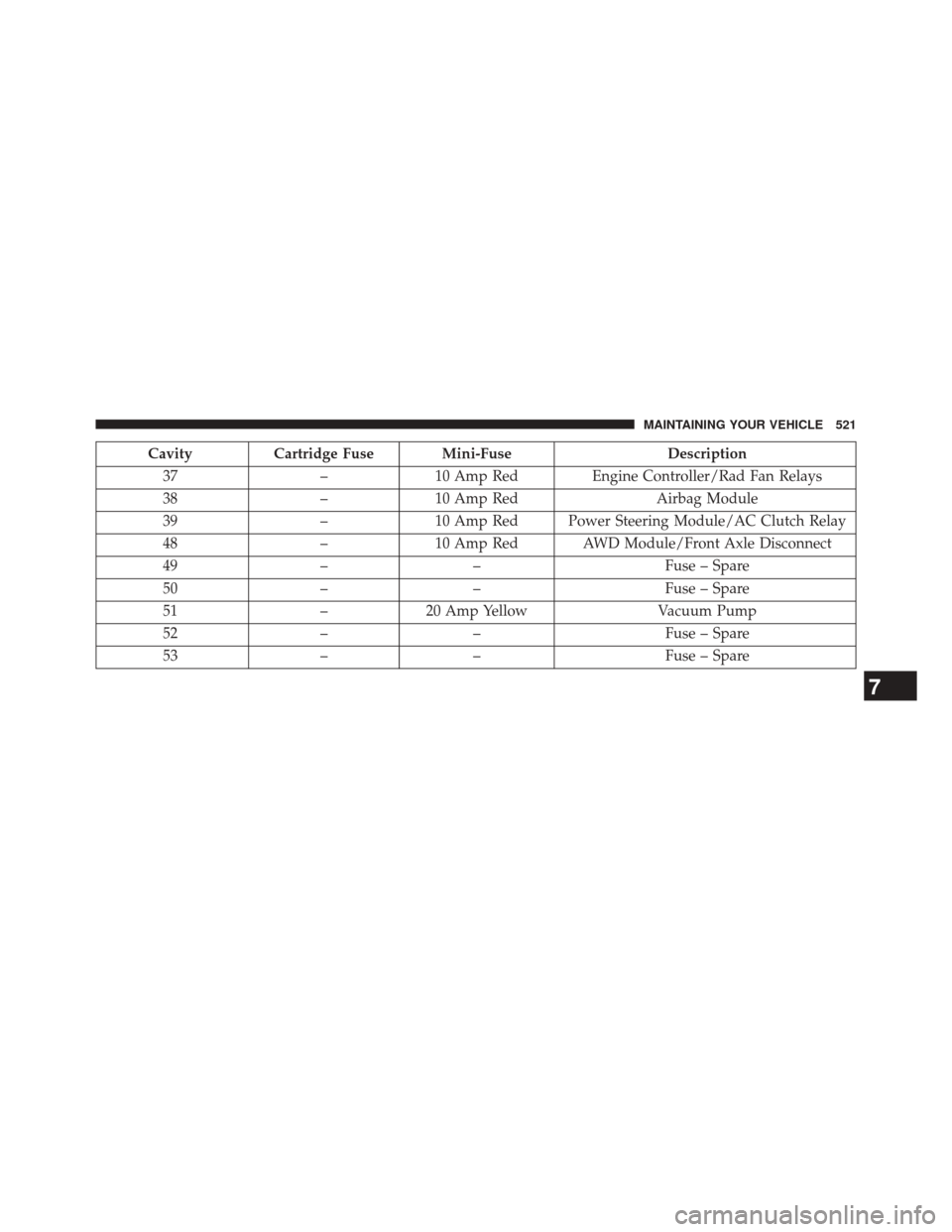
Front Power Distribution Center (Fuses)
The Front Power Distribution Center is located in the
engine compartment. This module contains fuses and
relays.
7
MAINTAINING YOUR VEHICLE 517
Page 521 of 590
CavityCartridge Fuse Mini-Fuse Description
3 50 Amp Red –Power Steering #1
4 30 Amp Pink – Starter
5 40 Amp Green –Anti-Lock Brakes
6 25 Amp Natural –Anti-Lock Brakes
7 –– Fuse – Spare
8 –– Fuse – Spare
9 –20 Amp Yellow All-Wheel Drive Module – If Equipped
10 –5 Amp Tan Security
11 –20 Amp Yellow Horns
12 –10 Amp Red Air Conditioning Clutch
13 –– Fuse – Spare
14 –– Fuse – Spare
15 –– Fuse – Spare
16 –– Fuse – Spare
18 50 Amp Red –Radiator Fan #2
7
MAINTAINING YOUR VEHICLE 519
Page 522 of 590
CavityCartridge Fuse Mini-Fuse Description
19 50 Amp Red –Power Steering #2
20 30 Amp Pink –Wiper Motor
21 30 Amp Pink –Headlamp Washers
22 –– Fuse – Spare
23 –– Fuse – Spare
24 –– Fuse – Spare
28 –25 Amp Natural Fuel Pump
29 –15 Amp Blue Transmission Shifter
30 –– Fuse – Spare
31 –25 Amp Natural Engine Module
32 –– Fuse – Spare
33 –– Fuse – Spare
34 –25 Amp Natural Powertrain #1
35 –20 Amp Yellow Powertrain #2
36 –10 Amp Red Anti-Lock Brake Module
520 MAINTAINING YOUR VEHICLE
Page 523 of 590
CavityCartridge Fuse Mini-Fuse Description
37 –10 Amp Red Engine Controller/Rad Fan Relays
38 –10 Amp Red Airbag Module
39 –10 Amp Red Power Steering Module/AC Clutch Relay
48 –10 Amp Red AWD Module/Front Axle Disconnect
49 –– Fuse – Spare
50 –– Fuse – Spare
51 –20 Amp Yellow Vacuum Pump
52 –– Fuse – Spare
53 –– Fuse – Spare
7
MAINTAINING YOUR VEHICLE 521
Page 527 of 590
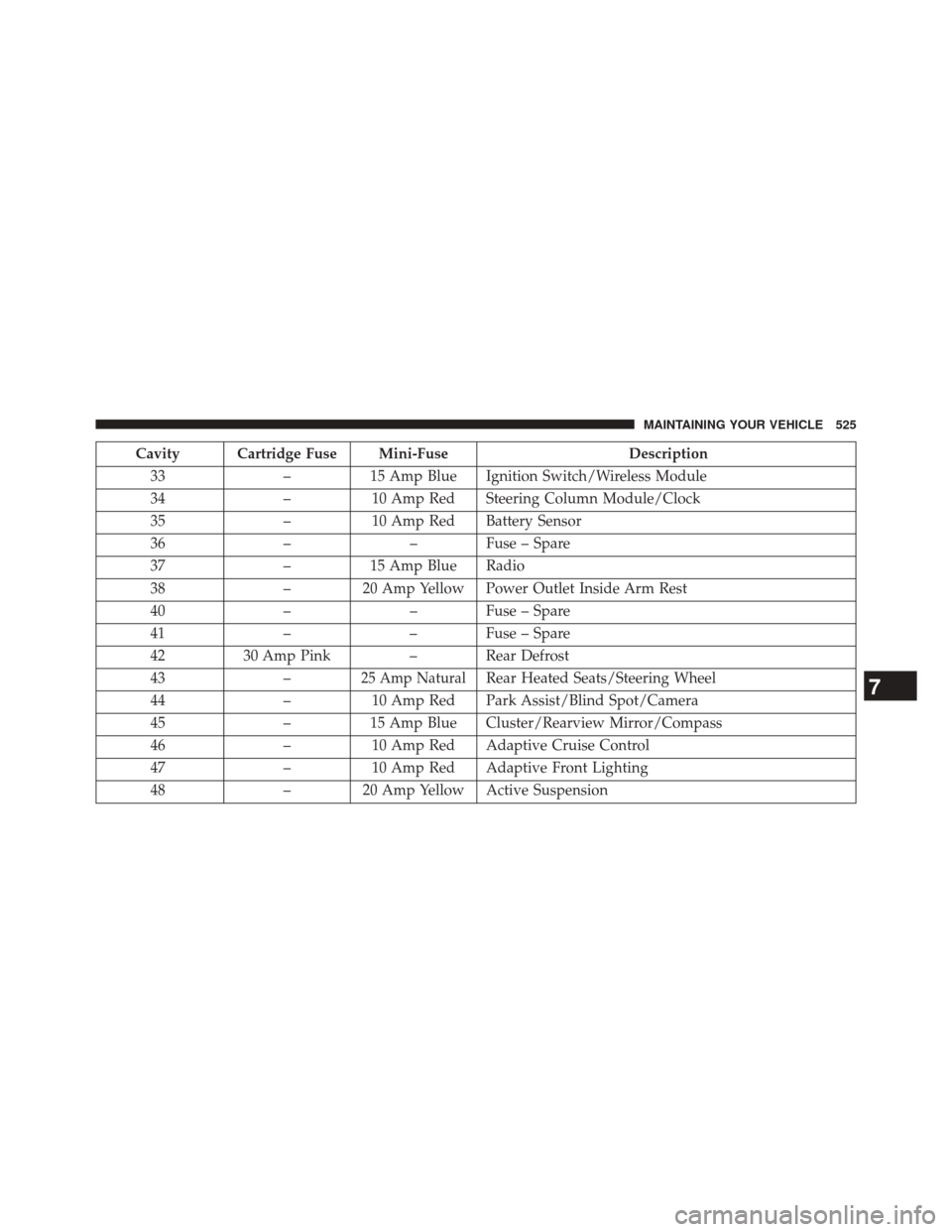
Cavity Cartridge Fuse Mini-FuseDescription
33 –15 Amp Blue Ignition Switch/Wireless Module
34 –10 Amp Red Steering Column Module/Clock
35 –10 Amp Red Battery Sensor
36 –– Fuse – Spare
37 –15 Amp Blue Radio
38 – 20 Amp Yellow Power Outlet Inside Arm Rest
40 –– Fuse – Spare
41 –– Fuse – Spare
42 30 Amp Pink – Rear Defrost
43 –
25 Amp NaturalRear Heated Seats/Steering Wheel
44 –10 Amp Red Park Assist/Blind Spot/Camera
45 –15 Amp Blue Cluster/Rearview Mirror/Compass
46 –10 Amp Red Adaptive Cruise Control
47 –10 Amp Red Adaptive Front Lighting
48 – 20 Amp Yellow Active Suspension7
MAINTAINING YOUR VEHICLE 525
Page 538 of 590
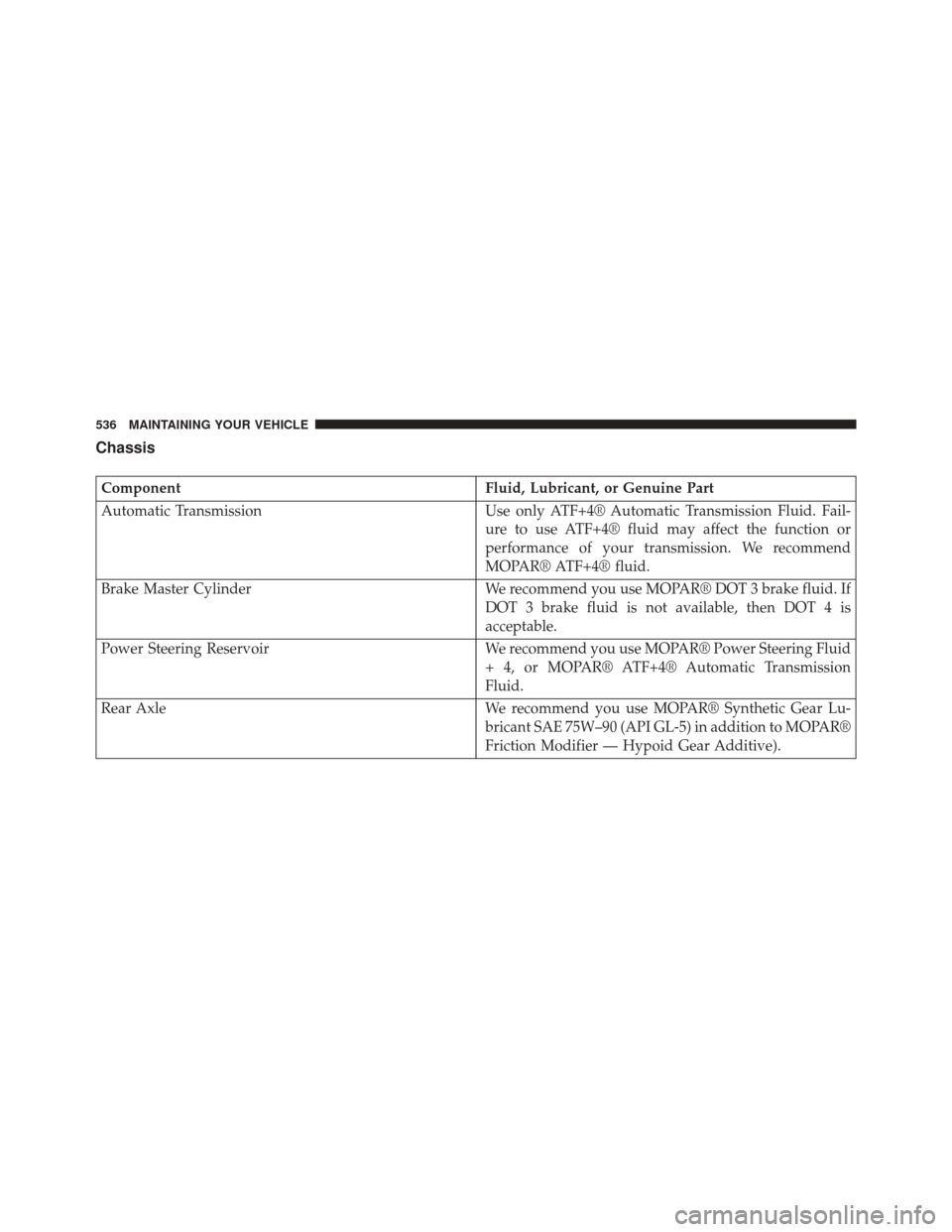
Chassis
ComponentFluid, Lubricant, or Genuine Part
Automatic Transmission Use only ATF+4® Automatic Transmission Fluid. Fail-
ure to use ATF+4® fluid may affect the function or
performance of your transmission. We recommend
MOPAR® ATF+4® fluid.
Brake Master Cylinder We recommend you use MOPAR® DOT 3 brake fluid. If
DOT 3 brake fluid is not available, then DOT 4 is
acceptable.
Power Steering Reservoir We recommend you use MOPAR® Power Steering Fluid
+ 4, or MOPAR® ATF+4® Automatic Transmission
Fluid.
Rear Axle We recommend you use MOPAR® Synthetic Gear Lu-
bricant SAE 75W–90 (API GL-5) in addition to MOPAR®
Friction Modifier — Hypoid Gear Additive).
536 MAINTAINING YOUR VEHICLE