lock CHRYSLER ASPEN 2008 2.G Owners Manual
[x] Cancel search | Manufacturer: CHRYSLER, Model Year: 2008, Model line: ASPEN, Model: CHRYSLER ASPEN 2008 2.GPages: 479, PDF Size: 4.3 MB
Page 291 of 479
WARNING!
²Always fully apply the parking brake when leav-
ing your vehicle, or the vehicle may roll and cause
damage or injury. Also be certain to leave an
automatic transmission in Park. Failure to do so
may cause the vehicle to roll and cause damage or
injury.
²Be sure the parking brake is fully disengaged
before driving, failure to do so can lead to brake
failure and an accident.
²Never leave children alone in a vehicle. Leaving
unattended children in a vehicle is dangerous for a
number of reasons. A child or others could be
seriously or fatally injured. Don't leave the keys in
the ignition. A child could operate power win-
dows, other controls, or move the vehicle.
BRAKE SYSTEM
In the event power assist is lost for any reason, (for
example, repeated brake applications with the engine
off), the brakes will still function. The effort required to
brake the vehicle will be significantly increased over that
required with the power system operating.
If either the front or rear hydraulic systems lose normal
capability, the remaining system will still function with
some loss of braking effectiveness. This will be evident by
increased pedal travel during application, greater pedal
force required to slow or stop, and activation of the Brake
Warning Light and the ABS Light during brake use.
Four-Wheel Anti-Lock Brake System (ABS)
The Anti-Lock Brake System (ABS) is designed to aid the
driver in maintaining vehicle control under adverse
braking conditions. The system operates with a separate
computer to modulate hydraulic pressure to prevent
wheel lock-up and help avoid skidding on slippery
290 STARTING AND OPERATING
Page 292 of 479
surfaces. All vehicle wheels and tires must be the same
size and type and tires must be properly inflated to
produce accurate signals for the computer.
WARNING!
Significant over-or-under-inflation of tires, or mixing
sizes of tires or wheels on the vehicle can lead to loss
of braking effectiveness.
The ABS conducts a low-speed self-test at about 12 mph
(20 km/h). If you have your foot lightly on the brake
while this test is occurring you may feel slight pedal
movement. The movement can be more apparent on ice
and snow. This is normal. The ABS pump motor runs
during the self-test at 12 mph (20 km/h) and during an
ABS stop. The pump motor makes a low humming noise
during operation, which is normal.At the instant one of the wheels is about to lock up, a
slight pulsation can be felt in the brake pedal, indicating
that the ABS is in the regulating mode. Keep firm and
steady pressure on the brake pedal while experiencing
the pulsation. Continuous, steady brake pedal pressure
results in optimal braking power while maintaining the
ability to steer the vehicle. In the case of an emergency
brake maneuver, keep continuous full pressure on the
brake pedal. In this manner only can the ABS be most
effective. On slippery road surfaces, the ABS will respond
even with light brake pedal pressure because of the
increased likelihood of locking wheels. The pulsating
brake pedal can be an indication of hazardous road
conditions and functions as a reminder to take extra care
while driving.
STARTING AND OPERATING 291
5
Page 293 of 479
WARNING!
ABS contains sophisticated electronic equipment. It
may be susceptible to interference caused by improp-
erly installed or high output radio transmitting
equipment. This interference can cause possible loss
of anti-lock braking capability. Installation of such
equipment should be done by qualified
professionals.
WARNING!
Pumping of the Anti-lock brakes will diminish their
effectiveness and may lead to an accident. Pumping
makes the stopping distance longer. Just press firmly
on your brake pedal when you need to slow down or
stop.
WARNING!
²ABS cannot prevent the natural laws of physics
from acting on the vehicle, nor can it increase
braking or steering efficiency beyond that af-
forded by the condition of the vehicle brakes and
tires or the traction afforded.
²The ABS cannot prevent accidents, including
those resulting from excessive speed in turns,
following another vehicle too closely, or hydro-
planing. Only a safe, attentive, and skillful driver
can prevent accidents.
²The capabilities of an ABS equipped vehicle must
never be exploited in a reckless or dangerous
manner which could jeopardize the user's safety
or the safety of others.
292 STARTING AND OPERATING
Page 295 of 479
CAUTION!
Prolonged operation of the steering system at the end
of the steering wheel travel will increase the steering
fluid temperature and should be avoided when pos-
sible. Damage to the power steering pump may occur.
ELECTRONIC BRAKE CONTROL SYSTEM
Your vehicle is equipped with an advanced electronic
brake control system that includes Anti-Lock Brake Sys-
tem (ABS), Brake Assist System (BAS), Traction Control
System (TCS), Electronic Roll Mitigation (ERM), Elec-
tronic Stability Program (ESP) and Trailer Sway Control
(TSC). All six systems work together to enhance vehicle
stability and control in various driving conditions, and
are commonly referred to as ESP.
Anti-Lock Brake System (ABS)
This system aids the driver in maintaining vehicle control
under adverse braking conditions. The system controls
hydraulic brake pressure to prevent wheel lockup and
help avoid skidding on slippery surfaces during braking.
Refer to ªAnti-Lock Brake Systemº in Section 5 of this
manual for more information about ABS.
NOTE:ABS improves steering control of the vehicle
during hard braking maneuvers.
294 STARTING AND OPERATING
Page 301 of 479
4WD/4WD LOCK or 2WD Models
ON
This is the normal operating mode for ESP in 4WD LOCK
and in 2WD vehicles. Whenever the vehicle is started or
the transfer case (if equipped) is shifted from 4WD LOW
or NEUTRAL back to 4WD LOCK, the ESP system will be
in this mode. This mode should be used for almost all
driving situations. ESP should only be turned to ªPartial
Offº for specific reasons as noted below.
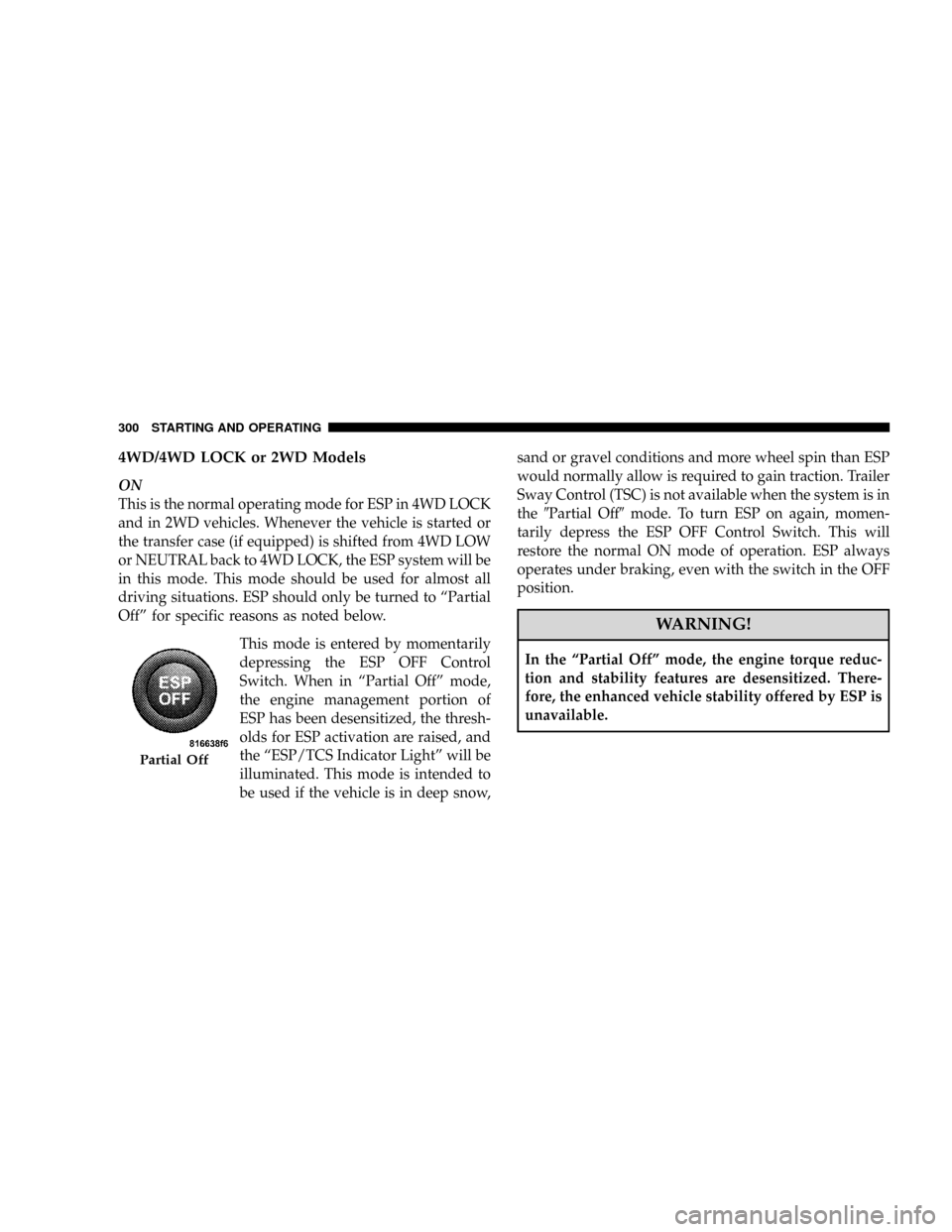
This mode is entered by momentarily
depressing the ESP OFF Control
Switch. When in ªPartial Offº mode,
the engine management portion of
ESP has been desensitized, the thresh-
olds for ESP activation are raised, and
the ªESP/TCS Indicator Lightº will be
illuminated. This mode is intended to
be used if the vehicle is in deep snow,sand or gravel conditions and more wheel spin than ESP
would normally allow is required to gain traction. Trailer
Sway Control (TSC) is not available when the system is in
the9Partial Off9mode. To turn ESP on again, momen-
tarily depress the ESP OFF Control Switch. This will
restore the normal ON mode of operation. ESP always
operates under braking, even with the switch in the OFF
position.
WARNING!
In the ªPartial Offº mode, the engine torque reduc-
tion and stability features are desensitized. There-
fore, the enhanced vehicle stability offered by ESP is
unavailable.
Partial Off
300 STARTING AND OPERATING
Page 302 of 479
NOTE:To improve the vehicle's traction when driving
with snow chains, or starting off in deep snow, sand or
gravel, it may be desirable to switch to the ªPartial Offº
mode by pressing the ESP Control Switch. Once the
situation requiring ESP to be switched to the ªPartial Offº
mode is overcome, turn ESP on by momentarily depress-
ing the ESP Control Switch. This may be done with the
vehicle in motion.
4WD LOW Range
Partial Off
This is the normal operating mode for ESP in 4WD LOW.
Whenever the vehicle is started in 4WD LOW or the
transfer case (if equipped) is shifted from 4WD LOCK or
NEUTRAL to 4WD LOW, the ESP system will be in this
mode. In 4WD LOW, ESP function is desensitized until
the vehicle reaches a speed of 30 mph (48 km/h). At 30
mph (48 km/h) the normal ESP stability function returns
and the ESP/TCS Indicator Light turns off. When thevehicle speed drops below 25 mph (40 km/h) the ESP
system goes back to Partial Off. ESP is desensitized at low
vehicle speeds in 4WD LOW so that it will not interfere
with off road driving but ESP function returns to provide
the stability feature at speeds above 30 mph (48 km/h).
The ABS is in a special Off Road mode that allows wheels
to lock at lower speeds if gravel is detected to shorten
stopping distances.
NOTE:When the vehicle is in 4WD LOW, a feature of
the ESP system remains active whether the ESP is on or
off. This feature functions similar to a limited slip differ-
ential and controls the wheel spin across an axle. If one
wheel on an axle is spinning faster than the other, the
system will apply the brake of the spinning wheel and
allow more engine torque to be applied to the wheel that
is not spinning.
STARTING AND OPERATING 301
5
Page 354 of 479
WARNING!
Improper towing can lead to an injury accident.
Follow these guidelines to make your trailer towing
as safe as possible:
Make certain that the load is secured in the trailer
and will not shift during travel. When trailering
cargo that is not fully secured, dynamic load shifts
can occur that may be difficult for the driver to
control. You could lose control of your vehicle and
have an accident.
²When hauling cargo or towing a trailer, do not over-
load your vehicle or trailer. Overloading can cause a
loss of control, poor performance or damage to brakes,
axle, engine, transmission, steering, suspension, chas-
sis structure or tires.
²Safety chains must always be used between your
vehicle and trailer. Always connect the chains to the
frame or hook retainers of the vehicle hitch. Cross the
chains under the trailer tongue and allow enough
slack for turning corners.
²Vehicles with trailers should not be parked on a grade.
When parking, apply the parking brake on the tow
vehicle. Put the tow vehicle automatic transmission in
PARK. With a manual transmission, shift the transmis-
sion into REVERSE. And with 4-wheel drive vehicles,
make sure the transfer case is not in NEUTRAL.
Always, block or9chock9the trailer wheels.
²GCWR must not be exceeded.
²Total weight must be distributed between the tow
vehicle and the trailer so that the following four
ratings are not exceeded:
1. GVWR
STARTING AND OPERATING 353
5
Page 363 of 479

12. Turn ignition key to the unlocked OFF position.
13. Shift the automatic transmission into PARK.
14. Attach vehicle to tow vehicle with tow bar.
NOTE:Items 1 through 5 are requirements that must be
met prior to depressing the NEUTRAL selection button,
and must continue to be met until the four seconds
elapses and the shift has been completed.
If any of these requirements (with the exception of Step 3
- Key ON) are not met prior to depressing the NEUTRAL
button or are no longer met during the four second timer,
then the NEUTRAL indicator light will flash continu-
ously until all requirements are met or until the NEU-
TRAL button is released.
NOTE:The ignition key must be ON for a shift to take
place and for the position indicator lights to be operable.
If the key is not ON, the shift will not take place and no
position indicator lights will be on or flashing.CAUTION!
Damage to the transmission may occur if the trans-
mission is shifted into PARK with the transfer case in
NEUTRAL and the engine RUNNING. With the
transfer case in NEUTRAL, ensure that the engine is
OFF prior to shifting the transmission into PARK.
Shifting Out of NEUTRAL
Use the following procedure to prepare your vehicle for
normal usage.
1. Bring vehicle to a complete stop.
2. Shut engine OFF.
3. Turn the ignition key to the ON position without
starting the engine.
4. Depress brake pedal.
362 STARTING AND OPERATING
Page 368 of 479
If it is necessary to leave the vehicle to go for service, the
flasher system will continue to operate with the ignition
key removed and the vehicle locked.JACKING AND TIRE CHANGING
WARNING!
²Being under a jacked-up vehicle is dangerous. The
vehicle could slip off the jack and fall on you. You
could be crushed. Never put any part of your body
under a vehicle that is on a jack. Never start or run
the engine while the vehicle is on a jack. If you
need to get under a raised vehicle, take it to a
service center where it can be raised on a lift.
²The jack is designed to use as a tool for changing
tires only. The jack should not be used to lift the
vehicle for service purposes. The vehicle should
be jacked on a firm level surface only. Avoid ice or
slippery areas.
WHAT TO DO IN EMERGENCIES 367
6
Page 371 of 479

3. Turn the wrench counterclockwise to lower the spare
tire. Continue to turn the wrench until the spare tire can
be pulled out from under the vehicle.
It is recommended that you stow the flat tire or spare to
avoid tangling the loose cable.
CAUTION!
The winch mechanism is designed for use with the
jack extension tube only. Use of an air wrench or
other power tools is not recommended and can dam-
age the winch.
Tire Changing Procedure
WARNING!
Getting under a jacked-up vehicle is dangerous. The
vehicle could slip off the jack and fall on you. You
could be crushed. Never get any part of your body
under a vehicle that is on a jack. Never start or run
the engine while the vehicle is on a jack. If you need
to get under a raised vehicle, take it to a service center
where it can be raised on a lift.
Do not raise this vehicle using a bumper jack. The scissor
jack is designed as a tool for changing tires on this vehicle
only. It is not recommended that the jack be used for
service purposes or to lift more than one wheel at a time.
370 WHAT TO DO IN EMERGENCIES