warning CHRYSLER ASPEN 2008 2.G Owners Manual
[x] Cancel search | Manufacturer: CHRYSLER, Model Year: 2008, Model line: ASPEN, Model: CHRYSLER ASPEN 2008 2.GPages: 479, PDF Size: 4.3 MB
Page 332 of 479
display a ªCHECK TPM SYSTEMº message for three
seconds, and then display dashes (- - -) in place of a
pressure value.
5. Once you repair or replace the original road tire, and
reinstall it on the vehicle in place of the full size spare tire,
the TPMS will update automatically. In addition, the
TPM Telltale Light will turn OFF and the graphic in the
EVIC will display a new pressure value instead of dashes
(- - -), as long as no tire pressure is below the low-
pressure warning limit in any of the four active road tires.
The vehicle may need to be driven for up to 10 minutes
above 15 mph (25 km/h) in order for the TPMS to receive
this information.
General Information
This device complies with part 15 of the FCC rules and
RSS 210 of Industry Canada. Operation is subject to the
following conditions:
²This device may not cause harmful interference.
²This device must accept any interference received,
including interference that may cause undesired op-
eration.
The tire pressure sensors are covered under one of the
following licenses:
United States.....................KR5S120123
Canada........................2671-S120123
FUEL REQUIREMENTS
All engines (except 5.7L engines) are de-
signed to meet all emissions regulations
and provide excellent fuel economy and
performance when using high quality un-
leaded ªregularº gasoline having an oc-
tane rating of 87. The use of premium
gasoline is not recommended. Under normal conditions,
the use of premium gasoline will not provide a benefit
over high quality regular gasolines, and in some circum-
stances may result in poorer performance.
STARTING AND OPERATING 331
5
Page 336 of 479

NOTE:Intentional tampering with emissions control
systems can result in civil penalties being assessed
against you.Carbon Monoxide Warnings
WARNING!
Carbon monoxide (CO) in exhaust gases is deadly. Follow the
precautions below to prevent carbon monoxide poisoning:
²Do not inhale exhaust gases. They contain carbon monox-
ide, a colorless and odorless gas which can kill. Never run
the engine in a closed area, such as a garage, and never sit
in a parked vehicle with the engine running for an
extended period. If the vehicle is stopped in an open area
with the engine running for more than a short period,
adjust the ventilation system to force fresh, outside air
into the vehicle.
²Guard against carbon monoxide with proper maintenance.
Have the exhaust system inspected every time the vehicle
is raised. Have any abnormal conditions repaired
promptly. Until repaired, drive with all side windows
fully open.
²Keep the liftgate closed when driving your vehicle to
prevent carbon monoxide and other poisonous exhaust
gases from entering the vehicle.
STARTING AND OPERATING 335
5
Page 338 of 479

WARNING!
²Never have any smoking materials lit in or near
the vehicle when the gas cap is removed or the
tank filled.
²Never add fuel when the engine is running. This is
in violation of most state and federal fire regula-
tions and may cause the Malfunction Indicator
Light to turn on.
NOTE:Tighten the gas cap about 1/4 turn until you
hear one click. This is an indication that cap is properly
tightened.
If the gas cap is not tightened properly, the Malfunction
Indicator Light will come on. Be sure the gas cap is
tightened every time the vehicle is refueled.
WARNING!
A fire may result if gasoline is pumped into a
portable container that is inside of a vehicle. You
could be burned. Always place gas containers on the
ground while filling.
Loose Fuel Filler Cap (Gas Cap) Message
After fuel is added, the vehicle diagnostic system can
determine if the fuel filler cap is loose, improperly
installed, or damaged. A loose fuel filler cap message will
be displayed in the instrument cluster. Tighten the gas
cap until a9clicking9sound is heard. This is an indication
that the gas cap is properly tightened. Press the odometer
RESET button to turn the message off. If the problem
persists, the message will appear the next time the
vehicle is started. This might indicate a damaged cap. If
STARTING AND OPERATING 337
5
Page 340 of 479
CAUTION!
Only vehicles with the E-85 fuel filler cap (gas cap)
can operate on E-85.
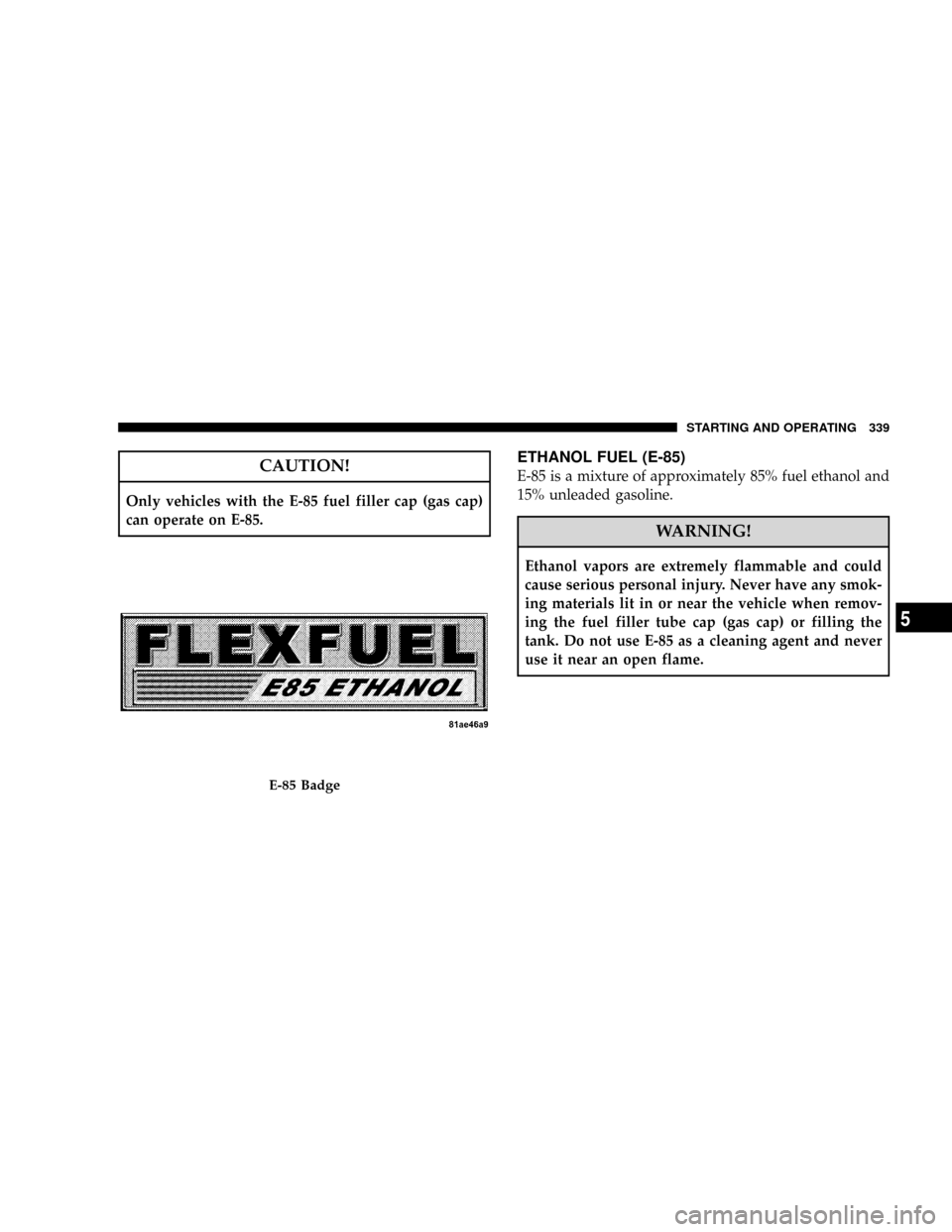
ETHANOL FUEL (E-85)
E-85 is a mixture of approximately 85% fuel ethanol and
15% unleaded gasoline.
WARNING!
Ethanol vapors are extremely flammable and could
cause serious personal injury. Never have any smok-
ing materials lit in or near the vehicle when remov-
ing the fuel filler tube cap (gas cap) or filling the
tank. Do not use E-85 as a cleaning agent and never
use it near an open flame.
E-85 Badge
STARTING AND OPERATING 339
5
Page 345 of 479
should then be determined separately to be sure that the
load is properly distributed over front and rear axle.
Weighing the vehicle may show that the GAWR of either
the front or rear axles has been exceeded but the total
load is within the specified GVWR. If so, weight must be
shifted from front to rear or rear to front as appropriate
until the specified weight limitations are met.
Store heavier items down low and be sure that the weight
is distributed equally. Stow all loose items securely before
driving.
Improper weight distribution can have an adverse effect
on the way your vehicle steers and handles and the way
the brakes operate.WARNING!
Do not load your vehicle any heavier than the GVWR
or the maximum front and rear GAWR. If you do,
parts on your vehicle can break, or it can change the
way your vehicle handles. This could cause you to
lose control. Also, overloading can shorten the life of
your vehicle.
A loaded vehicle is shown in the following example. Note
that neither GVWR nor GAWR capabilities are exceeded.
Overloading can cause potential safety hazards and
shorten service life.
NOTE: The weights shown in this chart are not the
weights for your vehicle. Also, the amount of load
added to both the front and rear axles can be computed
344 STARTING AND OPERATING
Page 347 of 479
Gross Trailer Weight (GTW)
The Gross Trailer Weight (GTW) is the weight of the
trailer plus the weight of all cargo, consumables and
equipment (permanent or temporary) loaded in or on the
trailer in its9loaded and ready for operation9condition.
The recommended way to measure GTW is to put your
fully loaded trailer on a vehicle scale. The entire weight
of the trailer must be supported by the scale.
Gross Combination Weight Rating (GCWR)
The Gross Combination Weight Rating (GCWR) is the
total permissible weight of your vehicle and trailer when
weighed in combination. (Note that GCWR ratings in-
clude a 150 lbs (68 kg) allowance for the presence of a
driver.)
Gross Axle Weight Rating (GAWR)
The GAWR is the maximum capacity of the front and rear
axles. Distribute the load over the front and rear axles
evenly. Make sure that you do not exceed either front or
rear GAWR.
WARNING!
It is important that you do not exceed the maximum
front or rear GAWR. A dangerous driving condition
can result if either rating is exceeded. You could lose
control of the vehicle and have an accident.
Tongue Weight (TW)
The downward force exerted on the hitch ball by the
trailer is the tongue weight. In most cases it should not be
less than 10% or more than 15% of the trailer load. You
must consider this as part of the load on your vehicle.
346 STARTING AND OPERATING
Page 349 of 479
used in accordance with the manufacturers' directions, it
provides for a more level ride, offering more consistent
steering and brake control thereby enhancing towing
safety. The addition of a friction/hydraulic sway control
also dampens sway caused by traffic and crosswinds and
contributes positively to tow vehicle and trailer stability.
Trailer sway control and a weight distributing (load
equalizing) hitch are recommended for heavier tongue
weights and may be required depending on vehicle and
trailer configuration/loading to comply with Gross Axle
Weight Rating (GAWR) requirements.WARNING!
An improperly adjusted Weight-Distributing Hitch
system may reduce handling, stability, and braking
performance, and could result in an accident.
Weight-Distributing Systems may not be compatible
with surge brake couplers. Consult with your hitch
and trailer manufacturer or a reputable recreational
vehicle dealer for additional information.
348 STARTING AND OPERATING
Page 354 of 479
WARNING!
Improper towing can lead to an injury accident.
Follow these guidelines to make your trailer towing
as safe as possible:
Make certain that the load is secured in the trailer
and will not shift during travel. When trailering
cargo that is not fully secured, dynamic load shifts
can occur that may be difficult for the driver to
control. You could lose control of your vehicle and
have an accident.
²When hauling cargo or towing a trailer, do not over-
load your vehicle or trailer. Overloading can cause a
loss of control, poor performance or damage to brakes,
axle, engine, transmission, steering, suspension, chas-
sis structure or tires.
²Safety chains must always be used between your
vehicle and trailer. Always connect the chains to the
frame or hook retainers of the vehicle hitch. Cross the
chains under the trailer tongue and allow enough
slack for turning corners.
²Vehicles with trailers should not be parked on a grade.
When parking, apply the parking brake on the tow
vehicle. Put the tow vehicle automatic transmission in
PARK. With a manual transmission, shift the transmis-
sion into REVERSE. And with 4-wheel drive vehicles,
make sure the transfer case is not in NEUTRAL.
Always, block or9chock9the trailer wheels.
²GCWR must not be exceeded.
²Total weight must be distributed between the tow
vehicle and the trailer so that the following four
ratings are not exceeded:
1. GVWR
STARTING AND OPERATING 353
5
Page 356 of 479

þAn electronically actuated trailer brake controller is
required when towing a trailer with electronically
actuated brakes. When towing a trailer equipped with
a hydraulic surge actuated brake system, an electronic
brake controller is not required.
þTrailer brakes are recommended for trailers over 1,000
lbs (454 kg) and required for trailers in excess of 2,000
lbs (907 kg).
CAUTION!
If the trailer weighs more than 1,000 lbs (454 kg)
loaded, it should have its own brakes and they
should be of adequate capacity. Failure to do this
could lead to accelerated brake lining wear, higher
brake pedal effort, and longer stopping distances.
WARNING!
Do not connect trailer brakes to your vehicle's hy-
draulic brake lines. It can overload your brake sys-
tem and cause it to fail. You might not have brakes
when you need them and could have an accident.
Towing any trailer will increase your stopping dis-
tance. When towing you should allow for additional
space between your vehicle and the vehicle in front
of you. Failure to do so could result in an accident.
STARTING AND OPERATING 355
5
Page 360 of 479
SNOWPLOW
NOTE:Do not use this vehicle for snowplow applica-
tions.
WARNING!
Snowplows, winches, and other aftermarket equip-
ment should not be added to the front end of your
vehicle. The airbag crash sensors may be affected by
the change in the front end structure. The airbags
could deploy unexpectedly or could fail to deploy
during a collision, resulting in serious injury or
death.
CAUTION!
Using this vehicle for snowplow applications can
cause damage to the vehicle.
WARNING!
Attaching a snowplow to this vehicle could adversely
affect performance of the airbag system in an acci-
dent. Do not expect that the airbag will perform as
described earlier in this manual.
STARTING AND OPERATING 359
5