warning CHRYSLER ASPEN 2008 2.G Owners Manual
[x] Cancel search | Manufacturer: CHRYSLER, Model Year: 2008, Model line: ASPEN, Model: CHRYSLER ASPEN 2008 2.GPages: 479, PDF Size: 4.3 MB
Page 406 of 479
²Use only high purity water such as distilled or deion-
ized water when mixing the water/engine coolant
solution. The use of lower quality water will reduce
the amount of corrosion protection in the engine
cooling system.
Please note that it is the owner's responsibility to main-
tain the proper level of protection against freezing ac-
cording to the temperatures occurring in the area where
the vehicle is operated.
NOTE:Mixing coolant types will decrease the life of the
engine coolant and will require more frequent coolant
changes.
Cooling System Pressure Cap
The cap must be fully tightened to prevent loss of
coolant, and to ensure that coolant will return to the
radiator from the coolant recovery bottle.The cap should be inspected and cleaned if there is any
accumulation of foreign material on the sealing surfaces.
WARNING!
²The warning words ªDO NOT OPEN HOTº on
the cooling system pressure cap are a safety pre-
caution. Never add coolant when the engine is
overheated. Do not loosen or remove the cap to
cool an overheated engine. Heat causes pressure to
build up in the cooling system. To prevent scald-
ing or injury, do not remove the pressure cap while
the system is hot or under pressure.
²Do not use a pressure cap other than the one
specified for your vehicle. Personal injury or en-
gine damage may result.
MAINTAINING YOUR VEHICLE 405
7
Page 410 of 479
Brake Master Cylinders
The fluid level in the master cylinders should be checked
whenever the vehicle is serviced, or immediately if the
brake system warning light is on. If necessary, add fluid
to bring level to the full mark on the side of the reservoir
of the brake master cylinder. Be sure to clean the top of
the master cylinder area before removing the cap. With
disc brakes, fluid level can be expected to fall as the brake
pads wear. Brake fluid level should be checked when
pads are replaced. If the brake fluid level is abnormally
low, check system for leaks.
For correct fluid type, refer to ºBrake Master Cylinderº
under ªFluids, Lubricants and Genuine Partsº in this
section.WARNING!
Use of brake fluid that may have a lower initial
boiling point, or is unidentified as to specifications
may result in sudden brake failure during hard
prolonged braking. You could have an accident.
WARNING!
Overfilling the brake fluid reservoir can result in
spilling brake fluid on hot engine parts and the
brake fluid catching on fire.
Use only brake fluid that has been in a tightly closed
container to avoid contamination from foreign matter or
moisture.
MAINTAINING YOUR VEHICLE 409
7
Page 411 of 479
CAUTION!
Do not allow a petroleum-base fluid to contaminate
the brake fluid. Seal damage may result.
Brake Hoses
Inspection should be performed whenever the brake
system is serviced or at intervals specified. Inspect hy-
draulic brake hoses for surface cracking, scuffing or worn
spots. If there is any evidence of cracking, scuffing, or
worn spots, the hose should be replaced immediately!
Eventual deterioration of the hose can take place with
possible burst failure.
WARNING!
Worn brake hoses can burst and cause brake failure.
You could have an accident. If you see any sign of
cracking, scuffing, or worn spots, have the brake
hoses replaced immediately.
Automatic Transmission
Fluid Level Check
NOTE:If equipped with a dipstick, use the following
procedure. If your vehicle has a capped dipstick, it is
sealed and should not be tampered with. Your authorized
dealer has the proper tools to ensure that the fluid level
is set properly.
Check the fluid level while the transmission is at normal
operating temperature 180ÉF (82ÉC). This occurs after at
410 MAINTAINING YOUR VEHICLE
Page 418 of 479

²For tough stains, apply MopartTotal Clean or a mild
soap solution to a clean, damp cloth and remove stain.
Use a fresh, damp towel to remove soap residue.
²For grease stains, apply MopartMulti-Purpose
Cleaner to a clean, damp cloth and remove stain. Use
a fresh, damp towel to remove soap residue.
²Do not use any solvents or protectants on
YES Essentialstproducts.
Interior Care
Use MopartFabric Cleaner to clean fabric upholstery
and carpeting.
Use MopartVinyl Cleaner to clean vinyl upholstery and
trim.
MopartTotal Clean is specifically recommended for
leather upholstery.Your leather upholstery can be best preserved by regular
cleaning with a damp soft cloth. Small particles of dirt
can act as an abrasive and damage the leather upholstery
and should be removed promptly with a damp cloth.
Stubborn soils can be removed easily with a soft cloth
and MopartTotal Clean. Care should be taken to avoid
soaking your leather upholstery with any liquid. Please
do not use polishes, oils, cleaning fluids, solvents, deter-
gents, or ammonia based cleaners to clean your leather
upholstery. Application of a leather conditioner is not
required to maintain the original condition.
WARNING!
Do not use volatile solvents for cleaning purposes.
Many are potentially flammable, and if used in
closed areas they may cause respiratory harm.
MAINTAINING YOUR VEHICLE 417
7
Page 446 of 479
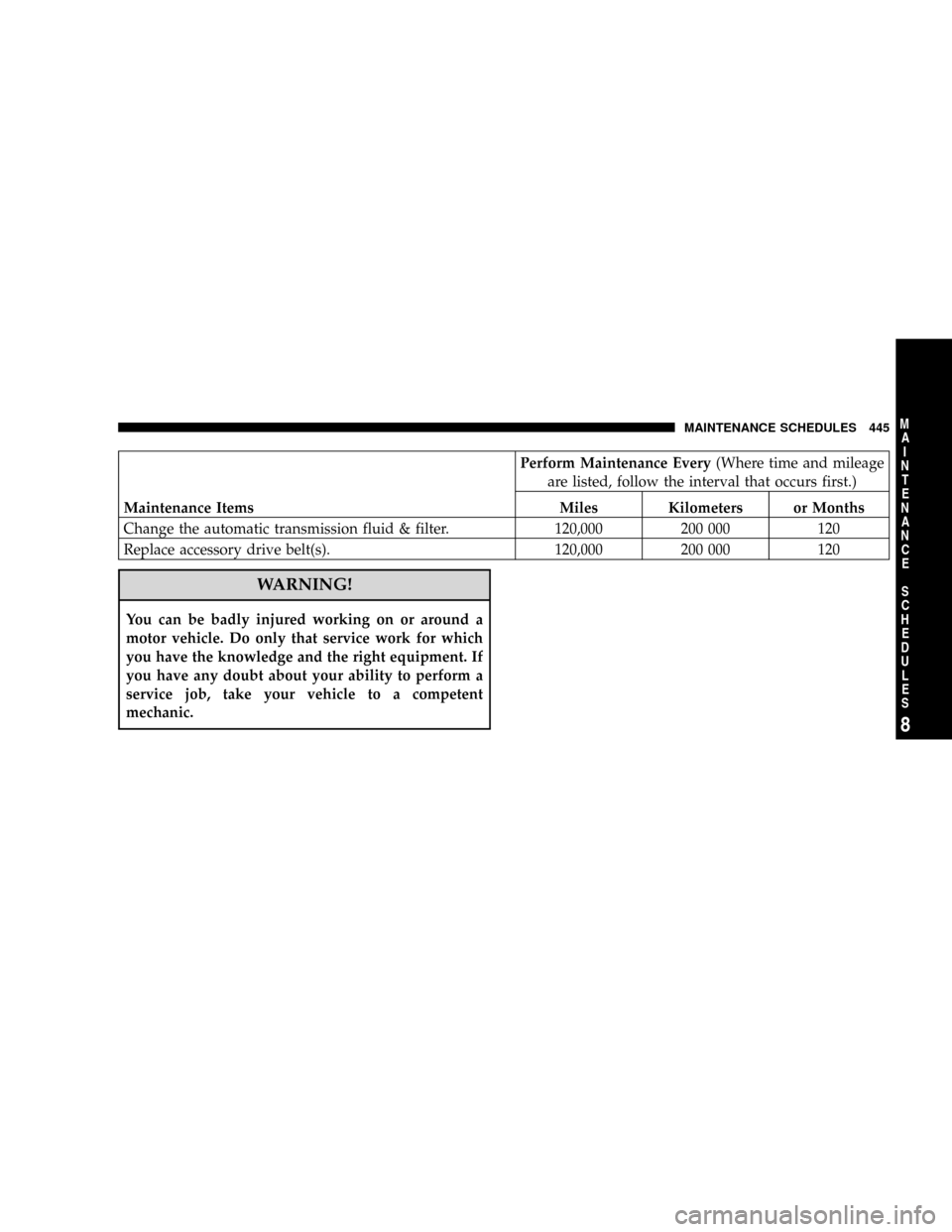
Perform Maintenance Every(Where time and mileage
are listed, follow the interval that occurs first.)
Maintenance Items Miles Kilometers or Months
Change the automatic transmission fluid & filter. 120,000 200 000 120
Replace accessory drive belt(s). 120,000 200 000 120
WARNING!
You can be badly injured working on or around a
motor vehicle. Do only that service work for which
you have the knowledge and the right equipment. If
you have any doubt about your ability to perform a
service job, take your vehicle to a competent
mechanic.
MAINTENANCE SCHEDULES 445
8
M
A
I
N
T
E
N
A
N
C
E
S
C
H
E
D
U
L
E
S
Page 453 of 479

WARNING!
Engine exhaust, some of its constituents, and certain
vehicle components contain, or emit, chemicals
known to the State of California to cause cancer and
birth defects or other reproductive harm. In addition,
certain fluids contained in vehicles and certain prod-
ucts of component wear contain, or emit, chemicals
known to the State of California to cause cancer and
birth defects or other reproductive harm.
WARRANTY INFORMATION (U.S. Vehicles Only)
See the Warranty Information Booklet for the terms and
provisions of DaimlerChrysler's warranties applicable to
this vehicle.
MOPARTPARTS
MOPARtfluids, lubricants, parts, and accessories are
available from your authorized dealer. They will help
you keep your vehicle operating at its best.
REPORTING SAFETY DEFECTS
In the 50 United States and Washington, D.C.
If you believe that your vehicle has a defect which could
cause a crash or cause injury or death, you should
immediately inform the National Highway Traffic Safety
Administration (NHTSA) in addition to notifying the
manufacturer.
If NHTSA receives similar complaints, it may open an
investigation, and if it finds that a safety defect exists in
a group of vehicles, it may order a recall and remedy
campaign. However, NHTSA cannot become involved in
individual problems between you, your authorized
dealer, and the manufacturer.
452 IF YOU NEED CONSUMER ASSISTANCE
Page 456 of 479
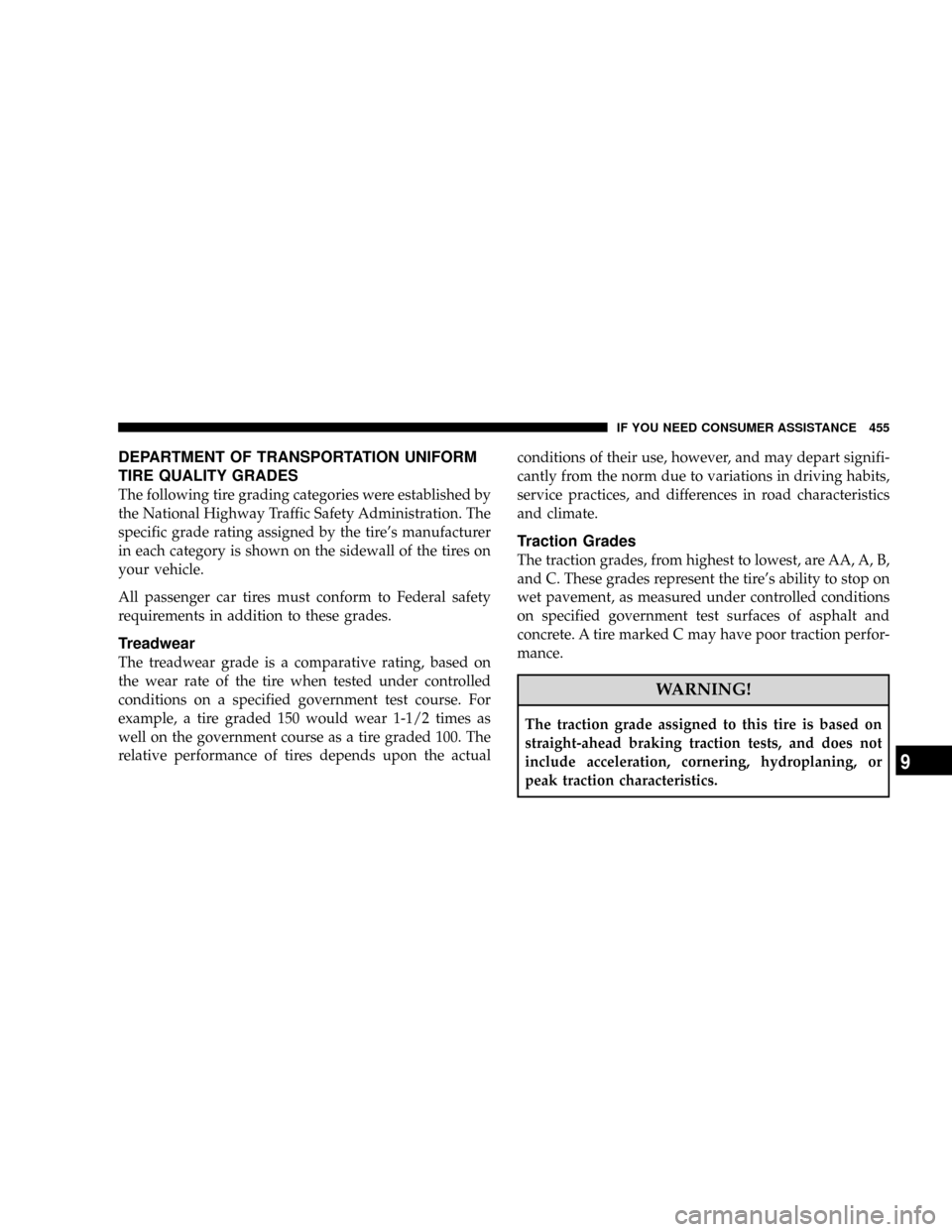
DEPARTMENT OF TRANSPORTATION UNIFORM
TIRE QUALITY GRADES
The following tire grading categories were established by
the National Highway Traffic Safety Administration. The
specific grade rating assigned by the tire's manufacturer
in each category is shown on the sidewall of the tires on
your vehicle.
All passenger car tires must conform to Federal safety
requirements in addition to these grades.
Treadwear
The treadwear grade is a comparative rating, based on
the wear rate of the tire when tested under controlled
conditions on a specified government test course. For
example, a tire graded 150 would wear 1-1/2 times as
well on the government course as a tire graded 100. The
relative performance of tires depends upon the actualconditions of their use, however, and may depart signifi-
cantly from the norm due to variations in driving habits,
service practices, and differences in road characteristics
and climate.
Traction Grades
The traction grades, from highest to lowest, are AA, A, B,
and C. These grades represent the tire's ability to stop on
wet pavement, as measured under controlled conditions
on specified government test surfaces of asphalt and
concrete. A tire marked C may have poor traction perfor-
mance.
WARNING!
The traction grade assigned to this tire is based on
straight-ahead braking traction tests, and does not
include acceleration, cornering, hydroplaning, or
peak traction characteristics.
IF YOU NEED CONSUMER ASSISTANCE 455
9
Page 457 of 479

Temperature Grades
The temperature grades are A (the highest), B, and C,
representing the tire's resistance to the generation of heat
and its ability to dissipate heat, when tested under
controlled conditions on a specified indoor laboratory
test wheel. Sustained high temperature can cause the
material of the tire to degenerate and reduce tire life, and
excessive temperature can lead to sudden tire failure. The
grade C corresponds to a level of performance, which all
passenger car tires must meet under the Federal Motor
Vehicle Safety Standard No. 109. Grades B and A repre-
sent higher levels of performance on the laboratory test
wheel, than the minimum required by law.WARNING!
The temperature grade for this tire is established for
a tire that is properly inflated and not overloaded.
Excessive speed, under-inflation, or excessive load-
ing, either separately or in combination, can cause
heat buildup and possible tire failure.
456 IF YOU NEED CONSUMER ASSISTANCE
Page 459 of 479
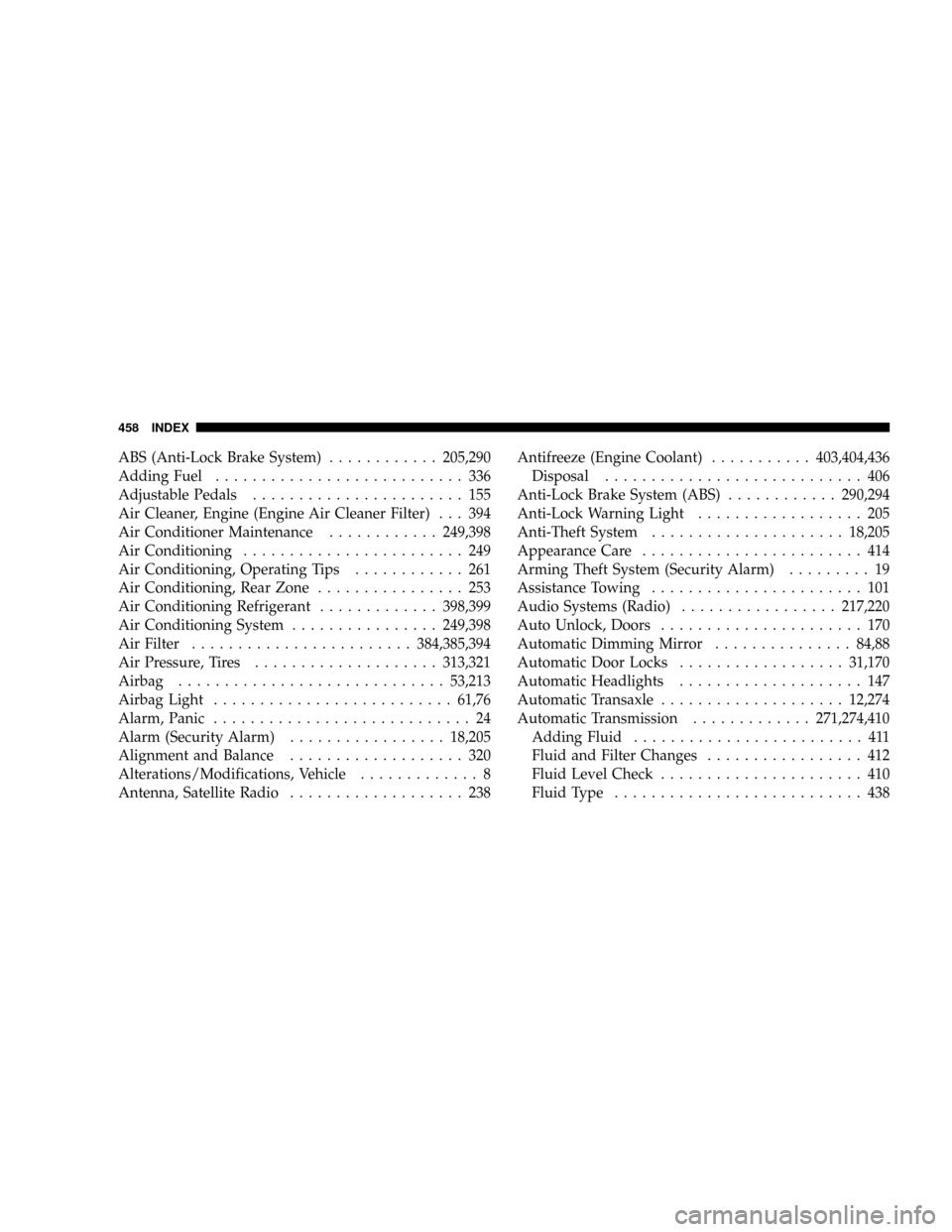
ABS (Anti-Lock Brake System)............205,290
Adding Fuel........................... 336
Adjustable Pedals....................... 155
Air Cleaner, Engine (Engine Air Cleaner Filter) . . . 394
Air Conditioner Maintenance............249,398
Air Conditioning........................ 249
Air Conditioning, Operating Tips............ 261
Air Conditioning, Rear Zone................ 253
Air Conditioning Refrigerant.............398,399
Air Conditioning System................249,398
Air Filter........................384,385,394
Air Pressure, Tires....................313,321
Airbag.............................53,213
Airbag Light..........................61,76
Alarm, Panic............................ 24
Alarm (Security Alarm).................18,205
Alignment and Balance................... 320
Alterations/Modifications, Vehicle............. 8
Antenna, Satellite Radio................... 238Antifreeze (Engine Coolant)...........403,404,436
Disposal............................ 406
Anti-Lock Brake System (ABS)............290,294
Anti-Lock Warning Light.................. 205
Anti-Theft System.....................18,205
Appearance Care........................ 414
Arming Theft System (Security Alarm)......... 19
Assistance Towing....................... 101
Audio Systems (Radio).................217,220
Auto Unlock, Doors...................... 170
Automatic Dimming Mirror...............84,88
Automatic Door Locks..................31,170
Automatic Headlights.................... 147
Automatic Transaxle....................12,274
Automatic Transmission.............271,274,410
Adding Fluid......................... 411
Fluid and Filter Changes................. 412
Fluid Level Check...................... 410
Fluid Type........................... 438
458 INDEX
Page 460 of 479
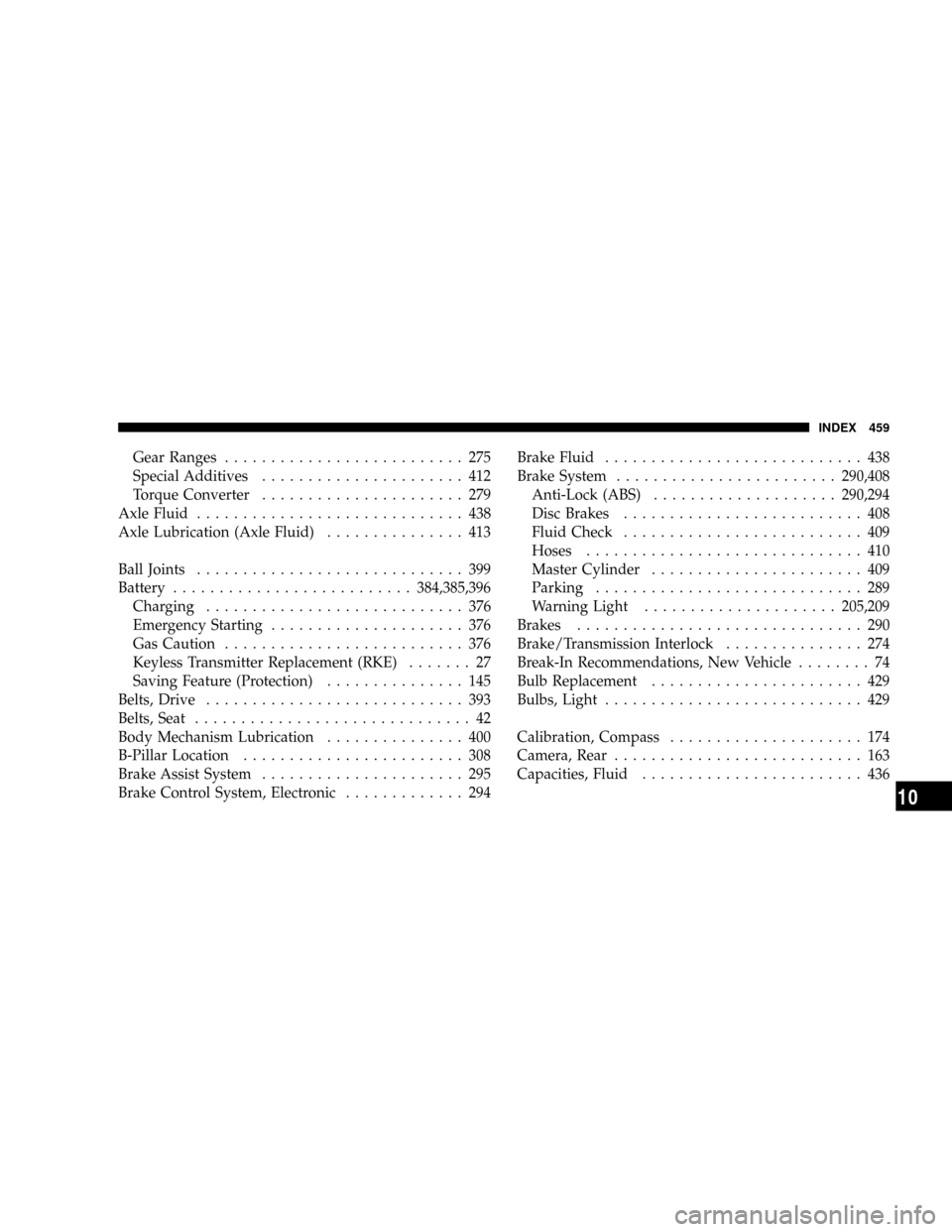
Gear Ranges.......................... 275
Special Additives...................... 412
Torque Converter...................... 279
Axle Fluid............................. 438
Axle Lubrication (Axle Fluid)............... 413
Ball Joints............................. 399
Battery..........................384,385,396
Charging............................ 376
Emergency Starting..................... 376
Gas Caution.......................... 376
Keyless Transmitter Replacement (RKE)....... 27
Saving Feature (Protection)............... 145
Belts, Drive............................ 393
Belts, Seat.............................. 42
Body Mechanism Lubrication............... 400
B-Pillar Location........................ 308
Brake Assist System...................... 295
Brake Control System, Electronic............. 294Brake Fluid............................ 438
Brake System........................290,408
Anti-Lock (ABS)....................290,294
Disc Brakes.......................... 408
Fluid Check.......................... 409
Hoses.............................. 410
Master Cylinder....................... 409
Parking............................. 289
Warning Light.....................205,209
Brakes............................... 290
Brake/Transmission Interlock............... 274
Break-In Recommendations, New Vehicle........ 74
Bulb Replacement....................... 429
Bulbs, Light............................ 429
Calibration, Compass..................... 174
Camera, Rear........................... 163
Capacities, Fluid........................ 436
INDEX 459
10