tires CHRYSLER ASPEN 2008 2.G User Guide
[x] Cancel search | Manufacturer: CHRYSLER, Model Year: 2008, Model line: ASPEN, Model: CHRYSLER ASPEN 2008 2.GPages: 479, PDF Size: 4.3 MB
Page 293 of 479
WARNING!
ABS contains sophisticated electronic equipment. It
may be susceptible to interference caused by improp-
erly installed or high output radio transmitting
equipment. This interference can cause possible loss
of anti-lock braking capability. Installation of such
equipment should be done by qualified
professionals.
WARNING!
Pumping of the Anti-lock brakes will diminish their
effectiveness and may lead to an accident. Pumping
makes the stopping distance longer. Just press firmly
on your brake pedal when you need to slow down or
stop.
WARNING!
²ABS cannot prevent the natural laws of physics
from acting on the vehicle, nor can it increase
braking or steering efficiency beyond that af-
forded by the condition of the vehicle brakes and
tires or the traction afforded.
²The ABS cannot prevent accidents, including
those resulting from excessive speed in turns,
following another vehicle too closely, or hydro-
planing. Only a safe, attentive, and skillful driver
can prevent accidents.
²The capabilities of an ABS equipped vehicle must
never be exploited in a reckless or dangerous
manner which could jeopardize the user's safety
or the safety of others.
292 STARTING AND OPERATING
Page 296 of 479
WARNING!
²ABS cannot prevent the natural laws of physics
from acting on the vehicle, nor can it increase
braking or steering efficiency beyond that af-
forded by the condition of the vehicle brakes and
tires or the traction afforded.
²The ABS cannot prevent accidents, including
those resulting from excessive speed in turns,
following another vehicle too closely, or hydro-
planing. Only a safe, attentive, and skillful driver
can prevent accidents.
²The capabilities of an ABS-equipped vehicle must
never be exploited in a reckless or dangerous
manner which could jeopardize the user's safety
or the safety of others.
BAS (Brake Assist System)
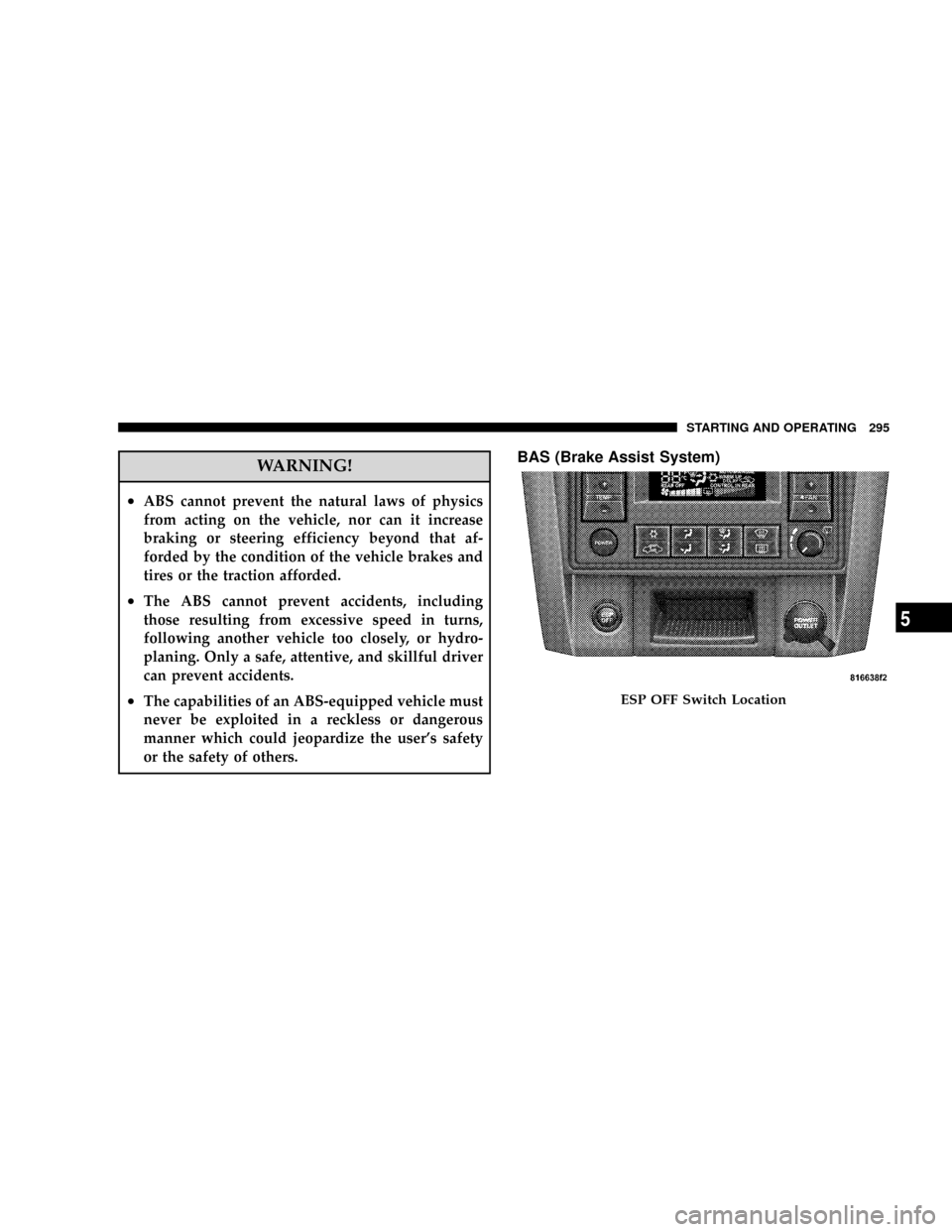
ESP OFF Switch Location
STARTING AND OPERATING 295
5
Page 297 of 479
The BAS is designed to optimize the vehicle's braking
capability during emergency braking maneuvers. The
system detects an emergency braking situation by sens-
ing the rate and amount of brake application and then
applies optimum pressure to the brakes. The system
applies optimum pressure to the brakes in emergency
braking conditions. This can help reduce braking dis-
tances. The BAS complements the ABS. Applying the
brakes very quickly results in the best BAS assistance. To
receive the benefit of the system, you must apply con-
tinuous braking pressure during the stopping sequence.
Do not reduce brake pedal pressure unless braking is no
longer desired.
Once the brake pedal is released, the BAS is deactivated.WARNING!
²BAS cannot prevent the natural laws of physics
from acting on the vehicle, nor can it increase
braking efficiency beyond that afforded by the
condition of the vehicle brakes and tires or the
traction afforded.
²The BAS cannot prevent accidents, including
those resulting from excessive speed in turns,
following another vehicle too closely, or hydro-
planing. Only a safe, attentive, and skillful driver
can prevent accidents.
²The capabilities of a BAS-equipped vehicle must
never be exploited in a reckless or dangerous
manner which could jeopardize the user 's safety
or the safety of others.
296 STARTING AND OPERATING
Page 300 of 479
²Understeer - when the vehicle is turning less than
appropriate for the steering wheel position.
ESP/TCS Indicator Light
The ESP/TCS Indicator Light starts to flash as
soon as the tires lose traction and the TCS or
ESP system becomes active. It will also flash
once a swaying trailer is detected and the
Trailer Sway Control (TSC) system activates. If the ESP/
TCS Indicator Light begins to flash during acceleration,
ease up on the accelerator and apply as little throttle as
possible. Be sure to adapt your speed and driving to the
prevailing road conditions.
WARNING!
²ESP cannot prevent the natural laws of physics
from acting on the vehicle, nor can it increase the
traction afforded.
²ESP cannot prevent accidents, including those
resulting from excessive speed in turns, or hydro-
planing. Only a safe, attentive, and skillful driver
can prevent accidents.
²The capabilities of an ESP-equipped vehicle must
never be exploited in a reckless or dangerous
manner which could jeopardize the user's safety
or the safety of others.
The ESP system has two available operating modes.
STARTING AND OPERATING 299
5
Page 304 of 479
stop the sway. The system will reduce engine power and
apply individual brakes that will counter act the sway of
the trailer. TSC will become active automatically once the
swaying trailer is recognized. No driver action is re-
quired. TSC cannot stop all trailers from swaying. Al-
ways use caution when towing a trailer and follow the
tongue weight recommendations. For additional infor-
mation on towing a trailer with your vehicle, refer to
9Trailer Towing9in Section 5.
MULTI-DISPLACEMENT SYSTEM (MDS) Ð 5.7L
ENGINE ONLY
This feature offers improved fuel economy by shutting
off four of the engine's eight cylinders during light load
and cruise conditions. The system is automatic with no
driver inputs or additional driving skills required.
NOTE:The MDS system may take some time to return
to full functionality after a battery disconnect.
TIRE SAFETY INFORMATION
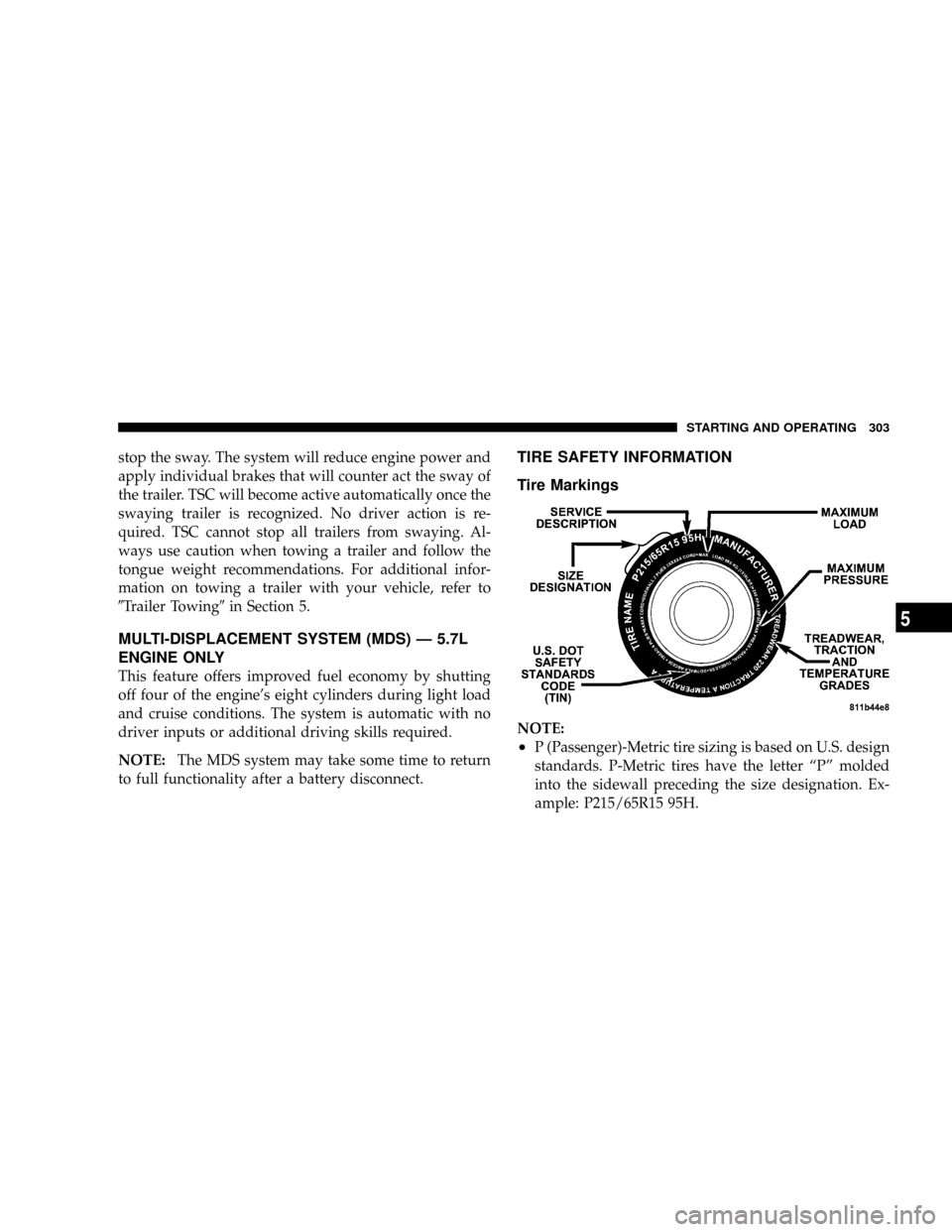
Tire Markings
NOTE:
²P (Passenger)-Metric tire sizing is based on U.S. design
standards. P-Metric tires have the letter ªPº molded
into the sidewall preceding the size designation. Ex-
ample: P215/65R15 95H.
STARTING AND OPERATING 303
5
Page 305 of 479
²European Metric tire sizing is based on European
design standards. Tires designed to this standard have
the tire size molded into the sidewall beginning with
the section width. The letter9P9is absent from this tire
size designation. Example: 215/65R15 96H
²LT (Light Truck)-Metric tire sizing is based on U.S.
design standards. The size designation for LT-Metric
tires is the same as for P-Metric tires except for the
letters ªLTº that are molded into the sidewall preced-
ing the size designation. Example: LT235/85R16.
²Temporary spare tires are high-pressure compact
spares designed for temporary emergency use only.
Tires designed to this standard have the letter ªTº
molded into the sidewall preceding the size designa-
tion. Example: T145/80D18 103M.
²High flotation tire sizing is based on U.S. design
standards, and it begins with the tire diameter molded
into the sidewall. Example: 31x10.5 R15 LT.
304 STARTING AND OPERATING
Page 308 of 479
Tire Identification Number (TIN)
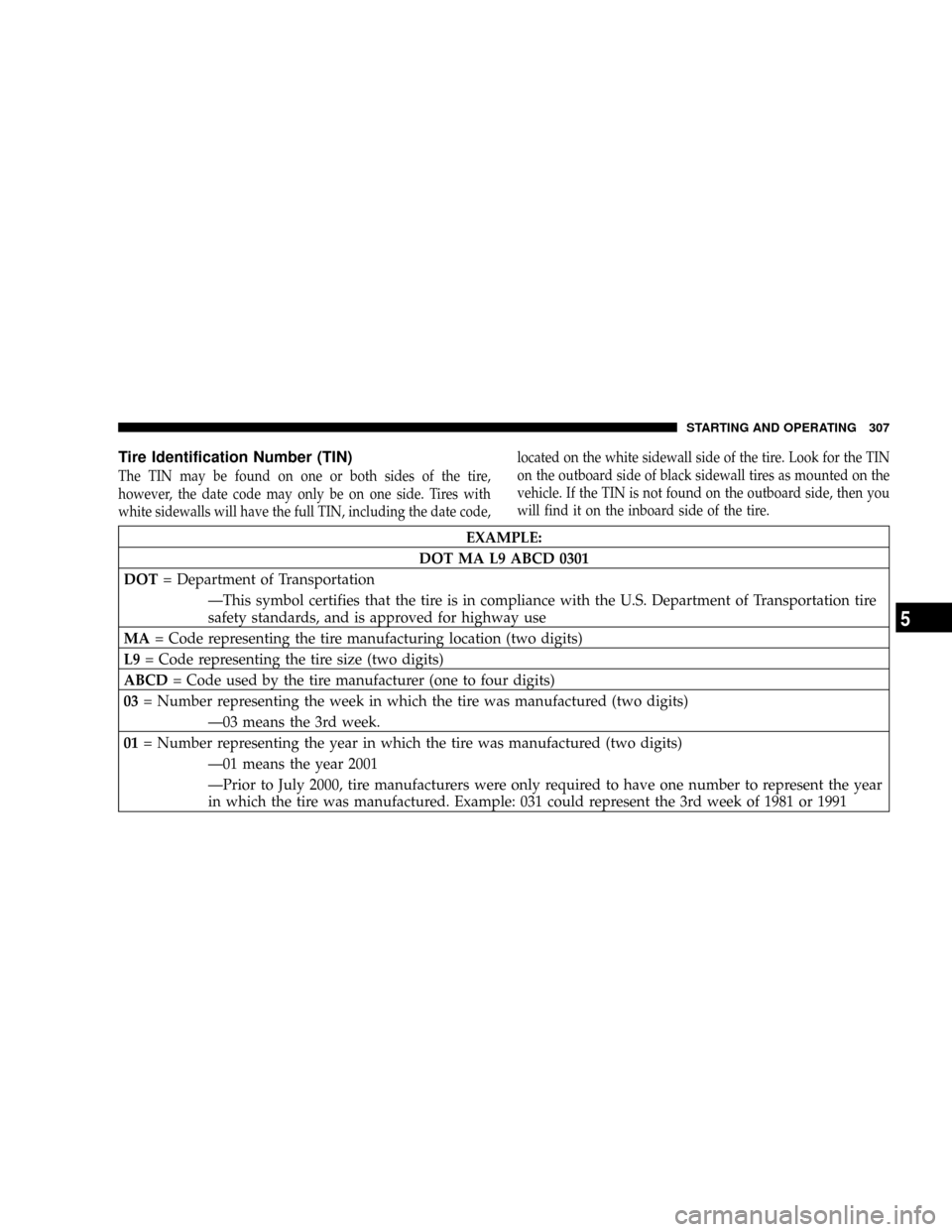
The TIN may be found on one or both sides of the tire,
however, the date code may only be on one side. Tires with
white sidewalls will have the full TIN, including the date code,located on the white sidewall side of the tire. Look for the TIN
on the outboard side of black sidewall tires as mounted on the
vehicle. If the TIN is not found on the outboard side, then you
will find it on the inboard side of the tire.
EXAMPLE:
DOT MA L9 ABCD 0301
DOT= Department of Transportation
ÐThis symbol certifies that the tire is in compliance with the U.S. Department of Transportation tire
safety standards, and is approved for highway use
MA= Code representing the tire manufacturing location (two digits)
L9= Code representing the tire size (two digits)
ABCD= Code used by the tire manufacturer (one to four digits)
03= Number representing the week in which the tire was manufactured (two digits)
Ð03 means the 3rd week.
01= Number representing the year in which the tire was manufactured (two digits)
Ð01 means the year 2001
ÐPrior to July 2000, tire manufacturers were only required to have one number to represent the year
in which the tire was manufactured. Example: 031 could represent the 3rd week of 1981 or 1991
STARTING AND OPERATING 307
5
Page 309 of 479
Tire Loading and Tire Pressure
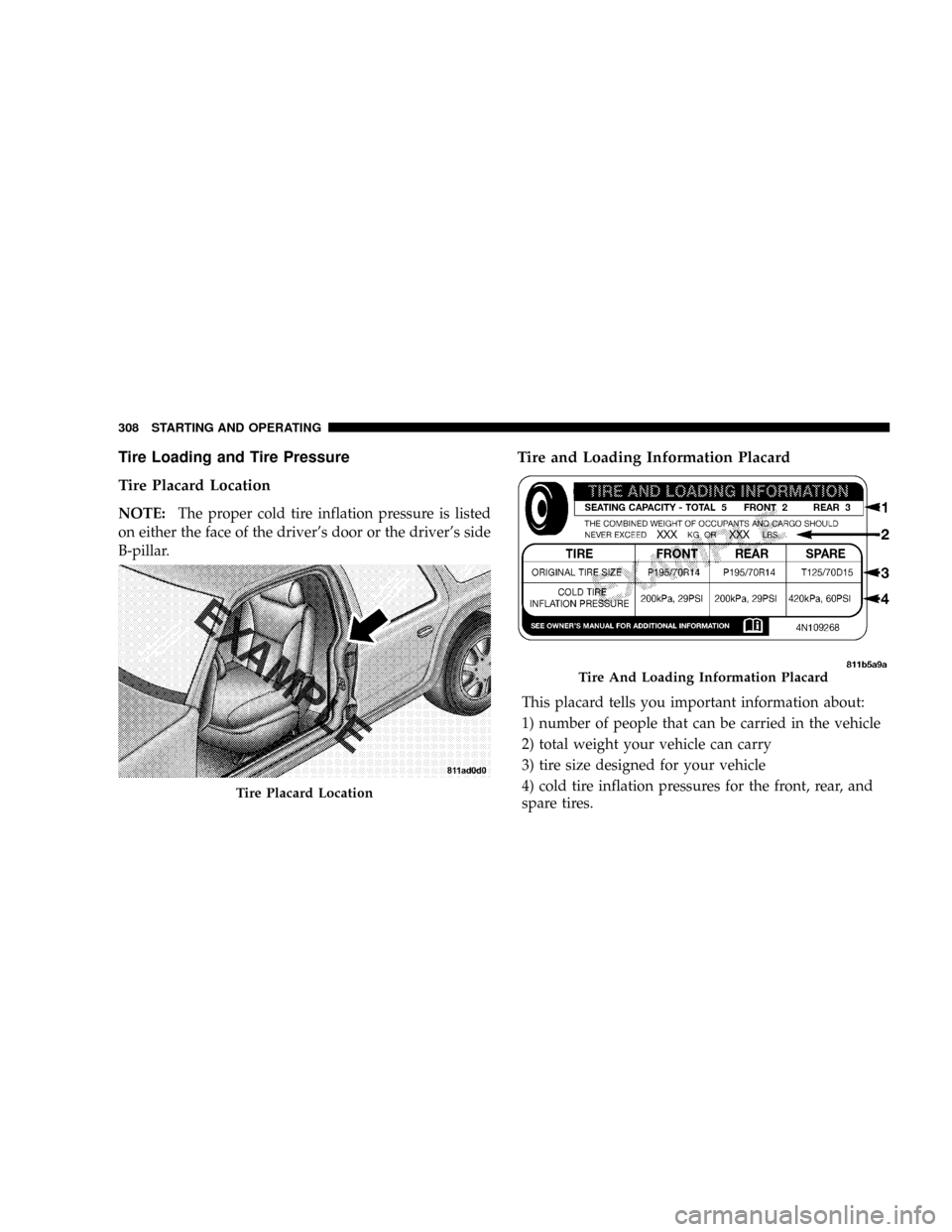
Tire Placard Location
NOTE:The proper cold tire inflation pressure is listed
on either the face of the driver's door or the driver's side
B-pillar.
Tire and Loading Information Placard
This placard tells you important information about:
1) number of people that can be carried in the vehicle
2) total weight your vehicle can carry
3) tire size designed for your vehicle
4) cold tire inflation pressures for the front, rear, and
spare tires.
Tire Placard Location
Tire And Loading Information Placard
308 STARTING AND OPERATING
Page 313 of 479
WARNING!
Overloading of your tires is dangerous. Overloading
can cause tire failure, affect vehicle handling, and
increase your stopping distance. Use tires of the
recommended load capacity for your vehicle. Never
overload them.
TIRES Ð GENERAL INFORMATION
Tire Pressure
Proper tire inflation pressure is essential to the safe and
satisfactory operation of your vehicle. Three primary
areas are affected by improper tire pressure:1. SafetyÐ
WARNING!
²Improperly inflated tires are dangerous and can
cause accidents.
²Under-inflation increases tire flexing and can result
in tire failure.
²Over-inflation reduces a tire's ability to cushion
shock. Objects on the road and chuckholes can cause
damage that result in tire failure.
²Unequal tire pressures can cause steering problems.
You could lose control of your vehicle.
²Over-inflated or under-inflated tires can affect ve-
hicle handling and can fail suddenly, resulting in loss
of vehicle control.
²Unequal tire pressures from one side of the vehicle
to the other can cause the vehicle to drift to the right or
left.
²Always drive with each tire inflated to the recom-
mended cold tire inflation pressure.
312 STARTING AND OPERATING
Page 315 of 479
check tire pressure. Do not make a visual judgement
when determining proper inflation. Radial tires may look
properly inflated even when they are under-inflated.
CAUTION!
After inspecting or adjusting the tire pressure, al-
ways reinstall the valve stem cap (if equipped). This
will prevent moisture and dirt from entering the
valve stem, which could damage the valve stem.
Inflation pressures specified on the placard are always
ªcold tire inflation pressure.º Cold tire inflation pressure
is defined as the tire pressure after the vehicle has not
been driven for at least three hours, or driven less than 1
mi (1.6 km) after a three hour period. The cold tire
inflation pressure must not exceed the maximum infla-
tion pressure molded into the tire sidewall.Check tire pressures more often if subject to a wide range
of outdoor temperatures, as tire pressures vary with
temperature changes.
Tire pressures change by approximately 1 psi (7 kPa) per
12ÉF (7ÉC) of air temperature change. Keep this in mind
when checking tire pressure inside a garage, especially in
the winter.
Example: If garage temperature = 68ÉF (20ÉC) and the
outside temperature = 32ÉF (0ÉC) then the cold tire
inflation pressure should be increased by 3 psi (21 kPa),
which equals 1 psi (7 kPa) for every 12 ÉF (7ÉC) for this
outside temperature condition.
Tire pressure may increase from 2 to 6 psi (13 to 40 kPa)
during operation. DO NOT reduce this normal pressure
build up or your tire pressure will be too low.
314 STARTING AND OPERATING