transmission CHRYSLER ASPEN 2008 2.G User Guide
[x] Cancel search | Manufacturer: CHRYSLER, Model Year: 2008, Model line: ASPEN, Model: CHRYSLER ASPEN 2008 2.GPages: 479, PDF Size: 4.3 MB
Page 207 of 479

charging voltage falls below 10 volts, the malfunction
indicator light illuminates and the ABS is switched off.
When the voltage is above this value again, the malfunc-
tion indicator light should go out and the ABS is opera-
tional. If the malfunction indicator light stays illumi-
nated, have the system checked at your authorized dealer
as soon as possible.
12. Engine Oil Pressure Indicator Light
This light indicates that the engine oil pressure has
become too low. For a bulb check, this light will
come on momentarily when the ignition is turned ON. If
the light turns on while driving, stop the vehicle and shut
off the engine as soon as possible. See your authorized
dealer for service immediately.
13. Tachometer
This gage measures engine Revolutions-Per-Minute
(RPM x 1000).14. Gear Selector
The electronic gear selector display is self-contained
within the instrument cluster. It displays the position of
the automatic transmission shift lever, and the relation of
each position to all other positions. For a good signal the
display will place a box around the selected transmission
range (PRND21). If the PRNDL displays only the char-
acters PRND21 (no boxes), have the system checked by
an authorized dealer.
15. Odometer/Trip Odometer
The odometer shows the total distance the vehicle has
been driven. U.S. federal regulations require that upon
transfer of vehicle ownership, the seller certify to the
purchaser the correct mileage that the vehicle has been
driven. Therefore, if the odometer reading is changed
during repair or replacement, be sure to keep a record of
the reading before and after the service so that the correct
mileage can be determined.
206 INSTRUMENT PANEL AND CONTROLS
Page 210 of 479
ESP/TCS indicator light starts to flash as soon as the tires
lose traction and the ESP system becomes active. The
ESP/TCS indicator light also flashes when TCS is active.
If the ESP/TCS indicator light begins to flash during
acceleration, ease up on the accelerator and apply as little
throttle as possible. Be sure to adapt your speed and
driving to the prevailing road conditions. The ESP/TCS
indicator light becomes illuminated when the ESP-OFF
button has been pressed or ESP is only partially available,
caused by lack of engine management or brake thermal
model.
19. Transmission Temperature Indicator
This light indicates that there is excessive trans-
mission fluid temperature that might occur
with severe usage, such as trailer towing. If this
light comes on, stop the vehicle and run the
engine at idle or faster, with the transmission in NEU-
TRAL until the light goes off.20. Electronic Throttle Control (ETC)
This light informs you of a problem with the
Electronic Throttle Control system. If a prob-
lem is detected, the light will come on while the
engine is running. If the light remains lit with
the engine running your vehicle will usually be drivable,
however, see your authorized dealer for service as soon
as possible. If the light is flashing when the engine is
running, immediate service is required and you may
experience reduced performance, an elevated/rough idle
or engine stall and your vehicle may require towing. The
light will come on when the ignition is first turned on
and remain on for 15 seconds as a bulb check. If the light
does not come on during starting, have the system
checked by your authorized dealer.
21. BRAKE System Warning Light
The red ªBRAKEº warning light will come on when the
ignition key is first turned on, and stay on briefly as a
bulb check. If the bulb does not come on during starting,
INSTRUMENT PANEL AND CONTROLS 209
4
Page 217 of 479
RADIO GENERAL INFORMATION
Radio Broadcast Signals
The radio will provide excellent reception under most
operating conditions. Like any system, however, vehicle
radios have performance limitations, due to mobile op-
eration and natural phenomena, which might lead you to
believe your sound system is malfunctioning. To help
you understand and save you concern about these ªap-
parentº malfunctions, you must understand a point or
two about the transmission and reception of radio sig-
nals.
Two Types of Signals
There are two basic types of radio signals: AM or
Amplitude Modulation, in which the transmitted sound
causes the amplitude, or height, of the radio waves to
vary; and FM or Frequency Modulation, in which the
frequency of the wave is varied to carry the sound.
Electrical Disturbances
Radio waves may pick up electrical disturbances during
transmission. They mainly affect the wave amplitude,
and thus remain a part of the AM reception. They
interfere very little with the frequency variations that
carry the FM signal.
AM Reception
AM sound is based on wave amplitude, so AM reception
can be disrupted by such things as lightning, power lines
and neon signs.
FM Reception
Because FM transmission is based on frequency varia-
tions, interference that consists of amplitude variations
can be filtered out, leaving the reception relatively clear,
which is the major feature of FM radio.
216 INSTRUMENT PANEL AND CONTROLS
Page 268 of 479

STARTING AND OPERATING
CONTENTS
mStarting Procedures.....................271
NAutomatic Transmission................271
NNormal Starting......................271
mEngine Block Heater ± If Equipped..........274
mAutomatic Transmission..................274
NBrake/Transmission Interlock System.......274
NGear Ranges.........................275
NOverdrive Operation...................277
NWhen To Use Tow/Haul Mode...........278NTorque Converter Clutch................279
mFour-Wheel Drive Operation...............280
NNV 140 Transfer Case Operating
Information/Precautions ± If Equipped......280
NNV 244 Generation II Transfer Case Operating
Information / Precautions...............280
NShifting Procedure - NV 244 Generation II
Transfer Case........................284
mDriving On Slippery Surfaces..............286
mDriving Through Water..................286
5
Page 272 of 479
STARTING PROCEDURES
Before starting your vehicle, adjust your seat, adjust both
inside and outside mirrors, and fasten your seat belts.
WARNING!
Be sure to turn off the engine and remove the key
from the ignition switch if you want to rest or sleep
in your car. Accidents can be caused by inadvertently
moving the shift lever or by pressing the accelerator
pedal. This may cause excessive heat in the exhaust
system, resulting in overheating and vehicle fire
which may cause serious or fatal injuries.
WARNING!
Do not leave children or animals inside parked
vehicles in hot weather. Interior heat build up may
cause serious injury or death.
Automatic Transmission
Start the engine with the selector lever in NEUTRAL or
PARK position. Apply the brake before shifting to any
driving range.
Normal Starting
Normal starting of either a warm or cold engine is
obtained without pumping or depressing the accelerator
pedal.
STARTING AND OPERATING 271
5
Page 275 of 479
ENGINE BLOCK HEATER ± IF EQUIPPED
The engine block heater warms the engine coolant and
permits quicker starts in cold weather. Connect the cord
to a standard 110-115 volt AC electrical outlet with a
grounded, three wire extension cord.
The 3.7L/4.7L engine block heater cord is located at the
front of the engine compartment near the radiator cap.
The 5.7L engine block heater cord is located on the left
side of the engine compartment and rearward of the
power distribution center.
WARNING!
Remember to disconnect the cord before driving.
Damage to the 110-115 volt electrical cord could cause
electrocution.
AUTOMATIC TRANSMISSION
The electronic PRNDL on the instrument cluster indicates
the transmission gear selected. The shift lever is mounted
on the right side of the steering column. To drive, move
the shift lever from PARK or NEUTRAL to the desired
drive position. Pull the shift lever toward you when
shifting into REVERSE, 2nd, 1st or PARK, or when
shifting out of PARK.
Brake/Transmission Interlock System
This system prevents you from moving the gear shift out
of PARK and into any gear unless the brake pedal is
pressed. This system is active only while the ignition
switch is in the ON position. Always depress thebrake
pedal first,before moving the gear selector out of PARK.
274 STARTING AND OPERATING
Page 276 of 479
Gear Ranges
DO NOT race the engine when shifting from PARK or
NEUTRAL position into another gear range.
ªPº PARK
Supplements parking brake by locking the transmission.
Engine can be started in this range. Never use PARK
while vehicle is in motion. Apply the parking brake when
leaving the vehicle in this range. Always apply the
parking brake first, then place the shift lever in PARK
position.WARNING!
Your vehicle could move and injure you and others if
it is not completely in PARK. Check by trying to
move the gearshift lever back and forth without first
pulling the lever toward you, after you have set it in
PARK. Make sure it is in PARK before leaving the
vehicle.
WARNING!
Never use the PARK position on an automatic trans-
mission as a substitute for the parking brake. Always
apply the parking brake fully when parked to guard
against vehicle movement and possible injury or
damage.
STARTING AND OPERATING 275
5
Page 277 of 479
WARNING!
It is dangerous to shift the gear shift lever out of
PARK or NEUTRAL if the engine speed is higher
than idle speed. If your foot is not firmly on the
brake pedal, the vehicle could accelerate quickly
forward or in reverse. You could lose control of the
vehicle and hit someone or something. Only shift
into gear when the engine is idling normally and
when your right foot is firmly on the brake pedal.
ªRº REVERSE
Use this range only after the vehicle has come to a
complete stop.ªNº NEUTRAL
Shift to NEUTRAL when the vehicle is standing for
prolonged periods with the engine running. The engine
may be started in this range. Set the parking brake if you
must leave the vehicle.
NOTE:Towing the vehicle (except as specified under
Towing A Disabled Vehicle), coasting, or otherwise driv-
ing the vehicle while in NEUTRAL can cause severe
transmission damage
ªDº DRIVE
For most city and highway driving.
ª2º 2nd
For driving slowly in heavy city traffic or on mountain
roads where more precise speed control is desirable. Use
it also when climbing long grades, and for engine brak-
ing when descending moderately steep grades. To pre-
vent excessive engine speed, do not exceed 45 mph (72
km/h) in this range.
276 STARTING AND OPERATING
Page 278 of 479
ª1º 1st
For driving up very steep hills and for engine braking at
low speeds (25 mph {40 km/h} or less) when going
downhill. To prevent excessive engine speed do not
exceed 25 mph (40 km/h) in this range.
OVERDRIVE Operation
The OVERDRIVE automatic transmission contains an
electronically controlled fourth and fifth (if equipped)
speed (OVERDRIVE). The transmission will automati-
cally shift from DRIVE to OVERDRIVE if the following
conditions are present:
²the transmission selector is in DRIVE;
²the engine coolant has reached normal operating tem-
perature;
²vehicle speed is above approximately 30 mph (48
km/h);
²the TOW/HAUL switch has not been activated;
²transmission has reached normal operating tempera-
ture.
NOTE:If the vehicle is started in extremely cold tem-
peratures, the transmission may not shift into OVER-
DRIVE and will automatically select the most desirable
gear for operation at this temperature. Normal operation
will resume when the transmission fluid temperature has
risen to a suitable level. Refer also to the Note under
torque converter clutch, later in this section.
If the transmission temperature gets extremely hot, the
transmission will automatically select the most desirable
gear for operation at this temperature. If the transmission
temperature becomes hot enough, the ªTRANS TEMPº
light may illuminate and the transmission may down-
shift out of OVERDRIVE until the transmission cools
down. After cooldown, the transmission will resume
normal operation.
STARTING AND OPERATING 277
5
Page 279 of 479
The transmission will downshift from OVERDRIVE to
DRIVE if the accelerator pedal is fully depressed at
vehicle speeds above approximately 35 mph (56 km/h).
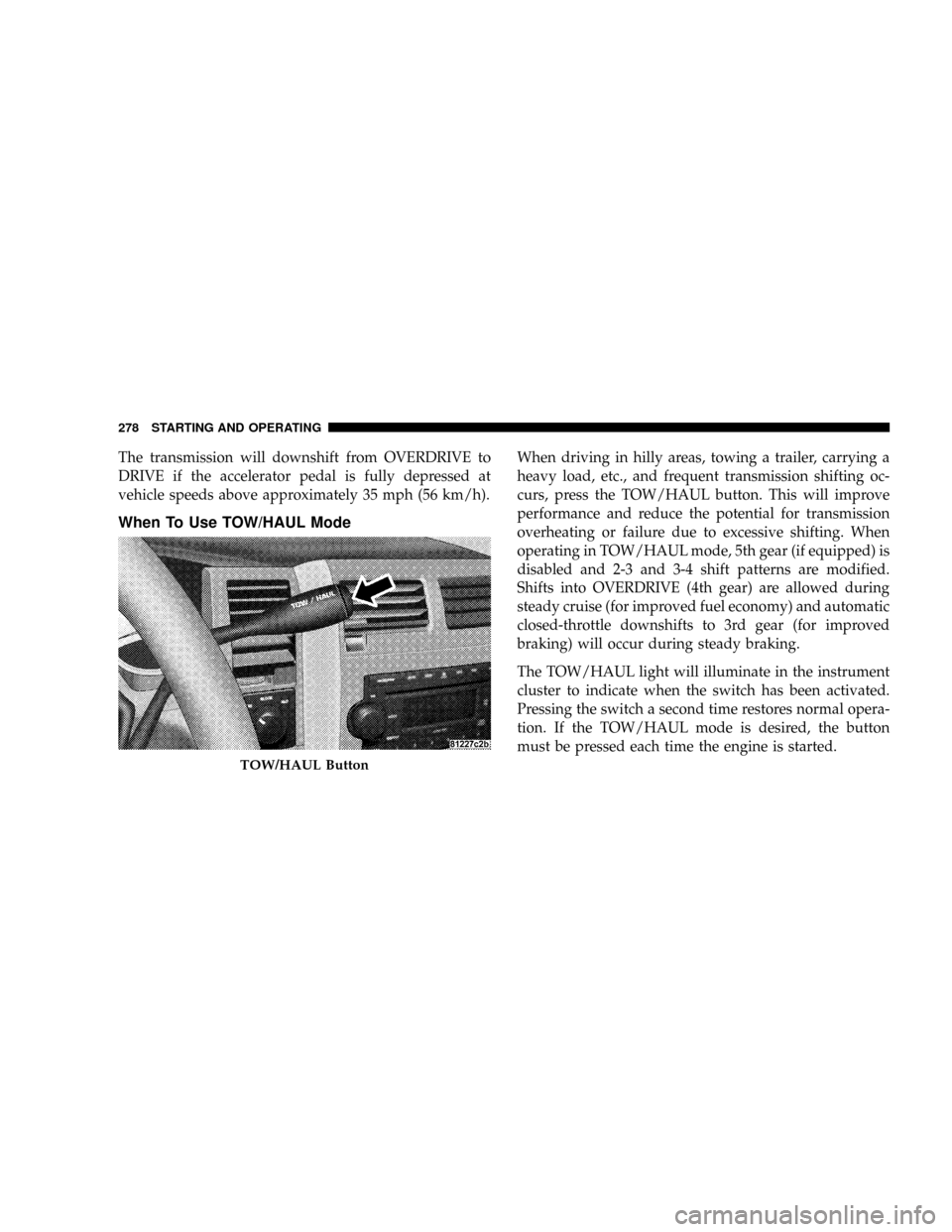
When To Use TOW/HAUL Mode
When driving in hilly areas, towing a trailer, carrying a
heavy load, etc., and frequent transmission shifting oc-
curs, press the TOW/HAUL button. This will improve
performance and reduce the potential for transmission
overheating or failure due to excessive shifting. When
operating in TOW/HAUL mode, 5th gear (if equipped) is
disabled and 2-3 and 3-4 shift patterns are modified.
Shifts into OVERDRIVE (4th gear) are allowed during
steady cruise (for improved fuel economy) and automatic
closed-throttle downshifts to 3rd gear (for improved
braking) will occur during steady braking.
The TOW/HAUL light will illuminate in the instrument
cluster to indicate when the switch has been activated.
Pressing the switch a second time restores normal opera-
tion. If the TOW/HAUL mode is desired, the button
must be pressed each time the engine is started.
TOW/HAUL Button
278 STARTING AND OPERATING