air condition CHRYSLER ASPEN 2008 2.G Owner's Manual
[x] Cancel search | Manufacturer: CHRYSLER, Model Year: 2008, Model line: ASPEN, Model: CHRYSLER ASPEN 2008 2.GPages: 479, PDF Size: 4.3 MB
Page 333 of 479
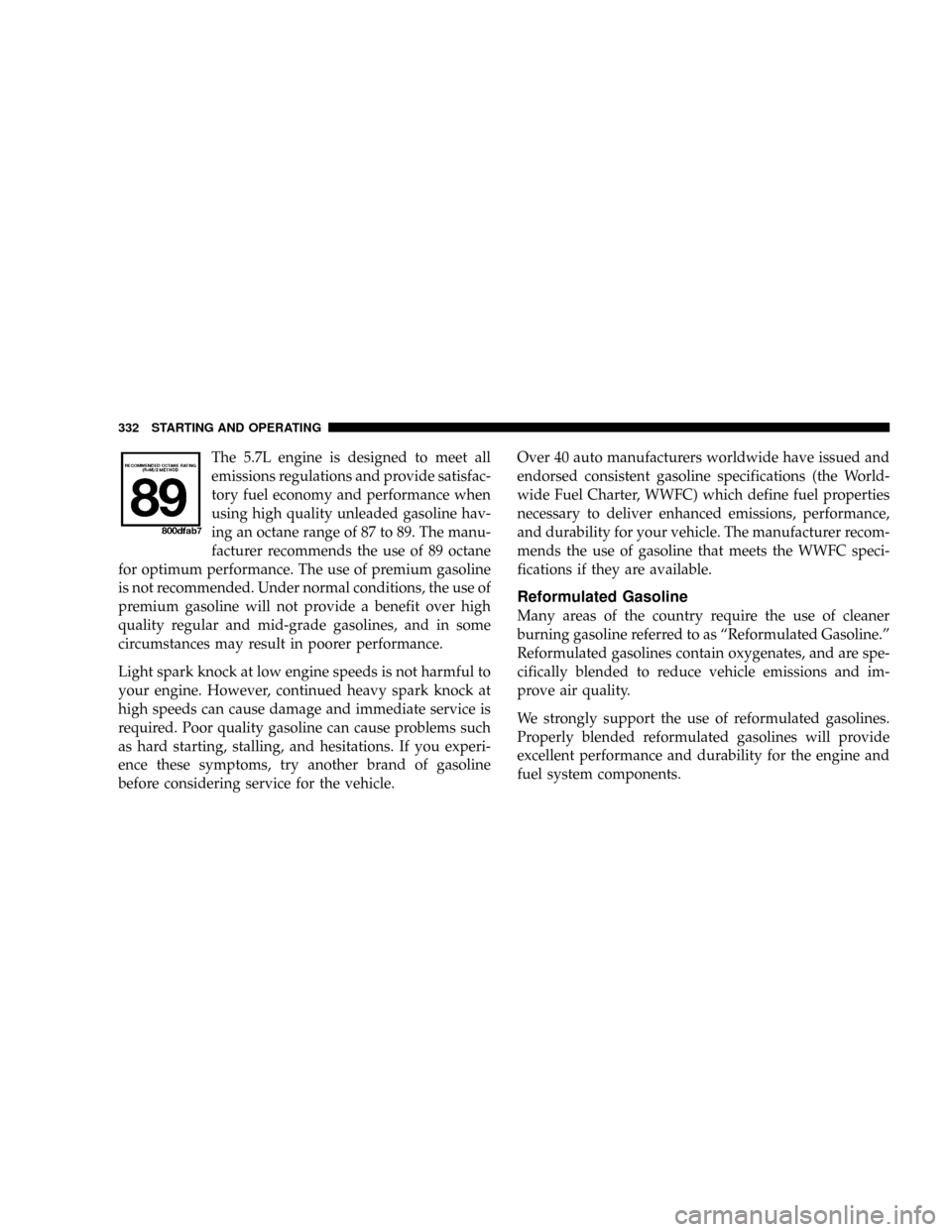
The 5.7L engine is designed to meet all
emissions regulations and provide satisfac-
tory fuel economy and performance when
using high quality unleaded gasoline hav-
ing an octane range of 87 to 89. The manu-
facturer recommends the use of 89 octane
for optimum performance. The use of premium gasoline
is not recommended. Under normal conditions, the use of
premium gasoline will not provide a benefit over high
quality regular and mid-grade gasolines, and in some
circumstances may result in poorer performance.
Light spark knock at low engine speeds is not harmful to
your engine. However, continued heavy spark knock at
high speeds can cause damage and immediate service is
required. Poor quality gasoline can cause problems such
as hard starting, stalling, and hesitations. If you experi-
ence these symptoms, try another brand of gasoline
before considering service for the vehicle.Over 40 auto manufacturers worldwide have issued and
endorsed consistent gasoline specifications (the World-
wide Fuel Charter, WWFC) which define fuel properties
necessary to deliver enhanced emissions, performance,
and durability for your vehicle. The manufacturer recom-
mends the use of gasoline that meets the WWFC speci-
fications if they are available.
Reformulated Gasoline
Many areas of the country require the use of cleaner
burning gasoline referred to as ªReformulated Gasoline.º
Reformulated gasolines contain oxygenates, and are spe-
cifically blended to reduce vehicle emissions and im-
prove air quality.
We strongly support the use of reformulated gasolines.
Properly blended reformulated gasolines will provide
excellent performance and durability for the engine and
fuel system components.
332 STARTING AND OPERATING
Page 335 of 479
of gasoline may not be indicated on the gasoline pump,
therefore, you should ask your gasoline retailer whether
or not his/her gasoline contains MMT. It is even more
important to look for gasolines without MMT in Canada,
because MMT can be used at levels higher than those
allowed in the United States. MMT is prohibited in
Federal and California reformulated gasoline.
Materials Added To Fuel
All gasolines sold in the United States are required to
contain effective detergent additives. Use of additional
detergents or other additives is not needed under normal
conditions and would result in unnecessary cost. There-
fore, you should not have to add anything to the fuel.
Fuel System Cautions
CAUTION!
Follow these guidelines to maintain your vehicle's performance:
²The use of leaded gas is prohibited by Federal law. Using
leaded gasoline can impair engine performance, damage the
emission control system.
²An out-of-tune engine, or certain fuel or ignition malfunc-
tions, can cause the catalytic converter to overheat. If you
notice a pungent burning odor or some light smoke, your
engine may be out of tune or malfunctioning and may require
immediate service. Contact your authorized dealer for service
assistance.
²When pulling a heavy load or driving a fully loaded vehicle
when the humidity is low and the temperature is high, use a
premium unleaded fuel to help prevent spark knock. If spark
knock persists, lighten the load, or engine piston damage may
result.
²The use of fuel additives which are now being sold as octane
enhancers is not recommended. Many of these products con-
tain high concentrations of methanol. Fuel system damage or
vehicle performance problems resulting from the use of such
fuels or additives is not the responsibility of the manufacturer.
334 STARTING AND OPERATING
Page 336 of 479

NOTE:Intentional tampering with emissions control
systems can result in civil penalties being assessed
against you.Carbon Monoxide Warnings
WARNING!
Carbon monoxide (CO) in exhaust gases is deadly. Follow the
precautions below to prevent carbon monoxide poisoning:
²Do not inhale exhaust gases. They contain carbon monox-
ide, a colorless and odorless gas which can kill. Never run
the engine in a closed area, such as a garage, and never sit
in a parked vehicle with the engine running for an
extended period. If the vehicle is stopped in an open area
with the engine running for more than a short period,
adjust the ventilation system to force fresh, outside air
into the vehicle.
²Guard against carbon monoxide with proper maintenance.
Have the exhaust system inspected every time the vehicle
is raised. Have any abnormal conditions repaired
promptly. Until repaired, drive with all side windows
fully open.
²Keep the liftgate closed when driving your vehicle to
prevent carbon monoxide and other poisonous exhaust
gases from entering the vehicle.
STARTING AND OPERATING 335
5
Page 359 of 479

NOTE:Check the automatic transmission fluid level
before towing.
Towing Tips Ð Tow/Haul (If Equipped)
To reduce potential for automatic transmission overheat-
ing, turn the TOW/HAUL feature ON when driving in
hilly areas or shift the transmission to Drive position 2 on
more severe grades.
Towing Tips Ð Electronic Speed Control (If
Equipped)
þ
Don't use in hilly terrain or with heavy loads.
þWhen using the speed control, if you experience speed
drops greater than 10 mph (16 km/h), disengage until
you can resume cruising speed.
þUse speed control in flat terrain and with light loads to
maximize fuel efficiency.
Towing Tips Ð Cooling System
To reduce potential for engine and transmission over-
heating, take the following actions:
þCity Driving
When stopped for short periods of time, put transmission
in NEUTRAL and increase engine idle speed.
þHighway Driving
Reduce speed.
þAir Conditioning
Turn off temporarily.
þrefer to ªCooling System Operatingº under ªMainte-
nance Proceduresº in section 8.
358 STARTING AND OPERATING
Page 382 of 479
MAINTAINING YOUR VEHICLE
CONTENTS
mEngine Compartment 4.7L V-8..............384
mEngine Compartment 5.7L HEMI V-8.........385
mOnboard Diagnostic System Ð OBD II........386
NLoose Fuel Filler Cap Message............386
mEmissions Inspection And Maintenance
Programs............................387
mReplacement Parts......................388
mDealer Service.........................389
mMaintenance Procedures..................389NEngine Oil..........................390
NEngine Oil Filter......................393
NDrive Belts Ð Check Condition And Tension . . 393
NSpark Plugs.........................394
NEngine Air Cleaner Filter................394
NEngine Fuel Filter.....................395
NCatalytic Converter....................395
NMaintenance Free Battery................396
NPower Steering Ð Fluid Check............398
7
Page 383 of 479
NAir Conditioner Maintenance.............398
NFront Suspension Ball Joints..............399
NDrive Shaft Constant Velocity Joints........400
NBody Lubrication.....................400
NWindshield Wiper Blades................400
NWindshield And Rear Window Washers.....401
NExhaust System......................401
NCooling System.......................402
NEmission Related Components............407
NBrake System........................408
NAutomatic Transmission................410
NTransfer Case........................413
NAxles..............................413NAppearance Care And Protection From
Corrosion...........................414
mFuse Block............................419
NFuses (Interior).......................420
NFuses (Power Distribution Center).........423
NFuses (Integrated Power Module)..........426
mVehicle Storage........................428
mReplacement Light Bulbs.................429
mBulb Replacement......................429
NHeadlights/Parking/Turn Signal..........429
NTail Lights, Turn Signals And Backup Lights Ð
Replacement.........................431
NLicense Lights........................433
NCenter High-Mounted Stoplight...........434
382 MAINTAINING YOUR VEHICLE
Page 392 of 479

Change Engine Oil
Follow the Maintenance Schedule for recommended en-
gine oil and filter change intervals.
NOTE:Under no circumstances should oil change in-
tervals exceed 6,000 miles (10 000 km) or 6 months,
whichever comes first.
4x4 Models, If Used Primarily For Off-Road Operation
Every 50 hours of use.
Dusty Conditions
Driving through dust-laden air increases the problems of
keeping abrasive materials out of the engine. Under these
conditions, special attention should be given to the
engine air cleaner and the crankcase inlet air cleaner. The
crankcase ventilation system should also be checked
periodically. Make sure that these units are always clean.
This will tend to reduce to a minimum the amount of
abrasive material that may enter the engine.
Engine Oil Selection
For best performance and maximum protection under all
types of operating conditions, the manufacturer only
recommends engine oils that are API certified and meet
the requirements of DaimlerChrysler Material Standard
MS-6395.
American Petroleum Institute (API) Engine Oil
Identification Symbol
This symbol means that the oil has
been certified by the American
Petroleum Institute (API). The
manufacturer only recommends
API Certified engine oils.
MAINTAINING YOUR VEHICLE 391
7
Page 399 of 479
Power Steering Ð Fluid Check
Checking the power steering fluid level at a defined
service interval is not required. The fluid should only be
checked if a leak is suspected, abnormal noises are
apparent, and/or the system is not functioning as antici-
pated. Coordinate inspection efforts through an autho-
rized DaimlerChrysler dealership.
WARNING!
Fluid level should be checked on a level surface and
with the engine off to prevent injury from moving
parts and to ensure accurate fluid level reading. Do
not overfill. Use only manufacturers recommended
power steering fluid.If necessary, add fluid to restore to the proper indicated
level. With a clean cloth, wipe any spilled fluid from all
surfaces. For correct fluid type, refer to ºPower Steering
Reservoirº under ªFluids, Lubricants, and Genuine
Partsº in this section.
Air Conditioner Maintenance
For best possible performance, your air conditioner
should be checked and serviced by an authorized dealer
at the start of each warm season. This service should
include cleaning of the condenser fins and a performance
test. Drive belt tension should also be checked at this
time.
398 MAINTAINING YOUR VEHICLE
Page 400 of 479
WARNING!
²Use only refrigerants and compressor lubricants
approved by the manufacturer for your air condi-
tioning system. Some unapproved refrigerants are
flammable and can explode, injuring you. Other
unapproved refrigerants or lubricants can cause
the system to fail, requiring costly repairs. Refer to
Section 3 of the Warranty Information book for
further warranty information.
²The air conditioning system contains refrigerant
under high pressure. To avoid risk of personal
injury or damage to the system, adding refrigerant
or any repair requiring lines to be disconnected
should be done by an experienced technician.NOTE:Use only manufacturer approved A/C System
Sealers, Stop Leak Products, Seal Conditioners, Compres-
sor Oils and Refrigerants.
Refrigerant Recovery and Recycling
R-134a air conditioning refrigerant is a hydrofluorocar-
bon (HFC) that is endorsed by the Environmental Pro-
tection Agency and is an ozone-saving product. How-
ever, the manufacturer recommends that air conditioning
service be performed by authorized dealers or other
service facilities using recovery and recycling equipment.
Front Suspension Ball Joints
The ball joints and seals should be inspected whenever
the vehicle is serviced for other reasons. Damaged seals
should be replaced to prevent leakage or contamination
of the grease.
MAINTAINING YOUR VEHICLE 399
7
Page 408 of 479
²Do not overfill the coolant recovery bottle.
²Check coolant freeze point in the radiator and in the
coolant recovery bottle. If antifreeze needs to be
added, contents of coolant recovery bottle must also be
protected against freezing.
²If frequent coolant additions are required, or if the
level in the coolant recovery bottle does not drop when
the engine cools, the cooling system should be pres-
sure tested for leaks.
²Maintain coolant concentration at 50% HOAT engine
coolant (minimum) and distilled/deionized water for
proper corrosion protection of your engine which
contains aluminum components.
²Make sure that the radiator and coolant recovery
bottle overflow hoses are not kinked or obstructed.
²Keep the front of the radiator clean. If your vehicle is
equipped with air conditioning, keep the front of the
condenser clean, also.
²Do not change the thermostat for summer or winter
operation. If replacement is ever necessary, install
ONLY the correct type thermostat. Other designs may
result in unsatisfactory coolant performance, poor gas
mileage, and increased emissions.
Emission Related Components
Fuel System Hoses and Vapor/Vacuum Harnesses
When the vehicle is serviced for scheduled maintenance,
inspect surface of hoses and nylon tubing for evidence of
heat and mechanical damage. Hard and brittle rubber,
cracking, checking, tears, cuts, abrasions, and excessive
swelling suggest deterioration of the rubber. Particular
attention should be given to examining hose surfaces
nearest to high heat sources, such as the exhaust mani-
fold.
MAINTAINING YOUR VEHICLE 407
7