maintenance CHRYSLER ASPEN 2008 2.G Owner's Guide
[x] Cancel search | Manufacturer: CHRYSLER, Model Year: 2008, Model line: ASPEN, Model: CHRYSLER ASPEN 2008 2.GPages: 479, PDF Size: 4.3 MB
Page 413 of 479

CAUTION!
Be aware that if the fluid temperature is below 50ÉF
(10ÉC) it may not register on the dipstick. Do not add
fluid until the temperature is elevated enough to
produce an accurate reading.
7. Check for leaks. Release parking brake.
To prevent dirt and water from entering the transmission
after checking or replenishing fluid, make certain that the
dipstick cap is properly reseated. It is normal for the
dipstick cap to spring back slightly from its fully seated
position, as long as its seal remains engaged in the
dipstick tube.
Automatic Transmission Fluid And Filter Change
Follow the Maintenance Schedule for recommended
transmission fluid and filter change intervals.
Selection of Lubricant
It is important that the proper lubricant is used in the
transmission to assure optimum transmission perfor-
mance. Use only manufacturer 's recommended transmis-
sion fluid; for correct fluid type, refer to ªAutomatic
Transmissionº under ªFluids, Lubricants and Genuine
Partsº in this section. It is important that the transmission
fluid be maintained at the prescribed level using the
recommended fluid.
Special Additives
Automatic Transmission Fluid (ATF) is an engineered
product and its performance may be impaired by supple-
mental additives. Therefore, do not add any fluid addi-
tives to the transmission. The only exception to this
policy is the use of special dyes to aid in detecting fluid
leaks. In addition, avoid using transmission sealers as
they may adversely affect seals.
412 MAINTAINING YOUR VEHICLE
Page 414 of 479
CAUTION!
Using a transmission fluid other than the manufac-
turer's recommended fluid may cause deterioration
in transmission shift quality and/or torque converter
shudder. Using a transmission fluid other than the
manufacturer's recommended fluid will result in
more frequent fluid and filter changes. For correct
fluid type, refer to ªAutomatic Transmissionº under
ªFluids, Lubricants and Genuine Partsº in this
section.
Transfer Case
Inspect the transfer case for fluid leaks. If a fluid leak is
evident the transfer case fluid level may be low. Have the
transfer case serviced immediately.
CAUTION!
Damage may result from operation of the vehicle
with low transfer case fluid.
Drain And Refill
Follow the Maintenance Schedule for recommended
transfer case fluid change intervals.
Lubricant Selection
For correct fluid type, refer to ºTransfer Caseº under
ªFluids, Lubricants and Genuine Partsº in this section.
Axles
For correct fluid type, refer to ºFront or Rear Axleº under
ªFluids, Lubricants and Genuine Partsº in this section.
Drain And Refill
Follow the Maintenance Schedule for recommended axle
fluid change intervals.
MAINTAINING YOUR VEHICLE 413
7
Page 415 of 479
NOTE:The presence of water in the gear lubricant will
result in corrosion and possible failure of differential
components. Operation of the vehicle in water, as may be
encountered in some off-highway types of service, will
require draining and refilling the axle to avoid damage.
Rear Axle
Rear Axle fluid levels should be 7/8 in (22 mm) +/- 1/4
in (6 mm) below the fill hole for 8 1/4 in (21 cm) and 9
1/4 (23 cm) in axles should be 1 5/8 in (31 mm) +/- 1/4
in (6 mm)
Front Axle
Front axle fluid level should be 3/4 in (20 mm) +/- 1/4 in
(6 mm) below the level of the fill hole.
Appearance Care and Protection From Corrosion
Protection of Body and Paint from Corrosion
Vehicle body care requirements vary according to geo-
graphic locations and usage. Chemicals that make roads
passable in snow and ice, and those that are sprayed on
trees and road surfaces during other seasons, are highly
corrosive to the metal in your vehicle. Outside parking,
which exposes your vehicle to airborne contaminants,
road surfaces on which the vehicle is operated, extreme
hot or cold weather and other extreme conditions will
have an adverse effect on paint, metal trim, and under-
body protection.
The following maintenance recommendations will enable
you to obtain maximum benefit from the corrosion
resistance built into your vehicle.
What Causes Corrosion?
Corrosion is the result of deterioration or removal of
paint and protective coatings from your vehicle.
414 MAINTAINING YOUR VEHICLE
Page 420 of 479
Seat Belt Maintenance
Do not bleach, dye or clean the belts with chemical
solvents or abrasive cleaners. This will weaken the fabric.
Sun damage will also weaken the fabric.
If the belts need cleaning, use a mild soap solution or
lukewarm water. Do not remove the belts from the
vehicle to wash them.
Replace the belts if they appear frayed or worn or if the
buckles do not work properly.
FUSE BLOCK
CAUTION!
When replacing a blown fuse, it is important to use
only a fuse having the correct amperage rating. The
use of a fuse with a rating other than indicated may
result in a dangerous electrical system overload. If a
properly rated fuse continues to blow, it suggests a
problem in the circuit that must be corrected.
NOTE:If you are leaving your vehicle dormant for
longer than 21 days you may want to take steps to protect
your battery. You may do this by disconnecting the
battery or by disconnecting the two ignition-off draw
(I.O.D.) fuses located in the auxiliary Power Distribution
Center (PDC) in the engine compartment. The I.O.D.
cavities include a snap-in retainer that allows the fuse to
be disconnected without removing it from the fuse block.
Pressing the I.O.D. fuse back into the cavity reconnects it.
MAINTAINING YOUR VEHICLE 419
7
Page 440 of 479
MAINTENANCE SCHEDULES
CONTENTS
mEmission Control System Maintenance........440
mMaintenance Schedule...................440NRequired Maintenance Intervals...........442
8
M
A
I
N
T
E
N
A
N
C
E
S
C
H
E
D
U
L
E
S
Page 441 of 479

EMISSION CONTROL SYSTEM MAINTENANCE
The ªScheduledº maintenance services, listed inbold
typeon the following pages, must be done at the times or
mileages specified to assure the continued proper func-
tioning of the emission control system. These, and all
other maintenance services included in this manual,
should be done to provide best vehicle performance and
reliability. More frequent maintenance may be needed for
vehicles in severe operating conditions such as dusty
areas and very short trip driving.
Inspection and service also should be done anytime a
malfunction is suspected.
NOTE:Maintenance, replacement, or repair of the emis-
sion control devices and systems on your vehicle may be
performed by any automotive repair establishment or
individual, using any automotive part that has been
certified pursuant to U.S. EPA or, in the State of Califor-
nia, California Air Resources Board regulations.
MAINTENANCE SCHEDULE
The oil change indicator system will remind you that it is
time to take your vehicle in for scheduled maintenance.
On Electronic Vehicle Information Center (EVIC)
equipped vehicles ªOil Change Requiredº will be dis-
played in the EVIC and a single chime will sound,
indicating that an oil change is necessary.
On non-EVIC equipped vehicles ªChange Oilº will flash
in the instrument cluster odometer and a single chime
will sound, indicating that an oil change is necessary.
Based on engine operation conditions the oil change
indicator message will illuminate, this means that service
is required for your vehicle. Have your vehicle serviced
as soon as possible, within the next 500 mi (805 km).
NOTE:
²The oil change indicator message will not monitor the
time since the last oil change. Change your vehicle's
440 MAINTENANCE SCHEDULES
8
M
A
I
N
T
E
N
A
N
C
E
S
C
H
E
D
U
L
E
S
Page 442 of 479
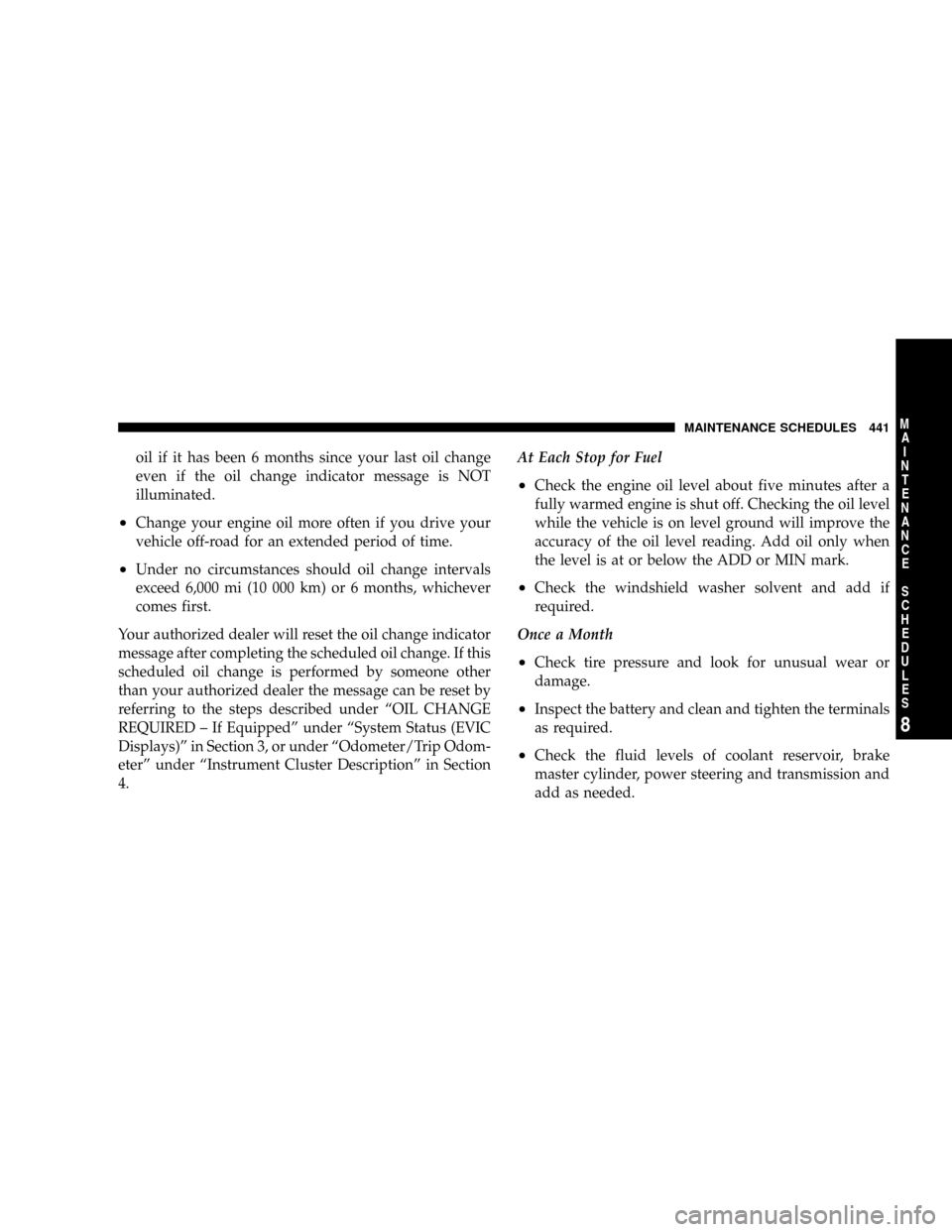
oil if it has been 6 months since your last oil change
even if the oil change indicator message is NOT
illuminated.
²Change your engine oil more often if you drive your
vehicle off-road for an extended period of time.
²Under no circumstances should oil change intervals
exceed 6,000 mi (10 000 km) or 6 months, whichever
comes first.
Your authorized dealer will reset the oil change indicator
message after completing the scheduled oil change. If this
scheduled oil change is performed by someone other
than your authorized dealer the message can be reset by
referring to the steps described under ªOIL CHANGE
REQUIRED ± If Equippedº under ªSystem Status (EVIC
Displays)º in Section 3, or under ªOdometer/Trip Odom-
eterº under ªInstrument Cluster Descriptionº in Section
4.At Each Stop for Fuel
²Check the engine oil level about five minutes after a
fully warmed engine is shut off. Checking the oil level
while the vehicle is on level ground will improve the
accuracy of the oil level reading. Add oil only when
the level is at or below the ADD or MIN mark.
²Check the windshield washer solvent and add if
required.
Once a Month
²Check tire pressure and look for unusual wear or
damage.
²Inspect the battery and clean and tighten the terminals
as required.
²Check the fluid levels of coolant reservoir, brake
master cylinder, power steering and transmission and
add as needed.
MAINTENANCE SCHEDULES 441
8
M
A
I
N
T
E
N
A
N
C
E
S
C
H
E
D
U
L
E
S
Page 443 of 479

²Check all lights and other electrical items for correct
operation.
At Each Oil Change
²Change the engine oil filter.
²Inspect the brake hoses and lines.
CAUTION!
Failure to perform the required maintenance items
may result in damage to the vehicle.
Required Maintenance Intervals
NOTE:** Vehicles built with the 4.7L engine are
equipped with 16 spark plugs; one set is located on the
top of the engine under the coils and the second set is
located on the side of the engine.
The spark plugs located under the coils are a standard
plug and must be changed every 30,000 mi (50 000 km).
The spark plugs located on the side of the engine are a
premium plug and must be changed every 102,000 mi
(170 000 km).
442 MAINTENANCE SCHEDULES
8
M
A
I
N
T
E
N
A
N
C
E
S
C
H
E
D
U
L
E
S
Page 444 of 479

Perform Maintenance Every(Where time and mileage
are listed, follow the interval that occurs first.)
Maintenance Items Miles Kilometers or Months
Change the engine oil and engine oil filter. 6,000 10 000 6
Rotate tires. 6,000 10 000 6
If using your vehicle for any of the following: Dusty or
off-road conditions. Inspect the engine air cleaner filter;
replace if necessary.12,000 20 000 12
Inspect the brake linings; replace if necessary. 12,000 20 000 12
Inspect the front and rear axle fluid; change if using your
vehicle for police, taxi, fleet, off-road or frequent trailer
towing.18,000 30 000 18
Inspect the CV joints. Perform the first inspection at
12,000 mi (20 000 km) or 12 months.24,000 40 000 24
Inspect exhaust system. Perform the first inspection at
12,000 mi (20 000 km) or 12 months.24,000 40 000 24
Inspect the front suspension, tie rod ends and boot seals;
replace if necessary.24,000 40 000 24
MAINTENANCE SCHEDULES 443
8
M
A
I
N
T
E
N
A
N
C
E
S
C
H
E
D
U
L
E
S
Page 445 of 479
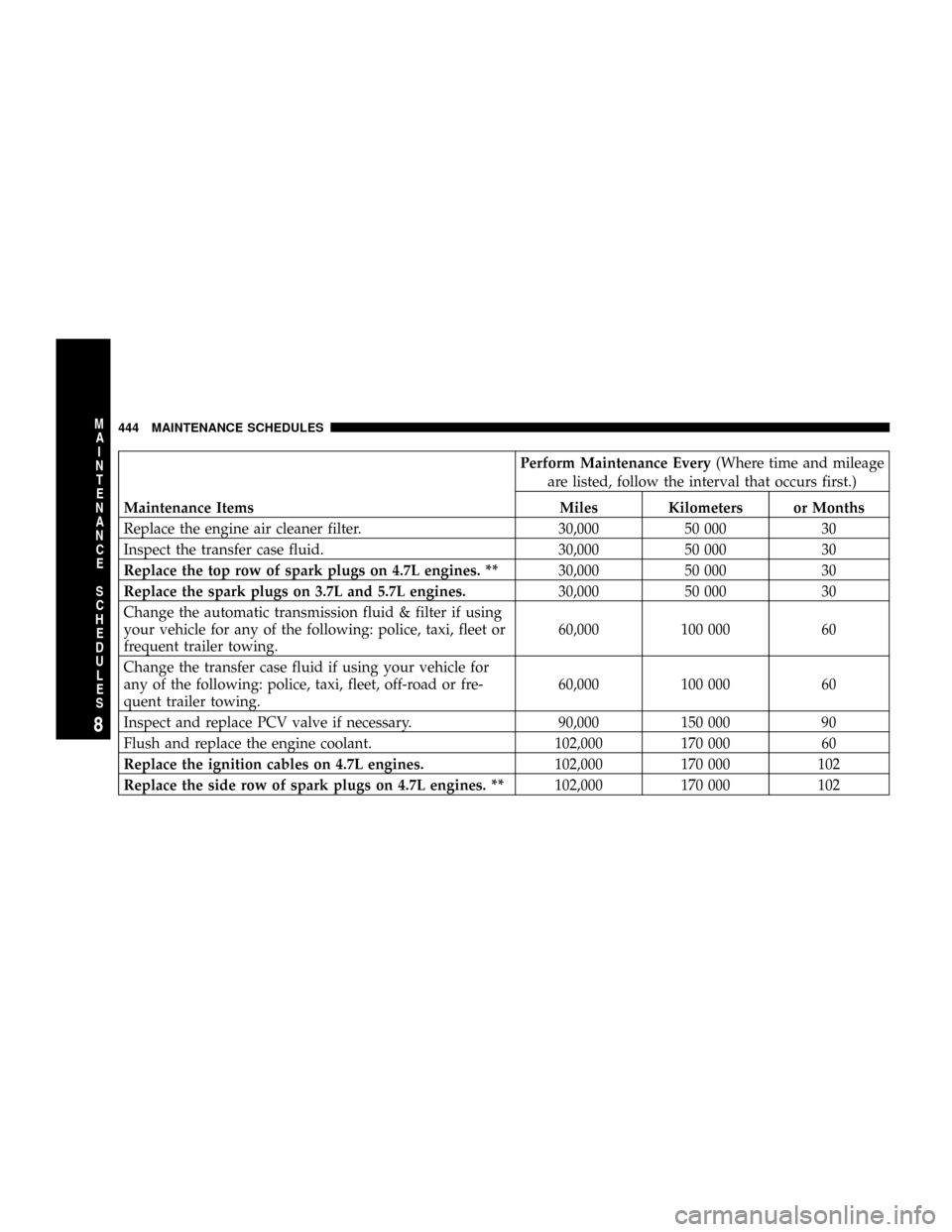
Perform Maintenance Every(Where time and mileage
are listed, follow the interval that occurs first.)
Maintenance Items Miles Kilometers or Months
Replace the engine air cleaner filter. 30,000 50 000 30
Inspect the transfer case fluid. 30,000 50 000 30
Replace the top row of spark plugs on 4.7L engines. **30,000 50 000 30
Replace the spark plugs on 3.7L and 5.7L engines.30,000 50 000 30
Change the automatic transmission fluid & filter if using
your vehicle for any of the following: police, taxi, fleet or
frequent trailer towing.60,000 100 000 60
Change the transfer case fluid if using your vehicle for
any of the following: police, taxi, fleet, off-road or fre-
quent trailer towing.60,000 100 000 60
Inspect and replace PCV valve if necessary. 90,000 150 000 90
Flush and replace the engine coolant. 102,000 170 000 60
Replace the ignition cables on 4.7L engines.102,000 170 000 102
Replace the side row of spark plugs on 4.7L engines. **102,000 170 000 102
444 MAINTENANCE SCHEDULES
8
M
A
I
N
T
E
N
A
N
C
E
S
C
H
E
D
U
L
E
S