key CHRYSLER ASPEN 2008 2.G Repair Manual
[x] Cancel search | Manufacturer: CHRYSLER, Model Year: 2008, Model line: ASPEN, Model: CHRYSLER ASPEN 2008 2.GPages: 479, PDF Size: 4.3 MB
Page 331 of 479
the pressure value(s) indicating which tire pressure
monitoring sensor(s) is not being received.
If the ignition key is cycled, this sequence will repeat,
providing the system fault still exists. If the system fault
no longer exists, the Tire Pressure Monitoring Telltale
Light will no longer flash, the9CHECK TPM SYSTEM9
text message will not be present, and a pressure value
will be displayed instead of dashes. A system fault can
occur by any of the following scenarios: 1) Jamming due
to electronic devices or driving next to facilities emitting
the same radio frequencies as the TPM sensors;. 2)
Installing some form of aftermarket window tinting that
affects radio wave signals; 3) Lots of snow or ice around
the wheels or wheel housings; 4) Using tire chains on the
vehicle; 5) Using wheels/tires not equipped with TPM
sensors.
NOTE:Your vehicle is equipped with a non-matching
full size spare wheel and tire assembly.1. This spare tire does not have a tire pressure monitor-
ing sensor. Therefore, the TPMS will not monitor the tire
pressure in the spare tire.
2. If you install the full size spare tire in place of a road
tire that has a pressure below the low-pressure warning
limit, upon the next ignition key cycle, a chime will
sound and the TPM Telltale Light will still turn ON. In
addition, the graphic in the EVIC will still display a
flashing pressure value.
3. However, after driving the vehicle for up to 10 min-
utes above 15 mph (25 km/h), the TPM Telltale Light will
flash on and off for 75 seconds and then remain on solid.
The EVIC will display a ªCHECK TPM SYSTEMº mes-
sage for three seconds and then display dashes (- - -) in
place of the pressure value.
4. For each subsequent ignition key cycle, a chime will
sound and the TPM Telltale Light will flash on and off for
75 seconds and then remain on solid. The EVIC will
330 STARTING AND OPERATING
Page 362 of 479

NOTE:The NV 244 Generation II transfer case must be
shifted into NEUTRAL for recreational towing. The NEU-
TRAL selection button is located on the lower left-hand
corner of the 4WD Control Switch. Shifts into and out of
transfer case NEUTRAL can take place with the selector
switch in any mode position.
Shifting into NEUTRAL
Use the following procedure to prepare your vehicle for
recreational towing.
CAUTION!
It is necessary to follow these steps to be certain that
the transfer case is fully in NEUTRAL before recre-
ational towing to prevent damage to internal parts.
1. Bring vehicle to a complete stop.
2. Shut engine OFF.3. Turn the ignition key to the ON position without
starting the engine.
4. Depress brake pedal.
5. Shift automatic transmission to NEUTRAL.
6. Using the point of a ballpoint pen or similar object,
depress the recessed transfer case NEUTRAL button for
four seconds.
7. After shift is completed and the NEUTRAL light
comes on, release the NEUTRAL button.
8. Start the engine.
9. Shift the automatic transmission into REVERSE.
10. Release brake pedal for five seconds and ensure that
there is no vehicle movement.
11. Repeat steps 9 and 10 with the transmission in
DRIVE.
STARTING AND OPERATING 361
5
Page 363 of 479

12. Turn ignition key to the unlocked OFF position.
13. Shift the automatic transmission into PARK.
14. Attach vehicle to tow vehicle with tow bar.
NOTE:Items 1 through 5 are requirements that must be
met prior to depressing the NEUTRAL selection button,
and must continue to be met until the four seconds
elapses and the shift has been completed.
If any of these requirements (with the exception of Step 3
- Key ON) are not met prior to depressing the NEUTRAL
button or are no longer met during the four second timer,
then the NEUTRAL indicator light will flash continu-
ously until all requirements are met or until the NEU-
TRAL button is released.
NOTE:The ignition key must be ON for a shift to take
place and for the position indicator lights to be operable.
If the key is not ON, the shift will not take place and no
position indicator lights will be on or flashing.CAUTION!
Damage to the transmission may occur if the trans-
mission is shifted into PARK with the transfer case in
NEUTRAL and the engine RUNNING. With the
transfer case in NEUTRAL, ensure that the engine is
OFF prior to shifting the transmission into PARK.
Shifting Out of NEUTRAL
Use the following procedure to prepare your vehicle for
normal usage.
1. Bring vehicle to a complete stop.
2. Shut engine OFF.
3. Turn the ignition key to the ON position without
starting the engine.
4. Depress brake pedal.
362 STARTING AND OPERATING
Page 364 of 479

5. Shift the automatic transmission to NEUTRAL.
6. Using the point of a ballpoint pen or similar object,
depress the recessed transfer case NEUTRAL button for
one second.
7. After the NEUTRAL indicator light turns off, release
the NEUTRAL button.
8. After the NEUTRAL button has been released, the
transfer case will shift to the position identified by the
selector switch.
9. Shift the automatic transmission into PARK.
10. Start the engine.
11. Shift the automatic transmission into DRIVE.NOTE:Steps 1 through 5 are requirements that must be
met prior to depressing the NEUTRAL selection button,
and must continue to be met until one second elapses and
the shift has been completed.
If any of these requirements are not met prior to depress-
ing the NEUTRAL button or are no longer met during the
one second time, then all of the position indicator lights
will flash continuously until all requirements are met or
until the NEUTRAL button is released.
NOTE:The ignition key must be ON for a shift to take
place and for the position indicator lights to be operable.
If the key is not ON, the shift will not take place and no
position indicator lights will be on or flashing.
NOTE:A flashing NEUTRAL position indicator light
indicates that shift requirements have not been met.
STARTING AND OPERATING 363
5
Page 368 of 479
If it is necessary to leave the vehicle to go for service, the
flasher system will continue to operate with the ignition
key removed and the vehicle locked.JACKING AND TIRE CHANGING
WARNING!
²Being under a jacked-up vehicle is dangerous. The
vehicle could slip off the jack and fall on you. You
could be crushed. Never put any part of your body
under a vehicle that is on a jack. Never start or run
the engine while the vehicle is on a jack. If you
need to get under a raised vehicle, take it to a
service center where it can be raised on a lift.
²The jack is designed to use as a tool for changing
tires only. The jack should not be used to lift the
vehicle for service purposes. The vehicle should
be jacked on a firm level surface only. Avoid ice or
slippery areas.
WHAT TO DO IN EMERGENCIES 367
6
Page 381 of 479
Four-Wheel Drive Vehicles
The manufacturer recommends towing with all wheels
OFFthe ground. Acceptable methods are to tow the
vehicle on a flatbed or with one end of the vehicle raised
and the opposite end on a towing dolly.
Two-Wheel Drive Vehicles
Provided that the transmission is operable, tow with the
transmission in NEUTRAL and the ignition key in the
OFF position, along with the front wheels raised and the
rear wheels on the ground. The speed must not exceed 30
mph (50 km/h), and the distance must not exceed 15 mi
(25 km).If the vehicle is to be towed more than 15 mi (25 km) or
faster than 30 mph (50 km/h), it must be towed on a
flatbed, or with the rear wheels raised and the front
wheels on the ground, or with the front end raised and
the rear wheels on a towing dolly.
NOTE:Towing the vehicle with the rear wheels on the
ground at more than 30 mph (50 km/h) or for more than
15 mi (25 km), can cause severe transmission damage.
380 WHAT TO DO IN EMERGENCIES
Page 388 of 479
the odometer RESET button to turn the message off. If the
problem persists, the message will appear the next time
the vehicle is started. This might indicate a damaged cap.
If the problem is detected twice in a row, the system will
turn on the MIL. Resolving the problem will turn the MIL
off.
EMISSIONS INSPECTION AND MAINTENANCE
PROGRAMS
In some localities, it may be a legal requirement to pass
an inspection of your vehicle's emissions control system.
Failure to pass could prevent vehicle registration.
For states which have an I/M (Inspection and
Maintenance) requirement, this check verifies the
following: the Malfunction Indicator Lamp (MIL)
is functioning and is not on when the engine is running,
and that the On Board Diagnostic (OBD) system is ready
for testing.Normally, the OBD system will be ready. The OBD
system maynotbe ready if your vehicle was recently
serviced, if you recently had a dead battery, or a battery
replacement. If the OBD system is determined not ready
for the I/M test, your vehicle may fail the test.
Your vehicle has a simple ignition key actuated test
which you can use prior to going to the test station. To
check if your vehicle's OBD system is ready, you must do
the following:
1. Insert your ignition key into the ignition switch.
2. Turn the ignition to the ON position, but do not crank
or start the engine. If you crank or start the engine, you
will have to start this test over.
3. As soon as you turn your key to the ON position, you
will see your MIL symbol come on as part of a normal
bulb check.
MAINTAINING YOUR VEHICLE 387
7
Page 389 of 479

4. Approximately 15 seconds later, one of two things will
happen:
a. The MIL will blink for approximately five seconds
and then remain on until the first engine crank or the
key is turned off. This means that your vehicle's OBD
system isnot readyand you shouldnotproceed to the
I/M station.
b. The MIL will remain fully illuminated until the first
engine crank or the key is turned off. This means that
your vehicle's OBD system isreadyand you can
proceed to the I/M station.
If your OBD system isnot ready,you should see your
authorized dealer or repair facility. If your vehicle was
recently serviced or had a battery failure or replacement,
you may need to do nothing more than drive your
vehicle as you normally would in order for your OBD
system to update. A recheck with the above test routine
may then indicate that the system is now ready.Regardless of whether your vehicle's OBD system is
ready or not ready, if the MIL symbol is illuminated
during normal vehicle operation, you should have your
vehicle serviced before going to the I/M station. The I/M
station can fail your vehicle because the MIL symbol is on
with the engine running.
REPLACEMENT PARTS
Use of genuine Mopartparts for normal/scheduled
maintenance and repairs is highly recommended to en-
sure the designed performance. Damage or failures
caused by the use of non-Mopartparts for maintenance
and repairs will not be covered by the manufacturer's
warranty.
388 MAINTAINING YOUR VEHICLE
Page 423 of 479
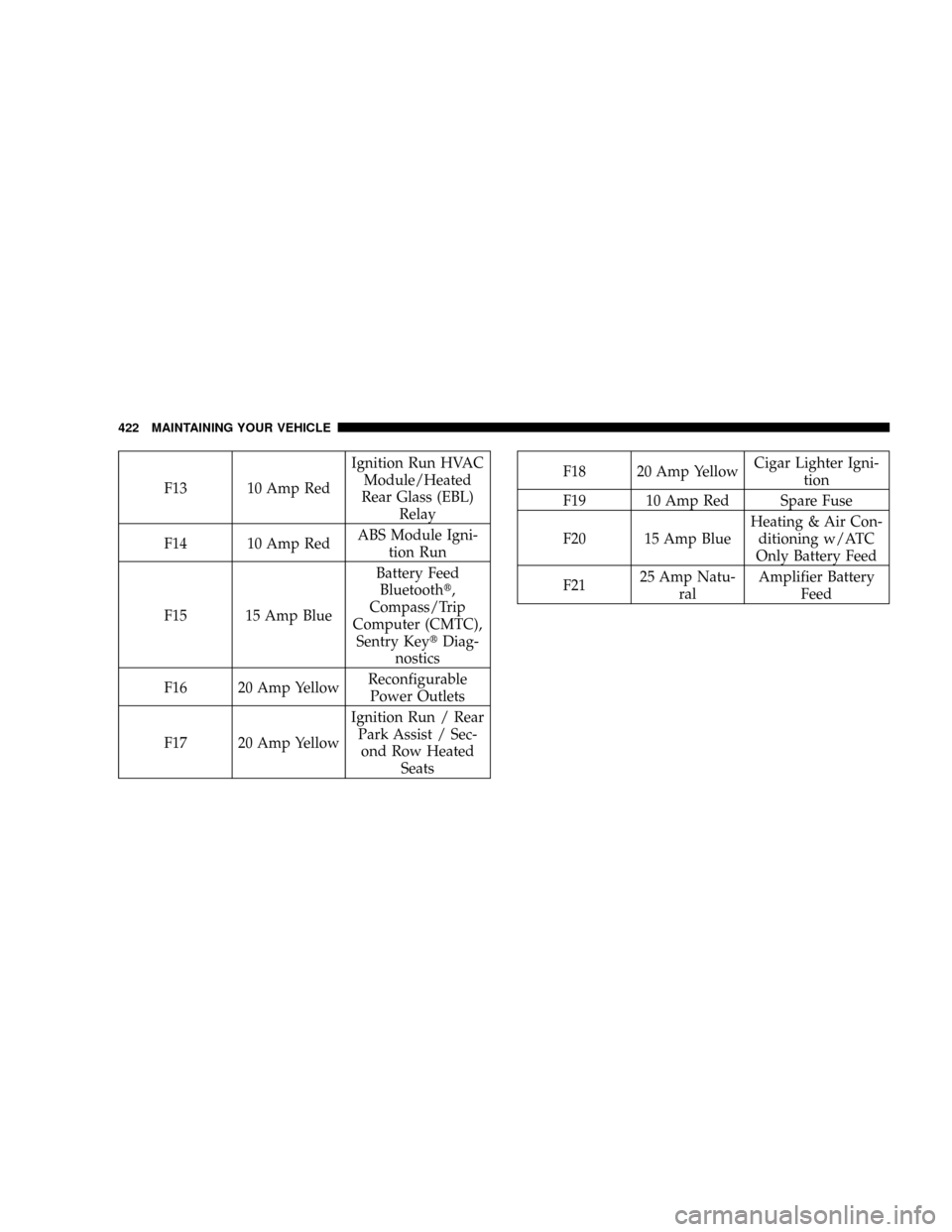
F13 10 Amp RedIgnition Run HVAC
Module/Heated
Rear Glass (EBL)
Relay
F14 10 Amp RedABS Module Igni-
tion Run
F15 15 Amp BlueBattery Feed
Bluetootht,
Compass/Trip
Computer (CMTC),
Sentry KeytDiag-
nostics
F16 20 Amp YellowReconfigurable
Power Outlets
F17 20 Amp YellowIgnition Run / Rear
Park Assist / Sec-
ond Row Heated
Seats
F18 20 Amp YellowCigar Lighter Igni-
tion
F19 10 Amp Red Spare Fuse
F20 15 Amp BlueHeating & Air Con-
ditioning w/ATC
Only Battery Feed
F2125 Amp Natu-
ralAmplifier Battery
Feed
422 MAINTAINING YOUR VEHICLE
Page 460 of 479
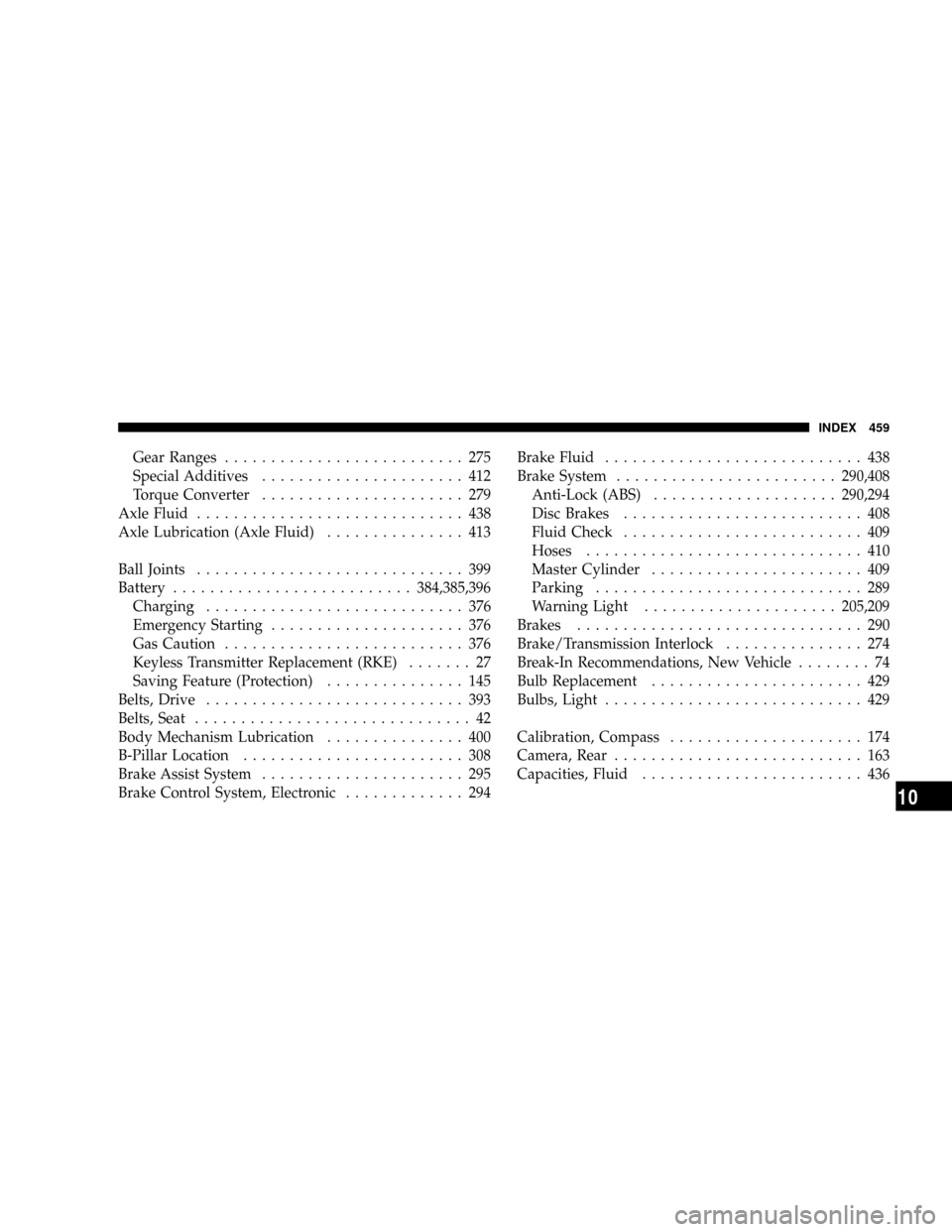
Gear Ranges.......................... 275
Special Additives...................... 412
Torque Converter...................... 279
Axle Fluid............................. 438
Axle Lubrication (Axle Fluid)............... 413
Ball Joints............................. 399
Battery..........................384,385,396
Charging............................ 376
Emergency Starting..................... 376
Gas Caution.......................... 376
Keyless Transmitter Replacement (RKE)....... 27
Saving Feature (Protection)............... 145
Belts, Drive............................ 393
Belts, Seat.............................. 42
Body Mechanism Lubrication............... 400
B-Pillar Location........................ 308
Brake Assist System...................... 295
Brake Control System, Electronic............. 294Brake Fluid............................ 438
Brake System........................290,408
Anti-Lock (ABS)....................290,294
Disc Brakes.......................... 408
Fluid Check.......................... 409
Hoses.............................. 410
Master Cylinder....................... 409
Parking............................. 289
Warning Light.....................205,209
Brakes............................... 290
Brake/Transmission Interlock............... 274
Break-In Recommendations, New Vehicle........ 74
Bulb Replacement....................... 429
Bulbs, Light............................ 429
Calibration, Compass..................... 174
Camera, Rear........................... 163
Capacities, Fluid........................ 436
INDEX 459
10