tow CHRYSLER ASPEN 2008 2.G Repair Manual
[x] Cancel search | Manufacturer: CHRYSLER, Model Year: 2008, Model line: ASPEN, Model: CHRYSLER ASPEN 2008 2.GPages: 479, PDF Size: 4.3 MB
Page 379 of 479

WARNING!
Any procedure other than above could result in:
1. Personal injury caused by electrolyte squirting out
the battery vent;
2. Personal injury or property damage due to battery
explosion;
3. Damage to charging system of booster vehicle or
of immobilized vehicle.
FREEING A STUCK VEHICLE
If vehicle becomes stuck in snow, sand, or mud, it can
often be moved by a rocking motion. Move the gear
selector rhythmically between FIRST and REVERSE,
while applying slight pressure to the accelerator.The least amount of accelerator pedal pressure to main-
tain the rocking motion without spinning the wheels or
racing the engine is most effective. Allow the engine to
idle with the shift lever in NEUTRAL for at least one
minute after every five rocking-motion cycles. This will
minimize overheating and reduce the risk of transmis-
sion failure during prolonged efforts to free a stuck
vehicle.
EMERGENCY TOW HOOKS Ð IF EQUIPPED
Your vehicle may be equipped with emergency tow
hooks.
NOTE:For off-road recovery, it is recommended to use
both of the front tow hooks to minimize the risk of
damage to the vehicle.
378 WHAT TO DO IN EMERGENCIES
Page 380 of 479
WARNING!
Chains are not recommended for freeing a stuck
vehicle. Chains may break, causing serious injury or
death.
WARNING!
Stand clear of vehicles when pulling with tow hooks.
Tow straps and chains may break, causing serious
injury.
CAUTION!
Tow hooks are for emergency use only, to rescue a
vehicle stranded off-road. Do not use tow hooks for
tow truck hookup or highway towing. You could
damage your vehicle.
TOWING A DISABLED VEHICLE
Proper towing or lifting equipment is required to prevent
damage to your vehicle. Use of safety chains is recom-
mended.Attach towing device to main structural mem-
bers of the vehicle Ð not to bumpers or associated
brackets. State and local laws, applying to vehicles
under tow, must be observed.
WHAT TO DO IN EMERGENCIES 379
6
Page 381 of 479
Four-Wheel Drive Vehicles
The manufacturer recommends towing with all wheels
OFFthe ground. Acceptable methods are to tow the
vehicle on a flatbed or with one end of the vehicle raised
and the opposite end on a towing dolly.
Two-Wheel Drive Vehicles
Provided that the transmission is operable, tow with the
transmission in NEUTRAL and the ignition key in the
OFF position, along with the front wheels raised and the
rear wheels on the ground. The speed must not exceed 30
mph (50 km/h), and the distance must not exceed 15 mi
(25 km).If the vehicle is to be towed more than 15 mi (25 km) or
faster than 30 mph (50 km/h), it must be towed on a
flatbed, or with the rear wheels raised and the front
wheels on the ground, or with the front end raised and
the rear wheels on a towing dolly.
NOTE:Towing the vehicle with the rear wheels on the
ground at more than 30 mph (50 km/h) or for more than
15 mi (25 km), can cause severe transmission damage.
380 WHAT TO DO IN EMERGENCIES
Page 387 of 479
ONBOARD DIAGNOSTIC SYSTEM Ð OBD II
Your vehicle is equipped with a sophisticated onboard
diagnostic system called OBD II. This system monitors
the performance of the emissions, engine, and automatic
transmission control systems. When these systems are
operating properly, your vehicle will provide excellent
performance and fuel economy, as well as engine emis-
sions well within current government regulations.
If any of these systems require service, the OBD II system
will turn on the Malfunction Indicator Light (MIL). It will
also store diagnostic codes and other information to
assist your service technician in making repairs. Al-
though your vehicle will usually be drivable and not
need towing, see your authorized dealer for service as
soon as possible.CAUTION!
²Prolonged driving with the MIL on could cause
further damage to the emission control system. It
could also affect fuel economy and driveability.
The vehicle must be serviced before any emissions
tests can be performed.
²If the MIL is flashing while the engine is running,
severe catalytic converter damage and power loss
will soon occur. Immediate service is required.
Loose Fuel Filler Cap Message
After fuel is added, the vehicle diagnostic system can
determine if the fuel filler cap is possibly loose, improp-
erly installed, or damaged. A loose fuel filler cap message
will be displayed in the instrument cluster. Tighten the
gas cap until a9clicking9sound is heard. This is an
indication that the gas cap is properly tightened. Press
386 MAINTAINING YOUR VEHICLE
Page 397 of 479

WARNING!
A hot exhaust system can start a fire if you park over
materials that can burn. Such materials might be
grass or leaves coming into contact with your exhaust
system. Do not park or operate your vehicle in areas
where your exhaust system can contact anything that
can burn.
In unusual situations involving grossly malfunctioning
engine operation, a scorching odor may indicate severe
and abnormal catalyst overheating. If this occurs, the
vehicle should be stopped, the engine shut off and the
vehicle allowed to cool. Thereafter, service, including a
tune-up to manufacturer's specifications, should be ob-
tained immediately.To minimize the possibility of catalyst damage:²Do not shut off the engine or interrupt the ignition
when the transmission is in gear and the vehicle is in
motion.
²Do not try to start engine by pushing or towing the
vehicle.
²Do not idle the engine with any spark plug wires
disconnected or removed, such as when diagnostic
testing, or for prolonged periods during very rough
idling or malfunctioning operating conditions.
Maintenance Free Battery
The top of the maintenance free battery is permanently
sealed. You will never have to add water, nor is periodic
maintenance required.
396 MAINTAINING YOUR VEHICLE
Page 402 of 479
Avoid using the wiper blades to remove frost or ice from
the windshield. Keep the blade rubber out of contact with
petroleum products such as engine oil, gasoline, etc.
Windshield and Rear Window Washers
The fluid reservoir for the windshield washers and the
rear window washer is shared. The fluid reservoir is
located in the engine compartment: be sure to check the
fluid level at regular intervals. Fill the reservoir with
windshield washer solvent only (not radiator antifreeze).
When refilling the washer fluid reservoir, take some
washer fluid and apply it to a cloth or towel and wipe
clean the wiper blades; this will help blade performance.
To prevent freeze-up of your windshield washer system
in cold weather, select a solution or mixture that meets or
exceeds the temperature range of your climate. This
rating information can be found on most washer fluid
containers.The washer fluid reservoir will hold a full gallon/liter of
fluid when the Low Washer Fluid Light illuminates.
WARNING!
Commercially available windshield washer solvents
are flammable. They could ignite and burn you. Care
must be exercised when filling or working around
the washer solution.
Exhaust System
The best protection against carbon monoxide entry into
the vehicle body is a properly maintained engine exhaust
system.
Whenever a change is noticed in the sound of the exhaust
system, when exhaust fumes can be detected inside the
vehicle, or when the underside or rear of the vehicle is
MAINTAINING YOUR VEHICLE 401
7
Page 417 of 479

²If you detect any stone chips or scratches in the paint,
touch them up immediately. The cost of such repairs is
considered the responsibility of the owner.
²If your vehicle is damaged due to an accident or
similar cause which destroys the paint and protective
coating have your vehicle repaired as soon as possible.
The cost of such repairs is considered the responsibil-
ity of the owner.
²If you carry special cargo such as chemicals, fertilizers,
de-icer salt, etc., be sure that such materials are well
packaged and sealed.
²If a lot of driving is done on gravel roads, consider
mud or stone shields behind each wheel.
²Use Moparttouch up paint on scratches as soon as
possible. Your authorized dealer has touch up paint to
match the color of your vehicle.
Wheel and Wheel Trim Care
All wheels and wheel trim, especially aluminum and
chrome plated wheels, should be cleaned regularly with
a mild soap and water to prevent corrosion. To remove
heavy soil, use MopartWheel Cleaner or select a non-
abrasive, non-acidic cleaner. Do not use scouring pads,
steel wool, a bristle brush or metal polishes. Only
Mopartcleaners are recommended. Do not use oven
cleaner. Avoid automatic car washes that use acidic
solutions or harsh brushes that may damage the wheels'
protective finish.
YES EssentialstFabric Cleaning Procedure ± If
Equipped
YES Essentialstseats may be cleaned in the following
manner:
²Remove as much of the stain as possible by blotting
with a clean, dry towel.
²Blot any remaining stain with a clean, damp towel.
416 MAINTAINING YOUR VEHICLE
Page 418 of 479

²For tough stains, apply MopartTotal Clean or a mild
soap solution to a clean, damp cloth and remove stain.
Use a fresh, damp towel to remove soap residue.
²For grease stains, apply MopartMulti-Purpose
Cleaner to a clean, damp cloth and remove stain. Use
a fresh, damp towel to remove soap residue.
²Do not use any solvents or protectants on
YES Essentialstproducts.
Interior Care
Use MopartFabric Cleaner to clean fabric upholstery
and carpeting.
Use MopartVinyl Cleaner to clean vinyl upholstery and
trim.
MopartTotal Clean is specifically recommended for
leather upholstery.Your leather upholstery can be best preserved by regular
cleaning with a damp soft cloth. Small particles of dirt
can act as an abrasive and damage the leather upholstery
and should be removed promptly with a damp cloth.
Stubborn soils can be removed easily with a soft cloth
and MopartTotal Clean. Care should be taken to avoid
soaking your leather upholstery with any liquid. Please
do not use polishes, oils, cleaning fluids, solvents, deter-
gents, or ammonia based cleaners to clean your leather
upholstery. Application of a leather conditioner is not
required to maintain the original condition.
WARNING!
Do not use volatile solvents for cleaning purposes.
Many are potentially flammable, and if used in
closed areas they may cause respiratory harm.
MAINTAINING YOUR VEHICLE 417
7
Page 419 of 479

Cleaning Headlights
Your vehicle has plastic headlights that are lighter and
less susceptible to stone breakage than glass headlights.
Plastic is not as scratch resistant as glass and therefore
different lens cleaning procedures must be followed.
To minimize the possibility of scratching the lenses and
reducing light output, avoid wiping with a dry cloth. To
remove road dirt, wash with a mild soap solution fol-
lowed by rinsing.
Do not use abrasive cleaning components, solvents, steel
wool or other aggressive material to clean the lenses.
Glass Surfaces
All glass surfaces should be cleaned on a regular basis
with any commercial household-type glass cleaner.
Never use an abrasive type cleaner. Use caution when
cleaning inside rear windows equipped with electricdefrosters or windshields equipped with a windshield
wiper de-icer. Do not use scrapers or other sharp instru-
ments which may scratch the elements.
When cleaning the rear view mirror, spray cleaner on the
towel or rag that you are using. Do not spray cleaner
directly on the mirror.
Cleaning Plastic Instrument Cluster Lenses
The lenses in front of the instruments in this vehicle are
molded in clear plastic. When cleaning the lenses, care
must be taken to avoid scratching the plastic.
1. Clean with a wet soft rag. A mild soap solution may be
used, but do not use high alcohol content or abrasive
cleaners. If soap is used, wipe clean with a clean damp
rag.
2. Dry with a soft tissue.
418 MAINTAINING YOUR VEHICLE
Page 426 of 479
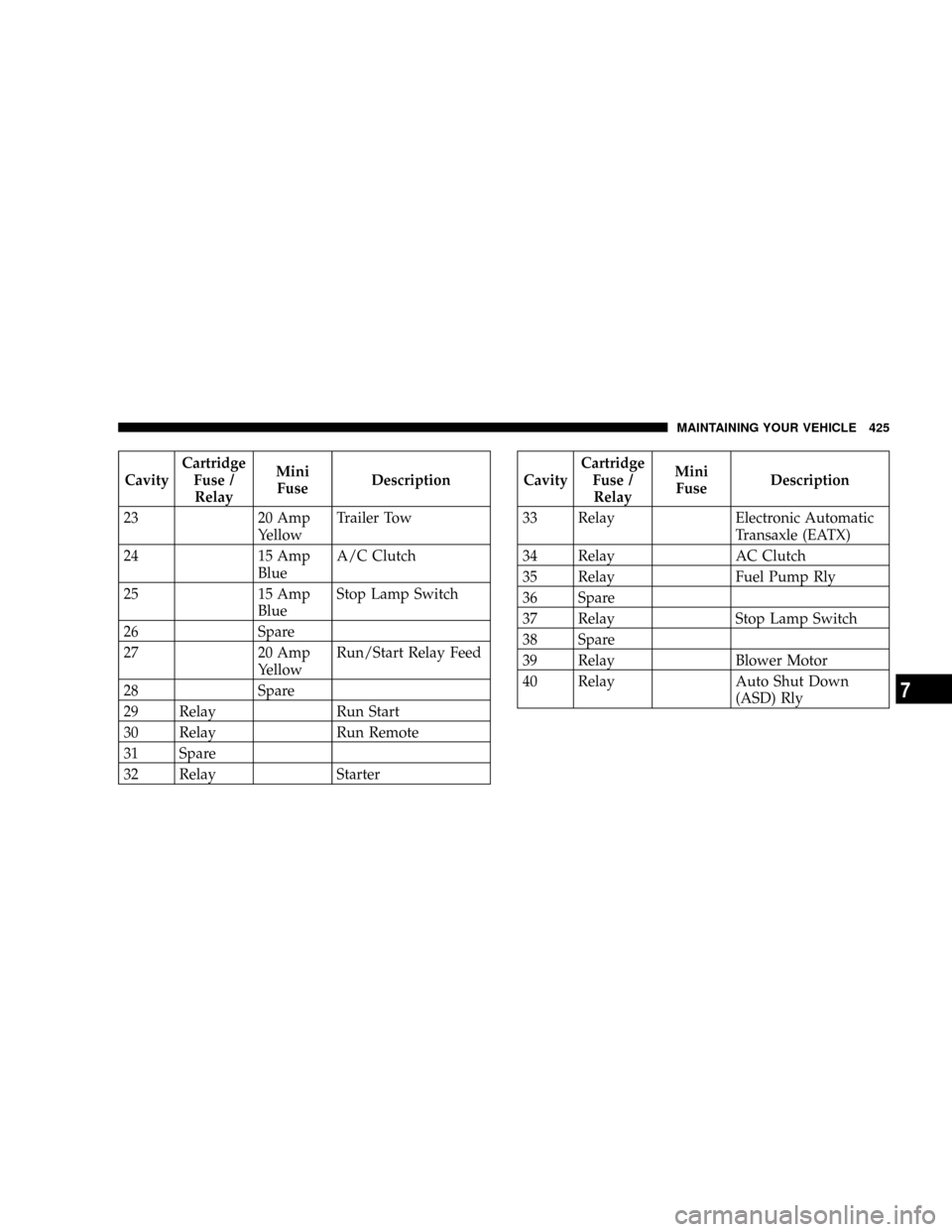
CavityCartridge
Fuse /
RelayMini
FuseDescription
23 20 Amp
YellowTrailer Tow
24 15 Amp
BlueA/C Clutch
25 15 Amp
BlueStop Lamp Switch
26 Spare
27 20 Amp
YellowRun/Start Relay Feed
28 Spare
29 Relay Run Start
30 Relay Run Remote
31 Spare
32 Relay StarterCavityCartridge
Fuse /
RelayMini
FuseDescription
33 Relay Electronic Automatic
Transaxle (EATX)
34 Relay AC Clutch
35 Relay Fuel Pump Rly
36 Spare
37 Relay Stop Lamp Switch
38 Spare
39 Relay Blower Motor
40 Relay Auto Shut Down
(ASD) Rly
MAINTAINING YOUR VEHICLE 425
7