engine oil CHRYSLER ASPEN 2009 2.G User Guide
[x] Cancel search | Manufacturer: CHRYSLER, Model Year: 2009, Model line: ASPEN, Model: CHRYSLER ASPEN 2009 2.GPages: 481, PDF Size: 9.28 MB
Page 339 of 481
CAUTION!
DO NOT use gasoline containing Methanol or E85
Ethanol. Use of these blends may result in starting
and driveability problems and may damage critical
fuel system components.
Problems that result from using methanol/gasoline
blends are not the responsibility of the manufacturer.
While MTBE is an oxygenate made from Methanol, it
does not have the negative effects of Methanol.
E-85 Usage In Non-Flex Fuel Vehicles
Non-FFV vehicles are compatible with gasoline contain-
ing 10% ethanol (E10). Gasoline with higher ethanol
content may void the vehicle's warranty.
If a Non-FFV vehicle is inadvertently fueled with E-85
fuel, the engine will have some or all of these symptoms:
²operate in a lean mode
²OBD II ªMalfunction Indicator Lightº on
²poor engine performance
²poor cold start and cold drivability
²increased risk for fuel system component corrosion
To fix a Non-FFV vehicle inadvertently fueled once with
E-85 perform the following:
²drain the fuel tank (see your authorized dealer)
²change the engine oil and oil filter
²disconnect and reconnect the battery to reset the
engine controller memory
More extensive repairs will be required for prolonged
exposure to E-85 fuel.
STARTING AND OPERATING 337
5
Page 345 of 481
Selection Of Engine Oil For Flexible Fuel Vehicles
(E-85) and Gasoline Vehicles
FFV vehicles operated on E-85 require specially formu-
lated engine oils. These special requirements are included
in MOPARtengine oils, and in equivalent oils meeting
Chrysler Specification MS-6395. The manufacturer only
recommends engine oils that are API Certified and meet
the requirements of Material Standard MS-6395. MS-6395
contains additional requirements, developed during ex-
tensive fleet testing, to provide additional protection to
Chrysler LLC engines. Use MOPARtor an equivalent oil
meeting the specification MS-6395.
Starting
The characteristics of E-85 fuel make it unsuitable for use
when ambient temperatures fall below 0ÉF (-18ÉC). In the
range of 0ÉF (-18ÉC) to 32ÉF (0ÉC), you may experience an
increase in the time it takes for your engine to start, and
a deterioration in drivability (sags and/or hesitations)
until the engine is fully warmed up.
CAUTION!
Do not use ethanol mixture greater than 85% in your
vehicle. It will cause difficulty in cold starting and
may affect drivability.
Cruising Range
Because E-85 fuel contains less energy per gallon/Liter
than gasoline, you will experience an increase in fuel
consumption. You can expect your miles per gallon
(mpg)/miles per liter and your driving range to decrease
by about 30%, compared to gasoline operation.
Replacement Parts
Many components in your Flexible Fuel Vehicle (FFV) are
designed to be compatible with ethanol. Always be sure
that your vehicle is serviced with correct ethanol, com-
patible parts.
STARTING AND OPERATING 343
5
Page 378 of 481
WARNING!
A loose tire or jack thrown forward in a collision or
hard stop could injure someone in the vehicle. Al-
ways stow the jack, tools and the extra tire and wheel
in the places provided.
7. Remove wheel blocks. Do not install chrome or alu-
minum wheel center caps on the spare wheel. This may
result in cap damage.
8. Lower the jack to its fully closed position. Stow the
replaced tire, jack, and tools as previously described.
9. Adjust the tire pressure when possible.
NOTE:Do not oil wheel studs. For chrome wheels, do
not substitute with chrome plated wheel nuts.
WARNING!
Carefully follow these tire changing warnings to
help prevent personal injury or damage to your
vehicle:
²Always park on a firm, level surface as far from
the edge of the roadway as possible before raising
the vehicle.
²Block the wheel diagonally opposite the wheel to
be raised.
²Apply the parking brake firmly before jacking.
²Never start the engine with the vehicle on a jack.
²Do not let anyone sit in the vehicle when it is on a
jack.
²Do not get under the vehicle when it is on a jack.
²Only use the jack in the positions indicated.
(Continued)
376 WHAT TO DO IN EMERGENCIES
Page 385 of 481
MAINTAINING YOUR VEHICLE
CONTENTS
mEngine Compartment ± 4.7L.............. 385
mEngine Compartment ± 5.7L.............. 386
mOnboard Diagnostic System Ð OBD II....... 387
NLoose Fuel Filler Cap Message........... 387
mEmissions Inspection And Maintenance
Programs............................ 388
mReplacement Parts..................... 389
mDealer Service........................ 390
mMaintenance Procedures................. 390NEngine Oil......................... 390
NEngine Oil Filter..................... 392
NEngine Air Cleaner Filter............... 393
NMaintenance-Free Battery............... 393
NAir Conditioner Maintenance............ 394
NDrive Shaft Constant Velocity Joints....... 395
NBody Lubrication..................... 396
NWindshield Wiper Blades............... 396
NWindshield And Rear Window Washers..... 397
7
Page 387 of 481
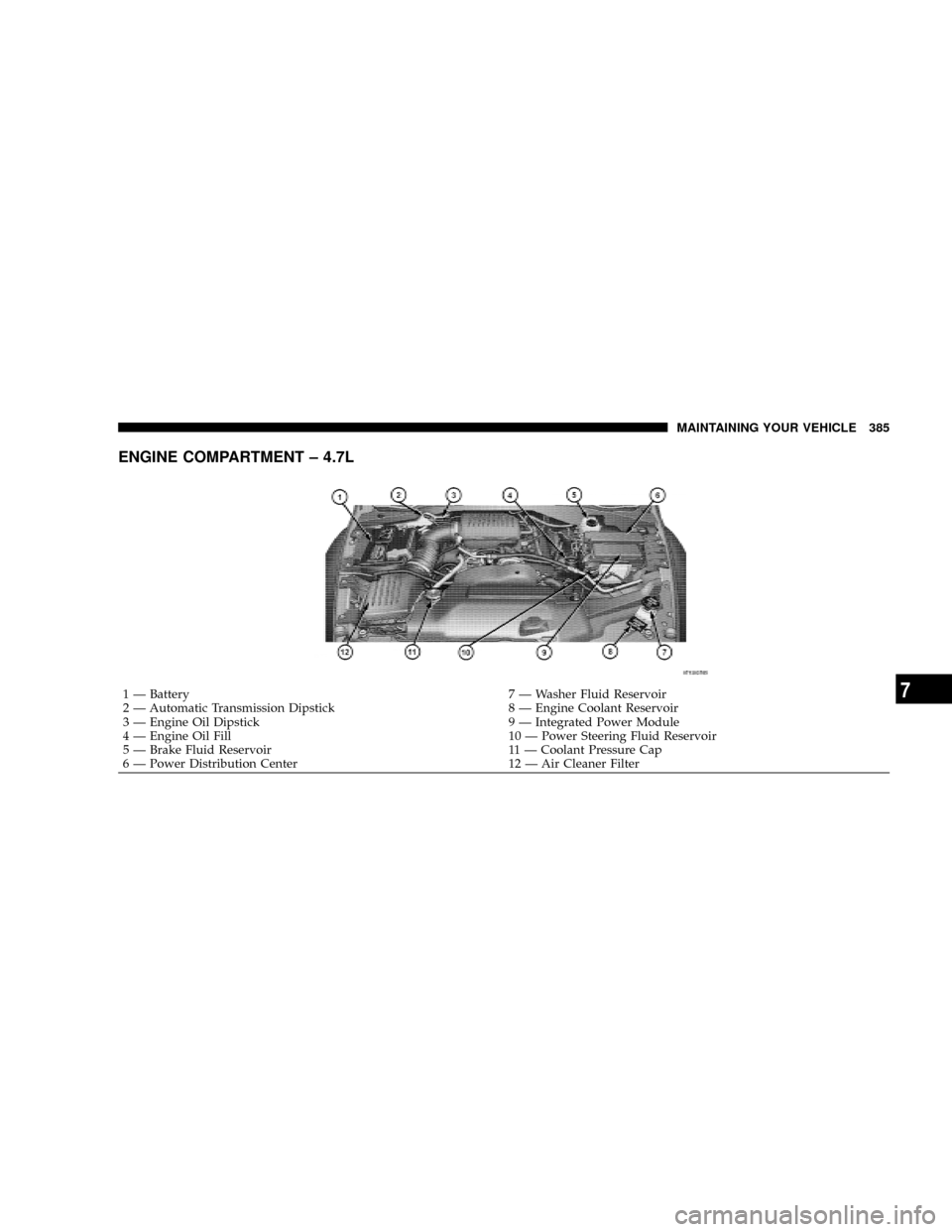
ENGINE COMPARTMENT ± 4.7L
1 Ð Battery 7 Ð Washer Fluid Reservoir
2 Ð Automatic Transmission Dipstick 8 Ð Engine Coolant Reservoir
3 Ð Engine Oil Dipstick 9 Ð Integrated Power Module
4 Ð Engine Oil Fill 10 Ð Power Steering Fluid Reservoir
5 Ð Brake Fluid Reservoir 11 Ð Coolant Pressure Cap
6 Ð Power Distribution Center 12 Ð Air Cleaner FilterMAINTAINING YOUR VEHICLE 3857
Page 388 of 481
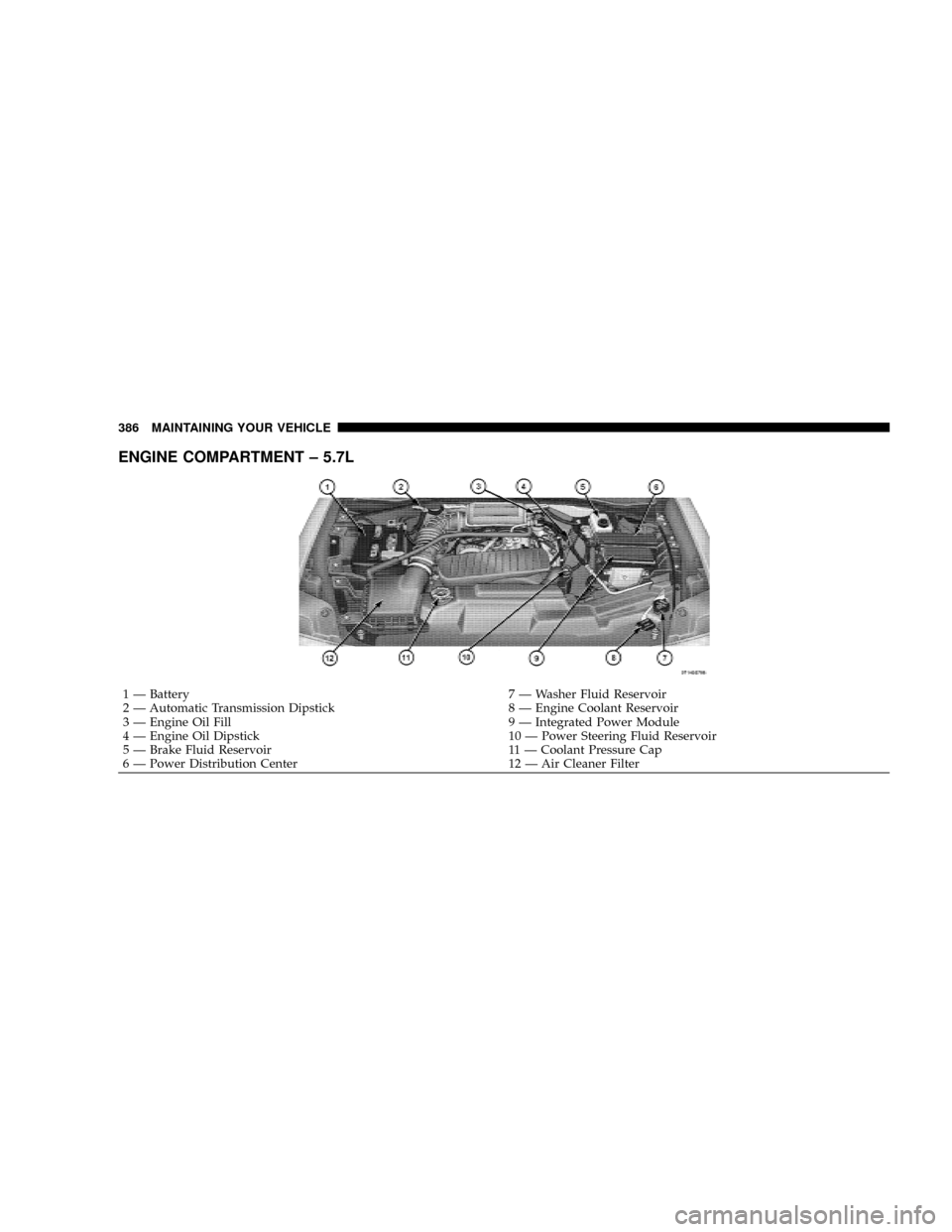
ENGINE COMPARTMENT ± 5.7L
1 Ð Battery 7 Ð Washer Fluid Reservoir
2 Ð Automatic Transmission Dipstick 8 Ð Engine Coolant Reservoir
3 Ð Engine Oil Fill 9 Ð Integrated Power Module
4 Ð Engine Oil Dipstick 10 Ð Power Steering Fluid Reservoir
5 Ð Brake Fluid Reservoir 11 Ð Coolant Pressure Cap
6 Ð Power Distribution Center 12 Ð Air Cleaner Filter 386 MAINTAINING YOUR VEHICLE
Page 392 of 481
DEALER SERVICE
Your authorized dealer has the qualified service person-
nel, special tools and equipment to perform all service
operations in an expert manner. Service Manuals are
available which include detailed service information for
your vehicle. Refer to these manuals before attempting
any procedure yourself.
NOTE:Intentional tampering with emissions control
systems can result in civil penalties being assessed
against you.
WARNING!
You can be badly injured working on or around a
motor vehicle. Do only that service work for which
you have the knowledge and the proper equipment.
If you have any doubt about your ability to perform
a service job, take your vehicle to a competent
mechanic.
MAINTENANCE PROCEDURES
The pages that follow contain therequiredmaintenance
services determined by the engineers who designed your
vehicle.
Besides the maintenance items for which there are fixed
maintenance intervals, there are other items that should
operate satisfactorily without periodic maintenance.
However, if a malfunction of these items does occur, it
could adversely affect the engine or vehicle performance.
These items should be inspected if a malfunction is
observed or suspected.
Engine Oil
Checking Oil Level
To assure proper lubrication of your vehicle's engine, the
engine oil must be maintained at the correct level. The
best time to check the engine oil level is about five
minutes after a fully warmed up engine is shut off or
before starting the engine after it has sat overnight.
390 MAINTAINING YOUR VEHICLE
Page 393 of 481
Checking the oil while the vehicle is on level ground will
improve the accuracy of the oil level readings. Always
maintain the oil level within the SAFE zone on the
dipstick. Adding 1 quart/liter of oil when the reading is
at the bottom of the SAFE zone will result in a reading at
the top of the SAFE zone on these engines.
CAUTION!
Overfilling or underfilling the crankcase will cause
oil aeration or loss of oil pressure. This could damage
your engine.
Change Engine Oil
Refer to the Maintenance Schedule in Section 8 for
recommended engine oil change intervals.
Engine Oil Selection
For best performance and maximum protection under all
types of operating conditions, the manufacturer onlyrecommends engine oils that are API certified and meet
the requirements of Chrysler Material Standard MS-6395.
American Petroleum Institute (API) Engine Oil
Identification Symbol
This symbol means that the oil has
been certified by the American
Petroleum Institute (API). The
manufacturer only recommends
API Certified engine oils.
Engine Oil Viscosity (SAE Grade)
SAE 5W-20 engine oil is recommended for all operating
temperatures. This engine oil improves low temperature
starting and vehicle fuel economy.
MAINTAINING YOUR VEHICLE 391
7
Page 394 of 481
The engine oil filler cap also shows the recommended
engine oil viscosity for your vehicle. For information on
engine oil filler cap location, refer to ªEngine Compart-
mentº in this section.
NOTE:Vehicles equipped with a 5.7L engine must use
SAE 5W-20 oil. Failure to do so may result in improper
operation of the Multiple Displacement System (MDS).
Refer to ªMulti Displacement Systemº under ªStarting
and Operatingº in Section 5.
Lubricants which do not have both the engine oil certi-
fication mark and the correct SAE viscosity grade num-
ber should not be used.
Synthetic Engine Oils
You may use synthetic engine oils provided the recom-
mended oil quality requirements are met, and the recom-
mended maintenance intervals for oil and filter changes
are followed.
Materials Added to Engine Oils
The manufacturer strongly recommends against the ad-
dition of any additives (other than leak detection dyes) to
the engine oil. Engine oil is an engineered product and its
performance may be impaired by supplemental
additives.
Disposing of Used Engine Oil and Oil Filters
Care should be taken in disposing of used engine oil and
oil filters from your vehicle. Used oil and oil filters,
indiscriminately discarded, can present a problem to the
environment. Contact your authorized dealer, service
station, or governmental agency for advice on how and
where used oil and oil filters can be safely discarded in
your area.
Engine Oil Filter
The engine oil filter should be replaced at every engine
oil change.
392 MAINTAINING YOUR VEHICLE
Page 395 of 481
Engine Oil Filter Selection
The manufacturer's engines have a full-flow type oil
filter. Use a filter of this type for replacement. The quality
of replacement filters varies considerably. Only high
quality filters should be used to assure most efficient
service. MOPARtengine oil filters are a high quality oil
filter and are recommended.
Engine Air Cleaner Filter
Refer to the Maintenance Schedule in Section 8 for
recommended engine air cleaner filter change intervals.
WARNING!
The air cleaner can provide a measure of protection
in the case of engine backfire. Do not remove the air
cleaner unless such removal is necessary for repair or
maintenance. Make sure that no one is near the
engine compartment before starting the vehicle with
the air cleaner removed. Failure to do so can result in
serious personal injury.
Maintenance-Free Battery
The top of the maintenance-free battery is permanently
sealed. You will never have to add water, nor is periodic
maintenance required.
MAINTAINING YOUR VEHICLE 393
7