torque CHRYSLER ASPEN 2009 2.G Owners Manual
[x] Cancel search | Manufacturer: CHRYSLER, Model Year: 2009, Model line: ASPEN, Model: CHRYSLER ASPEN 2009 2.GPages: 481, PDF Size: 9.28 MB
Page 284 of 481
²vehicle speed is above approximately 30 mph (48
km/h);
²the TOW/HAUL switch has not been activated;
²transmission has reached normal operating
temperature.
NOTE:If the vehicle is started in extremely cold tem-
peratures, the transmission may not shift into OVER-
DRIVE and will automatically select the most desirable
gear for operation at this temperature. Normal operation
will resume when the transmission fluid temperature has
risen to a suitable level. Refer also to the Note under
torque converter clutch, later in this section.
If the transmission temperature gets extremely hot, the
transmission will automatically select the most desirable
gear for operation at this temperature. If the transmission
temperature becomes hot enough, the ªTransmission
Temperature Indicator Lightº may illuminate and thetransmission may downshift out of OVERDRIVE until
the transmission cools down. After cooldown, the trans-
mission will resume normal operation.
The transmission will downshift from OVERDRIVE to
DRIVE if the accelerator pedal is fully depressed at
vehicle speeds above approximately 35 mph (56 km/h).
When To Use TOW/HAUL Mode
When driving in hilly areas, towing a trailer, carrying a
heavy load, etc., and frequent transmission shifting oc-
curs, press the TOW/HAUL button. This will improve
performance and reduce the potential for transmission
overheating or failure due to excessive shifting. When
operating in TOW/HAUL mode, 5th gear (if equipped) is
disabled and 2-3 and 3-4 shift patterns are modified.
Shifts into OVERDRIVE (4th gear) are allowed during
steady cruise (for improved fuel economy) and automatic
closed-throttle downshifts to 3rd gear (for improved
braking) will occur during steady braking.
282 STARTING AND OPERATING
Page 285 of 481
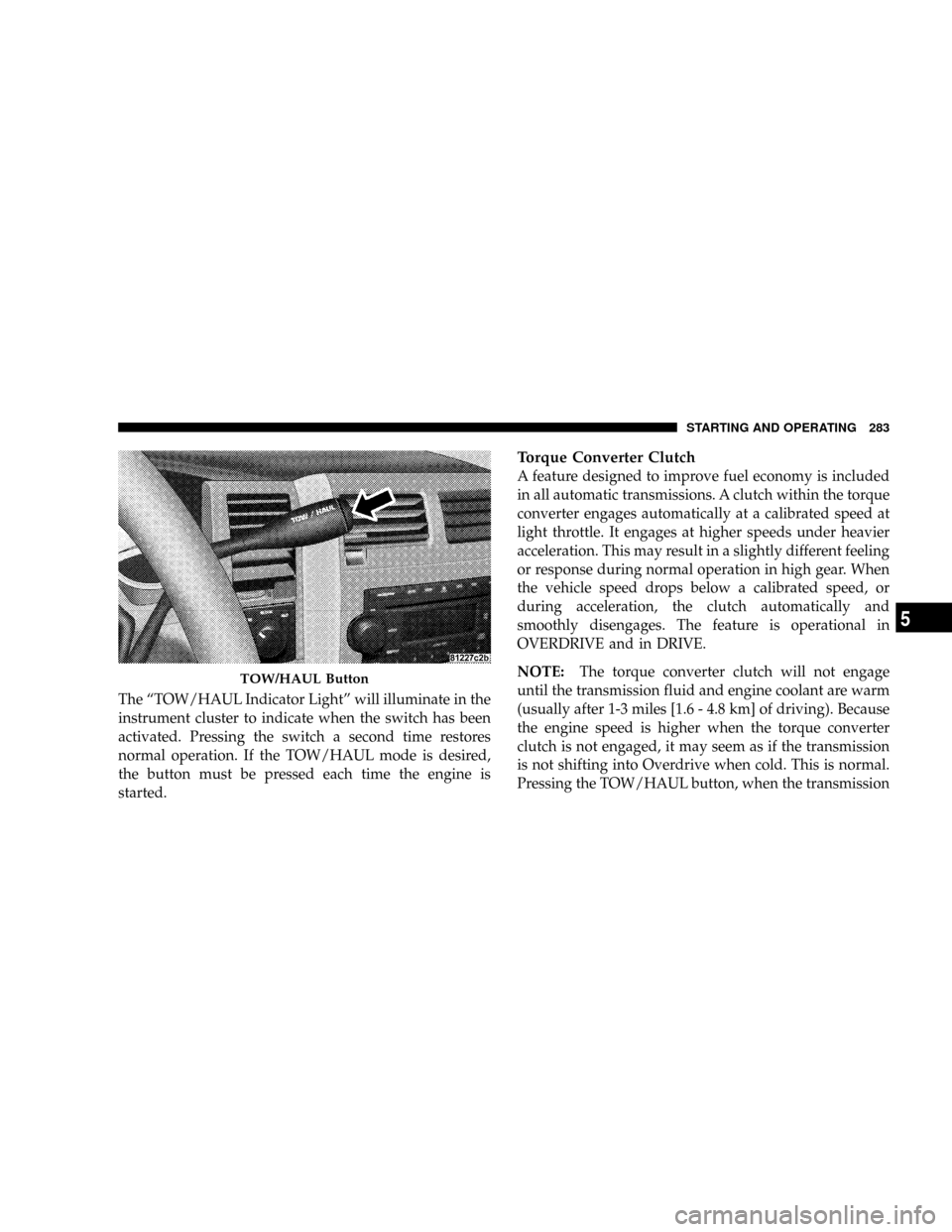
The ªTOW/HAUL Indicator Lightº will illuminate in the
instrument cluster to indicate when the switch has been
activated. Pressing the switch a second time restores
normal operation. If the TOW/HAUL mode is desired,
the button must be pressed each time the engine is
started.
Torque Converter Clutch
A feature designed to improve fuel economy is included
in all automatic transmissions. A clutch within the torque
converter engages automatically at a calibrated speed at
light throttle. It engages at higher speeds under heavier
acceleration. This may result in a slightly different feeling
or response during normal operation in high gear. When
the vehicle speed drops below a calibrated speed, or
during acceleration, the clutch automatically and
smoothly disengages. The feature is operational in
OVERDRIVE and in DRIVE.
NOTE:The torque converter clutch will not engage
until the transmission fluid and engine coolant are warm
(usually after 1-3 miles [1.6 - 4.8 km] of driving). Because
the engine speed is higher when the torque converter
clutch is not engaged, it may seem as if the transmission
is not shifting into Overdrive when cold. This is normal.
Pressing the TOW/HAUL button, when the transmission
TOW/HAUL Button
STARTING AND OPERATING 283
5
Page 286 of 481
is sufficiently warm, will demonstrate that the transmis-
sion is able to shift into, and out of, Overdrive. For
vehicles with 4.7L or 5.7L engines (which have two
Overdrive gears), the transmission may not shift into 5th
gear until the transmission fluid and engine coolant are
warm.
NOTE:If the vehicle has not been driven in several
days, the first few seconds of operation after shifting the
transmission into gear may seem sluggish. This is due to
the fluid partially draining from the torque converter into
the transmission. This condition is normal and will not
cause damage to the transmission. The torque converter
will refill within five seconds of shifting from PARK into
any other gear position.FOUR-WHEEL DRIVE OPERATION
NV 140 Transfer Case Operating
Information/Precautions ± If Equipped
The NV 140 is a single speed (HI range only) transfer case
which provides convenient full-time four-wheel drive.
No driver interaction is required.
Proper operation of four-wheel drive vehicles depends
on tires of equal size, type and circumference on each
wheel. Any difference in tire size can cause damage to the
transfer case.
Because four-wheel drive provides improved traction,
there is a tendency to exceed safe turning and stopping
speeds. Do not go faster than road conditions permit.
284 STARTING AND OPERATING
Page 302 of 481
Traction Control System (TCS)
This system monitors the amount of wheel spin of each of
the driven wheels. If wheel spin is detected, brake
pressure is applied to the slipping wheel(s) and engine
power is reduced to provide enhanced acceleration and
stability. A feature of the TCS system functions similar to
a limited slip differential and controls the wheel spin
across a driven axle. If one wheel on a driven axle is
spinning faster than the other, the system will apply the
brake of the spinning wheel. This will allow more engine
torque to be applied to the wheel that is not spinning.
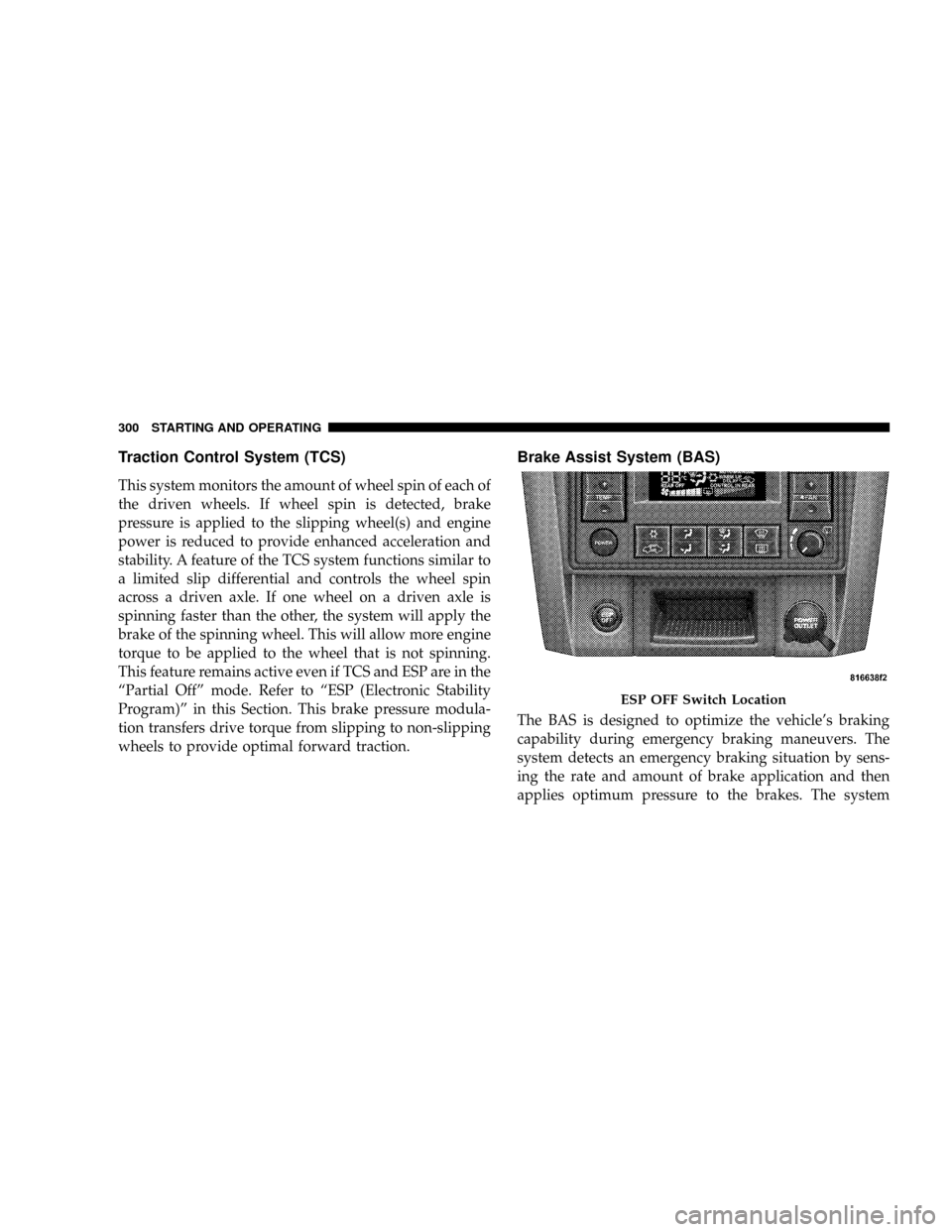
This feature remains active even if TCS and ESP are in the
ªPartial Offº mode. Refer to ªESP (Electronic Stability
Program)º in this Section. This brake pressure modula-
tion transfers drive torque from slipping to non-slipping
wheels to provide optimal forward traction.
Brake Assist System (BAS)
The BAS is designed to optimize the vehicle's braking
capability during emergency braking maneuvers. The
system detects an emergency braking situation by sens-
ing the rate and amount of brake application and then
applies optimum pressure to the brakes. The system
ESP OFF Switch Location
300 STARTING AND OPERATING
Page 307 of 481
WARNING!
In the ªPartial Offº mode, the engine torque reduc-
tion and stability features are desensitized. There-
fore, the enhanced vehicle stability offered by ESP is
unavailable.
NOTE:To improve the vehicle's traction when driving
with snow chains, or starting off in deep snow, sand or
gravel, it may be desirable to switch to the ªPartial Offº
mode by pressing the ESP Control Switch. Once the
situation requiring ESP to be switched to the ªPartial Offº
mode is overcome, turn ESP on by momentarily depress-
ing the ESP Control Switch. This may be done with the
vehicle in motion.
4WD LOW Range
Partial Off
This is the normal operating mode for ESP in 4WD LOW.
Whenever the vehicle is started in 4WD LOW or the
transfer case (if equipped) is shifted from 4WD LOCK or
NEUTRAL to 4WD LOW, the ESP system will be in this
mode. In 4WD LOW, ESP function is desensitized until
the vehicle reaches a speed of 30 mph (48 km/h). At 30
mph (48 km/h) the normal ESP stability function returns
and the ESP/TCS Indicator Light turns off. When the
vehicle speed drops below 25 mph (40 km/h) the ESP
system goes back to Partial Off. ESP is desensitized at low
vehicle speeds in 4WD LOW so that it will not interfere
with off road driving but ESP function returns to provide
the stability feature at speeds above 30 mph (48 km/h).
The ABS is in a special Off Road mode that allows wheels
to lock at lower speeds if gravel is detected to shorten
stopping distances.
STARTING AND OPERATING 305
5
Page 308 of 481
NOTE:When the vehicle is in 4WD LOW, a feature of
the ESP system remains active whether the ESP is on or
off. This feature functions similar to a limited slip differ-
ential and controls the wheel spin across an axle. If one
wheel on an axle is spinning faster than the other, the
system will apply the brake of the spinning wheel and
allow more engine torque to be applied to the wheel that
is not spinning.
WARNING!
In the Partial Off mode, the engine torque reduction
and stability features are desensitized. Therefore, the
enhanced vehicle stability offered by ESP is
unavailable.
Trailer Sway Control (TSC)
TSC uses sensors in the vehicle to recognize a swaying
trailer and will take the appropriate actions to attempt to
stop the sway. The system will reduce engine power andapply individual brakes that will counter act the sway of
the trailer. TSC will become active automatically once the
swaying trailer is recognized. No driver action is re-
quired. TSC cannot stop all trailers from swaying. Al-
ways use caution when towing a trailer and follow the
tongue weight recommendations. For additional infor-
mation on towing a trailer with your vehicle, refer to
9Trailer Towing9in Section 5.
ESP/BAS Warning Light and ESP/TCS Indicator
Light
The malfunction indicator for the ESP is combined with
the BAS indicator. The yellow ESP/BAS Warning Light
and the yellow ESP/TCS Indicator Light in the instru-
ment cluster both come on when the ignition switch is
turned to the ON position. They should both go out with
the engine running. If the ESP/BAS Warning Light comes
on continuously with the engine running, a malfunction
has been detected in either the ESP or BAS system, or
both. If this light remains on after several ignition cycles,
306 STARTING AND OPERATING
Page 377 of 481
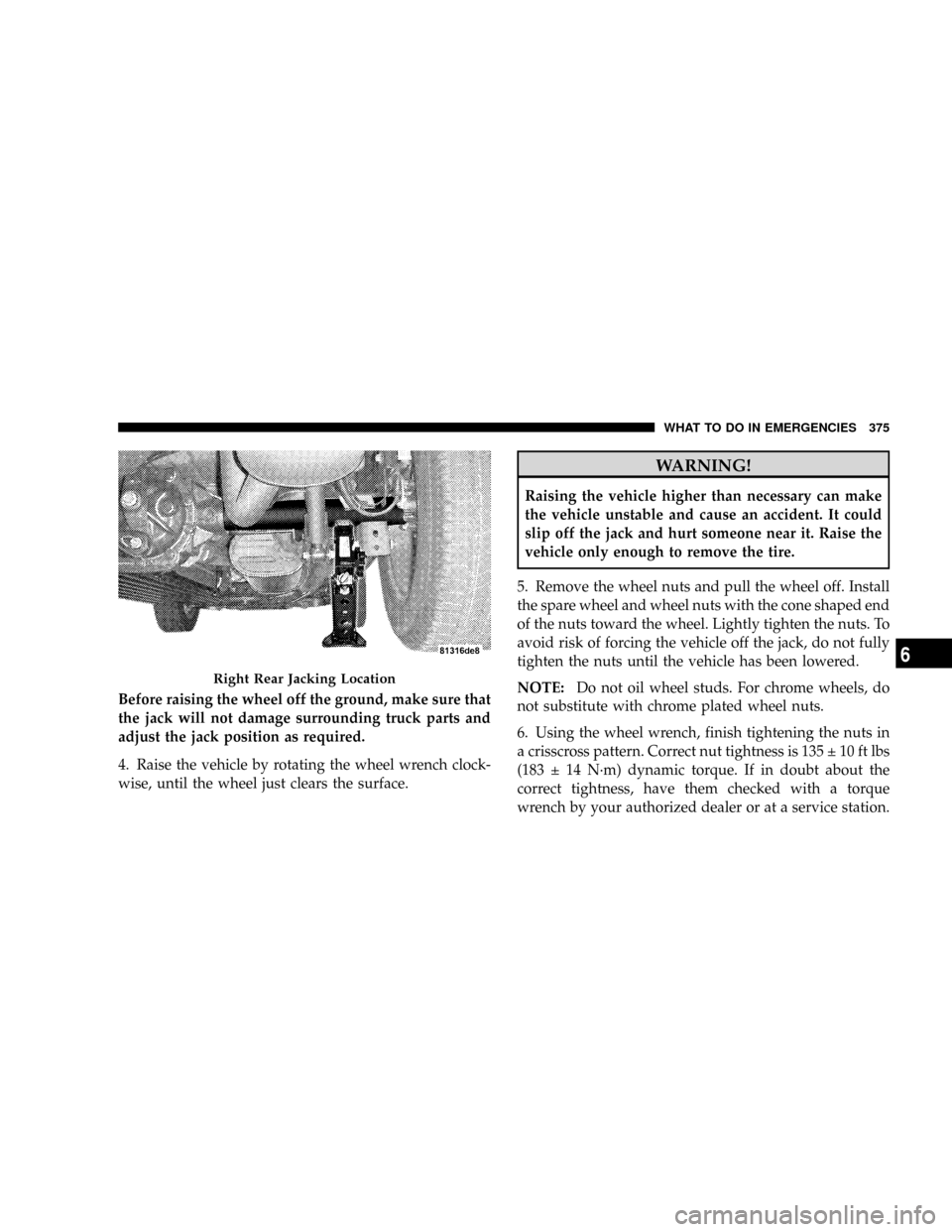
Before raising the wheel off the ground, make sure that
the jack will not damage surrounding truck parts and
adjust the jack position as required.
4. Raise the vehicle by rotating the wheel wrench clock-
wise, until the wheel just clears the surface.
WARNING!
Raising the vehicle higher than necessary can make
the vehicle unstable and cause an accident. It could
slip off the jack and hurt someone near it. Raise the
vehicle only enough to remove the tire.
5. Remove the wheel nuts and pull the wheel off. Install
the spare wheel and wheel nuts with the cone shaped end
of the nuts toward the wheel. Lightly tighten the nuts. To
avoid risk of forcing the vehicle off the jack, do not fully
tighten the nuts until the vehicle has been lowered.
NOTE:Do not oil wheel studs. For chrome wheels, do
not substitute with chrome plated wheel nuts.
6. Using the wheel wrench, finish tightening the nuts in
a crisscross pattern. Correct nut tightness is 135 10 ft lbs
(183 14 N´m) dynamic torque. If in doubt about the
correct tightness, have them checked with a torque
wrench by your authorized dealer or at a service station.
Right Rear Jacking Location
WHAT TO DO IN EMERGENCIES 375
6
Page 410 of 481
Selection of Lubricant
It is important that the proper lubricant is used in the
transmission to assure optimum transmission perfor-
mance. Use only manufacturer 's recommended transmis-
sion fluid; for correct fluid type, refer to ªAutomatic
Transmissionº under ªFluids, Lubricants and Genuine
Partsº in this section. It is important that the transmission
fluid be maintained at the prescribed level using the
recommended fluid.
Special Additives
Automatic Transmission Fluid (ATF) is an engineered
product and its performance may be impaired by supple-
mental additives. Therefore, do not add any fluid addi-
tives to the transmission. The only exception to this
policy is the use of special dyes to aid in detecting fluid
leaks. In addition, avoid using transmission sealers as
they may adversely affect seals.
CAUTION!
Using a transmission fluid other than the manufac-
turer's recommended fluid may cause deterioration
in transmission shift quality and/or torque converter
shudder. Using a transmission fluid other than the
manufacturer's recommended fluid will result in
more frequent fluid and filter changes. For correct
fluid type, refer to ªAutomatic Transmissionº under
ªFluids, Lubricants and Genuine Partsº in this
section.
Transfer Case
Inspect the transfer case for fluid leaks. If a fluid leak is
evident the transfer case fluid level may be low. Have the
transfer case serviced immediately.
408 MAINTAINING YOUR VEHICLE
Page 462 of 481
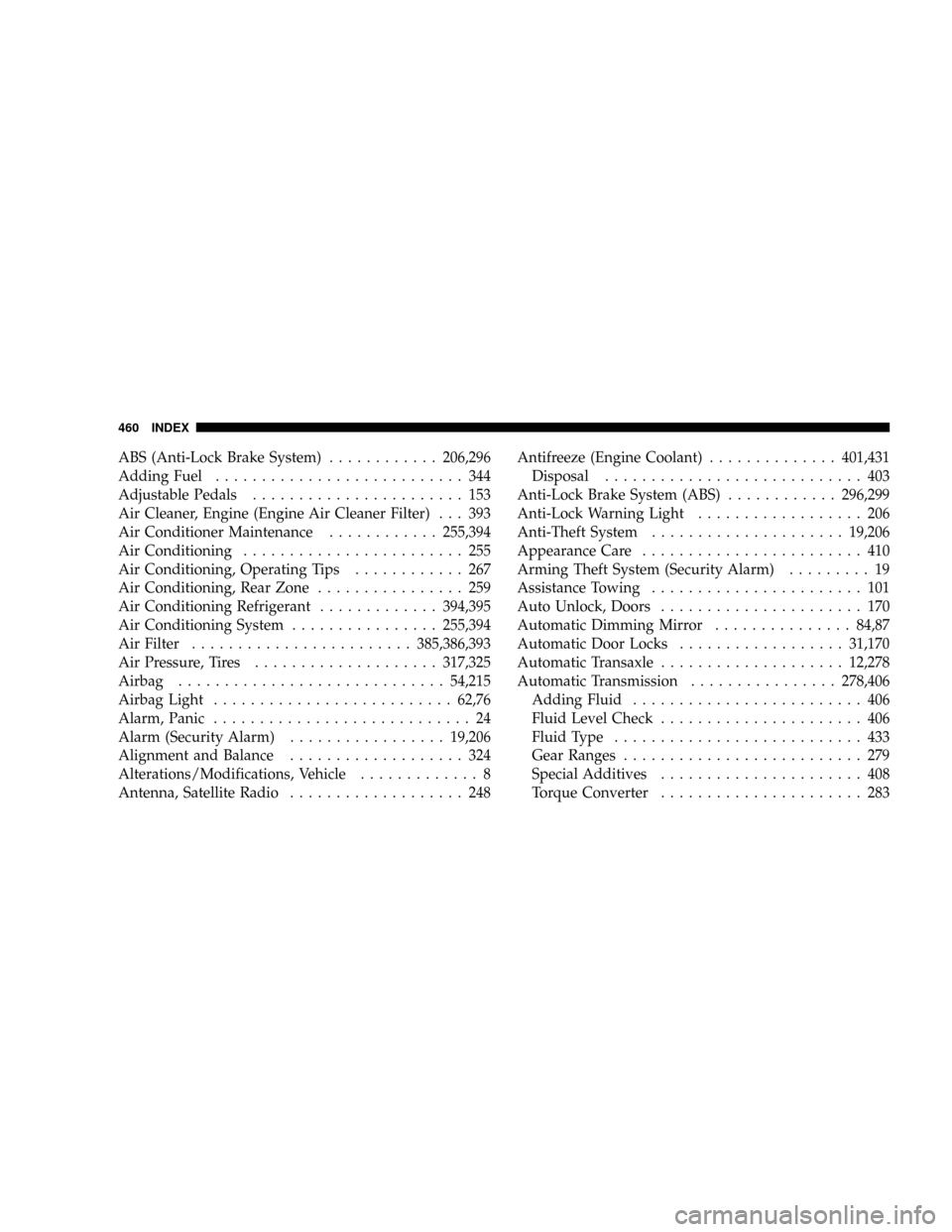
ABS (Anti-Lock Brake System)............206,296
Adding Fuel........................... 344
Adjustable Pedals....................... 153
Air Cleaner, Engine (Engine Air Cleaner Filter) . . . 393
Air Conditioner Maintenance............255,394
Air Conditioning........................ 255
Air Conditioning, Operating Tips............ 267
Air Conditioning, Rear Zone................ 259
Air Conditioning Refrigerant.............394,395
Air Conditioning System................255,394
Air Filter........................385,386,393
Air Pressure, Tires....................317,325
Airbag.............................54,215
Airbag Light..........................62,76
Alarm, Panic............................ 24
Alarm (Security Alarm).................19,206
Alignment and Balance................... 324
Alterations/Modifications, Vehicle............. 8
Antenna, Satellite Radio................... 248Antifreeze (Engine Coolant)..............401,431
Disposal............................ 403
Anti-Lock Brake System (ABS)............296,299
Anti-Lock Warning Light.................. 206
Anti-Theft System.....................19,206
Appearance Care........................ 410
Arming Theft System (Security Alarm)......... 19
Assistance Towing....................... 101
Auto Unlock, Doors...................... 170
Automatic Dimming Mirror...............84,87
Automatic Door Locks..................31,170
Automatic Transaxle....................12,278
Automatic Transmission................278,406
Adding Fluid......................... 406
Fluid Level Check...................... 406
Fluid Type........................... 433
Gear Ranges.......................... 279
Special Additives...................... 408
Torque Converter...................... 283
460 INDEX
Page 477 of 481
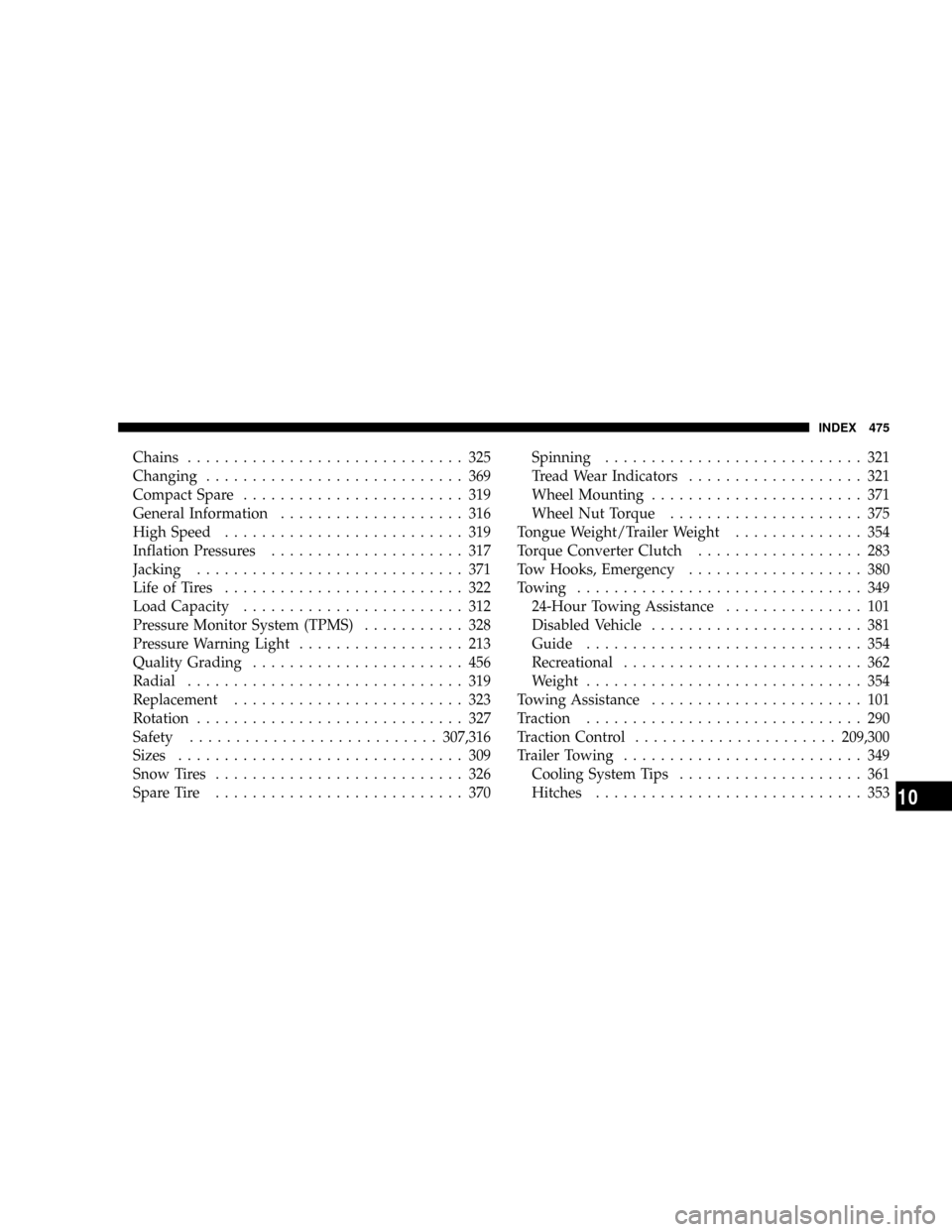
Chains.............................. 325
Changing............................ 369
Compact Spare........................ 319
General Information.................... 316
High Speed.......................... 319
Inflation Pressures..................... 317
Jacking............................. 371
Life of Tires.......................... 322
Load Capacity........................ 312
Pressure Monitor System (TPMS)........... 328
Pressure Warning Light.................. 213
Quality Grading....................... 456
Radial.............................. 319
Replacement......................... 323
Rotation............................. 327
Safety...........................307,316
Sizes............................... 309
Snow Tires........................... 326
Spare Tire........................... 370Spinning............................ 321
Tread Wear Indicators................... 321
Wheel Mounting....................... 371
Wheel Nut Torque..................... 375
Tongue Weight/Trailer Weight.............. 354
Torque Converter Clutch.................. 283
Tow Hooks, Emergency................... 380
Towing............................... 349
24-Hour Towing Assistance............... 101
Disabled Vehicle....................... 381
Guide.............................. 354
Recreational.......................... 362
Weight.............................. 354
Towing Assistance....................... 101
Traction.............................. 290
Traction Control......................209,300
Trailer Towing.......................... 349
Cooling System Tips.................... 361
Hitches............................. 353
INDEX 475
10