weight CHRYSLER ASPEN 2009 2.G User Guide
[x] Cancel search | Manufacturer: CHRYSLER, Model Year: 2009, Model line: ASPEN, Model: CHRYSLER ASPEN 2009 2.GPages: 481, PDF Size: 9.28 MB
Page 351 of 481
WARNING!
Do not load your vehicle any heavier than the GVWR
or the maximum front and rear GAWR. If you do,
parts on your vehicle can break, or it can change the
way your vehicle handles. This could cause you to
lose control. Also, overloading can shorten the life of
your vehicle.
TRAILER TOWING
In this section you will find safety tips and information
on limits to the type of towing you can reasonably do
with your vehicle. Before towing a trailer carefully re-
view this information to tow your load as efficiently and
safely as possible.
To maintain warranty coverage, follow the requirements
and recommendations in this manual concerning ve-
hicles used for trailer towing.
Common Towing Definitions
The following trailer towing related definitions will assist
you in understanding the following information:
Gross Vehicle Weight Rating (GVWR)
The GVWR is the total allowable weight of your vehicle.
This includes driver, passengers, cargo and tongue
weight. The total load must be limited so that you do not
exceed the GVWR.
Gross Trailer Weight (GTW)
The GTW is the weight of the trailer plus the weight of all
cargo, consumables and equipment (permanent or tem-
porary) loaded in or on the trailer in its9loaded and
ready for operation9condition. The recommended way to
measure GTW is to put your fully loaded trailer on a
vehicle scale. The entire weight of the trailer must be
supported by the scale.
STARTING AND OPERATING 349
5
Page 352 of 481
Gross Combination Weight Rating (GCWR)
The GCWR is the total permissible weight of your vehicle
and trailer when weighed in combination. (Note that
GCWR ratings include a 150 lbs (68 kg) allowance for the
presence of a driver.)
Gross Axle Weight Rating (GAWR)
The GAWR is the maximum capacity of the front and rear
axles. Distribute the load over the front and rear axles
evenly. Make sure that you do not exceed either front or
rear GAWR.
WARNING!
It is important that you do not exceed the maximum
front or rear GAWR. A dangerous driving condition
can result if either rating is exceeded. You could lose
control of the vehicle and have an accident.
Trailer Tongue Weight (TW)
The TW is the downward force exerted on the hitch ball
by the trailer. In most cases it should not be less than 10%
or more than 15% of the trailer load. You must consider
this as part of the load on your vehicle.
Frontal Area
The frontal area is the maximum height and maximum
width of the front of a trailer.
Weight-Carrying Hitch
A weight-carrying hitch supports the trailer tongue
weight, just as if it were luggage located at a hitch ball or
some other connecting point of the vehicle. These kind of
hitches are the most popular on the market today and
they're commonly used to tow small- and medium-sized
trailers.
350 STARTING AND OPERATING
Page 353 of 481
Weight-Distributing Hitch
A weight-distributing hitch works by applying leverage
through spring (load) bars. They are typically used for
heavier loads, to distribute trailer tongue weight to the
tow vehicle's front axle and the trailer axle(s). When used
in accordance with the manufacturers' directions, it pro-
vides for a more level ride, offering more consistent
steering and brake control thereby enhancing towing
safety. The addition of a friction/hydraulic sway control
also dampens sway caused by traffic and crosswinds and
contributes positively to tow vehicle and trailer stability.
Trailer sway control and a weight distributing (load
equalizing) hitch are recommended for heavier tongue
weights and may be required depending on vehicle and
trailer configuration/loading to comply with Gross Axle
Weight Rating (GAWR) requirements.WARNING!
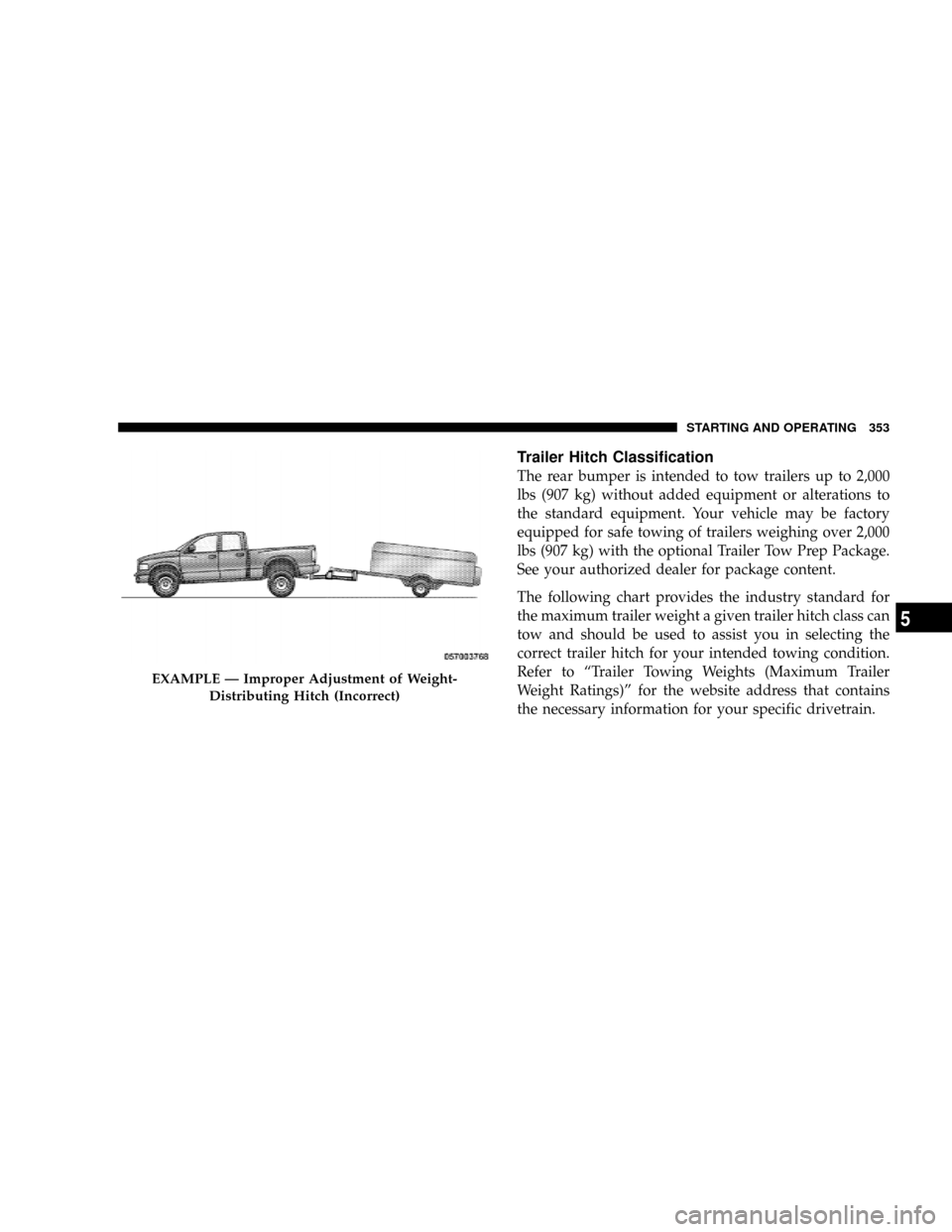
An improperly adjusted weight-distributing hitch
may reduce handling, stability, and braking perfor-
mance, and could result in an accident.
Weight-Distributing Systems may not be compatible
with surge brake couplers. Consult with your hitch
and trailer manufacturer or a reputable recreational
vehicle dealer for additional information.
STARTING AND OPERATING 351
5
Page 354 of 481
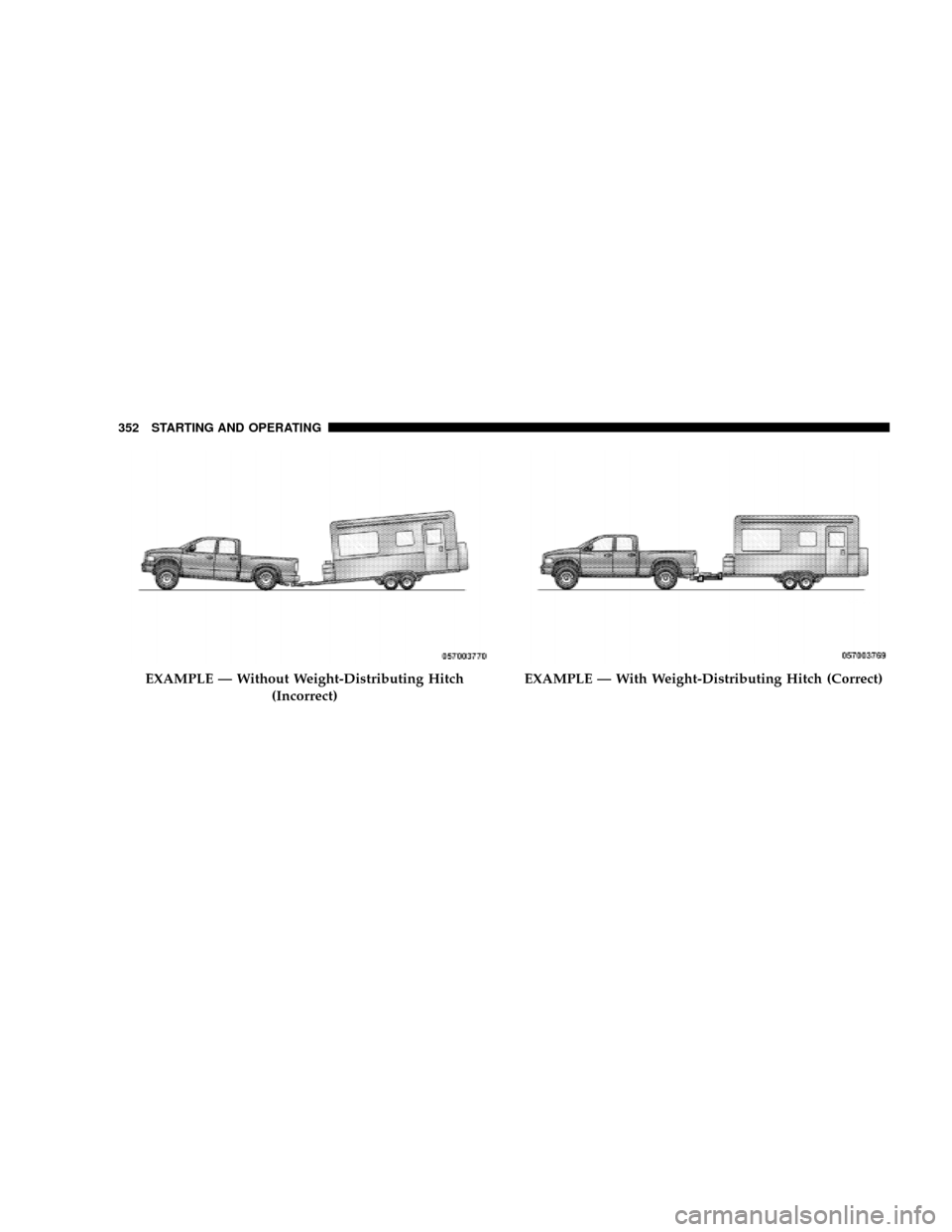
EXAMPLE Ð Without Weight-Distributing Hitch
(Incorrect)EXAMPLE Ð With Weight-Distributing Hitch (Correct)
352 STARTING AND OPERATING
Page 355 of 481
Trailer Hitch Classification
The rear bumper is intended to tow trailers up to 2,000
lbs (907 kg) without added equipment or alterations to
the standard equipment. Your vehicle may be factory
equipped for safe towing of trailers weighing over 2,000
lbs (907 kg) with the optional Trailer Tow Prep Package.
See your authorized dealer for package content.
The following chart provides the industry standard for
the maximum trailer weight a given trailer hitch class can
tow and should be used to assist you in selecting the
correct trailer hitch for your intended towing condition.
Refer to ªTrailer Towing Weights (Maximum Trailer
Weight Ratings)º for the website address that contains
the necessary information for your specific drivetrain.
EXAMPLE Ð Improper Adjustment of Weight-
Distributing Hitch (Incorrect)
STARTING AND OPERATING 353
5
Page 356 of 481
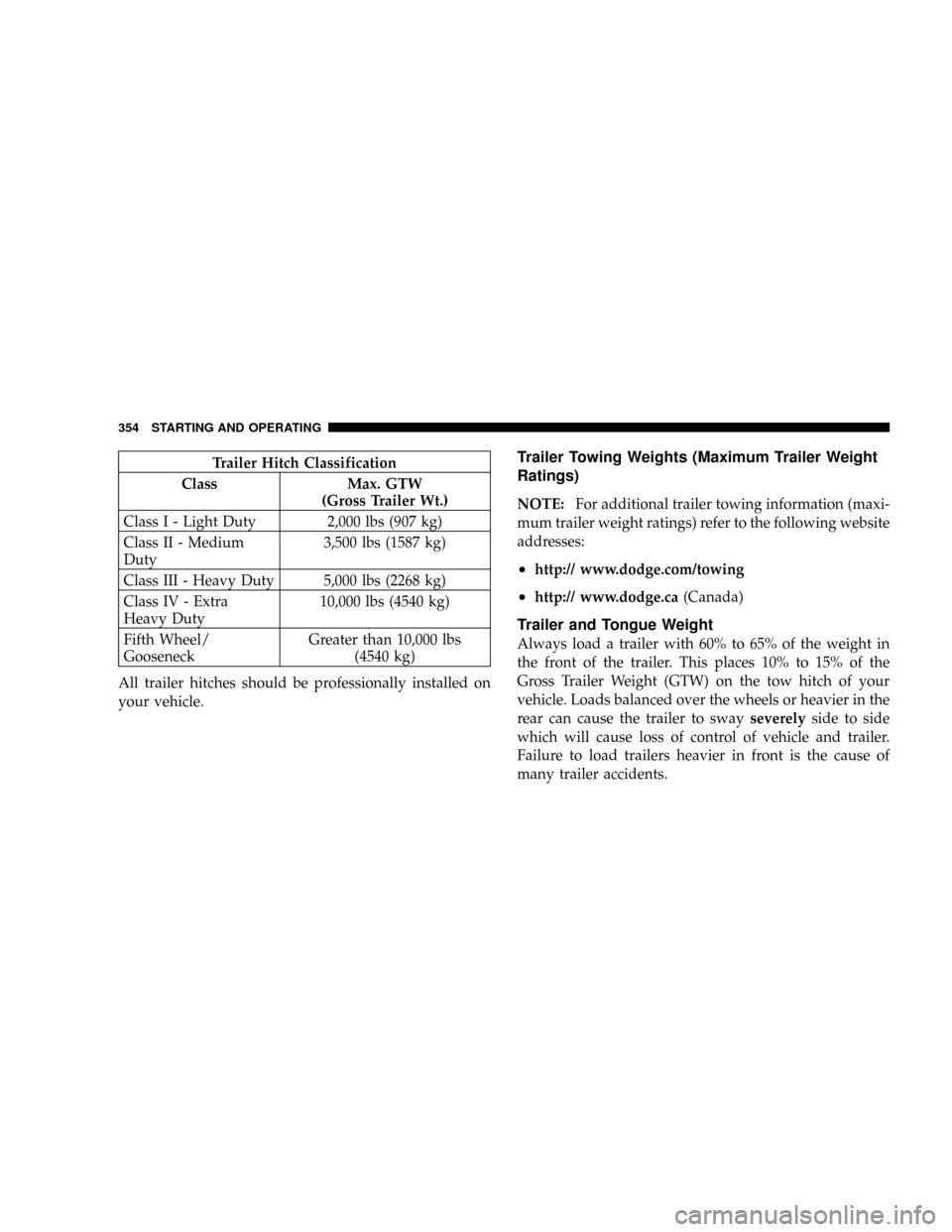
Trailer Hitch Classification
Class Max. GTW
(Gross Trailer Wt.)
Class I - Light Duty 2,000 lbs (907 kg)
Class II - Medium
Duty3,500 lbs (1587 kg)
Class III - Heavy Duty 5,000 lbs (2268 kg)
Class IV - Extra
Heavy Duty10,000 lbs (4540 kg)
Fifth Wheel/
GooseneckGreater than 10,000 lbs
(4540 kg)
All trailer hitches should be professionally installed on
your vehicle.Trailer Towing Weights (Maximum Trailer Weight
Ratings)
NOTE:For additional trailer towing information (maxi-
mum trailer weight ratings) refer to the following website
addresses:
²http:// www.dodge.com/towing
²http:// www.dodge.ca(Canada)
Trailer and Tongue Weight
Always load a trailer with 60% to 65% of the weight in
the front of the trailer. This places 10% to 15% of the
Gross Trailer Weight (GTW) on the tow hitch of your
vehicle. Loads balanced over the wheels or heavier in the
rear can cause the trailer to swayseverelyside to side
which will cause loss of control of vehicle and trailer.
Failure to load trailers heavier in front is the cause of
many trailer accidents.
354 STARTING AND OPERATING
Page 357 of 481
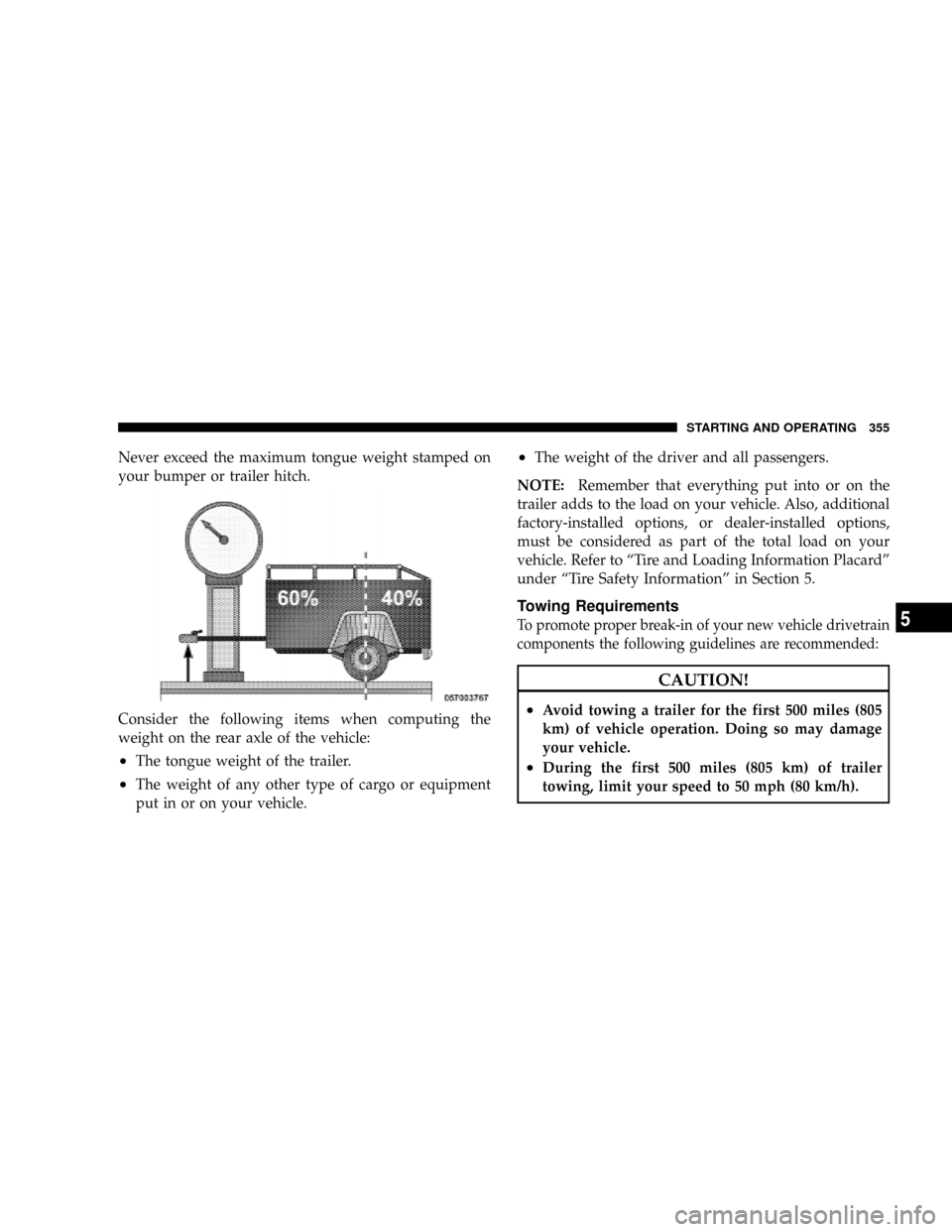
Never exceed the maximum tongue weight stamped on
your bumper or trailer hitch.
Consider the following items when computing the
weight on the rear axle of the vehicle:
²The tongue weight of the trailer.
²The weight of any other type of cargo or equipment
put in or on your vehicle.
²The weight of the driver and all passengers.
NOTE:Remember that everything put into or on the
trailer adds to the load on your vehicle. Also, additional
factory-installed options, or dealer-installed options,
must be considered as part of the total load on your
vehicle. Refer to ªTire and Loading Information Placardº
under ªTire Safety Informationº in Section 5.
Towing Requirements
To promote proper break-in of your new vehicle drivetrain
components the following guidelines are recommended:
CAUTION!
²Avoid towing a trailer for the first 500 miles (805
km) of vehicle operation. Doing so may damage
your vehicle.
²During the first 500 miles (805 km) of trailer
towing, limit your speed to 50 mph (80 km/h).
STARTING AND OPERATING 355
5
Page 359 of 481
²GCWR must not be exceeded.
²Total weight must be distributed between the tow
vehicle and the trailer so that the following four
ratings are not exceeded:
1. GVWR
2. GTW
3. GAWR
4. Tongue weight rating for the trailer hitch utilized
(This requirement may limit the ability to always
achieve the 10% to 15% range of tongue weight as a
percentage of total trailer weight.)
Towing Requirements Ð Tires
þ
Do not attempt to tow a trailer while using a compact
spare tire.
þProper tire inflation pressures are essential to the safe
and satisfactory operation of your vehicle. For proper
tire inflation procedures, refer to ªTire Pressuresº
under ºTires±General Informationº in Section 5.
þAlso, check the trailer tires for proper tire inflation
pressures before trailer usage.
þCheck for signs of tire wear or visible tire damage
before towing a trailer. For the proper inspection
procedure, refer to ªTread Wear Indicatorsº under
ºTires±General Informationº in Section 5.
þWhen replacing tires, refer to ªReplacement Tiresº
under ªTires±General Informationº in Section 5. Re-
placing tires with a higher load carrying capacity will
not increase the vehicle's GVWR and GAWR limits.
STARTING AND OPERATING 357
5
Page 468 of 481
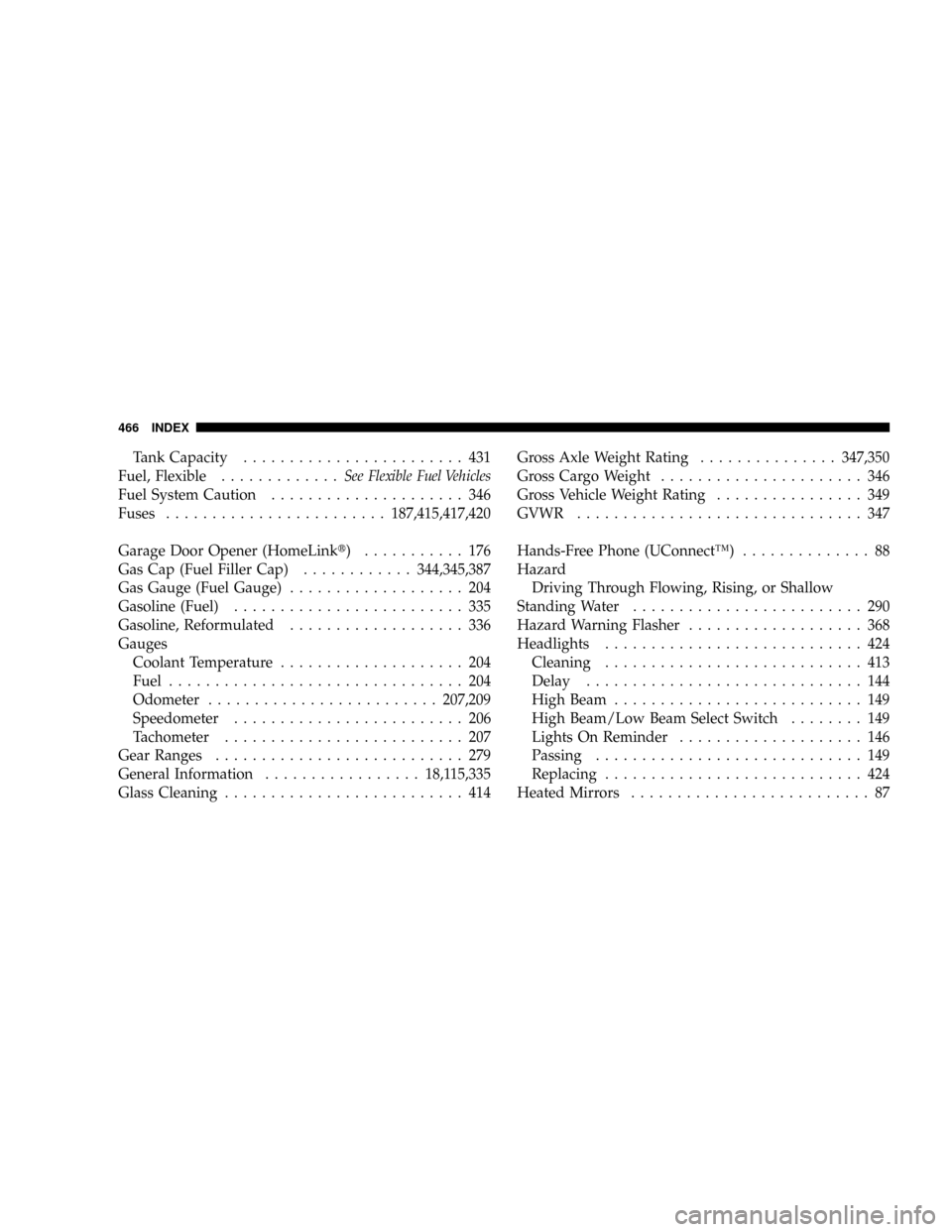
Tank Capacity........................ 431
Fuel, Flexible.............See Flexible Fuel Vehicles
Fuel System Caution..................... 346
Fuses........................187,415,417,420
Garage Door Opener (HomeLinkt) ........... 176
Gas Cap (Fuel Filler Cap)............344,345,387
Gas Gauge (Fuel Gauge)................... 204
Gasoline (Fuel)......................... 335
Gasoline, Reformulated................... 336
Gauges
Coolant Temperature.................... 204
Fuel................................ 204
Odometer.........................207,209
Speedometer......................... 206
Tachometer.......................... 207
Gear Ranges........................... 279
General Information.................18,115,335
Glass Cleaning.......................... 414Gross Axle Weight Rating...............347,350
Gross Cargo Weight...................... 346
Gross Vehicle Weight Rating................ 349
GVWR............................... 347
Hands-Free Phone (UConnectŸ).............. 88
Hazard
Driving Through Flowing, Rising, or Shallow
Standing Water......................... 290
Hazard Warning Flasher................... 368
Headlights............................ 424
Cleaning............................ 413
Delay.............................. 144
High Beam........................... 149
High Beam/Low Beam Select Switch........ 149
Lights On Reminder.................... 146
Passing............................. 149
Replacing............................ 424
Heated Mirrors.......................... 87
466 INDEX
Page 477 of 481
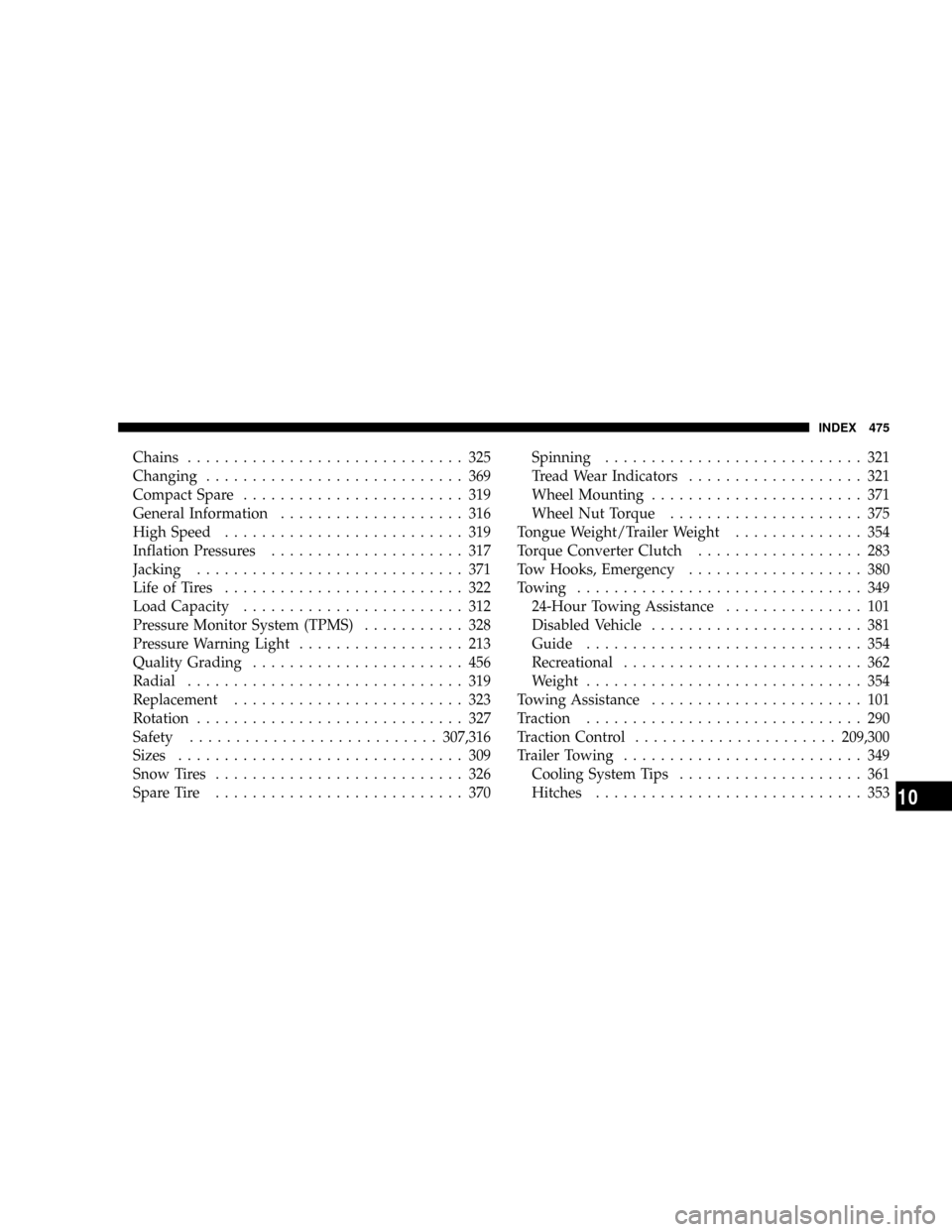
Chains.............................. 325
Changing............................ 369
Compact Spare........................ 319
General Information.................... 316
High Speed.......................... 319
Inflation Pressures..................... 317
Jacking............................. 371
Life of Tires.......................... 322
Load Capacity........................ 312
Pressure Monitor System (TPMS)........... 328
Pressure Warning Light.................. 213
Quality Grading....................... 456
Radial.............................. 319
Replacement......................... 323
Rotation............................. 327
Safety...........................307,316
Sizes............................... 309
Snow Tires........................... 326
Spare Tire........................... 370Spinning............................ 321
Tread Wear Indicators................... 321
Wheel Mounting....................... 371
Wheel Nut Torque..................... 375
Tongue Weight/Trailer Weight.............. 354
Torque Converter Clutch.................. 283
Tow Hooks, Emergency................... 380
Towing............................... 349
24-Hour Towing Assistance............... 101
Disabled Vehicle....................... 381
Guide.............................. 354
Recreational.......................... 362
Weight.............................. 354
Towing Assistance....................... 101
Traction.............................. 290
Traction Control......................209,300
Trailer Towing.......................... 349
Cooling System Tips.................... 361
Hitches............................. 353
INDEX 475
10