belt CHRYSLER ASPEN 2009 2.G Owner's Manual
[x] Cancel search | Manufacturer: CHRYSLER, Model Year: 2009, Model line: ASPEN, Model: CHRYSLER ASPEN 2009 2.GPages: 481, PDF Size: 9.28 MB
Page 56 of 481
Driver And Right Front Passenger Supplemental
Restraint System (SRS)ÐAirbags
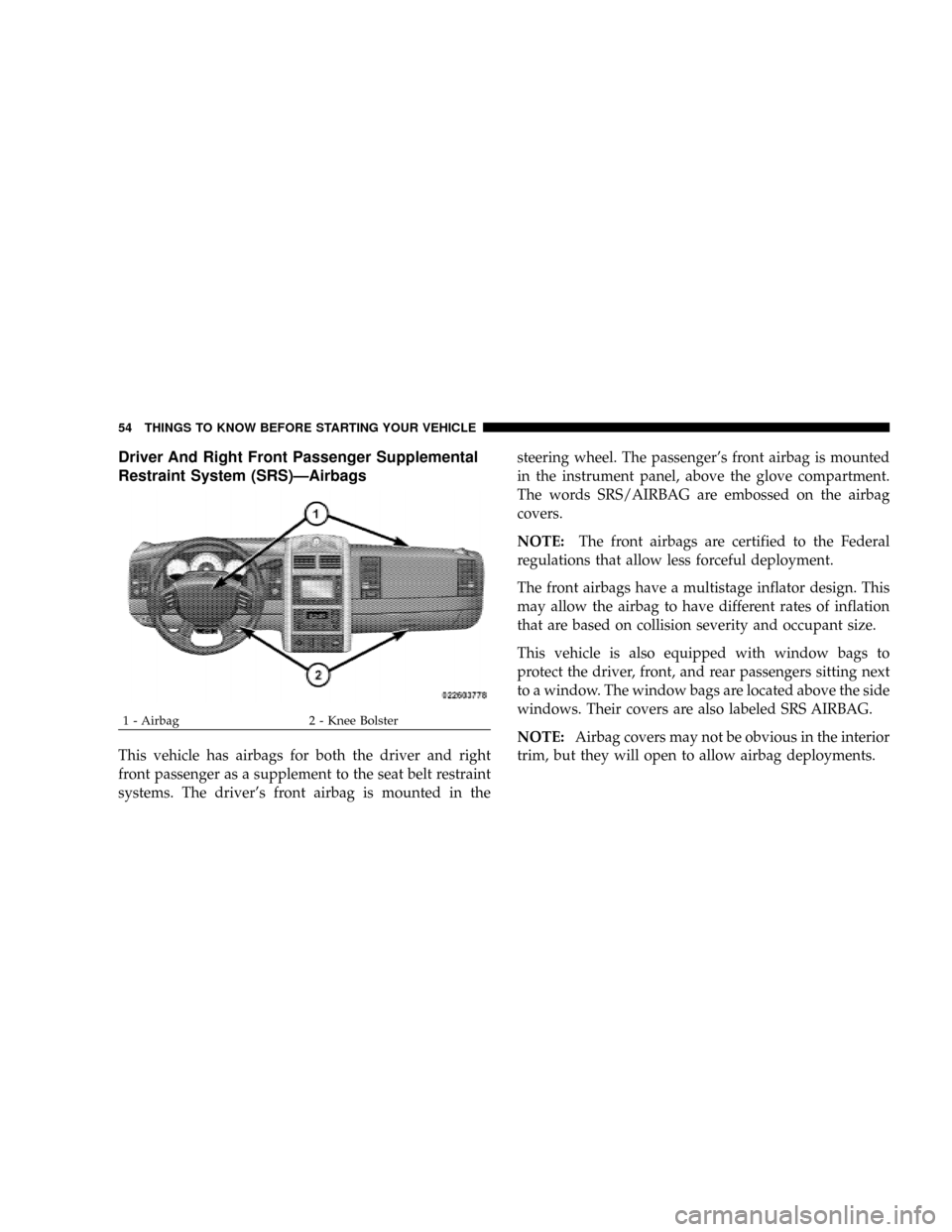
This vehicle has airbags for both the driver and right
front passenger as a supplement to the seat belt restraint
systems. The driver's front airbag is mounted in thesteering wheel. The passenger's front airbag is mounted
in the instrument panel, above the glove compartment.
The words SRS/AIRBAG are embossed on the airbag
covers.
NOTE:The front airbags are certified to the Federal
regulations that allow less forceful deployment.
The front airbags have a multistage inflator design. This
may allow the airbag to have different rates of inflation
that are based on collision severity and occupant size.
This vehicle is also equipped with window bags to
protect the driver, front, and rear passengers sitting next
to a window. The window bags are located above the side
windows. Their covers are also labeled SRS AIRBAG.
NOTE:Airbag covers may not be obvious in the interior
trim, but they will open to allow airbag deployments.
1 - Airbag 2 - Knee Bolster 54 THINGS TO KNOW BEFORE STARTING YOUR VEHICLE
Page 57 of 481
WARNING!
²Do not put anything on or around the front airbag
covers or attempt to manually open them. You may
damage the airbags and you could be injured
because the airbags are no longer functional.
These protective covers for the airbag cushions are
designed to open only when the airbags are inflat-
ing.
²Your vehicle is equipped with window bags. Do
not stack luggage or other cargo up high enough to
block the location of the window bag. The area
where the window bag is located should remain
free from any obstructions.
(Continued)
WARNING! (Continued)
²Do not have any accessory items installed which
will alter the roof, including adding a sunroof to
your vehicle. Do not add roof racks that require
permanent attachments (bolts or screws) for instal-
lation on the vehicle roof. Do not drill into the roof
of the vehicle for any reason.
NOTE:Do not use a clothing bar mounted to the coat
hooks in this vehicle. A clothing bar will impede the
proper performance of the window bags.
Along with the seat belts, front airbags work with the
instrument panel knee bolsters to provide improved
protection for the driver and front passenger. Window
bags also work with seat belts to improve occupant
protection.
THINGS TO KNOW BEFORE STARTING YOUR VEHICLE 55
2
Page 58 of 481
The seat belts are designed to protect you in many types
of collisions. The front airbags deploy in moderate to
severe frontal collisions.
The window bag on the crash side of the vehicle is
triggered in moderate to severe side collisions. Window
bags will also deploy on rollover events. But even in
collisions where the airbags work, you need the seat belts
to keep you in the correct position for the airbags to
protect you properly.
Here are some simple steps you can follow to minimize
the risk of harm from a deploying airbag.
1. Children 12 years and under should always ride
buckled up in a rear seat in an appropriate child restraint.
Infants in rear-facing child restraints shouldNEVERride
in the front seat of a vehicle with a passenger front airbag.
An airbag deployment can cause severe injury or death to
infants in that position.You should read the instructions provided with your
child restraint to make sure that you are using it properly.
2. All occupants should use their lap and shoulder belts
properly.
3. The driver and front passenger seats should be moved
back as far as practical to allow the airbag room to inflate.
4. If your vehicle has window bags, do not lean against
the door or window. Airbags will inflate forcefully into
the space between you and the door.
5. If the airbag system in this vehicle needs to be
modified to accommodate a disabled person, contact the
Customer Center. Refer to9If You Need Customer Assis-
tance9in Section 9.
56 THINGS TO KNOW BEFORE STARTING YOUR VEHICLE
Page 59 of 481
WARNING!
²Relying on the airbags alone could lead to more
severe injuries in a collision. The airbags work
with your seat belt to restrain you properly. In
some collisions the airbags won't deploy at all.
Always wear your seat belts even though you have
airbags.
²Being too close to the steering wheel or instrument
panel during airbag deployment could cause seri-
ous injury. Airbags need room to inflate. Sit back,
comfortably extending your arms to reach the
steering wheel or instrument panel.
²If the vehicle has window bags, they also need
room to inflate. Do not lean against the door or
window. Sit upright in the center of the seat.
Airbag System Components
The airbag system consists of the following:
²Occupant Restraint Controller
²Side Remote Acceleration Sensors
²Airbag Warning Light
²Driver Airbag
²Passenger Airbag
²Window Bags above Side Windows
²Steering Wheel and Column
²Instrument Panel
²Interconnecting Wiring
²Knee Impact Bolsters
²Front Acceleration Sensors
²Driver and Front Passenger Seat Belt Pretensioners
THINGS TO KNOW BEFORE STARTING YOUR VEHICLE 57
2
Page 60 of 481
How the Airbag System Works
²
TheOccupant Restraint Controller (ORC)determines
if a frontal collision is severe enough to require the
airbags to inflate. The front airbag inflators are de-
signed to provide different rates of airbag inflation
from direction provided by the ORC. The ORC will
detect a roll over when equipped with side airbags.
The ORC also monitors the readiness of the electronic
parts of the system whenever the ignition switch is in
the START or RUN positions. These include all of the
items listed above except the steering wheel and
column, and knee bolsters. If the key is in the OFF
position, in the ACC position, or not in the ignition,
the airbags are not ªonº and will not inflate.
During a moderate-to-severe rear impact the ORC may
deploy the seat belt pretensioners alone.Also, the ORC turns on the AIRBAG warning
light in the instrument cluster for 2.5 to 8
seconds for a self-check when the ignition is
first turned on. After the self-check, the AIR-
BAG warning light will turn off. If the ORC detects a
malfunction in any part of the system, it turns on the
AIRBAG warning light either momentarily or continu-
ously. A single chime will sound if the light comes on
again after initial start up.
WARNING!
Ignoring the AIRBAG warning light in your instru-
ment panel could mean you won't have the airbags to
protect you in a collision. If the light does not come
on, stays on after you start the vehicle, or if it comes
on as you drive, have the airbag system checked right
away.
58 THINGS TO KNOW BEFORE STARTING YOUR VEHICLE
Page 61 of 481
²TheDriver and Passenger Airbag/Inflator Unitsare
located in the center of the steering wheel and the right
side of the instrument panel. When the ORC detects a
collision requiring the airbags, it signals the inflator
units. A large quantity of nontoxic gas is generated to
inflate the front airbags. Different airbag inflation rates
may be possible based on collision severity. The steer-
ing wheel hub trim cover and the upper right side of
the instrument panel separate and fold out of the way
as the airbags inflate to their full size. The airbags fully
inflate in about 50 - 70 milliseconds. This is about half
of the time it takes to blink your eyes. The airbags then
quickly deflate while helping to restrain the driver and
front passenger. The driver's front airbag gas is vented
through vent holes in the sides of the airbag. The
passenger's front airbag gas is vented through vent
holes in the sides of the airbag. In this way the airbags
do not interfere with your control of the vehicle.²TheSide Impact SRS Window Bagsare designed to
activate only in certain side collisions or in a roll over
event. When the ORC (with side impact option) de-
tects a collision or roll over requiring the window bags
to inflate, it signals the inflators on the crash side of the
vehicle. Both window bags will inflate in a roll over
event. A quantity of nontoxic gas is generated to inflate
the window bag. The inflating window bag pushes the
outside edge of the headliner out of the way and
covers the window. The airbag inflates in about 30
milliseconds (about one quarter of the time it takes to
blink your eyes) with enough force to injure you if you
are not belted and seated properly, or if items are
positioned in the area where the window bag inflates.
This especially applies to children. The window bag is
only about 3-1/2 in (9 cm) thick when it is inflated.
THINGS TO KNOW BEFORE STARTING YOUR VEHICLE 59
2
Page 63 of 481
irritation continues, see your doctor. If these particles
settle on your clothing, follow the garment manufac-
turer's instructions for cleaning.
²It is not advisable to drive your vehicle after the
airbags have deployed. If you are involved in another
collision, the airbags will not be in place to protect you.
WARNING!
Deployed airbags and seat belt pretensioners cannot
protect you in another collision. Have the airbags,
seat belt pretensioners, and the front passenger seat
belt retractor assembly, replaced by an authorized
dealer as soon as possible.
Maintaining Your Airbag System
WARNING!
²Modifications to any part of the airbag system
could cause it to fail when you need it. You could
be injured if the airbag system is not there to
protect you. Do not modify the components or
wiring, including adding any kind of badges or
stickers to the steering wheel hub trim cover or the
upper right side of the instrument panel. Do not
modify the front bumper, vehicle body structure,
or add aftermarket side steps or running boards.
²You need proper knee impact protection in a
collision. Do not mount or locate any aftermarket
equipment on or behind the knee bolsters.
²It is dangerous to try to repair any part of the
airbag system yourself. Be sure to tell anyone who
works on your vehicle that it has an airbag system.
THINGS TO KNOW BEFORE STARTING YOUR VEHICLE 61
2
Page 66 of 481
particular driver, vehicle, or crash, will be treated confi-
dentially. Confidential data will not be disclosed by the
manufacturer to any third party except when:
1. Used for research purposes, such as to match data
with a particular crash record in an aggregate database,
provided confidentiality of personal data is thereafter
preserved
2. Used in defense of litigation involving a the manufac-
turer's product
3. Requested by police under a legal warrant
4. Otherwise required by law
Data parameters that may be recorded:
²Diagnostic trouble code(s) and warning light status for
electronically-controlled safety systems, including the
airbag system
²Airbag disable light status (if equipped)
²9Time9of airbag deployment (in terms of ignition
cycles and vehicle mileage)
²Airbag deployment level (if applicable)
²Impact acceleration and angle
²Seat belt status
²Brake status (service and parking brakes)
²Accelerator status (including vehicle speed)
²Engine control status (including engine speed)
²Transmission gear selection
²Cruise control status
²Traction/stability control status
²Tire pressure monitoring system (TPMS) status (if
equipped)
64 THINGS TO KNOW BEFORE STARTING YOUR VEHICLE
Page 67 of 481
Child Restraint
Everyone in your vehicle needs to be buckled up all the
time - babies and children, too. Every state in the United
States and all Canadian provinces require that small
children ride in proper restraint systems. This is the law,
and you can be prosecuted for ignoring it. Children 12
years and under should ride properly buckled up in a
rear seat, if available. According to crash statistics, chil-
dren are safer when properly restrained in the rear seats
rather than in the front.
There are different sizes and types of restraints for
children from newborn size to the child almost large
enough for an adult seat belt. Always check the child seat
Owner's Manual to ensure you have the right seat for
your child. Use the restraint that is correct for your child.
Infants and Small Children
²
This vehicle is not capable of accommodating the
installation of a car bed used for carrying newbornbabies at the right front passenger seat position. If a car
bed must be used to transport a newborn baby, the car
bed must be installed in the second seating row only.
²Safety experts recommend that children ride
rearward-facing in the vehicle until they are at least
one year old and weigh at least 20 lbs (9 kg). Two types
of child restraints can be used rearward facing: infant
carriers and9convertible9child seats.
²The infant carrier is only used rearward-facing in the
vehicle. It is recommended for children who weigh up
to about 20 lbs (9 kg).9Convertible9child seats can be
used either rearward-facing or forward-facing in the
vehicle. Convertible child seats often have a higher
weight limit in the rearward-facing direction than
infant carriers do, so they can be used rearward-facing
by children who weigh more than 20 lbs (9 kg) but are
less than one year old. Both types of child restraints are
held in the vehicle by the lap/shoulder belt or the
THINGS TO KNOW BEFORE STARTING YOUR VEHICLE 65
2
Page 68 of 481
LATCH child restraint anchorage system. (Refer to
ªLATCH - Child Seat Anchorage Systemº in this
section.)
²Rearward-facing child seats mustNEVERbe used in
the front seat of a vehicle with a front passenger
airbag. An airbag deployment could cause severe
injury or death to infants in this position.
Older Children and Child Restraints
Children who weigh more than 20 lbs (9 kg) and who are
older than one year can ride forward-facing in the
vehicle. Forward-facing child seats and convertible child
seats used in the forward-facing direction are for children
who weigh 20 to 40 lbs (9 to 18 kg) and who are older
than one year. These child seats are also held in the
vehicle by the lap/shoulder belt or the LATCH child
restraint anchorage system. (Refer to ªLATCH - Child
Seat Anchorage Systemº in this section.)The belt-positioning booster seat is for children weighing
more than 40 lbs (18 kg), but who are still too small to fit
the vehicle's seat belts properly. If the child cannot sit
with knees bent over the vehicle's seat cushion while the
child's back is against the seatback, they should use a
belt-positioning booster seat. The child and belt-
positioning booster seat are held in the vehicle by the
lap/shoulder belt.Children Too Large for Booster Seats
Children who are large enough to wear the shoulder belt
comfortably, and whose legs are long enough to bend
over the front of the seat when their back is against the
seatback should use the lap/shoulder belt in a rear seat.
²Make sure that the child is upright in the seat.
²The lap portion should be low on the hips and as snug
as possible.
66 THINGS TO KNOW BEFORE STARTING YOUR VEHICLE