brake CHRYSLER ASPEN 2009 2.G Service Manual
[x] Cancel search | Manufacturer: CHRYSLER, Model Year: 2009, Model line: ASPEN, Model: CHRYSLER ASPEN 2009 2.GPages: 481, PDF Size: 9.28 MB
Page 374 of 481
Preparations
Park the vehicle on a firm level surface, avoiding ice or
slippery areas. Set the parking brake and place the shift
lever in PARK (automatic transmission). On 4-wheel
drive vehicles, shift the transfer case to the ª4Lº position.
WARNING!
Do not attempt to change a tire on the side of the
vehicle close to moving traffic. Pull far enough off
the road to avoid the danger of being hit when
operating the jack or changing the wheel.
²Turn on the hazard warning flasher.
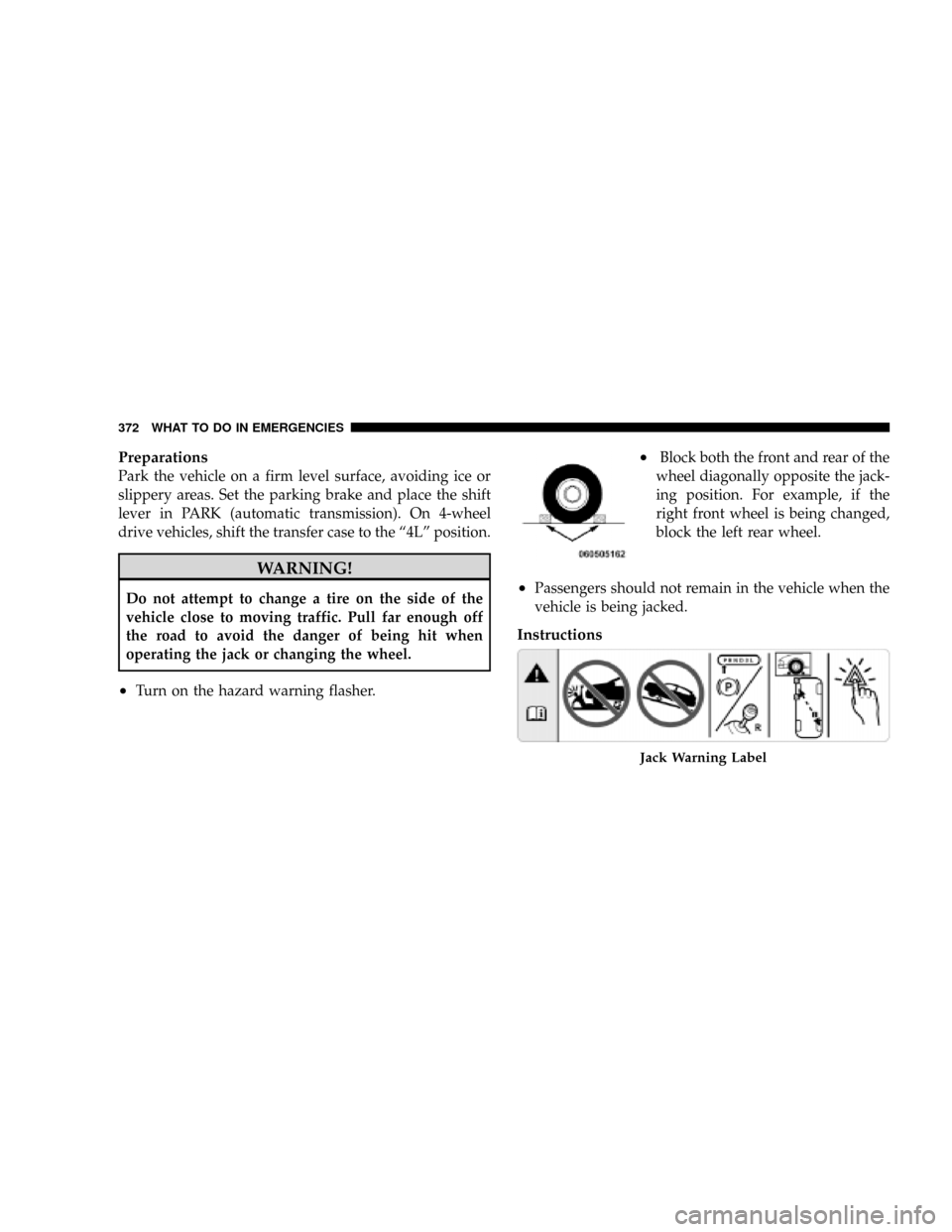
²Block both the front and rear of the
wheel diagonally opposite the jack-
ing position. For example, if the
right front wheel is being changed,
block the left rear wheel.
²Passengers should not remain in the vehicle when the
vehicle is being jacked.
Instructions
Jack Warning Label
372 WHAT TO DO IN EMERGENCIES
Page 375 of 481
WARNING!
Carefully follow these tire changing warnings to
help prevent personal injury or damage to your
vehicle:
²Always park on a firm, level surface as far from
the edge of the roadway as possible before raising
the vehicle.
²Block the wheel diagonally opposite the wheel to
be raised.
²Set the parking brake firmly and set an automatic
transmission in PARK; a manual transmission in
REVERSE.
²Never start or run the engine with the vehicle on a
jack.
²Do not let anyone sit in the vehicle when it is on a
jack.
²Do not get under the vehicle when it is on a jack.
(Continued)
WARNING! (Continued)
²Only use the jack in the positions indicated and
for lifting this vehicle during a tire change.
²If working on or near a roadway, be extremely
careful of motor traffic.
²To assure that spare tires, flat or inflated are
securely stowed, spares must be stowed with the
valve stem facing the ground.
²Turn on the Hazard warning flasher.
1. Remove the spare wheel, jack, and tools from storage.
2. Using the wheel wrench, loosen, but do not remove,
the wheel nuts by turning them counterclockwise one
turn while the wheel is still on the ground.
WHAT TO DO IN EMERGENCIES 373
6
Page 378 of 481
WARNING!
A loose tire or jack thrown forward in a collision or
hard stop could injure someone in the vehicle. Al-
ways stow the jack, tools and the extra tire and wheel
in the places provided.
7. Remove wheel blocks. Do not install chrome or alu-
minum wheel center caps on the spare wheel. This may
result in cap damage.
8. Lower the jack to its fully closed position. Stow the
replaced tire, jack, and tools as previously described.
9. Adjust the tire pressure when possible.
NOTE:Do not oil wheel studs. For chrome wheels, do
not substitute with chrome plated wheel nuts.
WARNING!
Carefully follow these tire changing warnings to
help prevent personal injury or damage to your
vehicle:
²Always park on a firm, level surface as far from
the edge of the roadway as possible before raising
the vehicle.
²Block the wheel diagonally opposite the wheel to
be raised.
²Apply the parking brake firmly before jacking.
²Never start the engine with the vehicle on a jack.
²Do not let anyone sit in the vehicle when it is on a
jack.
²Do not get under the vehicle when it is on a jack.
²Only use the jack in the positions indicated.
(Continued)
376 WHAT TO DO IN EMERGENCIES
Page 380 of 481
If the indicator is dark or shows a green dot, proceed as
follows:
1. Wear eye protection and remove all metal jewelry such
as watch bands or bracelets which might make an
unintended electrical contact.
2. Park the booster vehicle within cable reach but with-
out letting the vehicles touch. Set the parking brake, place
the automatic transmission in PARK and turn the ignition
OFF on both vehicles.
3. Turn OFF the heater, radio and all unnecessary elec-
trical loads.
4. Connect one end of a jumper cable to the positive
terminal of the booster battery. Connect the other end of
the same cable to the positive terminal of the discharged
battery.WARNING!
Do not permit vehicles to touch each other as this
could establish a ground connection and personal
injury could result.
5. Connect the other cable, first to the negative terminal
of the booster battery and then to the engine of the
vehicle with the discharged battery. Make sure you have
a good contact on the engine.
WARNING!
Do not connect the cable to the negative post of the
discharge battery. The resulting electrical spark could
cause the battery to explode.
(Continued)
378 WHAT TO DO IN EMERGENCIES
Page 386 of 481
NExhaust System...................... 397
NCooling System...................... 400
NBrake System....................... 405
NAutomatic Transmission................ 406
NTransfer Case....................... 408
NAxles............................. 409
NAppearance Care And Protection From
Corrosion.......................... 410
mFuses.............................. 415
NInterior Fuses....................... 415
NUnderhood Fuses
(Power Distribution Center)............. 417
NUnderhood Fuses
(Integrated Power Module).............. 420mVehicle Storage....................... 423
mReplacement Light Bulbs................. 423
mBulb Replacement..................... 424
NHeadlights/Parking/Turn Signal.......... 424
NTail Lights, Turn Signals And Backup Lights
Ð Replacement...................... 425
NLicense Lights....................... 427
NCenter High-Mounted Stoplight.......... 428
NFog Lights......................... 429
mFluids And Capacities................... 431
mFluids, Lubricants And Genuine Parts....... 432
NEngine............................ 432
NChassis............................ 433
384 MAINTAINING YOUR VEHICLE
Page 387 of 481
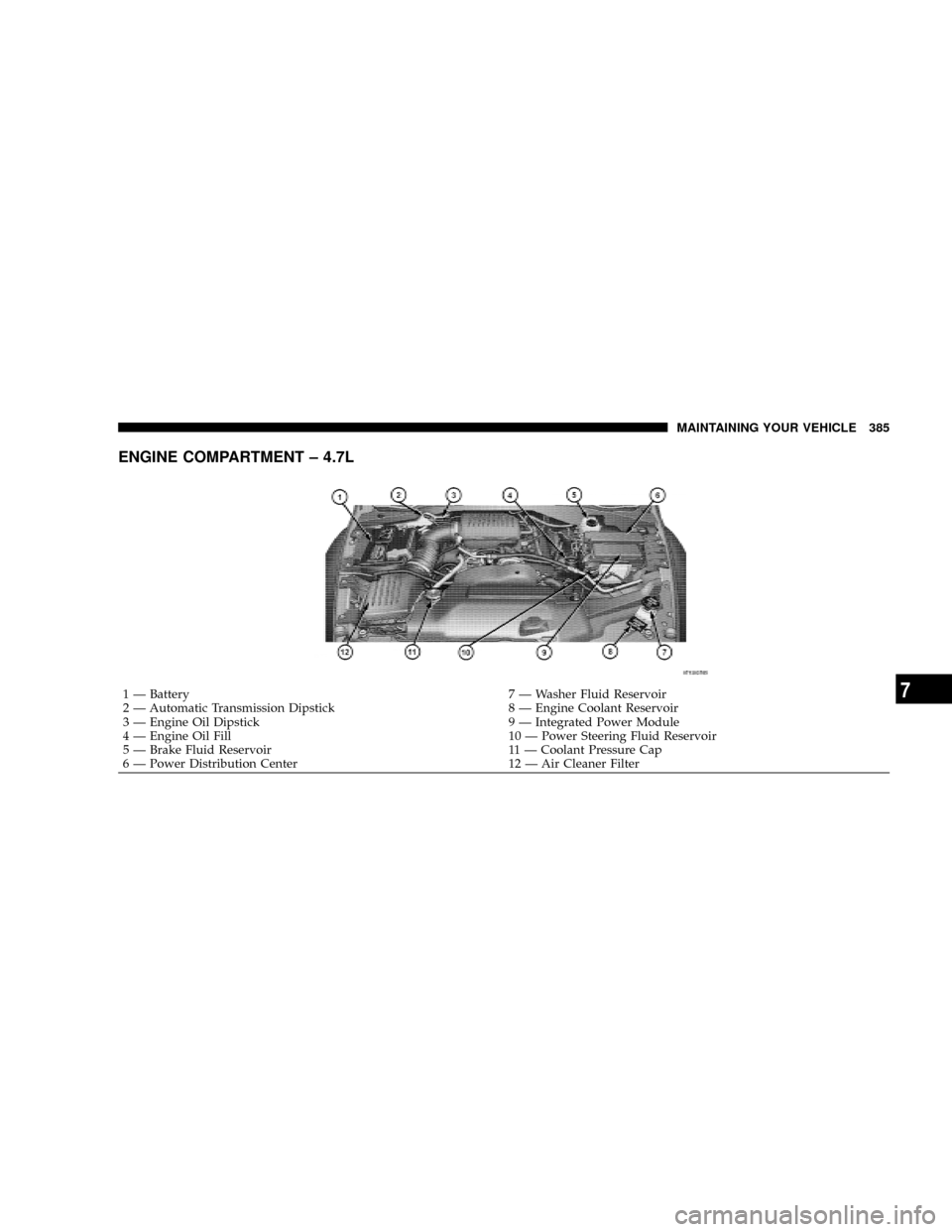
ENGINE COMPARTMENT ± 4.7L
1 Ð Battery 7 Ð Washer Fluid Reservoir
2 Ð Automatic Transmission Dipstick 8 Ð Engine Coolant Reservoir
3 Ð Engine Oil Dipstick 9 Ð Integrated Power Module
4 Ð Engine Oil Fill 10 Ð Power Steering Fluid Reservoir
5 Ð Brake Fluid Reservoir 11 Ð Coolant Pressure Cap
6 Ð Power Distribution Center 12 Ð Air Cleaner FilterMAINTAINING YOUR VEHICLE 3857
Page 388 of 481
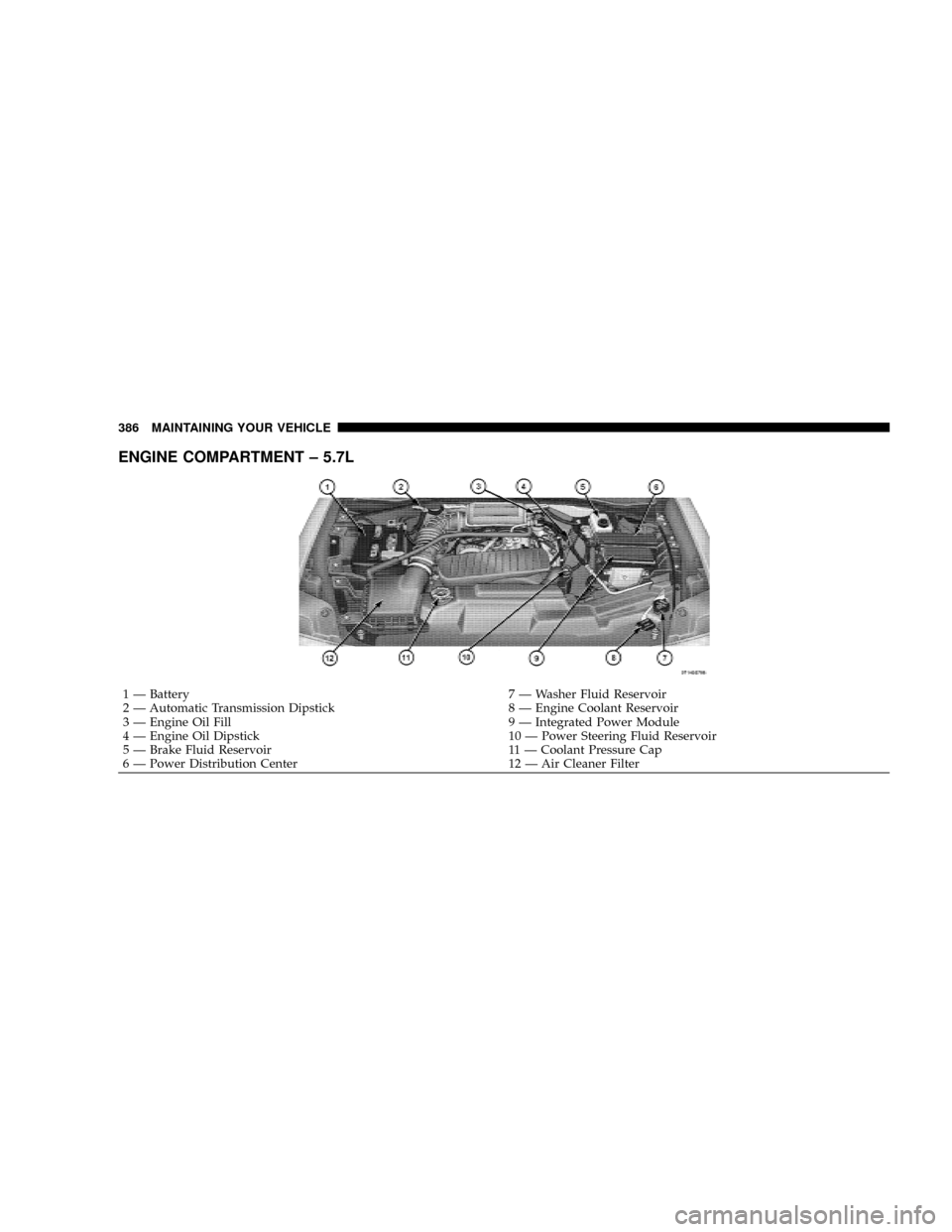
ENGINE COMPARTMENT ± 5.7L
1 Ð Battery 7 Ð Washer Fluid Reservoir
2 Ð Automatic Transmission Dipstick 8 Ð Engine Coolant Reservoir
3 Ð Engine Oil Fill 9 Ð Integrated Power Module
4 Ð Engine Oil Dipstick 10 Ð Power Steering Fluid Reservoir
5 Ð Brake Fluid Reservoir 11 Ð Coolant Pressure Cap
6 Ð Power Distribution Center 12 Ð Air Cleaner Filter 386 MAINTAINING YOUR VEHICLE
Page 407 of 481
²Do not change the thermostat for Summer or Winter
operation. If replacement is ever necessary, install
ONLY the correct type thermostat. Other designs may
result in unsatisfactory coolant performance, poor gas
mileage, and increased emissions.
Brake System
Brake Master Cylinder
The fluid level in the master cylinder should be checked
whenever the vehicle is serviced, or immediately if the
brake system warning light is on. If necessary, add fluid
to bring level to the full mark on the side of the reservoir
of the brake master cylinder. Be sure to clean the top of
the master cylinder area before removing the cap. With
disc brakes, fluid level can be expected to fall as the brake
pads wear. Brake fluid level should be checked when
pads are replaced. If the brake fluid level is abnormally
low, check system for leaks.For correct fluid type, refer to ºBrake Master Cylinderº
under ªFluids, Lubricants and Genuine Partsº in this
section.
WARNING!
²Use of brake fluid that may have a lower initial
boiling point, or is unidentified as to specifica-
tions may result in sudden brake failure during
hard prolonged braking. You could have an acci-
dent.
²Overfilling the brake fluid reservoir can result in
spilling brake fluid on hot engine parts and the
brake fluid catching on fire.
Use only brake fluid that has been in a tightly closed
container to avoid contamination from foreign matter or
moisture.
MAINTAINING YOUR VEHICLE 405
7
Page 408 of 481
CAUTION!
Do not allow a petroleum-base fluid to contaminate
the brake fluid. Seal damage may result.
Automatic Transmission
Fluid Level Check
NOTE:If equipped with a dipstick, use the following
procedure. If your vehicle has a capped dipstick, it is
sealed and should not be tampered with. Your authorized
dealer has the proper tools to ensure that the fluid level
is set properly.
Check the fluid level while the transmission is at normal
operating temperature 180ÉF (82ÉC). This occurs after at
least 15 miles (24 km) of driving. At normal operating
temperature the fluid cannot be held comfortably be-
tween the fingertips.To check the automatic transmission fluid level properly,
the following procedure must be used:
1. Operate the engine at idle speed and normal operating
temperature.
2. The vehicle must be on level ground.
3. Fully apply the parking brake and press the brake
pedal.
4. Place the shift lever momentarily in each gear position
ending with the lever in PARK.
5. Remove the dipstick, wipe it clean and reinsert it until
seated.
6. Remove the dipstick again and note the fluid level on
both sides. The fluid level should be between the ªHOTº
(upper) reference holes on the dipstick at normal operat-
ing temperature. Verify that solid coating of oil is seen on
both sides of the dipstick. If the fluid is low, add as
406 MAINTAINING YOUR VEHICLE
Page 409 of 481
required into the dipstick tube.Do not overfill.After
adding any quantity of oil through the oil fill tube, wait
a minimum of two minutes for the oil to fully drain into
the transmission before rechecking the fluid level.
NOTE:If it is necessary to check the transmissionbelow
the operating temperature, the fluid level should be
between the two ªCOLDº (lower) holes on the dipstick
with the fluid at approximately 70ÉF (21ÉC) (room tem-
perature). If the fluid level is correctly established at
room temperature, it should be between the ªHOTº
(upper) reference holes when the transmission reaches
180ÉF ( 82ÉC). Remember it is best to check the level at the
normal operating temperature.CAUTION!
Be aware that if the fluid temperature is below 50ÉF
(10ÉC) it may not register on the dipstick. Do not add
fluid until the temperature is elevated enough to
produce an accurate reading.
7. Check for leaks. Release parking brake.
To prevent dirt and water from entering the transmission
after checking or replenishing fluid, make certain that the
dipstick cap is properly reseated. It is normal for the
dipstick cap to spring back slightly from its fully seated
position, as long as its seal remains engaged in the
dipstick tube.
MAINTAINING YOUR VEHICLE 407
7