ECO mode CHRYSLER ASPEN 2009 2.G Workshop Manual
[x] Cancel search | Manufacturer: CHRYSLER, Model Year: 2009, Model line: ASPEN, Model: CHRYSLER ASPEN 2009 2.GPages: 481, PDF Size: 9.28 MB
Page 283 of 481
NOTE:Towing the vehicle, coasting, or driving for any
other reason with the shift lever in NEUTRAL can result
in severe transmission damage. Refer to ªRecreational
Towingº in Section 5 and ªTowing a Disabled Vehicleº in
Section 6 of this manual.
DRIVE
For most city and highway driving.
2 (Second)
For driving slowly in heavy city traffic or on mountain
roads where more precise speed control is desirable. Use
it also when climbing long grades, and for engine brak-
ing when descending moderately steep grades. To pre-
vent excessive engine speed, do not exceed 45 mph (72
km/h) in this range.1 (First)
For driving up very steep hills and for engine braking at
low speeds (25 mph {40 km/h} or less) when going
downhill. To prevent excessive engine speed do not
exceed 25 mph (40 km/h) in this range.
Overdrive Operation
The automatic transmission contains an electronically
controlled fourth and fifth (if equipped) speed (OVER-
DRIVE). The transmission will automatically shift from
DRIVE to OVERDRIVE if the following conditions are
present:
²the transmission selector is in DRIVE;
²the engine coolant has reached normal operating tem-
perature;
STARTING AND OPERATING 281
5
Page 284 of 481
²vehicle speed is above approximately 30 mph (48
km/h);
²the TOW/HAUL switch has not been activated;
²transmission has reached normal operating
temperature.
NOTE:If the vehicle is started in extremely cold tem-
peratures, the transmission may not shift into OVER-
DRIVE and will automatically select the most desirable
gear for operation at this temperature. Normal operation
will resume when the transmission fluid temperature has
risen to a suitable level. Refer also to the Note under
torque converter clutch, later in this section.
If the transmission temperature gets extremely hot, the
transmission will automatically select the most desirable
gear for operation at this temperature. If the transmission
temperature becomes hot enough, the ªTransmission
Temperature Indicator Lightº may illuminate and thetransmission may downshift out of OVERDRIVE until
the transmission cools down. After cooldown, the trans-
mission will resume normal operation.
The transmission will downshift from OVERDRIVE to
DRIVE if the accelerator pedal is fully depressed at
vehicle speeds above approximately 35 mph (56 km/h).
When To Use TOW/HAUL Mode
When driving in hilly areas, towing a trailer, carrying a
heavy load, etc., and frequent transmission shifting oc-
curs, press the TOW/HAUL button. This will improve
performance and reduce the potential for transmission
overheating or failure due to excessive shifting. When
operating in TOW/HAUL mode, 5th gear (if equipped) is
disabled and 2-3 and 3-4 shift patterns are modified.
Shifts into OVERDRIVE (4th gear) are allowed during
steady cruise (for improved fuel economy) and automatic
closed-throttle downshifts to 3rd gear (for improved
braking) will occur during steady braking.
282 STARTING AND OPERATING
Page 285 of 481
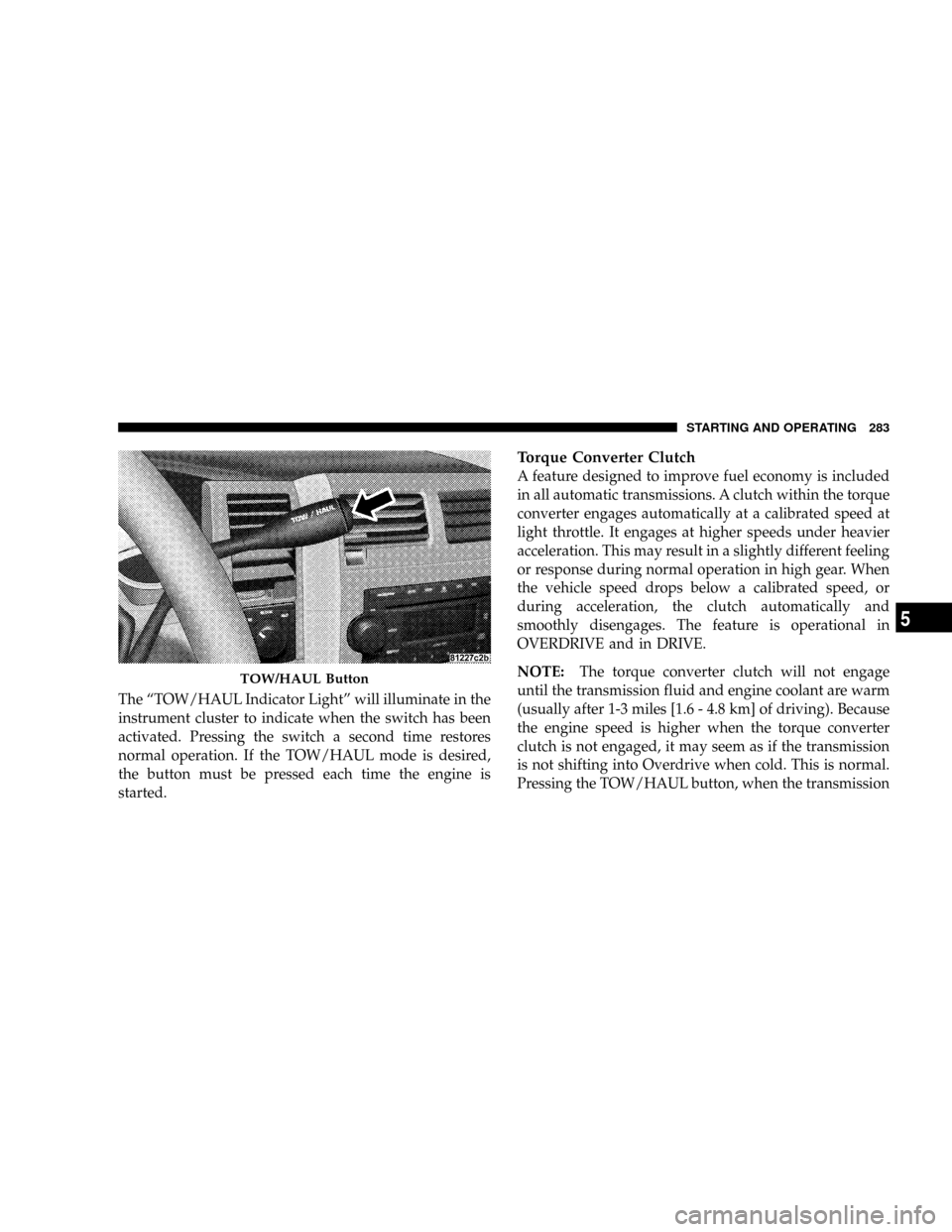
The ªTOW/HAUL Indicator Lightº will illuminate in the
instrument cluster to indicate when the switch has been
activated. Pressing the switch a second time restores
normal operation. If the TOW/HAUL mode is desired,
the button must be pressed each time the engine is
started.
Torque Converter Clutch
A feature designed to improve fuel economy is included
in all automatic transmissions. A clutch within the torque
converter engages automatically at a calibrated speed at
light throttle. It engages at higher speeds under heavier
acceleration. This may result in a slightly different feeling
or response during normal operation in high gear. When
the vehicle speed drops below a calibrated speed, or
during acceleration, the clutch automatically and
smoothly disengages. The feature is operational in
OVERDRIVE and in DRIVE.
NOTE:The torque converter clutch will not engage
until the transmission fluid and engine coolant are warm
(usually after 1-3 miles [1.6 - 4.8 km] of driving). Because
the engine speed is higher when the torque converter
clutch is not engaged, it may seem as if the transmission
is not shifting into Overdrive when cold. This is normal.
Pressing the TOW/HAUL button, when the transmission
TOW/HAUL Button
STARTING AND OPERATING 283
5
Page 308 of 481
NOTE:When the vehicle is in 4WD LOW, a feature of
the ESP system remains active whether the ESP is on or
off. This feature functions similar to a limited slip differ-
ential and controls the wheel spin across an axle. If one
wheel on an axle is spinning faster than the other, the
system will apply the brake of the spinning wheel and
allow more engine torque to be applied to the wheel that
is not spinning.
WARNING!
In the Partial Off mode, the engine torque reduction
and stability features are desensitized. Therefore, the
enhanced vehicle stability offered by ESP is
unavailable.
Trailer Sway Control (TSC)
TSC uses sensors in the vehicle to recognize a swaying
trailer and will take the appropriate actions to attempt to
stop the sway. The system will reduce engine power andapply individual brakes that will counter act the sway of
the trailer. TSC will become active automatically once the
swaying trailer is recognized. No driver action is re-
quired. TSC cannot stop all trailers from swaying. Al-
ways use caution when towing a trailer and follow the
tongue weight recommendations. For additional infor-
mation on towing a trailer with your vehicle, refer to
9Trailer Towing9in Section 5.
ESP/BAS Warning Light and ESP/TCS Indicator
Light
The malfunction indicator for the ESP is combined with
the BAS indicator. The yellow ESP/BAS Warning Light
and the yellow ESP/TCS Indicator Light in the instru-
ment cluster both come on when the ignition switch is
turned to the ON position. They should both go out with
the engine running. If the ESP/BAS Warning Light comes
on continuously with the engine running, a malfunction
has been detected in either the ESP or BAS system, or
both. If this light remains on after several ignition cycles,
306 STARTING AND OPERATING
Page 339 of 481
CAUTION!
DO NOT use gasoline containing Methanol or E85
Ethanol. Use of these blends may result in starting
and driveability problems and may damage critical
fuel system components.
Problems that result from using methanol/gasoline
blends are not the responsibility of the manufacturer.
While MTBE is an oxygenate made from Methanol, it
does not have the negative effects of Methanol.
E-85 Usage In Non-Flex Fuel Vehicles
Non-FFV vehicles are compatible with gasoline contain-
ing 10% ethanol (E10). Gasoline with higher ethanol
content may void the vehicle's warranty.
If a Non-FFV vehicle is inadvertently fueled with E-85
fuel, the engine will have some or all of these symptoms:
²operate in a lean mode
²OBD II ªMalfunction Indicator Lightº on
²poor engine performance
²poor cold start and cold drivability
²increased risk for fuel system component corrosion
To fix a Non-FFV vehicle inadvertently fueled once with
E-85 perform the following:
²drain the fuel tank (see your authorized dealer)
²change the engine oil and oil filter
²disconnect and reconnect the battery to reset the
engine controller memory
More extensive repairs will be required for prolonged
exposure to E-85 fuel.
STARTING AND OPERATING 337
5
Page 364 of 481
SNOWPLOW
Snow plows, winches, and other aftermarket equipment
shouldnotbe added to the front end of your vehicle. The
airbag crash sensors may be affected by the change in the
front end structure. The airbags could deploy unexpect-
edly or could fail to deploy during a collision.
WARNING!
Do not add a snow plow, winches, or any other
aftermarket equipment to the front of your vehicle.
This could adversely affect the functioning of the
airbag system and you could be injured.
RECREATIONAL TOWING (BEHIND
MOTORHOME, ETC.)
2WD Models
Recreational towing of 2WD models is not allowable.
Towing the vehicle with the transmission in NEUTRAL
can cause severe transmission damage. Removal of the
driveshaft for towing is not recommended since this
allows transmission fluid to leak out.
4WD Models
CAUTION!
Vehicles equipped with an NV 140 Transfer Case
(which has no NEUTRAL position) may NOT be
used for recreational towing.
362 STARTING AND OPERATING
Page 397 of 481
include cleaning of the condenser fins and a performance
test. Drive belt tension should also be checked at this
time.
WARNING!
²Use only refrigerants and compressor lubricants
approved by the manufacturer for your air condi-
tioning system. Some unapproved refrigerants are
flammable and can explode, injuring you. Other
unapproved refrigerants or lubricants can cause
the system to fail, requiring costly repairs. Refer to
Section 3 of the Warranty Information book for
further warranty information.
²The air conditioning system contains refrigerant
under high pressure. To avoid risk of personal
injury or damage to the system, adding refrigerant
or any repair requiring lines to be disconnected
should be done by an experienced technician.NOTE:Use only manufacturer approved A/C System
Sealers, Stop Leak Products, Seal Conditioners, Compres-
sor Oils and Refrigerants.
Refrigerant Recovery and Recycling
R-134a air conditioning refrigerant is a hydrofluoro-
carbon (HFC) that is endorsed by the Environmental
Protection Agency and is an ozone-saving product. How-
ever, the manufacturer recommends that air conditioning
service be performed by authorized dealers or other
service facilities using recovery and recycling equipment.
Drive Shaft Constant Velocity Joints
All 4-wheel drive models are equipped with four con-
stant velocity joints. Periodic lubrication of these joints is
not required. However, the joint boot should be inspected
for external leakage or damage periodically. If external
leakage or damage is evident, the joint boot and grease
should be replaced immediately. Continued operation
could result in failure of the joint due to water and dirt
MAINTAINING YOUR VEHICLE 395
7
Page 425 of 481
VEHICLE STORAGE
If you are storing your vehicle for more than 21 days, we
recommend that you take the following steps to mini-
mize the drain on your vehicle's battery:
²Disconnect the Ignition Off Draw (I.O.D.) fuses located
in the Power Distribution Center (PDC). The I.O.D.
cavity includes a snap-in retainer that allows the fuse
to be disconnected without removing it from the fuse
block.
²The transfer case should be placed in the 4HI mode
and kept in this position to minimize the battery drain.
²As an alternative to the above steps you may discon-
nect the negative cable from the battery.
REPLACEMENT LIGHT BULBS
LIGHT BULBS Ð Interior Bulb No.
Dome Light.................... NotServiceable
Liftgate Lamp........................... 567
Overhead Console Lights........... NotServiceable
Reading Light................... NotServiceable
Visor Vanity Lights............... NotServiceable
LIGHT BULBS Ð Exterior Bulb No.
Headlight............................. H13
Front Park/Turn......................3457AK
Backup...............................3057
Center High-Mounted Stop Light............. 921
Front Side Marker........................ 168
Fog Lamp.............................9145
License Plate Light....................... 168
Rear Tail, Stop, Turn Signal and Side Marker....3057
MAINTAINING YOUR VEHICLE 423
7