warning CHRYSLER ASPEN 2009 2.G Repair Manual
[x] Cancel search | Manufacturer: CHRYSLER, Model Year: 2009, Model line: ASPEN, Model: CHRYSLER ASPEN 2009 2.GPages: 481, PDF Size: 9.28 MB
Page 207 of 481
5. High Beam Indicator
Indicates that headlights are on high beam.
6. Seat Belt Reminder Light
This light comes on for several seconds after the
ignition is turned ON as a reminder to ªbuckle
up.º This light will remain on as long as the seat
belt remains unbuckled. If this light flashes, it indicates a
fault in the seat belt system. Have the system checked by
an authorized dealer.
7. Engine Temperature Warning Light
This light warns of an overheated engine condi-
tion. As temperatures rise and the gauge ap-
proachesH(Hot), this indicator will illuminate
and a single chime will sound after reaching a set
threshold. Further overheating will cause the tempera-
ture gauge to passH(Hot), the indicator will continu-
ously flash and a continuous chime will occur until the
engine is allowed to cool.CAUTION!
Driving with a hot engine cooling system could
damage your vehicle. If the temperature light is on,
safely pull over and stop the vehicle. Idle the vehicle
in neutral with the air conditioner turned off until
the light turns off. If the light remains on, turn the
engine off immediately, and call for service.
WARNING!
A hot engine cooling system is dangerous. You or
others could be badly burned by steam or boiling
coolant. You may want to call a service center if your
vehicle overheats. If you decide to look under the
hood yourself, see Section 7 of this manual. Follow
the warnings under the Cooling System Pressure Cap
paragraph.
UNDERSTANDING YOUR INSTRUMENT PANEL 205
4
Page 209 of 481
When the voltage is above this value again, the malfunc-
tion indicator light should go out and the ABS is opera-
tional. If the malfunction indicator light stays illumi-
nated, have the system checked at an authorized dealer
as soon as possible.
12. Oil Pressure Warning Light
This light indicates low engine oil pressure. The
light should turn on momentarily when the engine
is started. If the light turns on while driving, stop the
vehicle and shut off the engine as soon as possible. A
chime will sound when this light turns on.
Do not operate the vehicle until the cause is corrected.
This light does not show how much oil is in the engine.
The engine oil level must be checked under the hood.
13. Tachometer
This gauge measures engine Revolutions-Per-Minute
(RPM x 1000).14. Shift Lever Indicator
The shift lever indicator is self-contained within the
instrument cluster. It displays the position of the auto-
matic transmission shift lever, and the relation of each
position to all other positions. For a good signal the
display will place a box around the selected transmission
range (PRND21). If the PRNDL displays only the char-
acters PRND21 (no boxes), have the system checked by
an authorized dealer.
15. Odometer / Trip Odometer
The two trip odometers show individual trip mileage. To
switch from odometer to trip odometers, press and
release the Trip Odometer button.
To reset a trip odometer, display the desired trip odom-
eter to be reset then push and hold the button until the
display resets (approximately two seconds).
UNDERSTANDING YOUR INSTRUMENT PANEL 207
4
Page 210 of 481
Vehicle Warning Messages
For non-Electronic Vehicle Information Center (EVIC)
equipped vehicles, when the appropriate conditions ex-
ist, messages such as ªdoor ajarº (indicates that a door(s)
may be ajar), ªgASCAPº (which indicates that your gas
cap is possibly loose or damaged),9CHANgE OILº
(indicates that the engine oil should be changed), ªLo-
WASHº (low washer fluid), and ªnoFUSEº (indicates
that the IOD fuse is removed from the Integrated Power
Module), will display in the odometer.
NOTE:If the vehicle is equipped with an EVIC, most
warnings will display in the EVIC. For additional infor-
mation, refer to ªElectronic Vehicle Information Center
(EVIC) Ð If Equippedº in Section 3.
The outside temperature will display in the odometer for
non-EVIC equipped vehicles. Pressing the trip odometer
RESET button toggles the feature back to the odometer.Change Oil Message
Your vehicle is equipped with an engine oil change
indicator system. The ªChange Oilº message will flash in
the instrument cluster odometer for approximately 12
seconds after a single chime has sounded to indicate the
next scheduled oil change interval. The engine oil change
indicator system is duty cycle based, which means the
engine oil change interval may fluctuate dependent upon
your personal driving style.
Unless reset, this message will continue to display each
time you turn the ignition switch to the ON/RUN
position. To turn off the message temporarily, press and
release the Trip Odometer button on the instrument
cluster. To reset the oil change indicator system (after
performing the scheduled maintenance) refer to the fol-
lowing procedure.
1. Turn the ignition switch to the ON position(Do not
start the engine).
208 UNDERSTANDING YOUR INSTRUMENT PANEL
Page 212 of 481
button has been pressed or ESP is only partially available
caused by lack of engine management or brake thermal
model.
19. Transmission Temperature Indicator
This light indicates that there is excessive trans-
mission fluid temperature that might occur
with severe usage, such as trailer towing. If this
light comes on, stop the vehicle and run the
engine at idle or faster, with the transmission in NEU-
TRAL until the light goes off.
20. Electronic Throttle Control (ETC)
This light informs you of a problem with the
Electronic Throttle Control (ETC) system. If a
problem is detected, the light will come on
while the engine is running. If the light remains
lit with the engine running your vehicle will usually be
drivable, however, see an authorized dealer for service as
soon as possible. If the light is flashing when the engineis running, immediate service is required and you may
experience reduced performance, an elevated/rough idle
or engine stall and your vehicle may require towing. The
light will come on when the ignition is first turned on
and remain on for 15 seconds as a bulb check. If the light
does not come on during starting, have the system
checked by an authorized dealer.
21. Brake System Warning Light
This light monitors various brake functions,
including brake fluid level and parking brake
application. If the brake light turns on, it may
indicate that the parking brake is applied, that
the brake fluid level is low, or that there is a problem with
the anti-lock brake system reservoir.
If the light remains on when the parking brake has been
disengaged, and the fluid level is at the full mark on the
master cylinder reservoir, it indicates a possible brake
hydraulic system malfunction or a problem with the
210 UNDERSTANDING YOUR INSTRUMENT PANEL
Page 213 of 481
Brake Booster has been detected by the Anti-Lock Brake
System (ABS) / Electronic Stability Program (ESP) sys-
tem. In this case, the light will remain on until the
condition has been corrected. If the problem is related to
the brake booster, the ABS pump will run when applying
the brake and a brake pedal pulsation may be felt during
each stop.
The dual brake system provides a reserve braking capac-
ity in the event of a failure to a portion of the hydraulic
system. A leak in either half of the dual brake system is
indicated by the Brake Warning Light which will turn on
when the brake fluid level in the master cylinder has
dropped below a specified level.
The light will remain on until the cause is corrected.
NOTE:The light may flash momentarily during sharp
cornering maneuvers which change fluid level condi-
tions. The vehicle should have service performed, and
the brake fluid level checked.If brake failure is indicated, immediate repair is neces-
sary.
WARNING!
Driving a vehicle with the brake light on is danger-
ous. Part of the brake system may have failed. It will
take longer to stop the vehicle. You could have an
accident. Have the vehicle checked immediately.
Vehicles equipped with the Anti-Lock Brake System
(ABS), are also equipped with Electronic Brake Force
Distribution (EBD). In the event of an EBD failure, the
Brake Warning Light will turn on along with the ABS
Light. Immediate repair to the ABS system is required.
Operation of the Brake Warning Light can be checked by
turning the ignition switch from the OFF position to the
ON position. The light should illuminate for approxi-
mately two seconds. The light should then turn off unless
UNDERSTANDING YOUR INSTRUMENT PANEL 211
4
Page 214 of 481
the parking brake is applied or a brake fault is detected.
If the light does not illuminate, have the light inspected
by an authorized dealer.
The light also will turn on when the parking brake is
applied with the ignition switch in the ON position.
NOTE:This light shows only that the parking brake is
applied. It does not show the degree of brake application.
22. Electronic Stability Program (ESP) / Brake Assist
System (BAS) Warning Lamp
The malfunction lamp for the Electronic Stabil-
ity Program (ESP) is combined with Brake
Assist System (BAS). The yellow ESP/BAS
warning lamp is in the instrument cluster it
comes on when the ignition switch is turned to the ON
position, it should go out with the engine running. If the
ESP/BAS warning lamp comes on continuously with the
engine running, a malfunction has been detected in either
the ESP or the BAS system. If this light remains on afterseveral ignition cycles, and the vehicle has been driven
several miles at speeds greater than 30 mph (48 km/h),
see an authorized dealer as soon as possible.
NOTE:The ESP control system will make buzzing or
clicking sounds when it is actively operating.
23. Malfunction Indicator Light (MIL)
The Malfunction Indicator Light (MIL) is part of
an onboard diagnostic system which monitors
the emissions and engine control system. If the
vehicle is ready for emissions testing, the MIL will come
on when the ignition is first turned on and remain on, as
a bulb check, until the engine is started. If the vehicle is
not ready for emissions testing, the MIL will come on
when the ignition is first turned on and remain on for 15
seconds, then blink for 10 seconds, and remain on until
the vehicle is started. If the MIL does not come on during
starting, see an authorized dealer as soon as possible.
212 UNDERSTANDING YOUR INSTRUMENT PANEL
Page 217 of 481
CAUTION!
The TPMS has been optimized for the original
equipment tires and wheels. TPMS pressures and
warning have been established for the tire size
equipped on your vehicle. Undesirable system opera-
tion or sensor damage may result when using re-
placement equipment that is not of the same size,
type, and/or style. Aftermarket wheels can cause
sensor damage. Do not use tire sealant from a can, or
balance beads if your vehicle is equipped with a
TPMS, as damage to the sensors may result.
25. Airbag Indicator
The airbag indicator light illuminates and re-
mains lit for six to eight seconds when the
ignition is first turned ON. If the light does not
come on when the ignition is first turned on, orthe light stays on or comes on while driving, have the
airbag system checked by an authorized dealer.
26. 4WD Indicator
The 4WD indicator light illuminates when the transfer
case is in 4WD position.
27. SVC (Service) 4WD Indicator
The SVC 4WD light will illuminate when the ignition key
is turned to the ON position and will stay on for two
seconds. If the light stays on or comes on during driving,
it means that the 4WD system is not functioning properly
and that service is required.
28. Cruise Light (Speed Control)
The cruise light indicator illuminates when the electronic
speed control system is turned on.
UNDERSTANDING YOUR INSTRUMENT PANEL 215
4
Page 248 of 481
²MUSIC TYPEbutton: TheMUSIC TYPEbutton is
another shortcut button to the genre listing on your
iPodt.
CAUTION!
²Leaving the iPodt(or any supported device) any-
where in the vehicle in extreme heat or cold can
alter the operation, or damage the device. Follow
the device manufacturer 's guidelines.
²Placing items on the iPodt, or connections to the
iPodtin the vehicle, can cause damage to the
device and/or to the connectors.
WARNING!
Do not plug in or remove the iPodtwhile driving.
Failure to following this warning could result in an
accident.
SATELLITE RADIO Ð IF EQUIPPED
(REN/REQ/RER/RES/REU RADIOS ONLY)
Satellite radio uses direct satellite-to-receiver broadcast-
ing technology to provide clear digital sound, coast to
coast. The subscription service provider is Sirius Satellite
Radio. This service offers over 130 channels of music,
sports, news, entertainment, and programming for chil-
dren, directly from its satellites and broadcasting studios.
NOTE:Sirius service is not available in Hawaii and has
limited coverage in Alaska.
System Activation
Sirius Satellite Radio service is pre-activated, and you
may begin listening immediately to the one year of audio
service that is included with the factory-installed satellite
radio system in your vehicle. Sirius will supply a wel-
come kit that contains general information, including
how to setup your on-line listening account at no addi-
tional charge. For further information, call the toll-free
246 UNDERSTANDING YOUR INSTRUMENT PANEL
Page 274 of 481
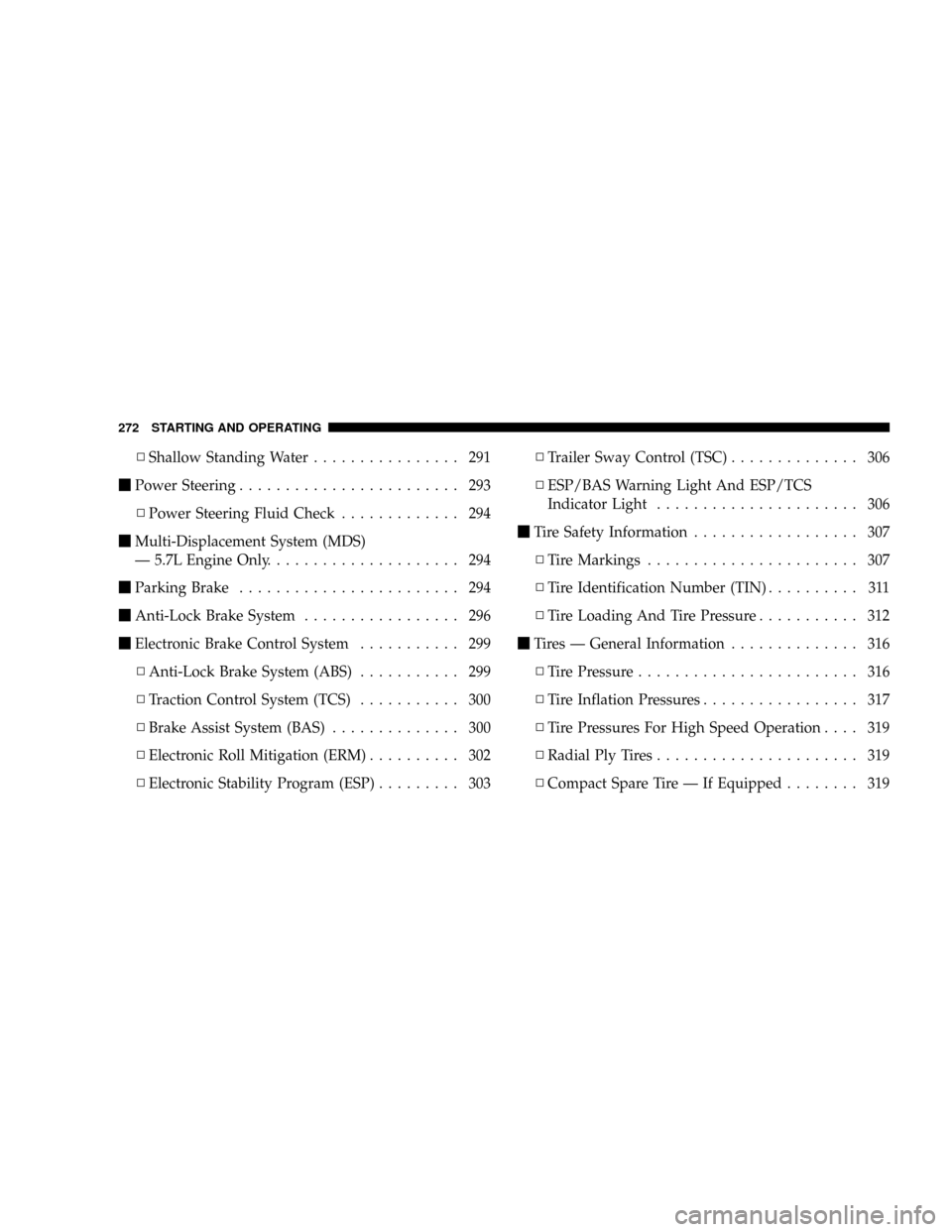
NShallow Standing Water................ 291
mPower Steering........................ 293
NPower Steering Fluid Check............. 294
mMulti-Displacement System (MDS)
Ð 5.7L Engine Only..................... 294
mParking Brake........................ 294
mAnti-Lock Brake System................. 296
mElectronic Brake Control System........... 299
NAnti-Lock Brake System (ABS)........... 299
NTraction Control System (TCS)........... 300
NBrake Assist System (BAS).............. 300
NElectronic Roll Mitigation (ERM).......... 302
NElectronic Stability Program (ESP)......... 303NTrailer Sway Control (TSC).............. 306
NESP/BAS Warning Light And ESP/TCS
Indicator Light...................... 306
mTire Safety Information.................. 307
NTire Markings....................... 307
NTire Identification Number (TIN).......... 311
NTire Loading And Tire Pressure........... 312
mTires Ð General Information.............. 316
NTire Pressure........................ 316
NTire Inflation Pressures................. 317
NTire Pressures For High Speed Operation.... 319
NRadial Ply Tires...................... 319
NCompact Spare Tire Ð If Equipped........ 319
272 STARTING AND OPERATING
Page 275 of 481
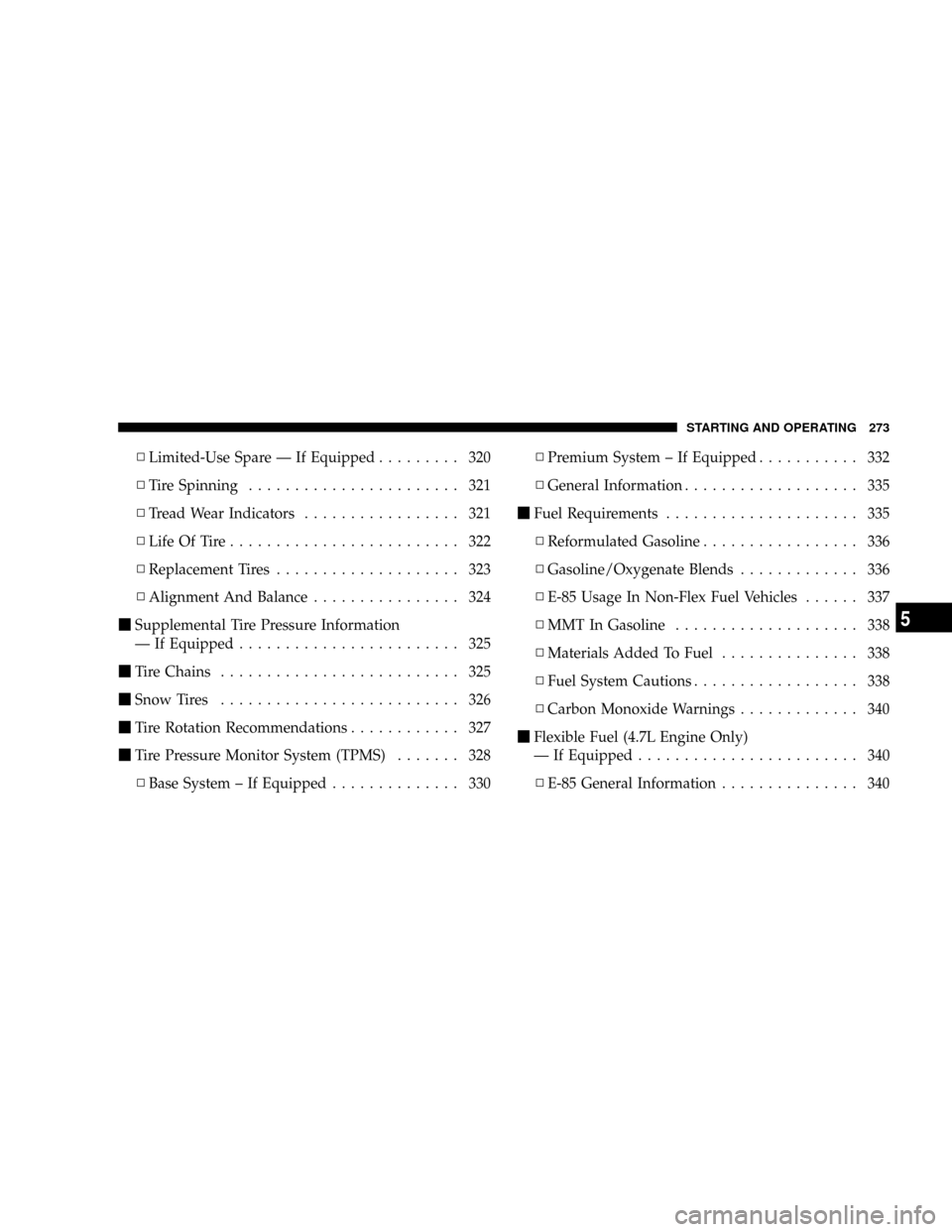
NLimited-Use Spare Ð If Equipped......... 320
NTire Spinning....................... 321
NTread Wear Indicators................. 321
NLife Of Tire......................... 322
NReplacement Tires.................... 323
NAlignment And Balance................ 324
mSupplemental Tire Pressure Information
Ð If Equipped......................... 325
mTire Chains.......................... 325
mSnow Tires.......................... 326
mTire Rotation Recommendations............ 327
mTire Pressure Monitor System (TPMS)....... 328
NBase System ± If Equipped.............. 330NPremium System ± If Equipped........... 332
NGeneral Information................... 335
mFuel Requirements..................... 335
NReformulated Gasoline................. 336
NGasoline/Oxygenate Blends............. 336
NE-85 Usage In Non-Flex Fuel Vehicles...... 337
NMMT In Gasoline.................... 338
NMaterials Added To Fuel............... 338
NFuel System Cautions.................. 338
NCarbon Monoxide Warnings............. 340
mFlexible Fuel (4.7L Engine Only)
Ð If Equipped......................... 340
NE-85 General Information............... 340
STARTING AND OPERATING 273
5