service CHRYSLER CARAVAN 2003 Service Manual
[x] Cancel search | Manufacturer: CHRYSLER, Model Year: 2003, Model line: CARAVAN, Model: CHRYSLER CARAVAN 2003Pages: 2177, PDF Size: 59.81 MB
Page 480 of 2177
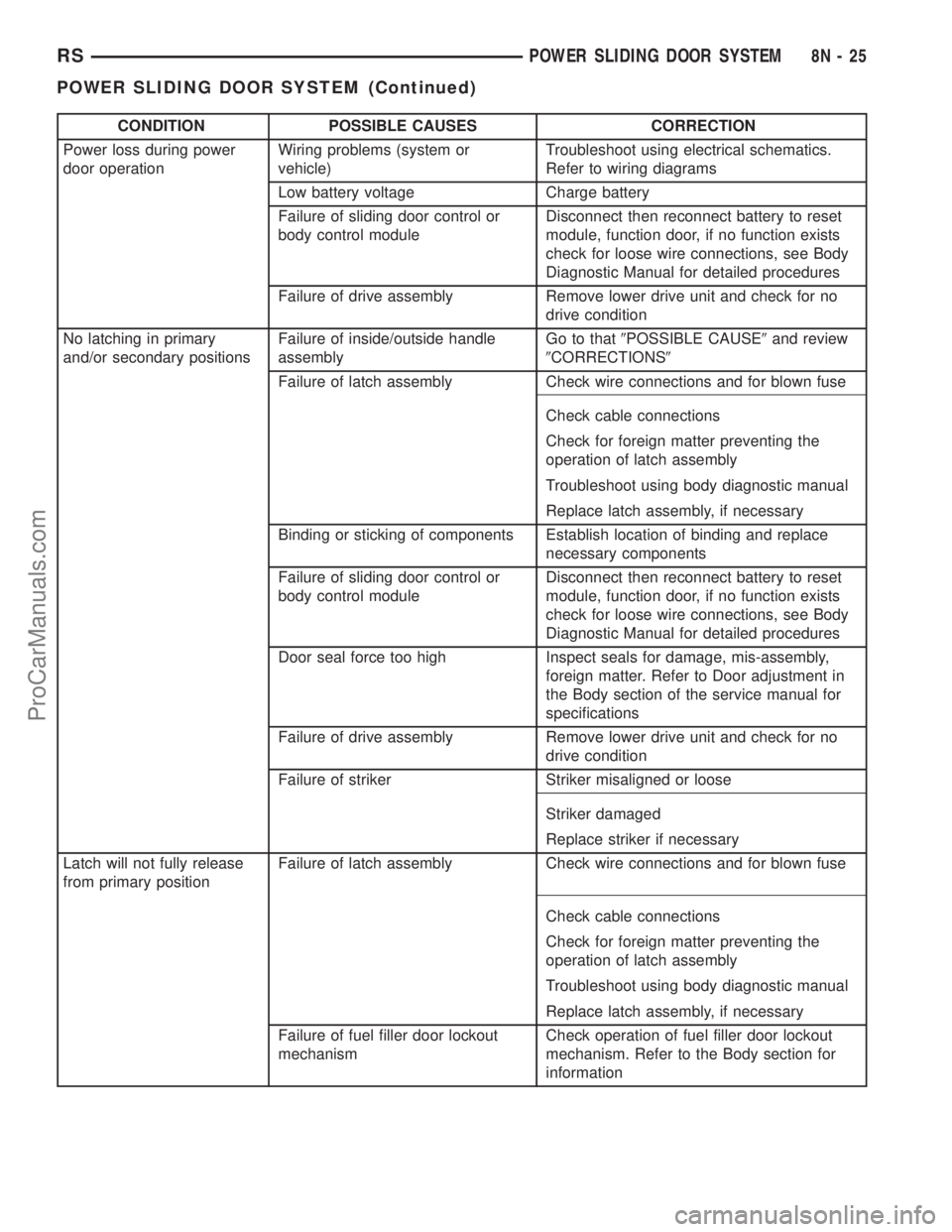
CONDITION POSSIBLE CAUSES CORRECTION
Power loss during power
door operationWiring problems (system or
vehicle)Troubleshoot using electrical schematics.
Refer to wiring diagrams
Low battery voltage Charge battery
Failure of sliding door control or
body control moduleDisconnect then reconnect battery to reset
module, function door, if no function exists
check for loose wire connections, see Body
Diagnostic Manual for detailed procedures
Failure of drive assembly Remove lower drive unit and check for no
drive condition
No latching in primary
and/or secondary positionsFailure of inside/outside handle
assemblyGo to that9POSSIBLE CAUSE9and review
9CORRECTIONS9
Failure of latch assembly Check wire connections and for blown fuse
Check cable connections
Check for foreign matter preventing the
operation of latch assembly
Troubleshoot using body diagnostic manual
Replace latch assembly, if necessary
Binding or sticking of components Establish location of binding and replace
necessary components
Failure of sliding door control or
body control moduleDisconnect then reconnect battery to reset
module, function door, if no function exists
check for loose wire connections, see Body
Diagnostic Manual for detailed procedures
Door seal force too high Inspect seals for damage, mis-assembly,
foreign matter. Refer to Door adjustment in
the Body section of the service manual for
specifications
Failure of drive assembly Remove lower drive unit and check for no
drive condition
Failure of striker Striker misaligned or loose
Striker damaged
Replace striker if necessary
Latch will not fully release
from primary positionFailure of latch assembly Check wire connections and for blown fuse
Check cable connections
Check for foreign matter preventing the
operation of latch assembly
Troubleshoot using body diagnostic manual
Replace latch assembly, if necessary
Failure of fuel filler door lockout
mechanismCheck operation of fuel filler door lockout
mechanism. Refer to the Body section for
information
RSPOWER SLIDING DOOR SYSTEM8N-25
POWER SLIDING DOOR SYSTEM (Continued)
ProCarManuals.com
Page 483 of 2177

STANDARD PROCEDURE
STANDARD PROCEDURE - POWER DOOR
LEARN CYCLE
Any time a power side door component is removed,
replaced, door adjustment is performed or diagnostic
trouble codes are addressed and erased, a learn cycle
mustbe performed. This learn cycle enables the
power side door control module to learn or relearn its
critical information (travel limits, resistance to door
travel, etc.) which allows it to perform properly and
safely. It also tells the technician that the system is
performing properly and is able to be returned to ser-
vice. To perform a power door learn cycle do the fol-
lowing:
(1) Obtain a DRB IIItscan tool.
Connect the DRB IIItto the vehicle and check for
any power side door system stored diagnostic trouble
codes, erase any stored codes. Operate the system
and check to see if any trouble codes return. If any
diagnostic trouble codes return, diagnose, correct and
erase the codes before performing the learn cycle. If a
DRB IIItscan tool is not available, the learn cycle
can be performed by opening and closing the power
side door using any of the normal open/close com-
mand switches. Be certain to cycle the side door
through a complete openandclose cycle or the pro-
cedure will not be complete.
(2) Using the DRB IIIt, Go into Test Routine
Menu and select a power open command.
(3) Select a power close command.
(4) The power side door learn cycle is complete.
NOTE: If the power side door will not complete a
full cycle, a problem exists with the power side
door system. Refer to Power Side Door Diagnosis
and Testing.
STANDARD PROCEDURE - PUSH-PIN
GROMMET REPLACEMENT
Vehicles equipped with a power sliding door utilize
push-pin grommets. These push-pin grommets are
used to hold and isolate the power sliding door motor
to and from the door inner panel. This secures the
door motor assembly to the inner panel and keeps
the audible motor vibrations to a minimum. If a
push-pin grommet shows signs of wear, it must be
replaced. Follow the procedure below if replacement
is necessary.
(1) Remove the door motor from the door inner
panel. (Refer to 8 - ELECTRICAL/POWER DOORS/
MOTOR - REMOVAL).(2) Using a trim panel tool (special tool #C-4755)
or equivalent, remove the push-pin grommets from
the inner panel by pulling them straight out (Fig. 4).
(3) Install the replacement push-pin grommets in
the inner panel and install the door motor(Refer to 8
- ELECTRICAL/POWER DOORS/MOTOR - INSTAL-
LATION).
STANDARD PROCEDURE - SLIDING DOOR
ADJUSTMENT
In order for the power sliding door system to func-
tion properly the door must move freely and
smoothly. The power sliding door system can accom-
modate for some minor changes in the effort required
to move the door. However, in extreme conditions the
door may need to be mechanically adjusted for proper
fit. (Refer to 23 - BODY/DOORS - SLIDING/SLID-
ING DOOR - ADJUSTMENTS).
If a problem exists with the power sliding door and
it is suspected to be extreme effort, check for proper
door alignment and adjustment first, then check the
door tracks and drive unit for free manual operation.
Use a known good vehicle for side door comparison
data. Refer to the Side Door Adjustment procedure in
the Body section of the service manual for detailed
instructions.
Fig. 4 Side Door Motor push-pin grommets
1 - Push-Pin Grommets
2 - Side Door Inner Panel
8N - 28 POWER SLIDING DOOR SYSTEMRS
POWER SLIDING DOOR SYSTEM (Continued)
ProCarManuals.com
Page 484 of 2177
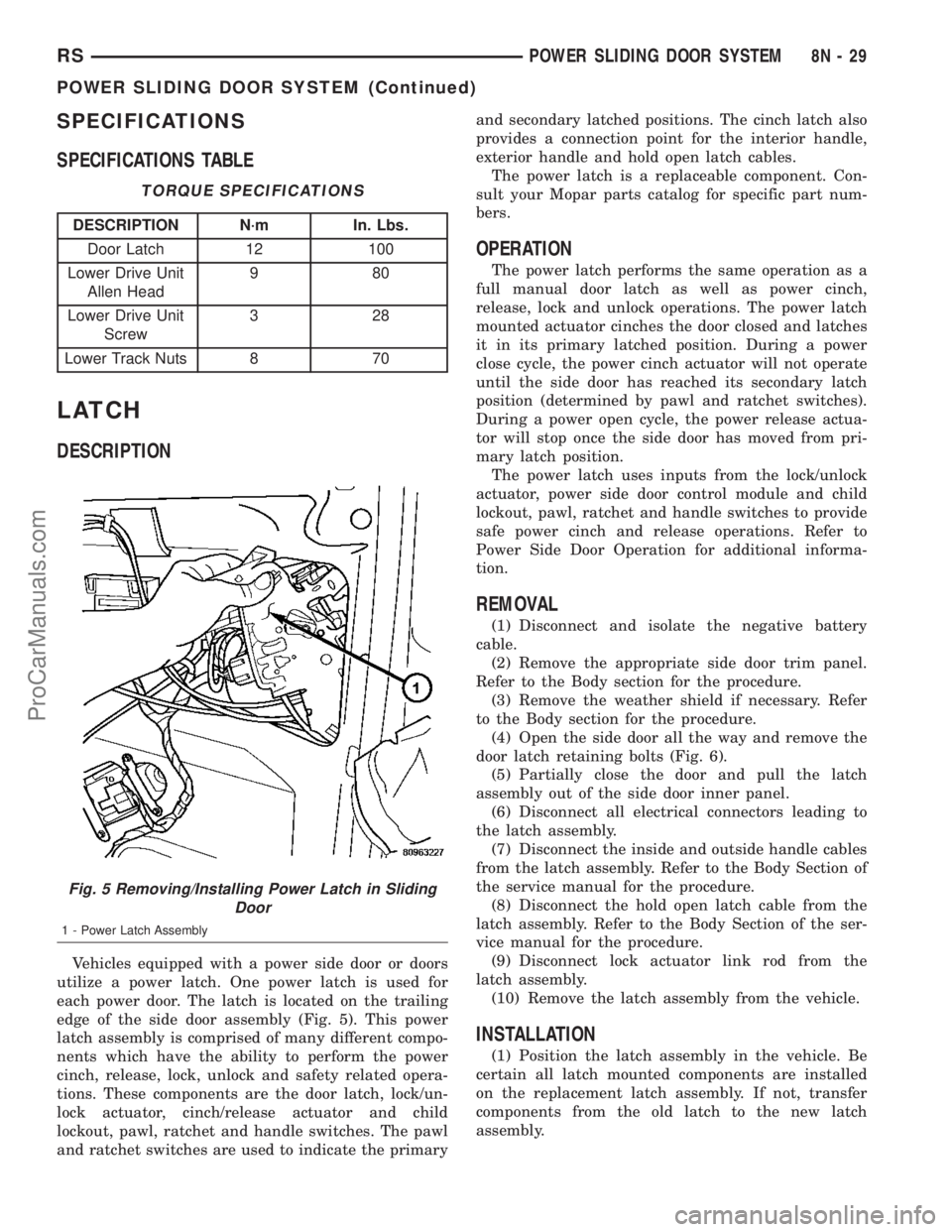
SPECIFICATIONS
SPECIFICATIONS TABLE
TORQUE SPECIFICATIONS
DESCRIPTION N´m In. Lbs.
Door Latch 12 100
Lower Drive Unit
Allen Head980
Lower Drive Unit
Screw328
Lower Track Nuts 8 70
LATCH
DESCRIPTION
Vehicles equipped with a power side door or doors
utilize a power latch. One power latch is used for
each power door. The latch is located on the trailing
edge of the side door assembly (Fig. 5). This power
latch assembly is comprised of many different compo-
nents which have the ability to perform the power
cinch, release, lock, unlock and safety related opera-
tions. These components are the door latch, lock/un-
lock actuator, cinch/release actuator and child
lockout, pawl, ratchet and handle switches. The pawl
and ratchet switches are used to indicate the primaryand secondary latched positions. The cinch latch also
provides a connection point for the interior handle,
exterior handle and hold open latch cables.
The power latch is a replaceable component. Con-
sult your Mopar parts catalog for specific part num-
bers.
OPERATION
The power latch performs the same operation as a
full manual door latch as well as power cinch,
release, lock and unlock operations. The power latch
mounted actuator cinches the door closed and latches
it in its primary latched position. During a power
close cycle, the power cinch actuator will not operate
until the side door has reached its secondary latch
position (determined by pawl and ratchet switches).
During a power open cycle, the power release actua-
tor will stop once the side door has moved from pri-
mary latch position.
The power latch uses inputs from the lock/unlock
actuator, power side door control module and child
lockout, pawl, ratchet and handle switches to provide
safe power cinch and release operations. Refer to
Power Side Door Operation for additional informa-
tion.
REMOVAL
(1) Disconnect and isolate the negative battery
cable.
(2) Remove the appropriate side door trim panel.
Refer to the Body section for the procedure.
(3) Remove the weather shield if necessary. Refer
to the Body section for the procedure.
(4) Open the side door all the way and remove the
door latch retaining bolts (Fig. 6).
(5) Partially close the door and pull the latch
assembly out of the side door inner panel.
(6) Disconnect all electrical connectors leading to
the latch assembly.
(7) Disconnect the inside and outside handle cables
from the latch assembly. Refer to the Body Section of
the service manual for the procedure.
(8) Disconnect the hold open latch cable from the
latch assembly. Refer to the Body Section of the ser-
vice manual for the procedure.
(9) Disconnect lock actuator link rod from the
latch assembly.
(10) Remove the latch assembly from the vehicle.
INSTALLATION
(1) Position the latch assembly in the vehicle. Be
certain all latch mounted components are installed
on the replacement latch assembly. If not, transfer
components from the old latch to the new latch
assembly.
Fig. 5 Removing/Installing Power Latch in Sliding
Door
1 - Power Latch Assembly
RSPOWER SLIDING DOOR SYSTEM8N-29
POWER SLIDING DOOR SYSTEM (Continued)
ProCarManuals.com
Page 486 of 2177

(2) Remove the door trim panel from the appropri-
ate side door. Refer to the Body section for the pro-
cedure.
(3) Remove water shield as necessary to gain
access to motor assembly.
(4) Remove retaining clip holding flex drive assem-
bly to the motor (Fig. 8). Pull flex drive cable straight
out of the motor assembly.
(5) Disconnect door motor electrical connector.
(6) Using a trim stick (special tool #C-4755) or
equivalent, gently pry out push-pin fasteners retain-
ing motor.
(7) Remove the motor assembly from the vehicle.
INSTALLATION
(1) Position the motor assembly on the door inner
panel.
(2) Install the push-pin fasteners retaining the
motor assembly to the sliding door.
NOTE: Push in on the push-pins at the clutch hous-
ing (plastic side) until you hear one click. Push in
on the push-pin fasteners at the motor mount
(sheet metal side) until you hear two clicks. This
assures proper installation/attachment of the motor
to the sliding door.
(3) Install the flex shaft by lining up the square
shaped drive shaft with corresponding hole in motor
drive unit and push straight in.(4) Install the E-clip to secure flex-shaft.
(5) Connect the negative battery cable.
(6) Install the weather shield. Refer to the Body
section of the service manual for the procedure.
(7) Install the door trim panel on the side door.
Refer to Body for the procedure.
FULL OPEN SWITCH
DESCRIPTION
Vehicles equipped with a power sliding door utilize
a full open switch. This switch is located in the hold
open latch (Fig. 9) under the side door lower hinge.
When the power side door module receives a ground
signal input from the full open switch, and as long as
the cinching latch actuator is not in power mode or
the handle switch is open, the signal indicates that
the door is at the full open position.
The full open switch is incorporated into the hold
open latch. If the full open switch proves faulty, the
entire hold open latch assembly must be replaced.
OPERATION
The full open switch is triggered by a pawl lever in
the hold open latch. When the full open switch is
closed (circuit to ground) the ratchet has engaged on
the hold open striker and the pawl lever has engaged
on the ratchet, locking the latch from opening and
holding the door in the full open position.
Fig. 8 Flex Drive Retaining Clip
1 - Flex Drive Cable Retaining Clip
2 - Flex Drive Cable
3 - Side Door Motor Assembly
Fig. 9 Full Open Switch Position & Orientation
1 - Hold Open Latch Assembly
2 - Hold Open Latch Cable
3 - Full Open Switch
RSPOWER SLIDING DOOR SYSTEM8N-31
SLIDING DOOR MOTOR (Continued)
ProCarManuals.com
Page 489 of 2177
LOWER DRIVE UNIT TRACK &
RACK
DESCRIPTION
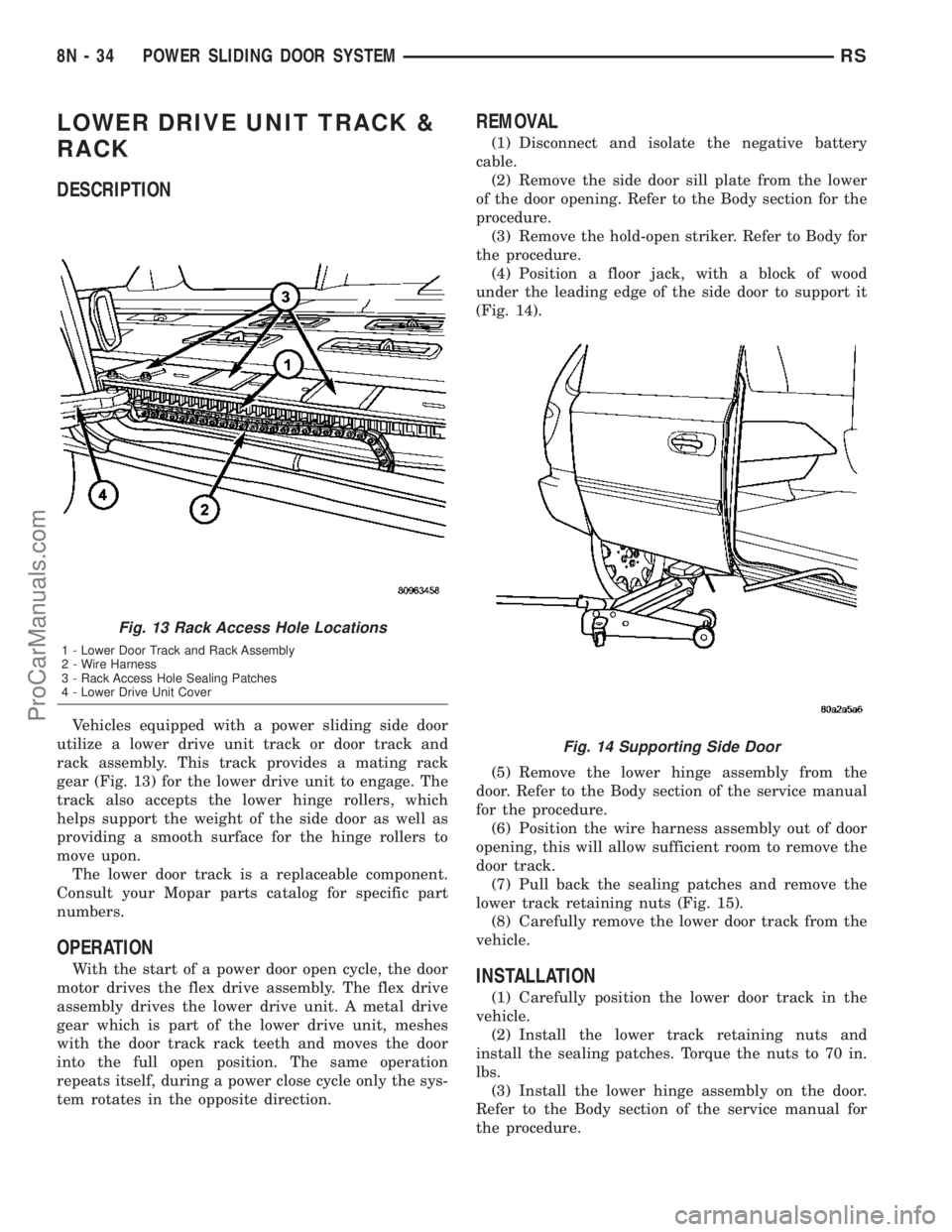
Vehicles equipped with a power sliding side door
utilize a lower drive unit track or door track and
rack assembly. This track provides a mating rack
gear (Fig. 13) for the lower drive unit to engage. The
track also accepts the lower hinge rollers, which
helps support the weight of the side door as well as
providing a smooth surface for the hinge rollers to
move upon.
The lower door track is a replaceable component.
Consult your Mopar parts catalog for specific part
numbers.
OPERATION
With the start of a power door open cycle, the door
motor drives the flex drive assembly. The flex drive
assembly drives the lower drive unit. A metal drive
gear which is part of the lower drive unit, meshes
with the door track rack teeth and moves the door
into the full open position. The same operation
repeats itself, during a power close cycle only the sys-
tem rotates in the opposite direction.
REMOVAL
(1) Disconnect and isolate the negative battery
cable.
(2) Remove the side door sill plate from the lower
of the door opening. Refer to the Body section for the
procedure.
(3) Remove the hold-open striker. Refer to Body for
the procedure.
(4) Position a floor jack, with a block of wood
under the leading edge of the side door to support it
(Fig. 14).
(5) Remove the lower hinge assembly from the
door. Refer to the Body section of the service manual
for the procedure.
(6) Position the wire harness assembly out of door
opening, this will allow sufficient room to remove the
door track.
(7) Pull back the sealing patches and remove the
lower track retaining nuts (Fig. 15).
(8) Carefully remove the lower door track from the
vehicle.
INSTALLATION
(1) Carefully position the lower door track in the
vehicle.
(2) Install the lower track retaining nuts and
install the sealing patches. Torque the nuts to 70 in.
lbs.
(3) Install the lower hinge assembly on the door.
Refer to the Body section of the service manual for
the procedure.
Fig. 13 Rack Access Hole Locations
1 - Lower Door Track and Rack Assembly
2 - Wire Harness
3 - Rack Access Hole Sealing Patches
4 - Lower Drive Unit Cover
Fig. 14 Supporting Side Door
8N - 34 POWER SLIDING DOOR SYSTEMRS
ProCarManuals.com
Page 493 of 2177
POWER LOCKS
TABLE OF CONTENTS
page page
POWER LOCKS
DESCRIPTION.........................38
OPERATION...........................39
DOOR CYLINDER LOCK SWITCH
DESCRIPTION.........................40
OPERATION...........................40
DIAGNOSIS AND TESTING - DOOR
CYLINDER LOCK SWITCH..............40
REMOVAL.............................41
INSTALLATION.........................41
DOOR LOCK MOTOR
DIAGNOSIS AND TESTING - DOOR LOCK
MOTOR .............................41
DOOR LOCK SWITCH
DIAGNOSIS AND TESTING - DOOR LOCK
SWITCH............................41
REMOVAL.............................42
INSTALLATION.........................42
KEYLESS ENTRY TRANSMITTER
DIAGNOSIS AND TESTING - KEYLESS ENTRY
TRANSMITTER.......................42STANDARD PROCEDURE
STANDARD PROCEDURE - HORN CHIRP
PREFERENCE........................42
STANDARD PROCEDURE - BATTERY
REPLACEMENT.......................42
STANDARD PROCEDURE - RKE
TRANSMITTER PROGRAMING...........43
SPECIFICATIONS
RANGE.............................43
BATTERY...........................43
REMOTE KEYLESS ENTRY MODULE
DESCRIPTION.........................43
OPERATION...........................43
DIAGNOSIS AND TESTING - REMOTE
KEYLESS ENTRY MODULE..............43
REMOVAL.............................44
INSTALLATION.........................44
SLIDING DOOR LOCK MOTOR
REMOVAL.............................44
INSTALLATION.........................44
POWER LOCKS
DESCRIPTION
POWER DOOR LOCK SYSTEM
The front doors, sliding door(s) and liftgate are
equipped with actuator motors to lock or unlock the
latch mechanisms. The door lock actuator motor is
not serviced separately from the door latch, except
for the sliding door(s).
AUTOMATIC DOOR LOCK
The vehicle comes with two options for power door
locks:
²Rolling automatic lock (ENABLE), doors auto-
matically lock at approximately at 25.7 Km/h (16
mph).
²No rolling automatic lock (DISABLE), doors do
not automatically lock when the vehicle is moving.
AUTOMATIC DOOR UNLOCK
The doors will unlock automatically on vehicles
equipped with power door locks if:
²Auto door locks feature is enabled and automatic
unlock is enabled.²The transmission was in gear and speed was
above zero.
²The transmission in park or neutral and speed
is zero.
²Any door (excluding liftgate) opens.
DOOR LOCK INHIBIT
The BCM cancels out the door lock switch actua-
tion, when the key is in the Ignition Switch and
either front door is open.
Pressing the key fob RKE lock/unlock under these
conditions results in normal lock/unlock activation.
CENTRAL LOCKING
If equipped with Vehicle Theft Security System
(VTSS), all the doors can be locked with the key by
using the driver door lock cylinder. Turning the key
to the lock position will lock all the doors.
DOOR LOCK CIRCUIT PROTECTION
The door lock system is protected by a 40 amp fuse
located in the IPM. The BCM receives lock/unlock
input and will turn on the appropriate drivers and
provide a voltage level to the door lock motor for a
specific time. The IPM is located along the side of the
vehicle battery in the engine compartment.
8N - 38 POWER LOCKSRS
ProCarManuals.com
Page 500 of 2177

POWER MIRRORS
TABLE OF CONTENTS
page page
POWER MIRRORS
DESCRIPTION.........................45
OPERATION...........................45
DIAGNOSIS AND TESTING - POWER
MIRRORS...........................46
AUTOMATIC DAY / NIGHT MIRROR
DESCRIPTION.........................47
OPERATION...........................47
DIAGNOSIS AND TESTING - AUTOMATIC DAY
/ NIGHT MIRROR......................47
POWER FOLDAWAY MIRROR SWITCH -
EXPORT
DESCRIPTION.........................48OPERATION...........................48
REMOVAL.............................48
INSTALLATION.........................49
REMOTE SWITCH
DIAGNOSIS AND TESTING - REMOTE
SWITCH............................49
REMOVAL.............................49
INSTALLATION.........................49
SIDEVIEW MIRROR
REMOVAL.............................49
POWER MIRRORS
DESCRIPTION
If equipped with power mirrors, the control switch
is located on the instrument panel to the left of the
headlamp switch.
OPERATION
The power mirrors are connected to battery feed at
all times. Each mirror head contains two electric
motors, two drive mechanisms, an electric heating
element, and the mirror glass. If the vehicle is
equipped with the optional memory system, the
driver side mirror head also contains both a horizon-
tal and a vertical motor position sensor. One motor
and drive controls mirror up-and-down movement,
and the other controls right-and-left movement.An optional driver side outside electrochromic mir-
ror is able to automatically change its reflectance
level. This mirror is controlled by the circuitry of the
automatic day/night inside rear view mirror. A thin
layer of electrochromic material between two pieces
of conductive glass make up the face of the mirror.
Two photocell sensors on the inside rear view mirror
are used to monitor light levels and adjust the reflec-
tance of both the inside and driver side outside mir-
rors. This change in reflectance helps to reduce the
glare of headlamps approaching the vehicle from the
rear. (Refer to 8 - ELECTRICAL/POWER MIRRORS/
AUTOMATIC DAY / NIGHT MIRROR - DESCRIP-
TION) for more information on this system.
The motors which operate the mirrors are part of
the mirror assembly and cannot be serviced sepa-
rately.
RSPOWER MIRRORS8N-45
ProCarManuals.com
Page 503 of 2177
ered. This defeats the day-detect logic. If OK, go to
Step 8. If not OK, replace the faulty mirror unit.
(8) With the mirror darkened, place the transmis-
sion gear selector lever in the Reverse position. The
automatic day/night mirror should return to its nor-
mal reflectance. If not OK, replace the faulty mirror
unit.
Bench testing both mirrors can be done, of care is
exercised. For an inside mirror, the pin closest to he
mount is 12V (+), the next is 12V (-). The third is
reverse override. The fourth is outside mirror (+),
and the fifth is outside mirror (-).Do not apply 12
volts to the fourth and fifth pins.With 12 volts
on pins 1 and 2, the mirror can be tested by blocking
the rear sensor and shining a light into the forward
sensor. For an outside mirror, there is a 2±pin con-
nector. Applying 1.2 volts will cause the mirror to
dim. If the mirror does not dim, the entire glass
assembly can be replaced just as it is when the glass
is broken.
WARNING: Do not apply 12 volts to the outside mir-
ror. Damage to the mirror will result.
POWER FOLDAWAY MIRROR
SWITCH - EXPORT
DESCRIPTION
These vehicles may be equipped with Power Fold-
away Mirrors. This feature allows both the driver
and passenger side view mirrors to fold inward
(retract) on demand. The vehicle has an additional
switch located on the steering column that controls
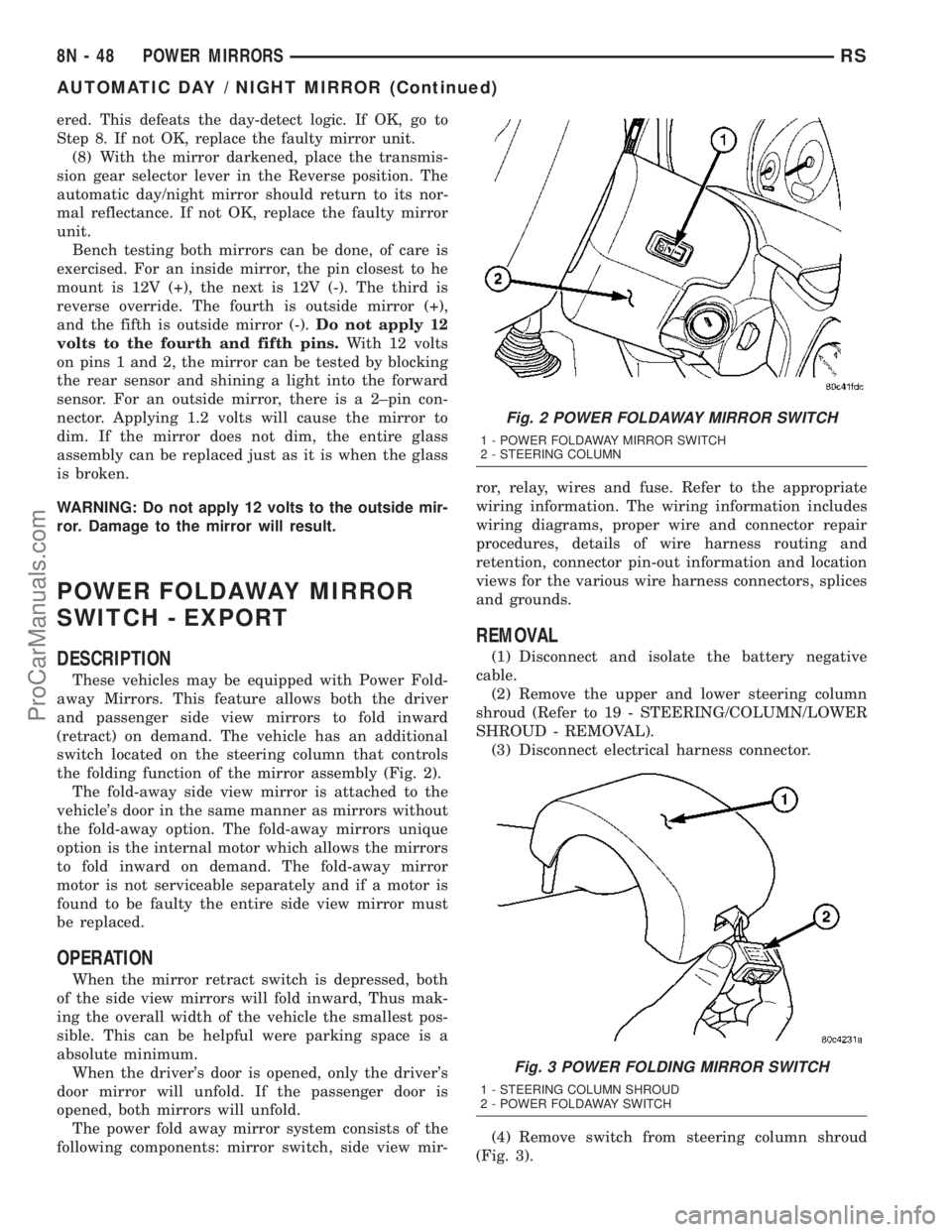
the folding function of the mirror assembly (Fig. 2).
The fold-away side view mirror is attached to the
vehicle's door in the same manner as mirrors without
the fold-away option. The fold-away mirrors unique
option is the internal motor which allows the mirrors
to fold inward on demand. The fold-away mirror
motor is not serviceable separately and if a motor is
found to be faulty the entire side view mirror must
be replaced.
OPERATION
When the mirror retract switch is depressed, both
of the side view mirrors will fold inward, Thus mak-
ing the overall width of the vehicle the smallest pos-
sible. This can be helpful were parking space is a
absolute minimum.
When the driver's door is opened, only the driver's
door mirror will unfold. If the passenger door is
opened, both mirrors will unfold.
The power fold away mirror system consists of the
following components: mirror switch, side view mir-ror, relay, wires and fuse. Refer to the appropriate
wiring information. The wiring information includes
wiring diagrams, proper wire and connector repair
procedures, details of wire harness routing and
retention, connector pin-out information and location
views for the various wire harness connectors, splices
and grounds.
REMOVAL
(1) Disconnect and isolate the battery negative
cable.
(2) Remove the upper and lower steering column
shroud (Refer to 19 - STEERING/COLUMN/LOWER
SHROUD - REMOVAL).
(3) Disconnect electrical harness connector.
(4) Remove switch from steering column shroud
(Fig. 3).
Fig. 2 POWER FOLDAWAY MIRROR SWITCH
1 - POWER FOLDAWAY MIRROR SWITCH
2 - STEERING COLUMN
Fig. 3 POWER FOLDING MIRROR SWITCH
1 - STEERING COLUMN SHROUD
2 - POWER FOLDAWAY SWITCH
8N - 48 POWER MIRRORSRS
AUTOMATIC DAY / NIGHT MIRROR (Continued)
ProCarManuals.com
Page 504 of 2177
INSTALLATION
(1) Install switch to steering column shroud.
(2) Connect wire harness connector.
(3) Install the upper and lower steering column
shroud (Refer to 19 - STEERING/COLUMN/LOWER
SHROUD - INSTALLATION).
(4) Connect the battery negative cable.
REMOTE SWITCH
DIAGNOSIS AND TESTING - REMOTE SWITCH
(1) Remove power mirror switch. (Refer to 8 -
ELECTRICAL/POWER MIRRORS/POWER MIRROR
SWITCH - REMOVAL).
(2) Disconnect wiring harness at switch connector.
(3) Using a ohmmeter, test for continuity between
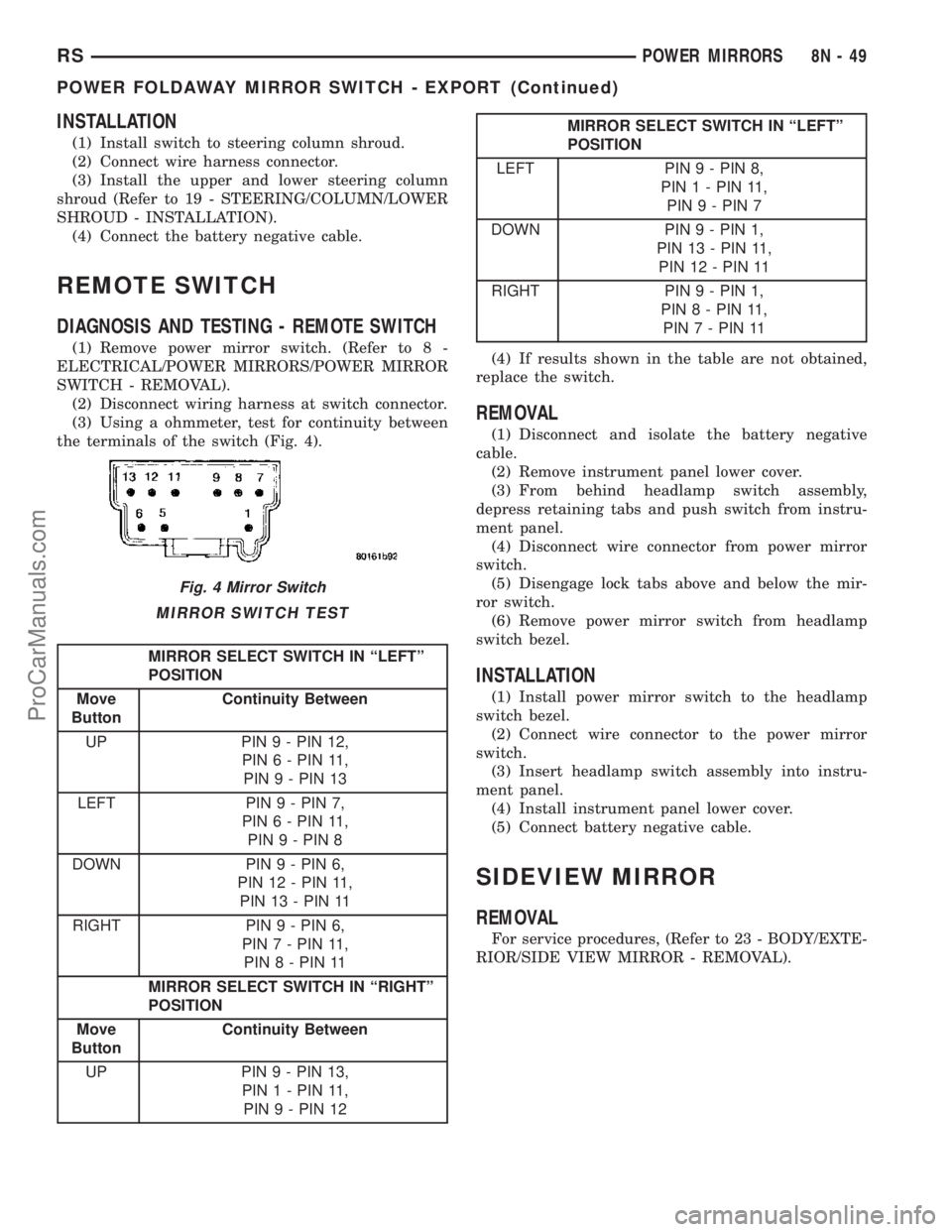
the terminals of the switch (Fig. 4).
MIRROR SWITCH TEST
MIRROR SELECT SWITCH IN ªLEFTº
POSITION
Move
ButtonContinuity Between
UP PIN 9 - PIN 12,
PIN 6 - PIN 11,
PIN 9 - PIN 13
LEFT PIN 9 - PIN 7,
PIN 6 - PIN 11,
PIN 9 - PIN 8
DOWN PIN 9 - PIN 6,
PIN 12 - PIN 11,
PIN 13 - PIN 11
RIGHT PIN 9 - PIN 6,
PIN 7 - PIN 11,
PIN 8 - PIN 11
MIRROR SELECT SWITCH IN ªRIGHTº
POSITION
Move
ButtonContinuity Between
UP PIN 9 - PIN 13,
PIN 1 - PIN 11,
PIN 9 - PIN 12
MIRROR SELECT SWITCH IN ªLEFTº
POSITION
LEFT PIN 9 - PIN 8,
PIN 1 - PIN 11,
PIN 9 - PIN 7
DOWN PIN 9 - PIN 1,
PIN 13 - PIN 11,
PIN 12 - PIN 11
RIGHT PIN 9 - PIN 1,
PIN 8 - PIN 11,
PIN 7 - PIN 11
(4) If results shown in the table are not obtained,
replace the switch.
REMOVAL
(1) Disconnect and isolate the battery negative
cable.
(2) Remove instrument panel lower cover.
(3) From behind headlamp switch assembly,
depress retaining tabs and push switch from instru-
ment panel.
(4) Disconnect wire connector from power mirror
switch.
(5) Disengage lock tabs above and below the mir-
ror switch.
(6) Remove power mirror switch from headlamp
switch bezel.
INSTALLATION
(1) Install power mirror switch to the headlamp
switch bezel.
(2) Connect wire connector to the power mirror
switch.
(3) Insert headlamp switch assembly into instru-
ment panel.
(4) Install instrument panel lower cover.
(5) Connect battery negative cable.
SIDEVIEW MIRROR
REMOVAL
For service procedures, (Refer to 23 - BODY/EXTE-
RIOR/SIDE VIEW MIRROR - REMOVAL).
Fig. 4 Mirror Switch
RSPOWER MIRRORS8N-49
POWER FOLDAWAY MIRROR SWITCH - EXPORT (Continued)
ProCarManuals.com
Page 505 of 2177

POWER SEAT SYSTEM
TABLE OF CONTENTS
page page
POWER SEAT SYSTEM
DESCRIPTION
DESCRIPTION........................50
DESCRIPTION - MEMORY SYSTEM.......51
OPERATION
OPERATION - POWER SEAT SYSTEM.....52
OPERATION - MEMORY SYSTEM.........52
DIAGNOSIS AND TESTING
DIAGNOSIS AND TESTING - POWER SEAT
SYSTEM............................52
DIAGNOSIS AND TESTING - MEMORY
SYSTEM............................53
DRIVER SEAT SWITCH
DESCRIPTION.........................53
OPERATION...........................54
DIAGNOSIS AND TESTING - DRIVER SEAT
SWITCH............................54
REMOVAL.............................55
INSTALLATION.........................55
MEMORY SET SWITCH
DESCRIPTION.........................55
OPERATION...........................56
DIAGNOSIS AND TESTING - MEMORY
SWITCH............................56REMOVAL.............................56
INSTALLATION.........................56
PASSENGER SEAT SWITCH
DESCRIPTION.........................56
OPERATION...........................56
DIAGNOSIS AND TESTING - PASSENGER
SEAT SWITCH........................57
REMOVAL.............................57
INSTALLATION.........................57
DRIVER POWER SEAT TRACK
DESCRIPTION.........................58
OPERATION...........................58
DIAGNOSIS AND TESTING - DRIVER POWER
SEAT TRACK.........................58
REMOVAL.............................59
INSTALLATION.........................59
PASSENGER POWER SEAT TRACK
DESCRIPTION.........................59
OPERATION...........................60
DIAGNOSIS AND TESTING - POWER SEAT
TRACK.............................60
REMOVAL.............................61
INSTALLATION.........................61
POWER SEAT SYSTEM
DESCRIPTION
DESCRIPTION
The power seat system option allows the driver
and front seat passenger to electrically adjust their
seating positions for optimum control and comfort
using the power seat switches located on the out-
board seat cushion side shield of each front seat. The
driver side power front seat can be adjusted in eight
different directions: up, down, front up, front down,
rear up, rear down, forward, rearward and recliner
forward and rearward. The passenger side power
front seat can be adjusted in four different directions:
forward, rearward and recliner forward and rear-
ward.
The power seat system receives battery current
through a 40 amp fuse in the Intelligent Power Mod-
ule and a 30 amp circuit breaker under the seat so
that the power seats remain operational, regardless
of the ignition switch position.WARNING: SOME VEHICLES ARE EQUIPPED WITH
SEATBACK MOUNTED AIRBAGS (Fig. 1). BEFORE
ATTEMPTING TO DIAGNOSE OR SERVICE ANY
SEAT OR POWER SEAT SYSTEM COMPONENT
YOU MUST FIRST DISCONNECT AND ISOLATE THE
BATTERY NEGATIVE CABLE. THEN WAIT TWO MIN-
UTES FOR THE SYSTEM CAPACITOR TO DIS-
CHARGE BEFORE FURTHER SYSTEM SERVICE.
THIS IS THE ONLY SURE WAY TO DISABLE THE
AIRBAG SYSTEM. FAILURE TO DO SO COULD
RESULT IN ACCIDENTAL AIRBAG DEPLOYMENT
AND POSSIBLE PERSONAL INJURY.
A eight-way driver side power seat is standard on
highline models and optional on others. This option
includes a six-way adjustable seat cushion track and
a two-way power seat back.
The eight-way driver side power seat is also avail-
able with the heated seat and/or memory seat system
that automatically positions the power seat for two
different drivers. Refer toHeated Seatsfor more
information on the heated seat option. Refer to
Description - Memory Systemin this section for
more information on the memory seat system.
8N - 50 POWER SEAT SYSTEMRS
ProCarManuals.com