wiring CHRYSLER CARAVAN 2005 Service Manual
[x] Cancel search | Manufacturer: CHRYSLER, Model Year: 2005, Model line: CARAVAN, Model: CHRYSLER CARAVAN 2005Pages: 2339, PDF Size: 59.69 MB
Page 457 of 2339

that axis may have an open, short or be incorrectly
connected. Check the wiring to that axis (module to
motor). Repair any wiring problems and retry that
axis. Refer to the appropriate wiring information for
complete circuit schematic or connector pin-out infor-
mation.
SEAT SWITCH
DESCRIPTION
Vehicles equipped with a driver side power seat
utilize an eight-way power seat switch. Vehicles
equipped with a passenger side power seat utilize a
four-way power seat switch. These power seat
switches features two knobs ganged together on the
outboard seat cushion side shield (Fig. 2).
The switch is secured to the back of the seat cush-
ion side shield with two screws. However, the control
knobs for the seat switch unit must be removed
before the seat switch can be removed from the side
shield.The power seat switch cannot be repaired. If one
switch is damaged or faulty, the entire power seat
switch unit must be replaced.
OPERATION
When a power seat switch control knob or knobs
are actuated, a battery feed and a ground path are
applied through the switch contacts to the power seat
track or recliner adjuster motor. The selected
adjuster motor operates to move the seat track or
recliner through its drive unit in the selected direc-
tion until the switch is released, or until the travel
limit of the adjuster is reached. When the switch is
moved in the opposite direction, the battery feed and
ground path to the motor are reversed through the
switch contacts. This causes the adjuster motor to
run in the opposite direction.
No power seat switch should be held applied in any
direction after the adjuster has reached its travel
limit. The power seat adjuster motors each contain a
self-resetting circuit breaker to protect them from
overload. However, consecutive or frequent resetting
of the circuit breaker must not be allowed to con-
tinue, or the motor may be damaged.
DIAGNOSIS AND TESTING
DRIVER SEAT SWITCH
(1) Remove the power seat switch, (Refer to 8 -
ELECTRICAL/POWER SEATS/DRIVER SEAT
SWITCH - REMOVAL).
(2) Using an ohmmeter, check pin #1 of the power
seat switch wire harness connector for continuity to
ground. It should be present. If OK, go to Step 3. If
not OK, repair the open ground circuit as required.
(3) Using a voltmeter, check pin #5 of the power
seat switch wire harness connector for battery cur-
rent. It should be present. If OK, go to Step 4. If not
OK, repair the open voltage supply circuit as
required.
(4) Using an ohmmeter, test the power seat switch
for continuity, refer to SEAT SWITCH CONTINUITY
TEST TABLE (Fig. 3). If continuity is not present as
indicated, replace the power seat switch.
Fig. 2 POWER SEAT SWITCH LOCATION
1 - POWER SEAT SWITCH
2 - SEAT CUSHION SIDE SHIELD
8N - 34 POWER SEAT SYSTEMRS
POWER SEAT SYSTEM (Continued)
Page 463 of 2339

POWER SLIDING DOOR SYSTEM
TABLE OF CONTENTS
page page
POWER SLIDING DOOR SYSTEM
DESCRIPTION.........................40
OPERATION...........................41
DIAGNOSIS AND TESTING
POWER SLIDING DOOR SYSTEM........42
STANDARD PROCEDURE
POWER SLIDING DOOR LEARN CYCLE....48
PUSH-PIN GROMMET REPLACEMENT.....48
POWER SLIDING DOOR ADJUSTMENT....49
LATCH
DESCRIPTION.........................49
OPERATION...........................49
REMOVAL.............................49
INSTALLATION.........................50
SLIDING DOOR MOTOR
DESCRIPTION.........................51
OPERATION...........................51
REMOVAL.............................51
INSTALLATION.........................51
FULL OPEN SWITCH
DESCRIPTION.........................52
OPERATION...........................52
B-PILLAR SWITCH
DESCRIPTION.........................52OPERATION...........................52
REMOVAL.............................52
INSTALLATION.........................52
LOWER DRIVE UNIT
DESCRIPTION.........................53
OPERATION...........................53
REMOVAL.............................53
INSTALLATION.........................54
FLEX DRIVE
DESCRIPTION.........................55
OPERATION...........................55
REMOVAL.............................55
INSTALLATION.........................56
LOWER DRIVE UNIT TRACK & RACK
DESCRIPTION.........................57
OPERATION...........................57
REMOVAL.............................57
INSTALLATION.........................58
WIRING HARNESS
DESCRIPTION.........................59
OPERATION...........................59
REMOVAL.............................59
INSTALLATION.........................59
POWER SLIDING DOOR
SYSTEM
DESCRIPTION
Some vehicles are equipped with a power sliding
door system. Vehicles may be equipped with only a
right side power sliding door or a right and left side
power sliding doors. The components of the power
sliding door system are:
²Door motor assembly
²Latch assembly
²Sliding door control module
²Lower drive unit assembly
²Flex drive assembly
²Wire harness and track
²Lower drive unit track and rack assembly
²Full open switch
²B-pillar switch
²Overhead console switch
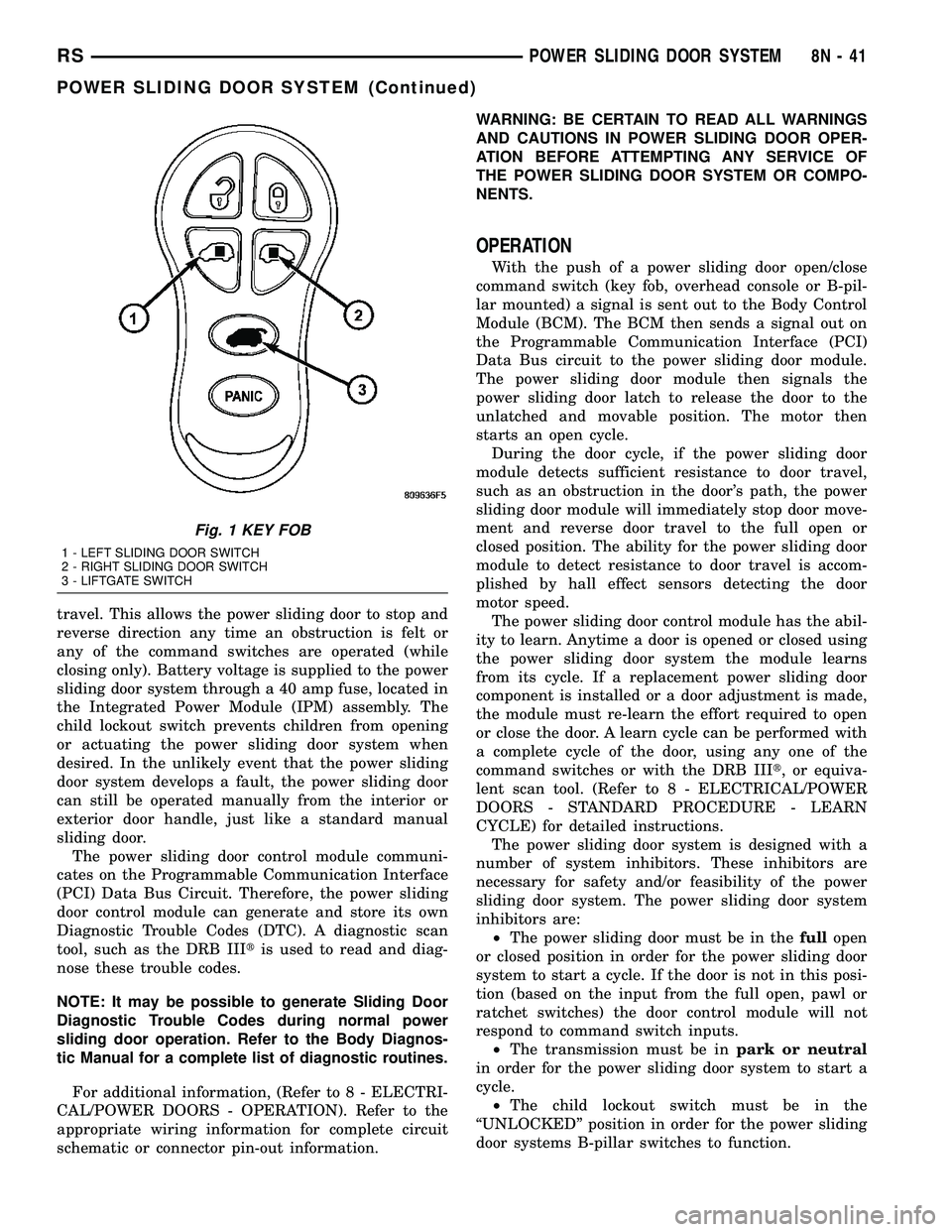
²Key fob switches (Fig. 1)
²Pawl switch
²Ratchet switch
²Child lockout and handle switchesEach power sliding door has its own door control
module, located in the center of the door behind the
door trim panel. (Refer to 8 - ELECTRICAL/ELEC-
TRONIC CONTROL MODULES/DOOR CONTROL
MODULE - DESCRIPTION) The power sliding door
motor is located in the front portion of the door, on
the inner door panel sheet metal. The latch assembly
is located in the rear of the power sliding door, near
the body line. The lower drive unit is attached to the
lower door hinge. The flex drive assembly connects
the door motor to the lower drive unit. The wire har-
ness and track and the lower drive unit track are vis-
ible with the door open in the lower door sill area.
The power sliding door full open switch is located
under the lower drive unit and is part of the hold
open latch assembly. The pawl, ratchet, handle and
child lockout switches are all located on the power
sliding door latch assembly. The B-pillar switch is an
open and close command switch located on the inte-
rior B-pillar trim. The overhead console switch, is an
open and close command switch located in the vehi-
cle's overhead console.
Software technology has enabled the power sliding
door control module to detect resistance to door
8N - 40 POWER SLIDING DOOR SYSTEMRS
Page 464 of 2339
travel. This allows the power sliding door to stop and
reverse direction any time an obstruction is felt or
any of the command switches are operated (while
closing only). Battery voltage is supplied to the power
sliding door system through a 40 amp fuse, located in
the Integrated Power Module (IPM) assembly. The
child lockout switch prevents children from opening
or actuating the power sliding door system when
desired. In the unlikely event that the power sliding
door system develops a fault, the power sliding door
can still be operated manually from the interior or
exterior door handle, just like a standard manual
sliding door.
The power sliding door control module communi-
cates on the Programmable Communication Interface
(PCI) Data Bus Circuit. Therefore, the power sliding
door control module can generate and store its own
Diagnostic Trouble Codes (DTC). A diagnostic scan
tool, such as the DRB IIItis used to read and diag-
nose these trouble codes.
NOTE: It may be possible to generate Sliding Door
Diagnostic Trouble Codes during normal power
sliding door operation. Refer to the Body Diagnos-
tic Manual for a complete list of diagnostic routines.
For additional information, (Refer to 8 - ELECTRI-
CAL/POWER DOORS - OPERATION). Refer to the
appropriate wiring information for complete circuit
schematic or connector pin-out information.WARNING: BE CERTAIN TO READ ALL WARNINGS
AND CAUTIONS IN POWER SLIDING DOOR OPER-
ATION BEFORE ATTEMPTING ANY SERVICE OF
THE POWER SLIDING DOOR SYSTEM OR COMPO-
NENTS.
OPERATION
With the push of a power sliding door open/close
command switch (key fob, overhead console or B-pil-
lar mounted) a signal is sent out to the Body Control
Module (BCM). The BCM then sends a signal out on
the Programmable Communication Interface (PCI)
Data Bus circuit to the power sliding door module.
The power sliding door module then signals the
power sliding door latch to release the door to the
unlatched and movable position. The motor then
starts an open cycle.
During the door cycle, if the power sliding door
module detects sufficient resistance to door travel,
such as an obstruction in the door's path, the power
sliding door module will immediately stop door move-
ment and reverse door travel to the full open or
closed position. The ability for the power sliding door
module to detect resistance to door travel is accom-
plished by hall effect sensors detecting the door
motor speed.
The power sliding door control module has the abil-
ity to learn. Anytime a door is opened or closed using
the power sliding door system the module learns
from its cycle. If a replacement power sliding door
component is installed or a door adjustment is made,
the module must re-learn the effort required to open
or close the door. A learn cycle can be performed with
a complete cycle of the door, using any one of the
command switches or with the DRB IIIt, or equiva-
lent scan tool. (Refer to 8 - ELECTRICAL/POWER
DOORS - STANDARD PROCEDURE - LEARN
CYCLE) for detailed instructions.
The power sliding door system is designed with a
number of system inhibitors. These inhibitors are
necessary for safety and/or feasibility of the power
sliding door system. The power sliding door system
inhibitors are:
²The power sliding door must be in thefullopen
or closed position in order for the power sliding door
system to start a cycle. If the door is not in this posi-
tion (based on the input from the full open, pawl or
ratchet switches) the door control module will not
respond to command switch inputs.
²The transmission must be inpark or neutral
in order for the power sliding door system to start a
cycle.
²The child lockout switch must be in the
ªUNLOCKEDº position in order for the power sliding
door systems B-pillar switches to function.
Fig. 1 KEY FOB
1 - LEFT SLIDING DOOR SWITCH
2 - RIGHT SLIDING DOOR SWITCH
3 - LIFTGATE SWITCH
RSPOWER SLIDING DOOR SYSTEM8N-41
POWER SLIDING DOOR SYSTEM (Continued)
Page 466 of 2339

POWER SLIDING DOOR SYSTEM DIAGNOSIS
CONDITION POSSIBLE CAUSES CORRECTION
Door opens unexpectedly Inoperative sliding door control module
or Body Control Module (BCM)Disconnect then reconnect battery negative
cable to reset module. Cycle door, if no
function exists check for loose wire
connections, Refer to the Body Diagnostic
Manual for detailed procedures
Inoperative latch assembly Check wiring/cable connections
Check for trouble codes, replace latch if
necessary
Inoperative open/close command
switchCheck for shorted or defective switch
Inoperative striker Striker misaligned or loose
Striker damaged
Replace striker if necessary
Door will not open manually
using inside handleThe child lock out switch is in the
9LOCKED9positionEnsure the child lock out switch is in the
9UNLOCKED9position
Inoperative inside handle assembly
Check for broken inside handle
assembly
Check cable connections at latch and
handle assembly.
Check for binds or kinks in cable.
Check for foreign matter preventing the
operation of handle assembly
Replace the handle if necessary
Inoperative latch assembly Check cable connections
Check for foreign matter preventing the
operation of latch assembly
Replace latch if necessary
Inoperative inside handle cable
assemblyCheck cable for binding
Check cable for broken condition
Replace the cable, if necessary
Binding or sticking of components Check for foreign matter preventing the
operation of door
Establish location of binding
Replace necessary components
Door will not open manually
using outside handleInoperative outside handle assembly Check for broken outside handle assembly
Check cable connections at latch and handle
assembly.
Check for binds or kinks in cable.
RSPOWER SLIDING DOOR SYSTEM8N-43
POWER SLIDING DOOR SYSTEM (Continued)
Page 468 of 2339

CONDITION POSSIBLE CAUSES CORRECTION
Wiring problems (system or vehicle) Troubleshoot using the appropriate wiring
information
Power loss during power
door operationWiring problems (system or vehicle) Troubleshoot using the appropriate wiring
information
Low battery voltage Charge battery
Inoperative sliding door control module
or BCMDisconnect then reconnect battery negative
cable to reset module. Cycle door, if no
function exists check for loose wire
connections, see Body Diagnostic Manual for
detailed procedures
Inoperative drive assembly Remove lower drive unit and check for no
drive condition
No latching in primary and/or
secondary positionsInoperative inside/outside handle
assemblyGo to that9POSSIBLE CAUSE9and review
9CORRECTIONS9
Inoperative latch assembly Check wire connections and for blown fuse
Check cable connections
Check for foreign matter preventing the
operation of latch assembly
Troubleshoot using body diagnostic manual
Replace latch assembly, if necessary
Binding or sticking of components Establish location of binding and replace
necessary components
Inoperative sliding door control module
or BCMDisconnect then reconnect battery negative
cable to reset module. Cycle door, if no
function exists check for loose wire
connections, see Body Diagnostic Manual for
detailed procedures
Door seal force too high Inspect seals for damage, mis-assembly,
foreign matter. (Refer to 8 - ELECTRICAL/
POWER DOORS - STANDARD
PROCEDURE) for door adjustment
procedure and specifications in the Body
section of the service manual for
specifications
Inoperative drive assembly Remove lower drive unit and check for no
drive condition
Inoperative striker Striker misaligned or loose
Striker damaged
Replace striker if necessary
Latch will not fully release
from primary positionInoperative latch assembly Check wire connections and for blown fuse
Check cable connections
Check for foreign matter preventing the
operation of latch assembly
Troubleshoot using body diagnostic manual
Replace latch assembly, if necessary
RSPOWER SLIDING DOOR SYSTEM8N-45
POWER SLIDING DOOR SYSTEM (Continued)
Page 469 of 2339

CONDITION POSSIBLE CAUSES CORRECTION
Inoperative fuel filler door lockout
mechanismCheck operation of fuel filler door lockout
mechanism.
Inoperative sliding door control module
or BCMDisconnect then reconnect battery negative
cable to reset module. Cycle door, if no
function exists check for loose wire
connections, see Body Diagnostic Manual for
detailed procedures
Inoperative striker Striker misaligned or loose
Striker damaged
Replace striker if necessary
Cables worn and stretched Replace cables as necessary
Binding or sticking of components Establish location of binding and replace
necessary components
Key fob, B-pillar or overhead
console switch does not
operate power sliding doorBlown Fuse Check fuse and replace
Battery voltage low Charge or replace battery
Inoperative latch assembly Check for foreign matter preventing the
operation of latch assembly
Check wire connection
Pawl and/or ratchet switch inoperative
Replace latch if necessary
Wiring problems (system or vehicle) Troubleshoot using the appropriate wiring
information
Inoperative BCM Check electrical connections
Refer to the body diagnostic manual for
additional checks
Replace BCM if necessary
Inoperative key fob Verify inoperative key fob by trying other key
fob functions
Replace key fob battery
Reprogram key fob
Replace key fob if necessary
Inoperative sliding door control module Disconnect then reconnect battery negative
cable to reset module. Cycle door, if no
function exists check for loose wire
connections, see Body Diagnostic Manual for
detailed procedures
Inoperative door motor assembly Check for foreign matter preventing the
operation of gear motor assembly
Check wire connections
Gear motor clutch does not engage, replace
assembly
8N - 46 POWER SLIDING DOOR SYSTEMRS
POWER SLIDING DOOR SYSTEM (Continued)
Page 470 of 2339

CONDITION POSSIBLE CAUSES CORRECTION
Full open switch inoperative, replace hold
open latch assembly
Replace motor assembly. if necessary
Door does not stay open Inoperative hold open latch assembly Check wire/cable connections
Replace hold open latch, if necessary
Inoperative hold open latch striker Replace hold open latch striker, if necessary
High inside/outside opening
effortInoperative latch assembly Check wire connections and for blown fuse
Check cable connections
Check for foreign matter preventing the
operation of latch assembly
Troubleshoot using body diagnostic manual
Replace latch assembly, if necessary
Inoperative inside/outside handle
assemblyGo to that9POSSIBLE CAUSE9and review
9CORRECTIONS9
Binding or sticking of components Establish location of binding and replace
necessary components
Door continues to cinch
closed during power modeInoperative latch assembly Check wire connections and for blown fuse
Check for foreign matter preventing the
operation of latch assembly
Troubleshoot using body diagnostic manual
Replace latch assembly, if necessary
Inoperative sliding door control module
or BCMDisconnect then reconnect battery negative
cable to reset module. Cycle door, if no
function exists check for loose wire
connections, see Body Diagnostic Manual for
detailed procedures
Wiring problems (system or vehicle) Troubleshoot using the appropriate wiring
information
Door continues to open
during power mode (runaway
motor)Inoperative sliding door control module
or BCMDisconnect then reconnect battery negative
cable to reset module. Cycle door, if no
function exists check for loose wire
connections, see Body Diagnostic Manual for
detailed procedures
Inoperative hold open latch assembly Check wire/cable connections
Replace hold open latch, if necessary
Inoperative drive assembly Remove lower drive unit and check for no
drive condition
Wiring problems (system or vehicle) Troubleshoot using electrical schematics.
Refer to wiring diagrams
Door opens very slowly Inoperative door motor assembly Check wire/cable connections
Replace motor assembly, if necessary
RSPOWER SLIDING DOOR SYSTEM8N-47
POWER SLIDING DOOR SYSTEM (Continued)
Page 482 of 2339
WIRING HARNESS
DESCRIPTION
The wire harness supplies power (12v), ground and
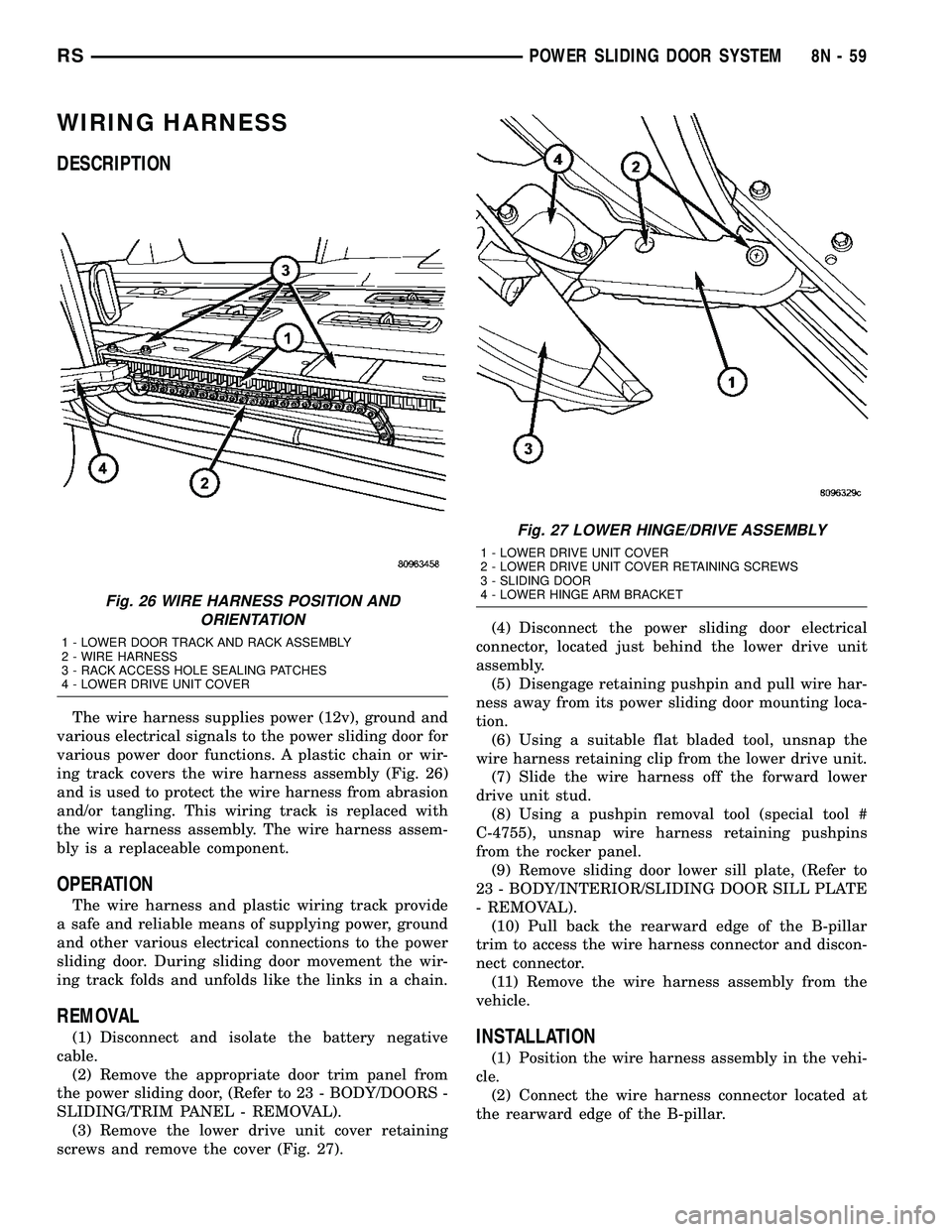
various electrical signals to the power sliding door for
various power door functions. A plastic chain or wir-
ing track covers the wire harness assembly (Fig. 26)
and is used to protect the wire harness from abrasion
and/or tangling. This wiring track is replaced with
the wire harness assembly. The wire harness assem-
bly is a replaceable component.
OPERATION
The wire harness and plastic wiring track provide
a safe and reliable means of supplying power, ground
and other various electrical connections to the power
sliding door. During sliding door movement the wir-
ing track folds and unfolds like the links in a chain.
REMOVAL
(1) Disconnect and isolate the battery negative
cable.
(2) Remove the appropriate door trim panel from
the power sliding door, (Refer to 23 - BODY/DOORS -
SLIDING/TRIM PANEL - REMOVAL).
(3) Remove the lower drive unit cover retaining
screws and remove the cover (Fig. 27).(4) Disconnect the power sliding door electrical
connector, located just behind the lower drive unit
assembly.
(5) Disengage retaining pushpin and pull wire har-
ness away from its power sliding door mounting loca-
tion.
(6) Using a suitable flat bladed tool, unsnap the
wire harness retaining clip from the lower drive unit.
(7) Slide the wire harness off the forward lower
drive unit stud.
(8) Using a pushpin removal tool (special tool #
C-4755), unsnap wire harness retaining pushpins
from the rocker panel.
(9) Remove sliding door lower sill plate, (Refer to
23 - BODY/INTERIOR/SLIDING DOOR SILL PLATE
- REMOVAL).
(10) Pull back the rearward edge of the B-pillar
trim to access the wire harness connector and discon-
nect connector.
(11) Remove the wire harness assembly from the
vehicle.INSTALLATION
(1) Position the wire harness assembly in the vehi-
cle.
(2) Connect the wire harness connector located at
the rearward edge of the B-pillar.
Fig. 26 WIRE HARNESS POSITION AND
ORIENTATION
1 - LOWER DOOR TRACK AND RACK ASSEMBLY
2 - WIRE HARNESS
3 - RACK ACCESS HOLE SEALING PATCHES
4 - LOWER DRIVE UNIT COVER
Fig. 27 LOWER HINGE/DRIVE ASSEMBLY
1 - LOWER DRIVE UNIT COVER
2 - LOWER DRIVE UNIT COVER RETAINING SCREWS
3 - SLIDING DOOR
4 - LOWER HINGE ARM BRACKET
RSPOWER SLIDING DOOR SYSTEM8N-59
Page 483 of 2339
(3) Install the sliding door lower sill plate, (Refer
to 23 - BODY/INTERIOR/SLIDING DOOR SILL
PLATE - INSTALLATION).
(4) Snap the wire harness retaining pushpins in
the rocker panel.
(5) Slide the wire harness on the lower drive unit
stud.
(6) Install the wire harness retaining clip on the
lower drive unit stud.
(7) Connect the power sliding door electrical con-
nector, located just behind the lower drive unit.
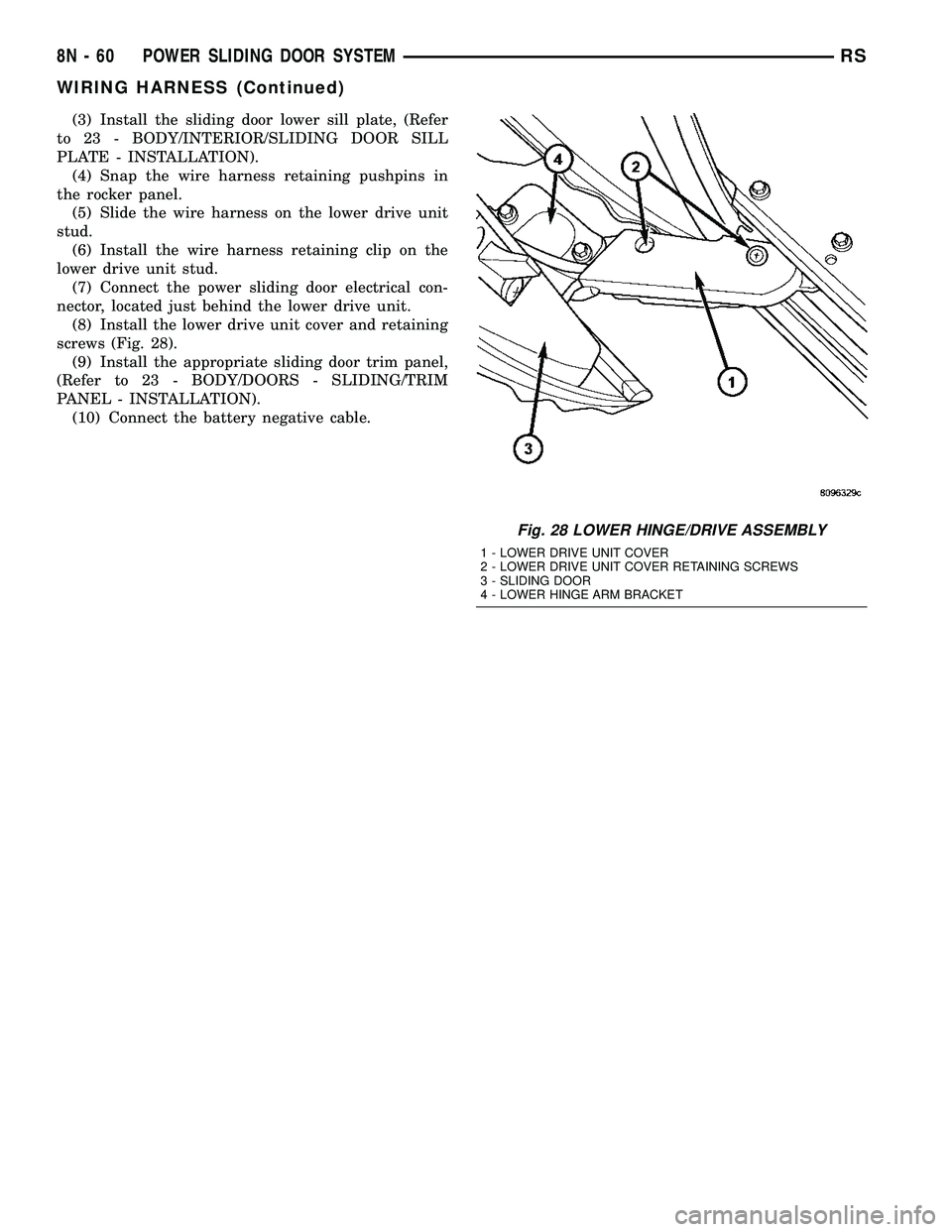
(8) Install the lower drive unit cover and retaining
screws (Fig. 28).
(9) Install the appropriate sliding door trim panel,
(Refer to 23 - BODY/DOORS - SLIDING/TRIM
PANEL - INSTALLATION).
(10) Connect the battery negative cable.
Fig. 28 LOWER HINGE/DRIVE ASSEMBLY
1 - LOWER DRIVE UNIT COVER
2 - LOWER DRIVE UNIT COVER RETAINING SCREWS
3 - SLIDING DOOR
4 - LOWER HINGE ARM BRACKET
8N - 60 POWER SLIDING DOOR SYSTEMRS
WIRING HARNESS (Continued)
Page 484 of 2339
POWER WINDOWS
TABLE OF CONTENTS
page page
POWER WINDOWS
DESCRIPTION.........................61
OPERATION...........................61
DIAGNOSIS AND TESTING
POWER WINDOWS....................61
VENT WINDOW MOTOR
DIAGNOSIS AND TESTING
VENT WINDOW MOTOR................62
REMOVAL.............................62INSTALLATION.........................62
WINDOW MOTOR
REMOVAL.............................62
WINDOW SWITCH
DIAGNOSIS AND TESTING
WINDOW SWITCH....................63
REMOVAL.............................64
INSTALLATION.........................64
POWER WINDOWS
DESCRIPTION
The Power Window System is activated through
switches mounted on the driver and passenger door
panels.
OPERATION
Front door window lift motors use permanent type
magnets. The B+ and ground applied at the motor
terminal pins will cause the motor to rotate in one
direction. Reversing current through the motor ter-
minals will cause the motor to rotate in the opposite
direction.
The power window motors ground through the
master switch in the driver door by a black wire
attached to the left cowl panel. Refer to the appropri-
ate wiring information.
The power rear vent windows, if equipped, are
operated by switches mounted in the driver door
switch bezel. A separate switch is used for each win-
dow. Permanent magnet type motors connected to a
crank system are used to open and close the rear
vent windows. A battery positive and negative con-
nection to either of the two motor terminals will
cause the motor to rotate in one direction. Reversing
current through these same two connections will
cause the motor to rotate in the opposite direction.
DIAGNOSIS AND TESTING
POWER WINDOWS
POWER WINDOW MOTOR TEST
If the power window motor is receiving proper cur-
rent and ground and does not operate, proceed withmotor test. Refer to the appropriate wiring informa-
tion.
(1) Remove front door trim panel and sound pad as
necessary to gain access to power window motor wire
connector, (Refer to 23 - BODY/DOOR - FRONT/
TRIM PANEL - REMOVAL).
(2) Disconnect power window motor wire connector
from door harness.
(3) Using two jumper wires, connect one to a bat-
tery (+) source and the other to a good ground (-).
(4) Connect the Negative (-) jumper probe to one of
the motor connector terminals.
(5) Momentarily touch the Positive (+) jumper
probe to the other motor connector terminal.
When positive probe is connected the motor should
rotate in one direction to either move window up or
down. If window is all the way up or down the motor
will grunt and the inner door panel will flex when
actuated in that one direction.
(6) Reverse jumper probes at the motor connector
terminals and window should now move in opposite
direction. If window does not move or grunt, replace
the motor.
If window moved completely up or down, reverse
the jumper probes and cycle window to the opposite
position to verify full operation.
If motor grunts and does not move, verify that reg-
ulator is not binding.
WIRING VOLTAGE TEST
The following wiring test determines whether or
not voltage is continuous through the body harness
to switch.
(1) Remove the power window switch and bezel
assembly from the driver door. (Refer to 8 - ELEC-
TRICAL/POWER WINDOWS/POWER WINDOW
SWITCH - REMOVAL).
(2) Disconnect wire connector from back of power
window switch.
RSPOWER WINDOWS8N-61