warning light CHRYSLER CONCORDE 2004 2.G User Guide
[x] Cancel search | Manufacturer: CHRYSLER, Model Year: 2004, Model line: CONCORDE, Model: CHRYSLER CONCORDE 2004 2.GPages: 273, PDF Size: 6 MB
Page 110 of 273
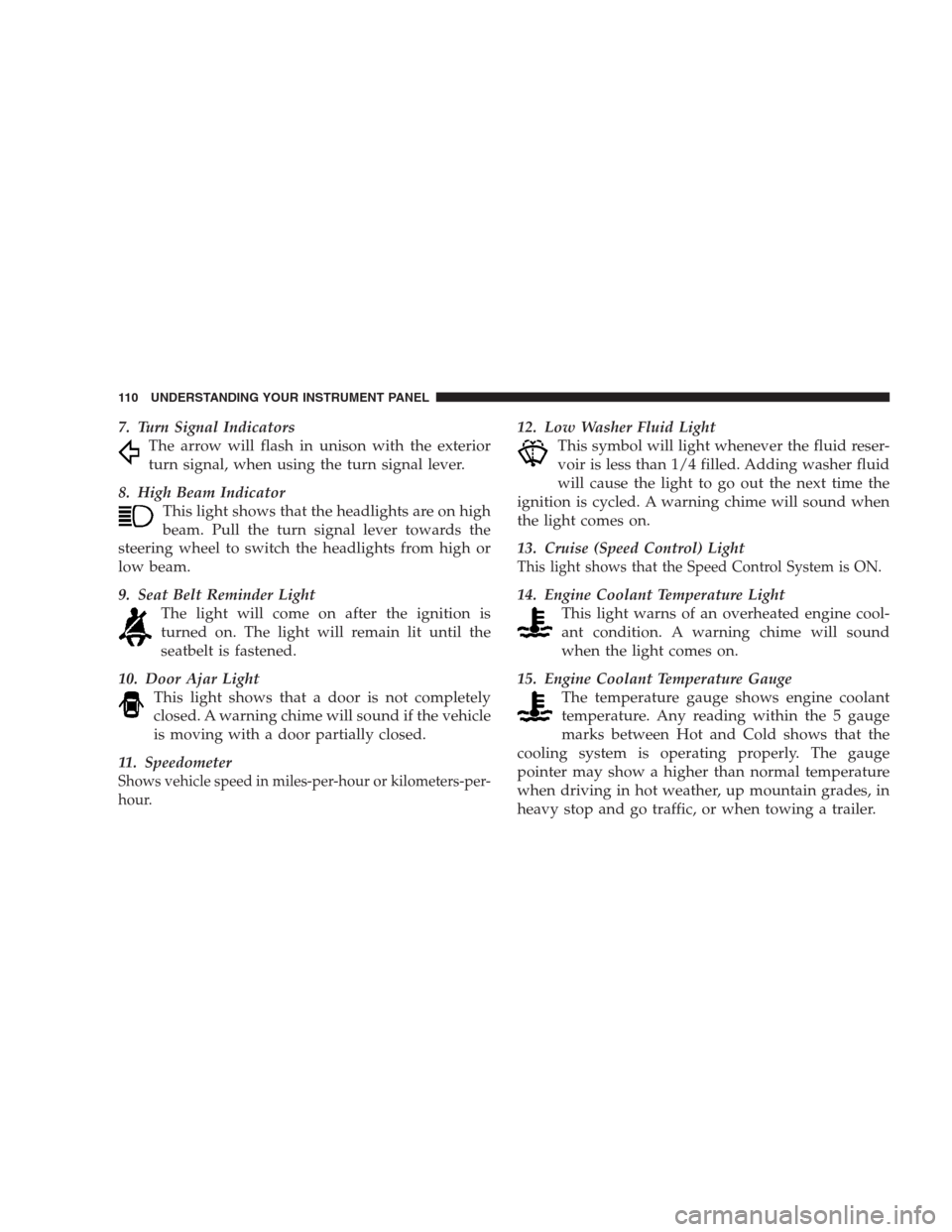
7. Turn Signal Indicators
The arrow will flash in unison with the exterior
turn signal, when using the turn signal lever.
8. High Beam Indicator
This light shows that the headlights are on high
beam. Pull the turn signal lever towards the
steering wheel to switch the headlights from high or
low beam.
9. Seat Belt Reminder Light
The light will come on after the ignition is
turned on. The light will remain lit until the
seatbelt is fastened.
10. Door Ajar Light
This light shows that a door is not completely
closed. A warning chime will sound if the vehicle
is moving with a door partially closed.
11. Speedometer
Shows vehicle speed in miles-per-hour or kilometers-per-
hour.
12. Low Washer Fluid Light
This symbol will light whenever the fluid reser-
voir is less than 1/4 filled. Adding washer fluid
will cause the light to go out the next time the
ignition is cycled. A warning chime will sound when
the light comes on.
13. Cruise (Speed Control) Light
This light shows that the Speed Control System is ON.
14. Engine Coolant Temperature Light
This light warns of an overheated engine cool-
ant condition. A warning chime will sound
when the light comes on.
15. Engine Coolant Temperature Gauge
The temperature gauge shows engine coolant
temperature. Any reading within the 5 gauge
marks between Hot and Cold shows that the
cooling system is operating properly. The gauge
pointer may show a higher than normal temperature
when driving in hot weather, up mountain grades, in
heavy stop and go traffic, or when towing a trailer.
110 UNDERSTANDING YOUR INSTRUMENT PANEL
Page 112 of 273
correct mileage that the vehicle has been driven. There-
fore, if the odometer reading is changed during repair or
replacement, be sure to keep a record of the reading
before and after the service so that the correct mileage can
be determined.
The Trip Odometer shows individual trip mileage and is
accessed by pressing the reset button.
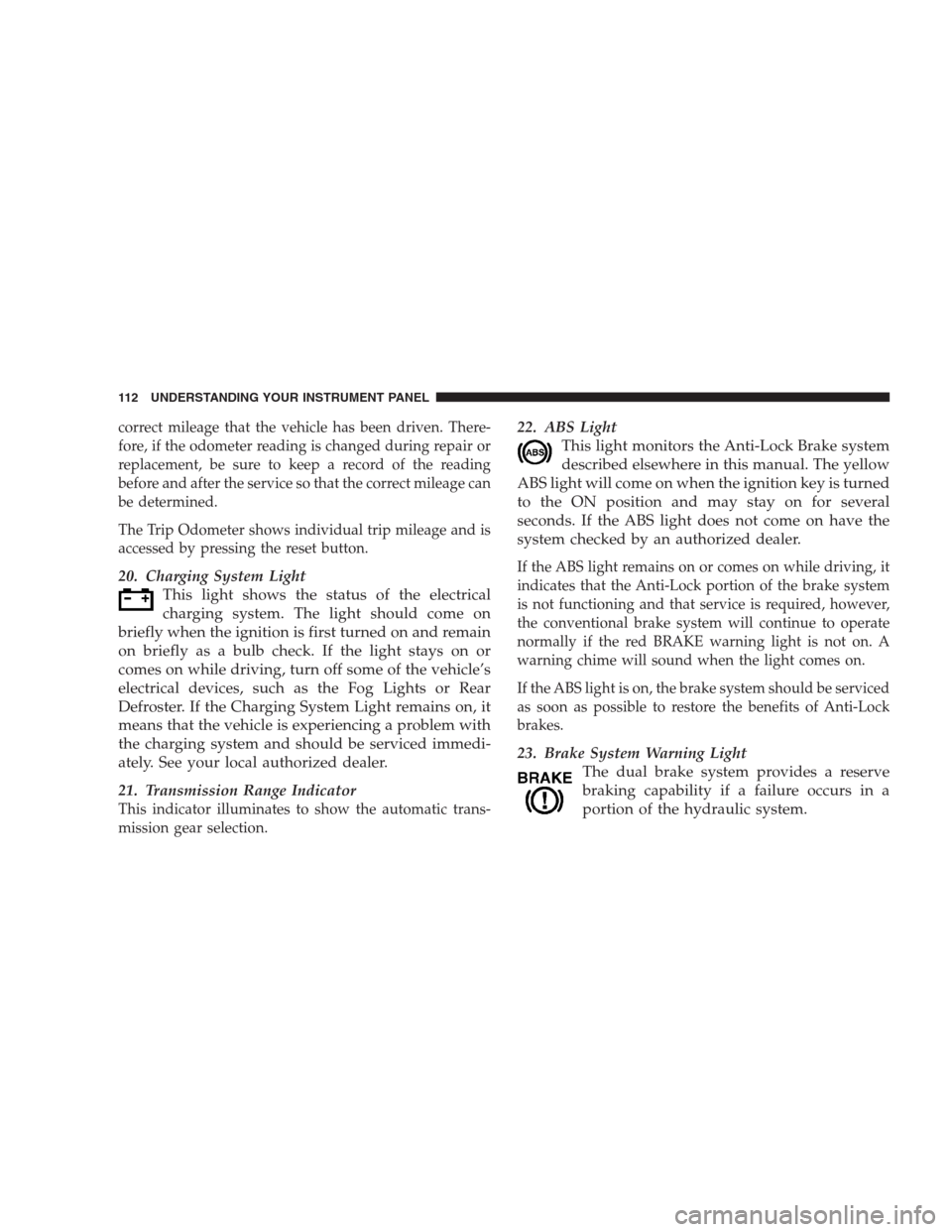
20. Charging System Light
This light shows the status of the electrical
charging system. The light should come on
briefly when the ignition is first turned on and remain
on briefly as a bulb check. If the light stays on or
comes on while driving, turn off some of the vehicle’s
electrical devices, such as the Fog Lights or Rear
Defroster. If the Charging System Light remains on, it
means that the vehicle is experiencing a problem with
the charging system and should be serviced immedi-
ately. See your local authorized dealer.
21. Transmission Range Indicator
This indicator illuminates to show the automatic trans-
mission gear selection.
22. ABS Light
This light monitors the Anti-Lock Brake system
described elsewhere in this manual. The yellow
ABS light will come on when the ignition key is turned
to the ON position and may stay on for several
seconds. If the ABS light does not come on have the
system checked by an authorized dealer.
If the ABS light remains on or comes on while driving, it
indicates that the Anti-Lock portion of the brake system
is not functioning and that service is required, however,
the conventional brake system will continue to operate
normally if the red BRAKE warning light is not on. A
warning chime will sound when the light comes on.
If the ABS light is on, the brake system should be serviced
as soon as possible to restore the benefits of Anti-Lock
brakes.
23. Brake System Warning Light
The dual brake system provides a reserve
braking capability if a failure occurs in a
portion of the hydraulic system.
112 UNDERSTANDING YOUR INSTRUMENT PANEL
Page 113 of 273
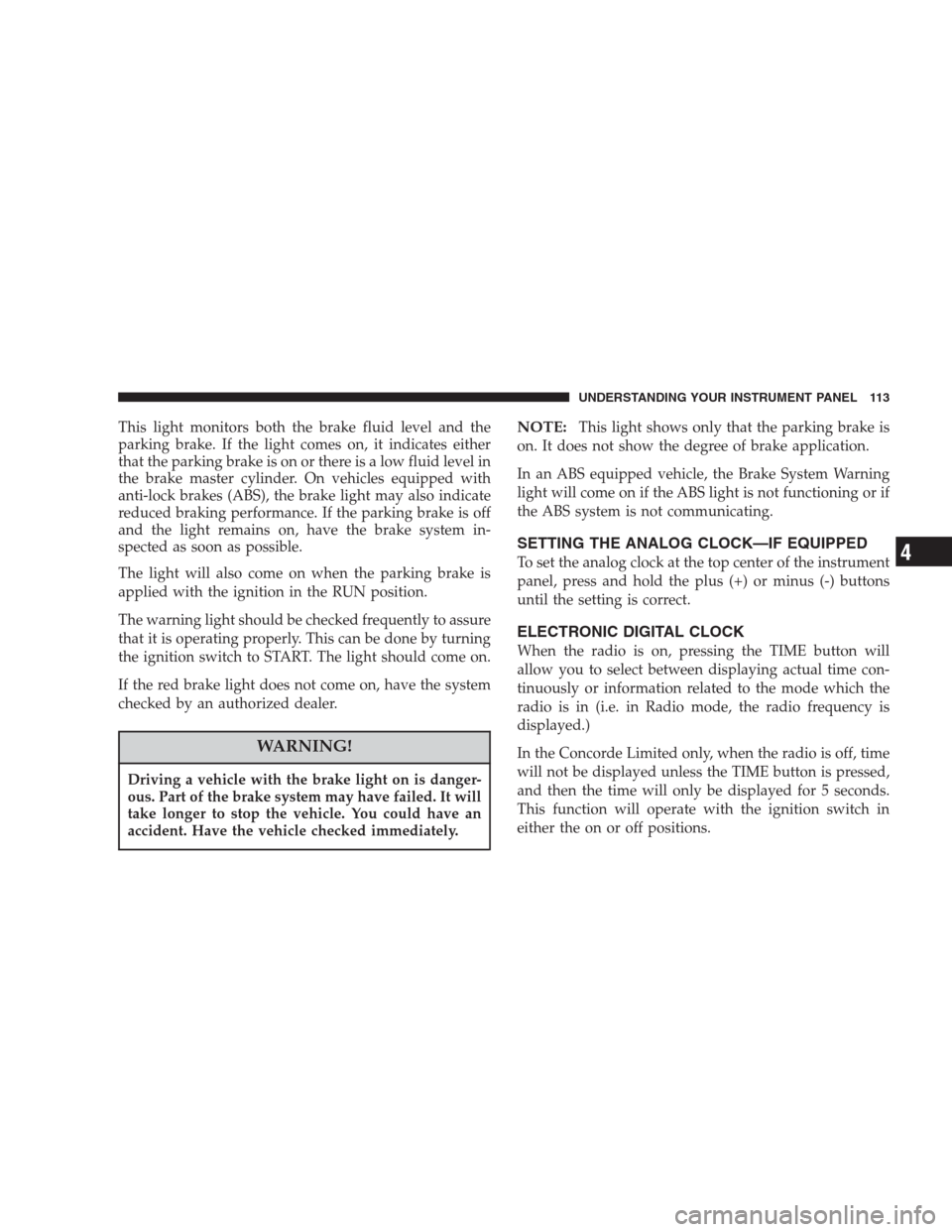
This light monitors both the brake fluid level and the
parking brake. If the light comes on, it indicates either
that the parking brake is on or there is a low fluid level in
the brake master cylinder. On vehicles equipped with
anti-lock brakes (ABS), the brake light may also indicate
reduced braking performance. If the parking brake is off
and the light remains on, have the brake system in-
spected as soon as possible.
The light will also come on when the parking brake is
applied with the ignition in the RUN position.
The warning light should be checked frequently to assure
that it is operating properly. This can be done by turning
the ignition switch to START. The light should come on.
If the red brake light does not come on, have the system
checked by an authorized dealer.
WARNING!
Driving a vehicle with the brake light on is danger-
ous. Part of the brake system may have failed. It will
take longer to stop the vehicle. You could have an
accident. Have the vehicle checked immediately.
NOTE:This light shows only that the parking brake is
on. It does not show the degree of brake application.
In an ABS equipped vehicle, the Brake System Warning
light will come on if the ABS light is not functioning or if
the ABS system is not communicating.
SETTING THE ANALOG CLOCK—IF EQUIPPED
To set the analog clock at the top center of the instrument
panel, press and hold the plus (+) or minus (-) buttons
until the setting is correct.
ELECTRONIC DIGITAL CLOCK
When the radio is on, pressing the TIME button will
allow you to select between displaying actual time con-
tinuously or information related to the mode which the
radio is in (i.e. in Radio mode, the radio frequency is
displayed.)
In the Concorde Limited only, when the radio is off, time
will not be displayed unless the TIME button is pressed,
and then the time will only be displayed for 5 seconds.
This function will operate with the ignition switch in
either the on or off positions.
UNDERSTANDING YOUR INSTRUMENT PANEL 113
4
Page 151 of 273
STARTING PROCEDURES
WARNING!
Do not leave children or animals inside parked
vehicles in hot weather. Interior heat build up may
cause serious injury or death.
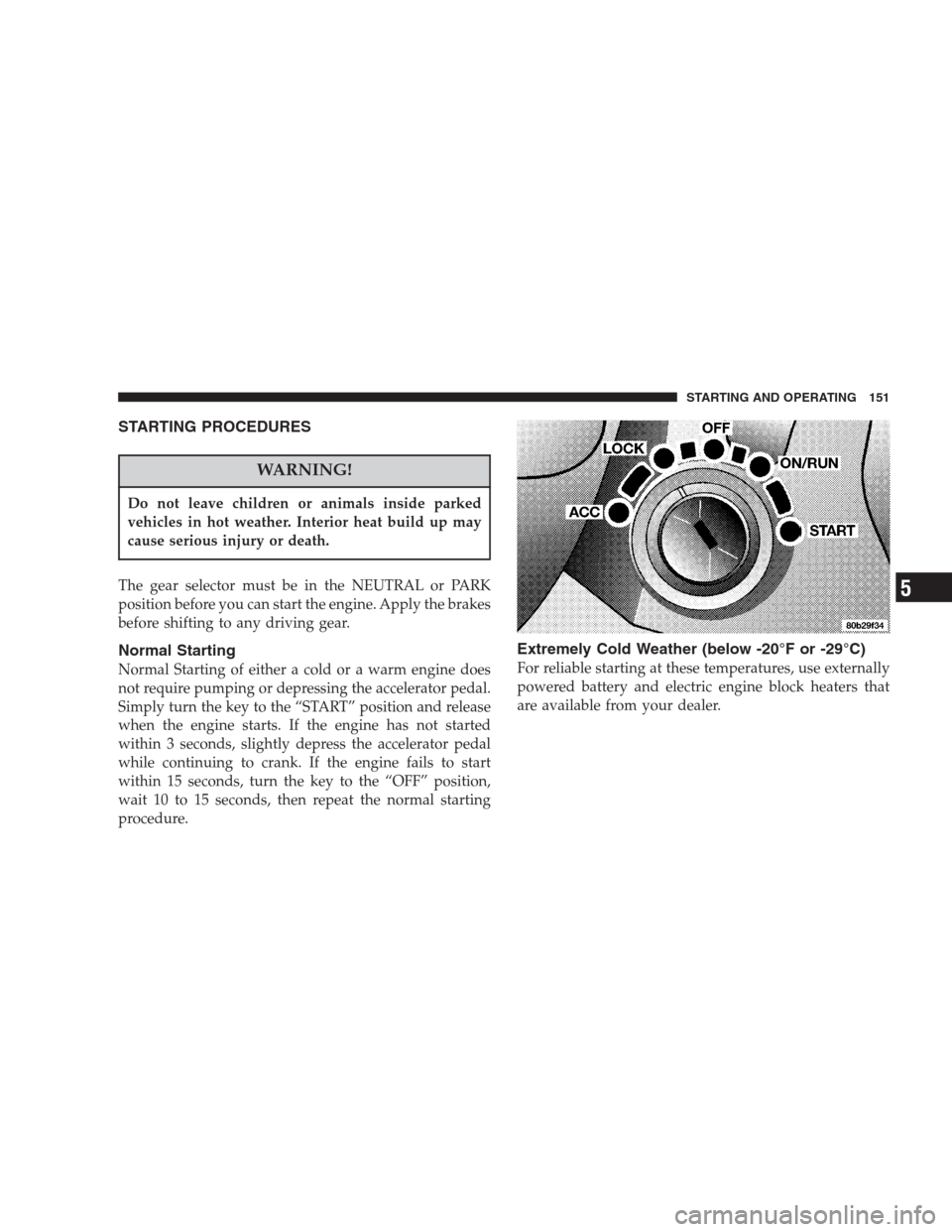
The gear selector must be in the NEUTRAL or PARK
position before you can start the engine. Apply the brakes
before shifting to any driving gear.
Normal Starting
Normal Starting of either a cold or a warm engine does
not require pumping or depressing the accelerator pedal.
Simply turn the key to the “START” position and release
when the engine starts. If the engine has not started
within 3 seconds, slightly depress the accelerator pedal
while continuing to crank. If the engine fails to start
within 15 seconds, turn the key to the “OFF” position,
wait 10 to 15 seconds, then repeat the normal starting
procedure.
Extremely Cold Weather (below -20°F or -29°C)
For reliable starting at these temperatures, use externally
powered battery and electric engine block heaters that
are available from your dealer.
STARTING AND OPERATING 151
5
Page 170 of 273
unleaded gasoline having lower sulfur to determine if the
problem is fuel related prior to returning your vehicle to
an authorized dealer for service.
CAUTION!
If the Malfunction Indicator Light is flashing, imme-
diate service is required. See the On Board Diagnos-
tics paragraph in the Maintenance section of this
manual.
Adding Fuel
NOTE:
The fuel tank filler tube has a restricting door
about 2 inches (50 mm) down from the opening. If fuel is
poured from a portable container, the container should
have a flexible nozzle long enough to force open the
restricting door.
CAUTION!
To avoid fuel spillage and overfilling, do not “top
off” the fuel tank after filling.
NOTE:When the fuel nozzle “clicks” or shuts off, the
fuel tank is full.
NOTE:Tighten the gas cap until you hear a “clicking”
sound. This is an indication that the gas cap is properly
tightened.
The Malfunction Indicator light will come on if the gas
cap is not properly secured. Make sure that the gas cap
is tightened each time the vehicle is refueled.
WARNING!
A fire may result if gasoline is pumped into a
portable container that is inside of a vehicle. You
could be burned. Always place gas containers on the
ground while filling.
170 STARTING AND OPERATING
Page 171 of 273
Fuel Filler Cap (Gas Cap)
The gas cap is behind the fuel filler door, on the driver’s
side of the vehicle. If the gas cap is lost or damaged, be
sure the replacement cap is for use with this vehicle.
CAUTION!
Damage to the fuel system or emission control
system could result from using an improper fuel
tank filler tube cap (gas cap). A poorly fitting cap
could let impurities into the fuel system. The Mal-
function Indicator light will come on if the gas cap is
not properly secured.
WARNING!
•Never have any smoking materials lit in or near
the vehicle when the gas cap is removed or the
tank filled.
•Never add fuel to the vehicle when the engine is
running.
VEHICLE LOADING
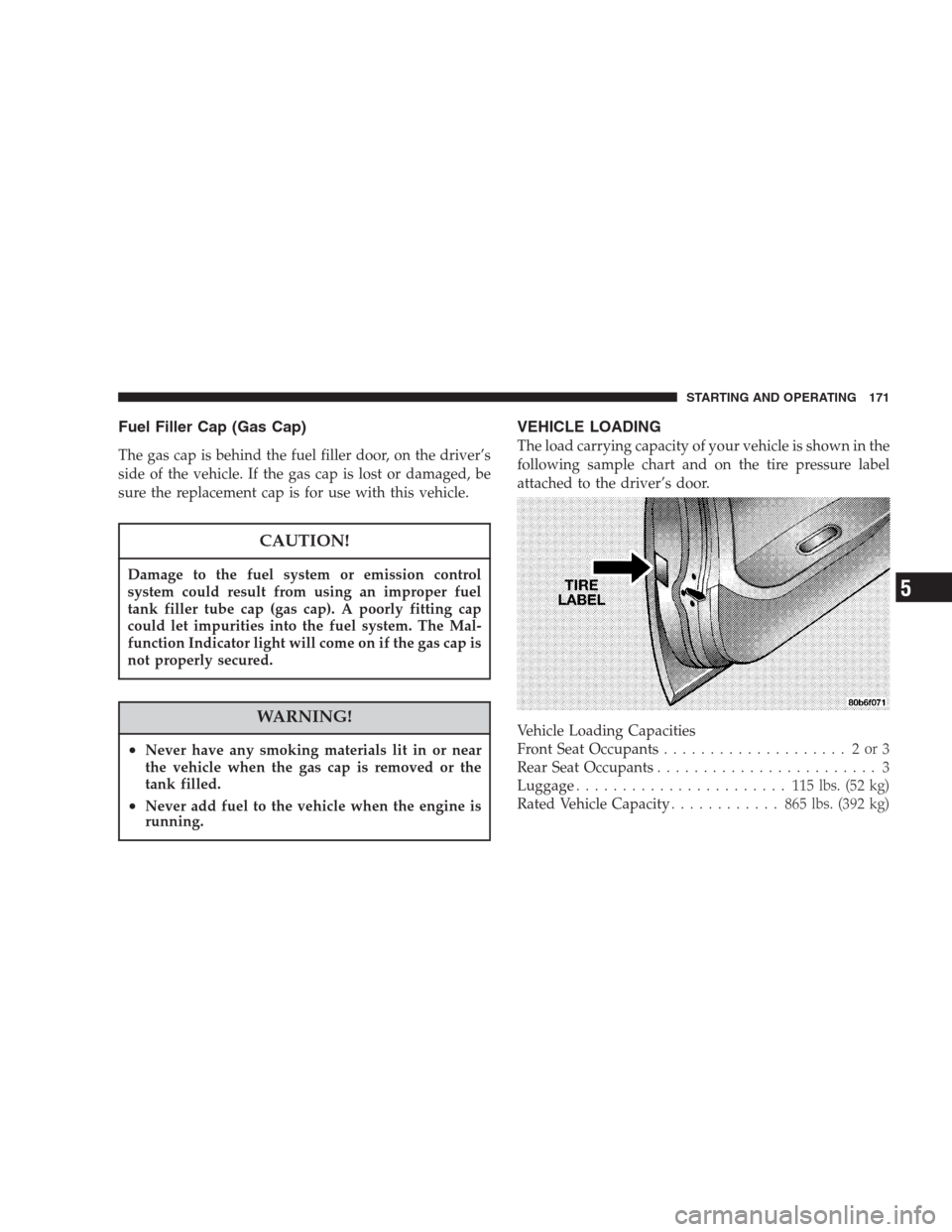
The load carrying capacity of your vehicle is shown in the
following sample chart and on the tire pressure label
attached to the driver’s door.
Vehicle Loading Capacities
Front Seat Occupants.................... 2or3
Rear Seat Occupants........................ 3
Luggage....................... 115lbs. (52 kg)
Rated Vehicle Capacity............ 865lbs. (392 kg)
STARTING AND OPERATING 171
5
Page 173 of 273
WARNING!
Connecting trailer brakes to your vehicle’s hydraulic
brake lines can overload your brake system and
cause it to fail. You might not have brakes when you
need them and could have an accident.
•Whenever you pull a trailer, regardless of the trailer
size, stop lights and turn signals on the trailer are
recommended for motoring safety.
•The automatic transmission fluid, filter, and hypoid
differential fluid should be changed per Maintenance
Schedule “B” if you tow a trailer.
•If your Engine Coolant Light comes on, see the para-
graph on Overheating in Section 6 of this manual.
NOTE:Check the automatic transmission fluid level
before all towing. Fluid discoloration, or a burnt odor,
shows the need for a transmission fluid and filter change.
STARTING AND OPERATING 173
5
Page 201 of 273

Under normal operating conditions, the catalytic con-
verter will not require maintenance. However, it is im-
portant to seek service to assure proper catalyst operation
and prevent possible catalyst damage. If the Malfunction
Indicator light is flashing, immediate service is required.
CAUTION!
Damage to the catalytic converter can result if your
vehicle is not kept in proper operating condition. In
the event of engine malfunction, particularly involv-
ing engine misfire or other apparent loss of perfor-
mance, have your vehicle serviced promptly. Contin-
ued operation of your vehicle with a severe
malfunction could cause the converter to overheat,
resulting in possible damage to the converter and the
vehicle.
WARNING!
A hot exhaust system can start a fire if you park over
materials that can burn. Such materials might be
grass or leaves coming into contact with your ex-
haust system. Do not park or operate your vehicle in
areas where your exhaust system can contact any-
thing that can burn.
In unusual situations involving grossly malfunctioning
engine operation, a scorching odor may suggest severe
and abnormal catalyst overheating. If this occurs, stop
the vehicle, turn off the engine and allow it to cool.
Service, including a tune up to manufacturer’s specifica-
tions, should be obtained immediately.
To minimize the possibility of catalyst damage:
•Do not shut off the engine or interrupt the ignition
when the transaxle is in gear and the vehicle is in
motion.
•Do not try to start the engine by pushing or towing the
vehicle.
MAINTAINING YOUR VEHICLE 201
7
Page 222 of 273
Use a mild soap and warm water solution to clean vinyl
or leather upholstery. For stubborn stains, use Mopar
Vinyl Cleaner.
Mopar Vinyl Cleaner is specifically recommended for
vinyl trim.
WARNING!
Do not use volatile solvents for cleaning purposes.
Many are potentially flammable, and if used in
closed areas they may cause respiratory harm.
CAUTION!
The use of vinyl, leather or plastic protectants may
cause excessive gloss and/or discoloration of interior
trim parts.
Leather Seat Care and Cleaning
Leather is best preserved by regular cleaning with a
damp soft cloth. Small particles of dirt can act as anabrasive and damage the leather surface and should be
removed immediately with a damp cloth. Stubborn soils
can be removed easily with a soft cloth and Mopar Total
Clean. Care should be taken to avoid soaking the leather
with any liquid. Please do not use polishes, oils, cleaning
fluids, solvents, detergents, or ammonia based cleaners
to clean the leather. Application of a leather conditioner is
not required to maintain the original condition.
Wooden Steering Wheel Care — If Equipped
If your vehicle is equipped with a wood steering wheel,
it is finished with a clear topcoat. Please take care to
avoid scratching the surface with sharp or abrasive
materials.
Cleaning Headlights
Your vehicle has plastic headlights that are lighter and
less susceptible to stone breakage than glass headlights.
Plastic is not as scratch resistant as glass and therefore
different lens cleaning procedures must be followed.
222 MAINTAINING YOUR VEHICLE
Page 262 of 273
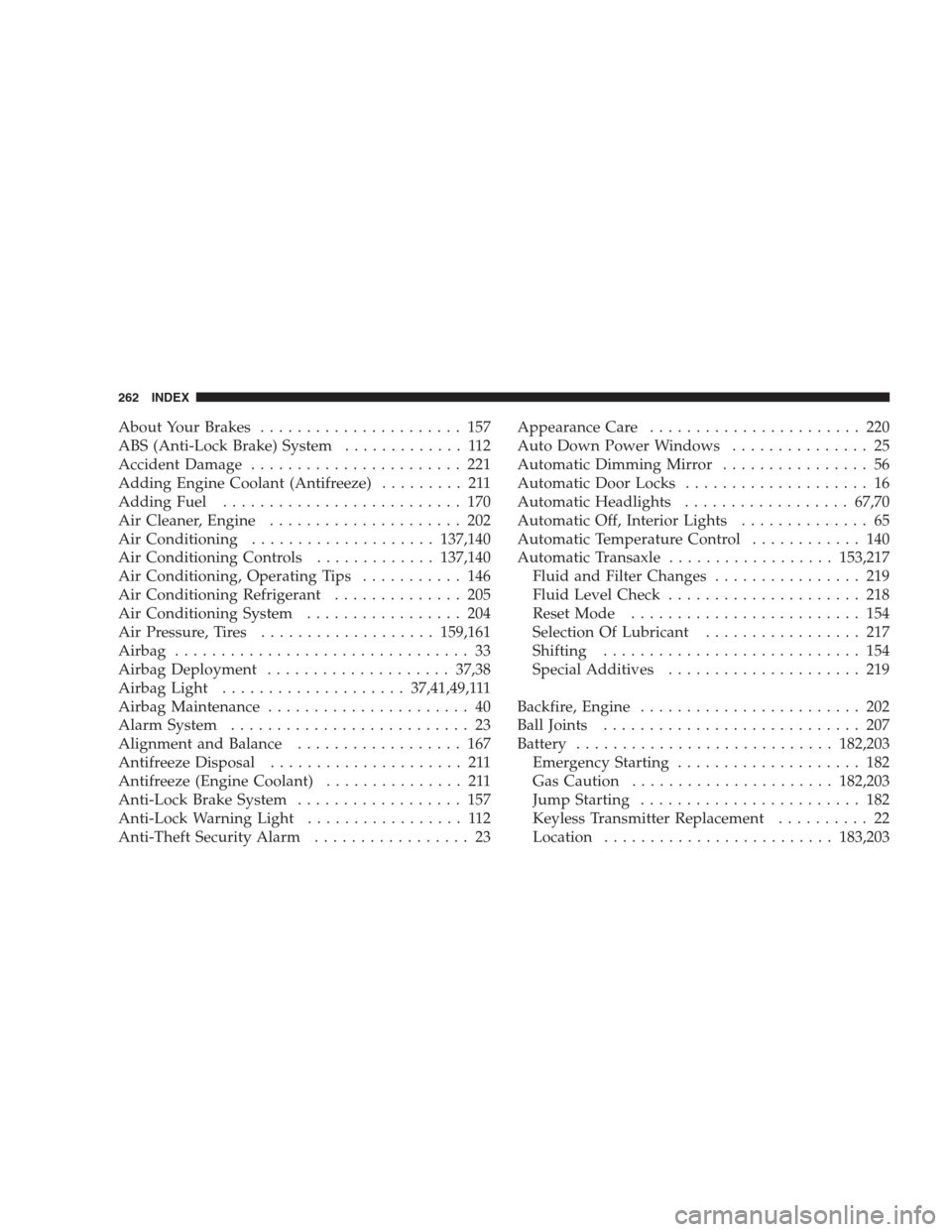
About Your Brakes...................... 157
ABS (Anti-Lock Brake) System............. 112
Accident Damage....................... 221
Adding Engine Coolant (Antifreeze)......... 211
Adding Fuel.......................... 170
Air Cleaner, Engine..................... 202
Air Conditioning....................137,140
Air Conditioning Controls.............137,140
Air Conditioning, Operating Tips........... 146
Air Conditioning Refrigerant.............. 205
Air Conditioning System................. 204
Air Pressure, Tires...................159,161
Airbag................................ 33
Airbag Deployment....................37,38
Airbag Light....................37,41,49,111
Airbag Maintenance...................... 40
Alarm System.......................... 23
Alignment and Balance.................. 167
Antifreeze Disposal..................... 211
Antifreeze (Engine Coolant)............... 211
Anti-Lock Brake System.................. 157
Anti-Lock Warning Light................. 112
Anti-Theft Security Alarm................. 23Appearance Care....................... 220
Auto Down Power Windows............... 25
Automatic Dimming Mirror................ 56
Automatic Door Locks.................... 16
Automatic Headlights..................67,70
Automatic Off, Interior Lights.............. 65
Automatic Temperature Control............ 140
Automatic Transaxle..................153,217
Fluid and Filter Changes................ 219
Fluid Level Check..................... 218
Reset Mode......................... 154
Selection Of Lubricant................. 217
Shifting............................ 154
Special Additives..................... 219
Backfire, Engine........................ 202
Ball Joints............................ 207
Battery............................182,203
Emergency Starting.................... 182
Gas Caution......................182,203
Jump Starting........................ 182
Keyless Transmitter Replacement.......... 22
Location.........................183,203
262 INDEX