warning light CHRYSLER CONCORDE 2004 2.G Owners Manual
[x] Cancel search | Manufacturer: CHRYSLER, Model Year: 2004, Model line: CONCORDE, Model: CHRYSLER CONCORDE 2004 2.GPages: 273, PDF Size: 6 MB
Page 36 of 273
4. If your vehicle has side airbags, do not lean against the
door, airbags will inflate forcefully into the space be-
tween you and the door.
WARNING!
•Relying on the airbags alone could lead to more
severe injuries in a collision. The airbags work
with your seat belt to restrain you properly. In
some collisions the airbags won’t deploy at all.
Always wear your seat belts even though you
have airbags.
•Being too close to the steering wheel or instru-
ment panel during airbag deployment could cause
serious injury.
•Airbags need room to inflate. Sit back, comfort-
ably extending your arms to reach the steering
wheel or instrument panel.
•If the vehicle has side airbags, they also need
room to inflate. Do not lean against the door. Sit
upright in the center of the seat.
Airbag System Components
The airbag system consists of the following:
•ACM (Airbag Control Module)
•AIRBAG Readiness Light
•Driver and Passenger Front Airbags
•Optional Driver and Passenger Side Airbags.
•Steering Wheel and Column
•Instrument Panel
•Interconnecting Wiring
•Crash Sensors
•Knee Impact Bolsters
The side airbag system, on vehicles so equipped, consists
of the following:
•AIRBAG Readiness Light
•Side Airbag in the Driver’s Seat
•Side Airbag in the Passenger’s Seat
36 THINGS TO KNOW BEFORE STARTING YOUR VEHICLE
Page 37 of 273
•ACM (Airbag Control Module)
•SIACM (Side Impact Airbag Control Module)
•Interconnecting Wiring
How the Frontal Airbag System Works
•
The front airbag control module determines if a frontal
collision is severe enough to require the airbags to
inflate.
•The airbag control module will not detect side, roll
over, or rear collisions.
•The airbag control module also monitors the readiness
of the electronic parts of the system whenever the
ignition switch is in the START or RUN positions.
These include all of the items listed above except the
knee bolsters, the instrument panel, and the steering
wheel and column. If the key is in the OFF position, in
the ACC position, or not in the ignition, the airbags are
not on and will not inflate.
•The airbag control module also turns on the
AIRBAG light in the instrument panel for 6 to
8 seconds when the ignition is first turned on,
then turns the light off. If it detects a malfunction in
any part of the system, it turns on the light either
momentarily or continuously.
WARNING!
Ignoring the AIRBAG light in your instrument panel
could mean you won’t have the airbags to protect
you in a collision. If the light does not come on, stays
on after you start the vehicle, or if it comes on as you
drive, have the airbag system checked right away.
THINGS TO KNOW BEFORE STARTING YOUR VEHICLE 37
2
Page 39 of 273
•As the airbags deflate you may see some smoke-like
particles. The particles are a normal by-product of the
process that generates the nontoxic gas used for airbag
inflation. These airborne particles may irritate the skin,
eyes, nose, or throat. If you have skin or eye irritation,
rinse the area with cool water. For nose or throat
irritation, move to fresh air. If the irritation continues,
see your doctor. If these particles settle on your
clothing, follow the garment manufacturer’s instruc-
tions for cleaning.
•It is not advisable to drive your vehicle after the
airbags have been deployed. If you are involved in
another collision, the airbags will not be in place to
protect you.
WARNING!
Deployed airbags can’t protect you in another colli-
sion. Have the airbags replaced by an authorized
dealer as soon as possible.
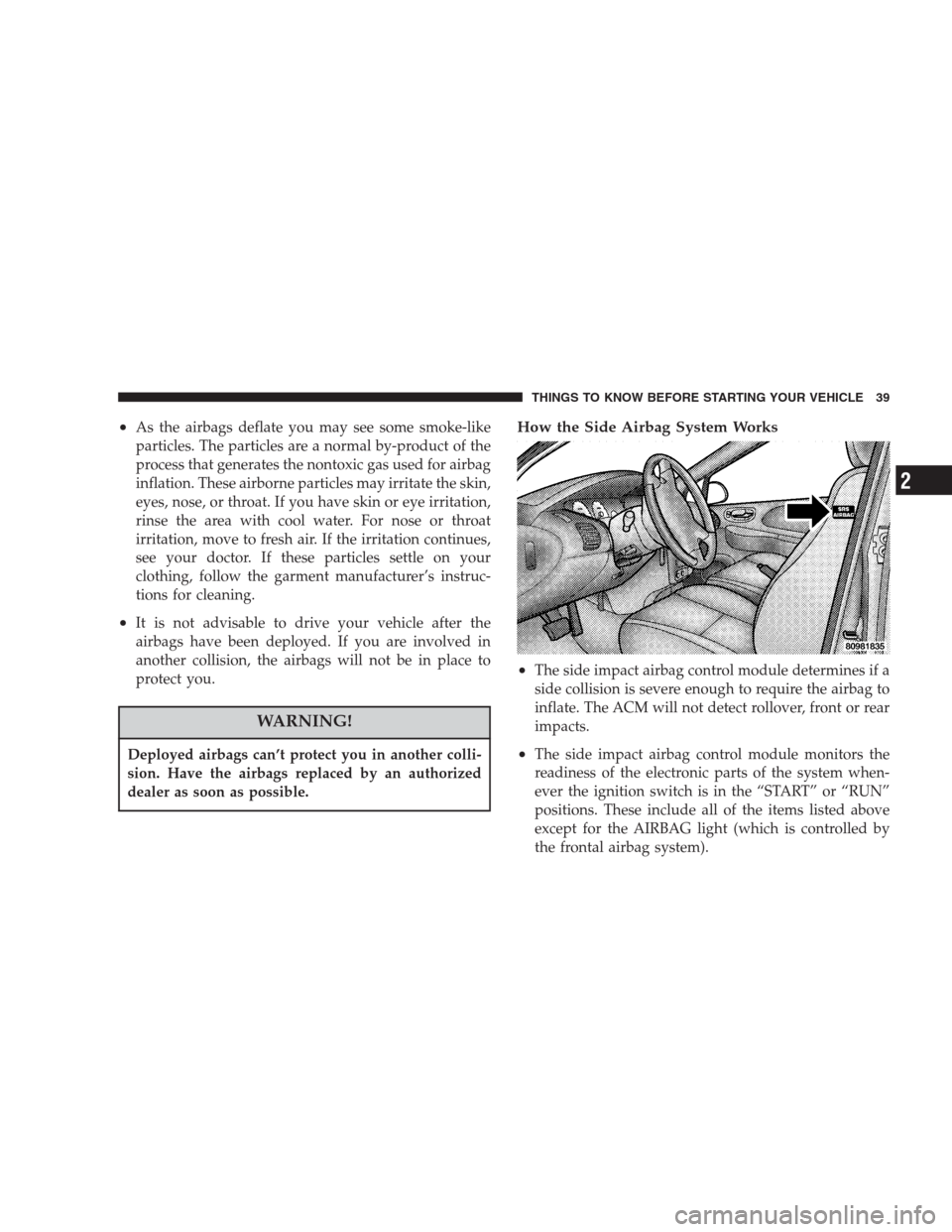
How the Side Airbag System Works
•
The side impact airbag control module determines if a
side collision is severe enough to require the airbag to
inflate. The ACM will not detect rollover, front or rear
impacts.
•The side impact airbag control module monitors the
readiness of the electronic parts of the system when-
ever the ignition switch is in the “START” or “RUN”
positions. These include all of the items listed above
except for the AIRBAG light (which is controlled by
the frontal airbag system).
THINGS TO KNOW BEFORE STARTING YOUR VEHICLE 39
2
Page 41 of 273
Airbag Light
You will want to have the airbags ready for your
protection in an impact. While the airbag system
is designed to be maintenance free, if any of the
following occurs, have an authorized dealer service the
system immediately.
•The AIRBAG light does not come on or flickers during
the 6 to 8 seconds when the ignition switch is first
turned on.
•The light remains on or flickers after the 6 to 8 second
interval.
•The light flickers or comes on and remains on while
driving.
Child Restraint
Everyone in your vehicle needs to be buckled up all the
time– babies and children too. Every state in the United
States and all Canadian provinces require that small
children ride in proper restraint systems. This is the law,
and you can be prosecuted for ignoring it.Children 12 years and under should ride properly buck-
led up in a rear seat. According to crash statistics,
children are safer when properly restrained in the rear
seat rather than the front.
WARNING!
In a collision, an unrestrained child, even a tiny
baby, can become a missile inside the vehicle. The
force required to hold even an infant on your lap
could become so great that you could not hold the
child, no matter how strong you are. The child and
others could be badly injured. Any child riding in
your vehicle should be in a proper restraint for the
child’s size.
There are different sizes and types of restraints for
children from newborn size to the child almost large
enough for an adult safety belt. Always check the child
seat owner’s manual to ensure you have the right seat for
your child. Use the restraint that is correct for your child:
THINGS TO KNOW BEFORE STARTING YOUR VEHICLE 41
2
Page 49 of 273
SAFETY TIPS
Exhaust Gas
WARNING!
Exhaust gases can injure or kill. They contain carbon
monoxide (CO) which is colorless and odorless.
Breathing it can make you unconscious and can
eventually poison you. To avoid breathing (CO)
follow the safety tips below.
•Do not run the engine in a closed garage or in confined
areas any longer than needed to move your vehicle in
or out of the area.
•If it is necessary to sit in a parked vehicle with the
engine running, adjust your heating or cooling con-
trols to force outside air into the vehicle. Set the blower
at high speed.
•To avoid drawing exhaust gases into the vehicle, close
the trunk while driving. However, if for some reason itmust remain open, close all windows. Adjust the
heating or cooling system to force outside air into the
vehicle. Set the blower at high speed.
Safety Checks You Should Make Inside the
Vehicle
Seat Belts
Inspect the belt system periodically, checking for cuts,
frays and loose parts. Damaged parts must be replaced
immediately. Do not disassemble or modify the system.
Safety belt assemblies must be replaced after an accident
if they have been damaged (bent retractor, torn webbing,
etc.). If there is any question regarding belt or retractor
condition, replace the belt.
Airbag Light
The light should come on and remain on for 6 to
8 seconds as a bulb check when the ignition
switch is first turned ON. If the bulb is not lit
during starting, have it replaced. If the light stays on or
comes on while driving, have the system checked by an
authorized dealer.
THINGS TO KNOW BEFORE STARTING YOUR VEHICLE 49
2
Page 65 of 273
WARNING!
If the hood is not fully latched, it could fly up when
the vehicle is moving and block your forward vision.
You could have a collision. Be sure all hood latches
are fully latched before driving.
INTERIOR LIGHTS
To Turn The Interior Lights On:
Rotate the Dimmer Control upward to the second detent.
Rotate the switch downward to turn the interior lights
off.
NOTE:The interior lights have a “fade to off” feature.
When the lights are turned off, they gradually “fade” off.
Battery Saver Feature—Interior Lights
The interior courtesy lights come on when a door is open
or left ajar. To prevent battery drain, if you leave a door
open or ajar these lights will turn off after 15 minutes.
After you close the door, the interior courtesy lights will
again function in the normal matter.
NOTE:The map lights or reading lights that are manu-
ally switched on will not turn off automatically.
Instrument Panel Lighting
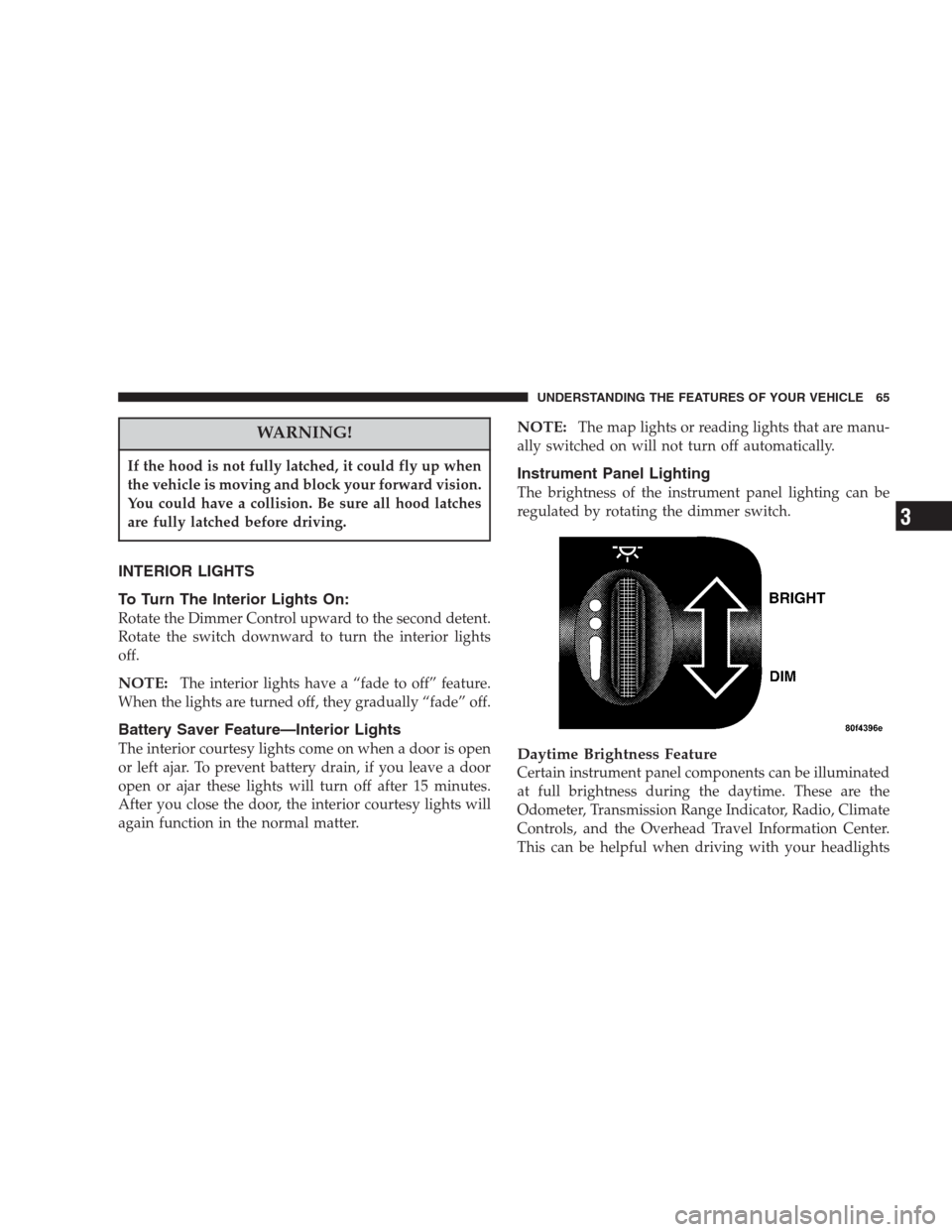
The brightness of the instrument panel lighting can be
regulated by rotating the dimmer switch.
Daytime Brightness Feature
Certain instrument panel components can be illuminated
at full brightness during the daytime. These are the
Odometer, Transmission Range Indicator, Radio, Climate
Controls, and the Overhead Travel Information Center.
This can be helpful when driving with your headlights
UNDERSTANDING THE FEATURES OF YOUR VEHICLE 65
3
Page 70 of 273
If the button is pushed and held while in the OFF
position, the wiper will operate for several wipes then
turn off.
If the button is pushed while in the OFF position, the
wipers will cycle twice.
NOTE:The Automatic Headlight System will turn on
the headlights if it detects that the windshield wipers
have been in operation for more than 10 seconds.
WARNING!
Sudden loss of visibility through the windshield
could lead to an accident. You might not see other
vehicles or other obstacles. To avoid sudden icing of
the windshield during freezing weather, warm the
windshield with the defroster before and during
windshield washer use.
Speed Sensitive Intermittent Wipers System
Use the intermittent feature of this system when weather
conditions make a single wiping cycle, with a variable
pause between cycles, desirable.
For maximum delay between cycles, turn the control
knob into the upper end of the delay range. The delay
interval decreases as you turn the knob until it enters the
LO continual speed position. The delay can be regulated
from a maximum of about 18 seconds between cycles, to
a cycle every 1/2 second.
NOTE:Vehicle speed is monitored to calculate wiper
delay intervals. The delay between cycles is shortened
when the vehicle is moving above 10 mph (16 km/h) and
lengthened below 10 mph (16 km/h).
70 UNDERSTANDING THE FEATURES OF YOUR VEHICLE
Page 73 of 273
To Activate:
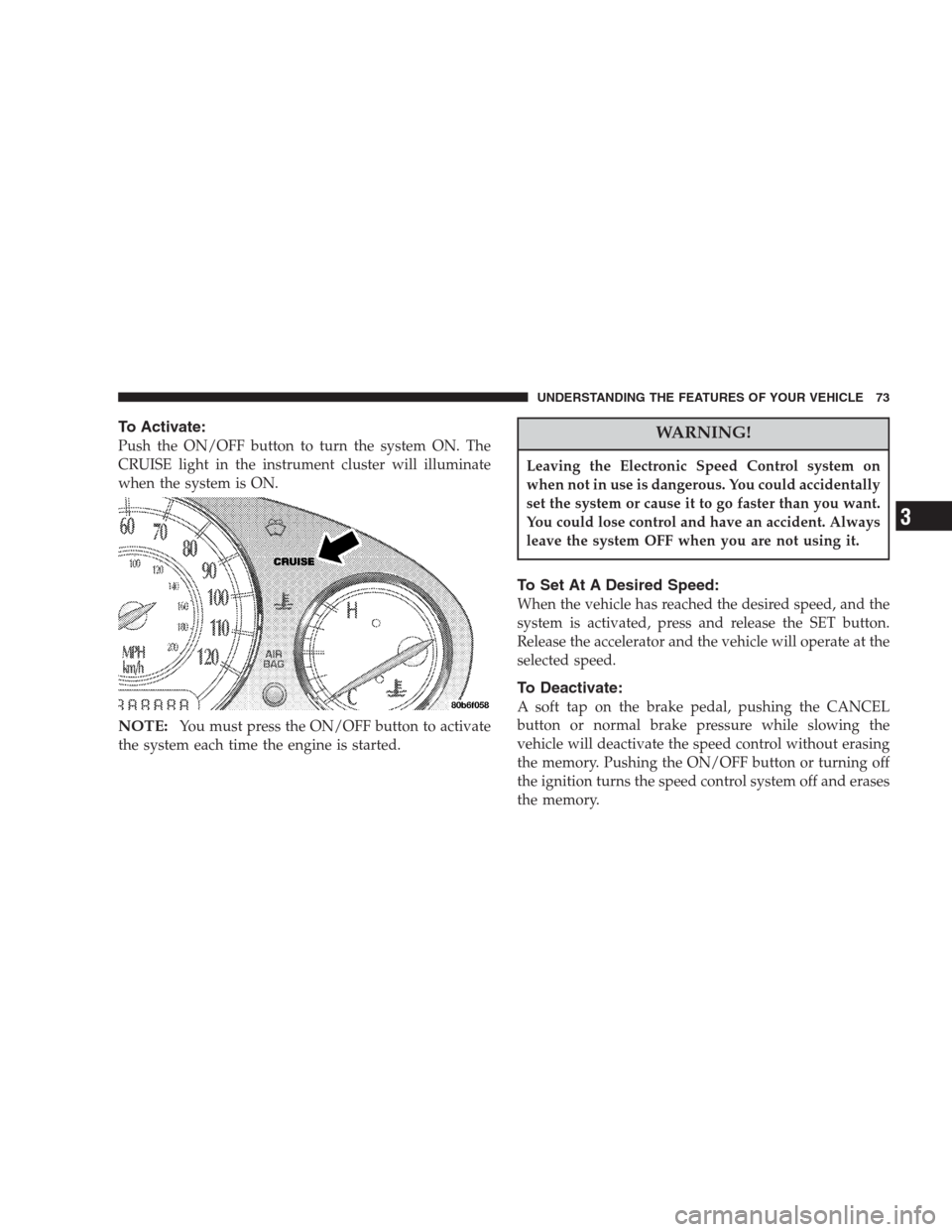
Push the ON/OFF button to turn the system ON. The
CRUISE light in the instrument cluster will illuminate
when the system is ON.
NOTE:You must press the ON/OFF button to activate
the system each time the engine is started.
WARNING!
Leaving the Electronic Speed Control system on
when not in use is dangerous. You could accidentally
set the system or cause it to go faster than you want.
You could lose control and have an accident. Always
leave the system OFF when you are not using it.
To Set At A Desired Speed:
When the vehicle has reached the desired speed, and the
system is activated, press and release the SET button.
Release the accelerator and the vehicle will operate at the
selected speed.
To Deactivate:
A soft tap on the brake pedal, pushing the CANCEL
button or normal brake pressure while slowing the
vehicle will deactivate the speed control without erasing
the memory. Pushing the ON/OFF button or turning off
the ignition turns the speed control system off and erases
the memory.
UNDERSTANDING THE FEATURES OF YOUR VEHICLE 73
3
Page 77 of 273
WARNING!
A moving garage door can cause injury to people and
pets in the path of the door. People or pets could be
seriously or fatally injured. Only use this transceiver
with a garage door opener that has a “stop and
reverse” feature as required by federal safety stan-
dards. This includes most garage door opener mod-
els manufactured after 1982. Do not use a garage
door opener without these safety features it could
cause injury or death. Call toll-free 1–800–355–3515
or, on the Internet at www.homelink.com for safety
information or assistance.
Programming The Universal Transceiver
For best results, install a new battery in the hand held
transmitter before programming. If your garage door
opener (located in the garage) is equipped with an
antenna, make sure that the antenna is hanging straight
down.
1. Turn off the engine.
WARNING!
Vehicle exhaust contains carbon monoxide, a danger-
ous gas. Do not run the vehicle’s exhaust while
training the transceiver. Exhaust gas can cause seri-
ous injury or death.
WARNING!
Your motorized door or gate will open and close
while you are training the universal transceiver. Do
not train the transceiver if people or pets are in the
path of the door or gate. A moving door or gate can
cause serious injury or death to people and pets or
damage to objects.
2. Erase the factory test codes by pressing the two
outside buttons. Release the buttons when the light in the
overhead console display begins to flash (about 20 sec-
onds).
UNDERSTANDING THE FEATURES OF YOUR VEHICLE 77
3
Page 109 of 273
INSTRUMENT CLUSTER DESCRIPTION
1. Fuel Gauge
When the ignition is in the ON position, the
pointer will show the level of fuel remaining in
the tank.
2. Low Fuel Warning Light
When the fuel level drops to about 2 gallons (8
liters), the Low Fuel symbol will light and re-
main lit until fuel is added. A warning chime will
sound when the light comes on.
3. Low Oil Pressure Light
This light indicates low engine oil pressure. The
light should come on briefly as a bulb check
when the engine is first started. If the light stays on or
comes on while driving, stop the vehicle and shut off
the engine. DO NOT operate the vehicle until the
cause is corrected.This light does not show how
much oil is in the engine.The engine oil level must be
checked under the hood.4. TRAC ON/OFF Lights
The Traction Control On light (TRAC ON) will come on
momentarily as a bulb check when the ignition switch is
first turned ON. If the light does not come on, have the
bulb replaced.
The TRAC ON light also will come on when the system
is controlling traction.
The Traction Control Off light (TRAC OFF) will come on
momentarily as a bulb check when the ignition switch is
first turned ON. If the TRAC OFF light does not come on,
have the bulb checked.
The TRAC OFF light will also come on when the Traction
Control switch has been used to turn the system off.
5. Trunk Ajar Light
This light indicates that the trunk is not latched
6. Tachometer
Measures engine revolutions-per-minute (RPM). The red
numbers at the end on the scale show the maximum
permissible RPM’s. Ease off on the accelerator before
reaching the red area.
UNDERSTANDING YOUR INSTRUMENT PANEL 109
4