ignition CHRYSLER CROSSFIRE 2005 1.G Owner's Manual
[x] Cancel search | Manufacturer: CHRYSLER, Model Year: 2005, Model line: CROSSFIRE, Model: CHRYSLER CROSSFIRE 2005 1.GPages: 288, PDF Size: 24.37 MB
Page 63 of 288

WARNING!
Keep compartment lids closed. This will help to
prevent stored objects from being thrown about and
injuring vehicle occupants during an accident.
Ashtray
Lightly touch the bottom of the ashtray cover. The
ashtray will open automatically.
To remove the ashtray insert, pull the ashtray past the
detent. Hold both sides of the insert, and pull up. To
install the ashtray, place it in the frame and push down to
engage.
WARNING!
Remove the ashtray only with the vehicle stopped
and the ignition off. Otherwise, the vehicle might
move unexpectedly as a result of unintended contact
with the gear selector lever.
UNDERSTANDING THE FEATURES OF YOUR VEHICLE 63
3
Page 64 of 288

Coin Holder
With the ashtray open, folding down the cover plate
reveals the coin holder, which can accommodate nine
coins in various sizes up to a U.S. quarter. The coin slots
are shaped to retain the coins, and the cover plate ensures
that the coins remain in the coin holder.
Power Outlet/Cigar Lighter
The dual-purpose power outlet is located in the console,
next to the passenger airbag off warning light. The power
outlet can accommodate a lighter or electrical accessoriesup to a maximum of 15 amps. The outlet is protected by
a 15 amp fuse, located behind the fuse cover on the left
end of the instrument panel.
The lighter will operate only when the ignition switch is
in the ON/ACC position. It heats up when pushed in and
pops out automatically when ready for use. To preserve
the heating element, do not hold the lighter in the heating
position.
64 UNDERSTANDING THE FEATURES OF YOUR VEHICLE
Page 70 of 288

Heated Seats
This feature heats the driver and passenger seats. The
controls for the heated seats are located on the instrument
panel, below the radio.
After turning the ignition switch ON, you can choose the
HI, LO, or OFF setting. Indicators on the switches show
which setting has been selected.
The heated seats setting will automatically switch from
HI to LO after approximately 5 minutes.
TO OPEN AND CLOSE THE HOOD
To open the hood, pull the release lever located inside
your vehicle, below the instrument panel.
Then, reach under the hood and pull upward on the
safety latch and lift the hood.
70 UNDERSTANDING THE FEATURES OF YOUR VEHICLE
Page 73 of 288

EXTERIOR LIGHTS
Headlights and Parking Lights
When the headlight switch is turned clockwise from OFF
to the first position, the parking lights, taillights, side
marker lights, license plate lights and instrument panel
lights are all illuminated.
The headlights turn on when the switch is turned to the
second position.
Lights-On Reminder
If the headlights or parking lights are left on after the
ignition is turned off, a warning will sound if the driver’s
door is opened.
Daytime Running Lights (Where Applicable)
VEHICLES WITH AUTOMATIC TRANSMISSION
The low beam headlights, parking lights, side marker
lights, taillights and license plate lights are automatically
switched on whenever the vehicle is started and the
transmission gear selector is in a driving position.
VEHICLES WITH MANUAL TRANSMISSION
The low beam headlights, parking lights, side marker
lights, taillights, and license plate lights are automatically
switched on whenever the vehicle is started and the
parking brake is released.
For nighttime driving, the exterior lights switch should
be in the low beam position to permit activation of the
high beam headlights.
UNDERSTANDING THE FEATURES OF YOUR VEHICLE 73
3
Page 74 of 288

Fog Lights
To operate the fog lights, pull the headlight
switch out one stop, with the parking lights
and/or low beam headlights on. A light to the
lower left of the headlight switch will illumi-
nate when the fog lights are on.
To turn off the fog lights, push the headlight switch in
fully. Selecting high beam headlights will also turn off the
fog lights.
Standing Lights
When the vehicle is parked on the street, the standing
lights (left or right side parking lights) can be turned on,
making your vehicle more visible to passing vehicles.To operate the standing lights, turn the headlight switch
counterclockwise one stop (right lamps) or two stops (left
lamps) from the OFF position. To turn off the standing
lights, return the headlight switch to the OFF position.
The standing lights cannot be operated when the ignition
switch is in the ON/RUN position.
CAUTION!
Standing lamps are intended for short term use
when parking. If these lights are left on for a long
period of time, your car’s battery may drain, causing
a possible starting problem. Assure that the head-
lamp switch is in the OFF position when leaving the
vehicle.
74 UNDERSTANDING THE FEATURES OF YOUR VEHICLE
Page 85 of 288

BRAKE ASSIST SYSTEM (BAS)
WARNING!
BAS cannot prevent the natural laws of physics from
acting on the vehicle, nor can it increase braking
efficiency beyond that afforded by the condition of
the vehicle brakes and tires or the traction afforded.
The BAS cannot prevent accidents, including those
resulting from excessive speed in turns, following
another vehicle too closely, or hydroplaning. Only a
safe, attentive, and skillful driver can prevent acci-
dents. The capabilities of a BAS-equipped vehicle
must never be exploited in a reckless or dangerous
manner which could jeopardize the user’s safety or
the safety of others.
The BAS is designed to maximize the vehicle’s braking
capability during emergency braking maneuvers. The
system applies maximum power boost to the brakes
more quickly in emergency braking conditions than
might otherwise be afforded solely by the driver’s brak-
ing style. This can help reduce braking distances. TheBAS complements the antilock brake system (ABS). Ap-
plying the brakes very quickly results in maximum BAS
assistance. To receive the benefit of the system, you must
apply continuous full braking power during the stopping
sequence. Do not reduce brake pedal pressure.
Once the brake pedal is released, the BAS is deactivated.
The malfunction indicator lamp for the Electronic Stabil-
ity Program is combined with the BAS. The yellow
BAS/ESP malfunction indicator light in the instrument
cluster and the yellow ESP warning light in the speed-
ometer dial come on with the key in the ignition switch
UNDERSTANDING THE FEATURES OF YOUR VEHICLE 85
3
Page 87 of 288

To improve the vehicle’s traction when driving with
snow chains, or starting off in deep snow, sand or gravel,
switch off the ESP system by pressing the upper half of
the ESP switch.
With the ESP system switched off, the engine torque
reduction feature is cancelled. Therefore, the enhanced
vehicle stability offered by ESP is unavailable. ESP al-
ways operates under braking, even with the switch in the
OFF position. If one drive wheel loses traction and begins
to spin, the brake is applied by the ESP system until thewheel regains sufficient traction. The traction control
engages at approximately 24 mph (40 km/h), and
switches off at 50 mph (80 km/h).
If the ESP warning light begins to flash during accelera-
tion, ease up on the accelerator and apply as little throttle
as possible. Be sure to adapt your speed and driving to the
prevailing road conditions. When the ESP warning light is
illuminated continuously, the ESP is switched off. To
return to the enhanced vehicle stability offered by ESP,
press the lower half of the switch (the ESP warning light
in the speedometer dial goes out). Avoid spinning one
drive wheel. This may cause serious damage to the drive
train and is not covered by the DaimlerChrysler warranty.
CAUTION!
If the vehicle is towed with the front axle raised, the
engine must be shut off (key in the ignition switch to
the OFF/LOCK or ACC position). Otherwise the ESP
will immediately be engaged and will apply the rear
wheel brakes.
UNDERSTANDING THE FEATURES OF YOUR VEHICLE 87
3
Page 88 of 288

Synchronizing ESP
If the power supply was interrupted (battery discon-
nected or discharged), the BAS/ESP malfunction indica-
tor light may be illuminated with the engine running. To
re-synchronize the ESP, and cancel the malfunction indi-
cator light, the steering angle sensor will need to be
recalibrated.
1. Turn the ignition switch to the ON/RUN position.
2. Rotate the steering wheel to the center position.
3. Rotate the steering wheel completely to the left, and
then rotate the steering wheel completely to the right.
4. Bring the steering wheel back to the center position.
5. The BAS/ESP malfunction indicator light will go out.
If the BAS/ESP malfunction indicator light is still illumi-
nated, the vehicle should be serviced at an authorized
dealer.
ELECTRONIC SPEED CONTROL
The electronic speed control automatically maintains the
set speed by actively regulating the throttle setting. Any
speed above approximately 20 mph (30 km/h) can be
maintained with the electronic speed control by operat-
ing the lever.
88 UNDERSTANDING THE FEATURES OF YOUR VEHICLE
Page 90 of 288

To Vary The Speed Setting
If a set speed needs to be adjusted slightly, lift up or hold
down the speed control lever briefly until the desired
speed is reached. A single tap on the lever up or down
will change the speed in 0.6 mph (1 km/h) increments.
When the lever is released, the newly set speed remains.
To increase the speed for passing, use the accelerator.
After the accelerator is released, the previously set speed
will resume automatically.
To Deactivate
A soft tap on the brake pedal, or normal brake pressure
while slowing the vehicle, will deactivate the speed
control without erasing the memory. Pushing the speed
control lever forward or turning the key in the ignition
switch to the OFF/LOCK position will turn off the speed
control and erase the memory.
90 UNDERSTANDING THE FEATURES OF YOUR VEHICLE
Page 93 of 288
WARNING!
Vehicle exhaust contains carbon monoxide, a danger-
ous gas. Do not run the vehicle’s engine while
programming the transceiver. Exhaust gas can cause
serious injury or death.
WARNING!
Your motorized door or gate will open and close
while you are programming the universal trans-
ceiver. Do not program the transceiver if people or
pets are in the path of the door or gate. A moving
door or gate can cause serious injury or death to
people and pets or damage to objects.
2. Turn the ignition to the ON/RUN position.
3. Erase the factory test codes by pressing the two
outside buttons. Release the buttons when the light in the
overhead console display begins to flash (about 20 sec-
onds).
NOTE:Step 3 does not have to be followed to program
additional hand-held transmitters.
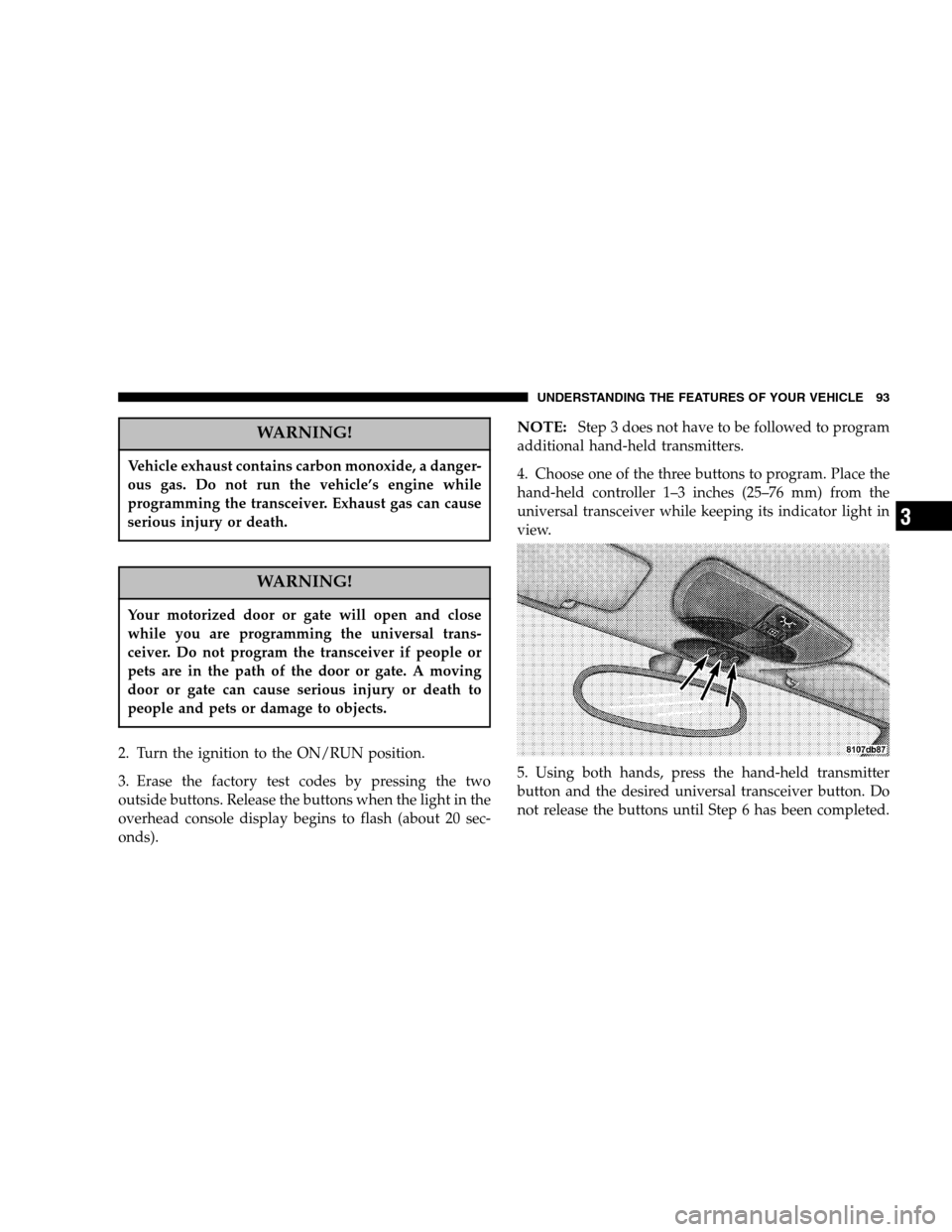
4. Choose one of the three buttons to program. Place the
hand-held controller 1–3 inches (25–76 mm) from the
universal transceiver while keeping its indicator light in
view.
5. Using both hands, press the hand-held transmitter
button and the desired universal transceiver button. Do
not release the buttons until Step 6 has been completed.
UNDERSTANDING THE FEATURES OF YOUR VEHICLE 93
3