belt CHRYSLER CROSSFIRE 2006 1.G User Guide
[x] Cancel search | Manufacturer: CHRYSLER, Model Year: 2006, Model line: CROSSFIRE, Model: CHRYSLER CROSSFIRE 2006 1.GPages: 296, PDF Size: 1.6 MB
Page 31 of 296
WARNING!
•Relying on the airbags alone could lead to more
severe injuries in a collision. The airbags work
with your seat belt to restrain you properly. In
some collisions the airbags won’t deploy at all.
Always wear your seat belts even though you
have airbags.
•Being too close to the steering wheel or instru-
ment panel during airbag deployment could cause
serious injury.
•Airbags need room to inflate. Sit back, comfort-
ably extending your arms to reach the steering
wheel or instrument panel.
•The side airbags also need room to inflate. Do not
lean against the door. Sit upright in the center of
the seat.
Airbag System Components
The airbag system consists of the following:
•Airbag control module and internal crash sensor
•AIRBAG readiness light
•Driver and passenger frontal airbag/inflator units
•Driver and passenger side airbag/inflator units
•Passenger airbag On/Off switch and indicator light
•Unique steering wheel and column
•Unique instrument panel
•Interconnecting wiring
•Knee impact bolster
•Side impact sensors
How the Front Airbag System Works
•
A crash sensor in the occupant compartment deter-
mines if a frontal impact is severe enough to require
the airbag. The sensor will not detect side, roll over, or
rear impacts. The sensor is connected to the diagnostic
unit and to the airbag/inflator unit.
THINGS TO KNOW BEFORE STARTING YOUR VEHICLE 31
2
Page 33 of 296
then quickly deflate while helping to restrain the
driver and passenger. The airbag gas is vented
through the airbag material towards the instrument
panel. In this way the airbags do not interfere with
your control of the vehicle.
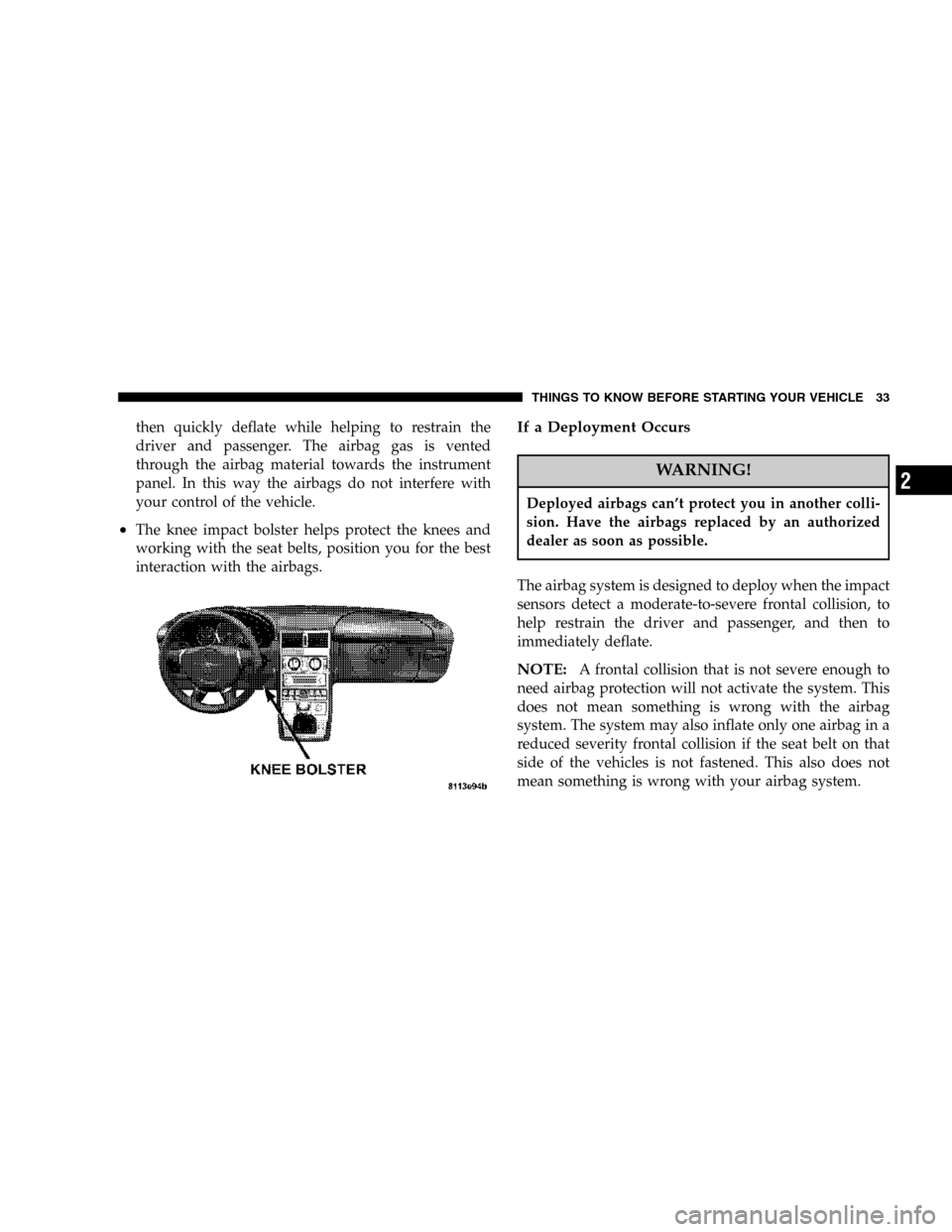
•The knee impact bolster helps protect the knees and
working with the seat belts, position you for the best
interaction with the airbags.
If a Deployment Occurs
WARNING!
Deployed airbags can’t protect you in another colli-
sion. Have the airbags replaced by an authorized
dealer as soon as possible.
The airbag system is designed to deploy when the impact
sensors detect a moderate-to-severe frontal collision, to
help restrain the driver and passenger, and then to
immediately deflate.
NOTE:A frontal collision that is not severe enough to
need airbag protection will not activate the system. This
does not mean something is wrong with the airbag
system. The system may also inflate only one airbag in a
reduced severity frontal collision if the seat belt on that
side of the vehicles is not fastened. This also does not
mean something is wrong with your airbag system.
THINGS TO KNOW BEFORE STARTING YOUR VEHICLE 33
2
Page 40 of 296
Airbag Light
You will want to have the airbags ready for
your protection in case of a collision. While the
airbag Supplemental Restraint System (SRS) is
designed to be maintenance free, if any of the
following occurs, have an authorized dealer service the
system immediately.
•The AIRBAG light does not come on or flickers during
the four seconds when the ignition switch is first
turned on.
•The light remains on or flickers after the four second
interval.
•The light flickers or comes on and remains on while
driving.
Child Restraint
Everyone in your vehicle needs to be buckled up all the
time, babies and children, too. Every state in the United
States and all Canadian provinces require that small
children ride in proper restraint systems. This is the law,
and you can be prosecuted for ignoring it.
WARNING!
In a collision, an unrestrained child, even a tiny
baby, can become a missile inside the vehicle. The
force required to hold even an infant on your lap
could become so great that you could not hold the
child, no matter how strong you are. The child and
others could be badly injured. Any child riding in
your vehicle should be in a proper restraint for the
child’s size.
Infants and Child Restraints
There are different sizes and types of restraints for children
from newborn size to the child almost large enough for an
adult safety belt. Always check the child seat Owner’s
Manual to ensure you have the right seat for your child.
Use the restraint that is correct for your child:
•Safety experts recommend that children ride
rearward-facing in the vehicle until they are at least
one year old and weigh at least 9 kg (20 lbs.). Two
types of child restraints can be used rearward-facing:
infant carriers and “convertible” child seats.
40 THINGS TO KNOW BEFORE STARTING YOUR VEHICLE
Page 41 of 296
•The infant carrier is only used rearward-facing in the
vehicle. It is recommended for children who weigh up
to about 20 lbs. (9 kg). “Convertible” child seats can be
used either rearward-facing or forward-facing in the
vehicle. Convertible child seats often have a higher
weight limit in the rearward-facing direction than
infant carriers do, so they can be used rearward-facing
by children who weigh more than 20 lbs. (9 kg) but are
less than one year old. Both types of child restraints are
held in the vehicle by the lap/shoulder belt or the
LATCH child restraint anchorage system. (See the
LATCH - Child Seat Anchorage System section.)
•Rearward-facing child seats mustNEVERbe used in
the front seat of a vehicle with the front passenger
airbag unless the airbag is turned off. An airbag
deployment could cause severe injury or death to
infants in this position.
WARNING!
•A rearward facing infant restraint must not be
used unless the passenger airbag has been shut
off. A rearward facing infant restraint may be
struck by a deploying passenger airbag which
may cause severe or fatal injury to the infant.
•Improper installation can lead to failure of a child
restraint. It could come loose in a collision. The
child could be badly injured or killed. Follow the
manufacturer’s directions exactly when installing
a child restraint.
Here are some tips on getting the most out of your child
restraint:
•Before buying any restraint system, make sure that it
has a label certifying that it meets all applicable Safety
Standards. We also recommend that you make sure
that you can install the child restraint in the vehicle
where you will use it before you buy it.
THINGS TO KNOW BEFORE STARTING YOUR VEHICLE 41
2
Page 42 of 296

•The restraint must be appropriate for your child’s
weight and height. Check the label on the restraint for
weight and height limits.
•Carefully follow the instructions that come with the
restraint. If you install the restraint improperly, it may
not work when you need it.
•Buckle the child into the seat according to the seat
manufacturer’s directions.
•When your child restraint is not in use, secure it in the
vehicle with the seat belt or remove it from the vehicle.
Do not leave it loose in the vehicle. In a sudden stop or
collision, it could strike the occupants and cause
serious personal injury.
NOTE:For additional information refer to
www.seatcheck.org or call 1–866–SEATCHECK.
Older Children and Child Restraints
Children who weigh more than 20 lbs. (9 kg) and who are
older than one year can ride forward-facing in the
vehicle. Forward-facing child seats and convertible child
seats used in the forward-facing direction are for children
who weigh 20 to 40 lbs. (9 to 18 kg) and who are olderthan one year. These child seats are also held in the
vehicle by the lap/shoulder belt or the LATCH child
restraint anchorage system. (See LATCH - Child Seat
Anchorage System section.)
The belt-positioning booster seat is for children weighing
more than 40 lbs. (18 kg), but who are still too small to fit
the vehicle’s seat belts properly. If the child cannot sit
with knees bent over the vehicle’s seat cushion while the
child’s back is against the seat back, they should use a
belt-positioning booster seat. The child and belt-
positioning booster seat are held in the vehicle by the
lap/shoulder belt.
Children Too Large For Booster Seats
Children who are large enough to wear the shoulder belt
comfortably, and whose legs are long enough to bend
over the front of the seat when their back is against the
seat back, should use the lap/shoulder belt.
•Make sure that the child is upright in the seat.
•The lap portion should be low on the hips and as snug
as possible.
42 THINGS TO KNOW BEFORE STARTING YOUR VEHICLE
Page 43 of 296
•Check belt fit periodically. A child’s squirming or
slouching can move the belt out of position.
•If the shoulder belt contacts the face or neck, move the
child closer to the center of the vehicle. Never allow a
child to put the shoulder belt under an arm or behind
their back.
LATCH - Child Seat Anchorage System (Lower
Anchors and Tether for Children)
Your vehicle’s passenger seat is equipped with the child
restraint anchorage system called LATCH. The LATCH
system provides for the installation of the child restraint
without using the vehicle’s belts, instead securing the
child restraint using lower anchorages and upper tether
straps from the child restraint to the vehicle structure.
LATCH-compatible child restraints are now available.
Installing the LATCH-Compatible Child Restraint
System
We urge that you carefully follow the directions of the
manufacturer when installing your child restraint. Theseare general instructions, and not all child restraint sys-
tems will be installed exactly as described here. Again,
carefully follow the installation instructions that were
provided with the child restraint system.
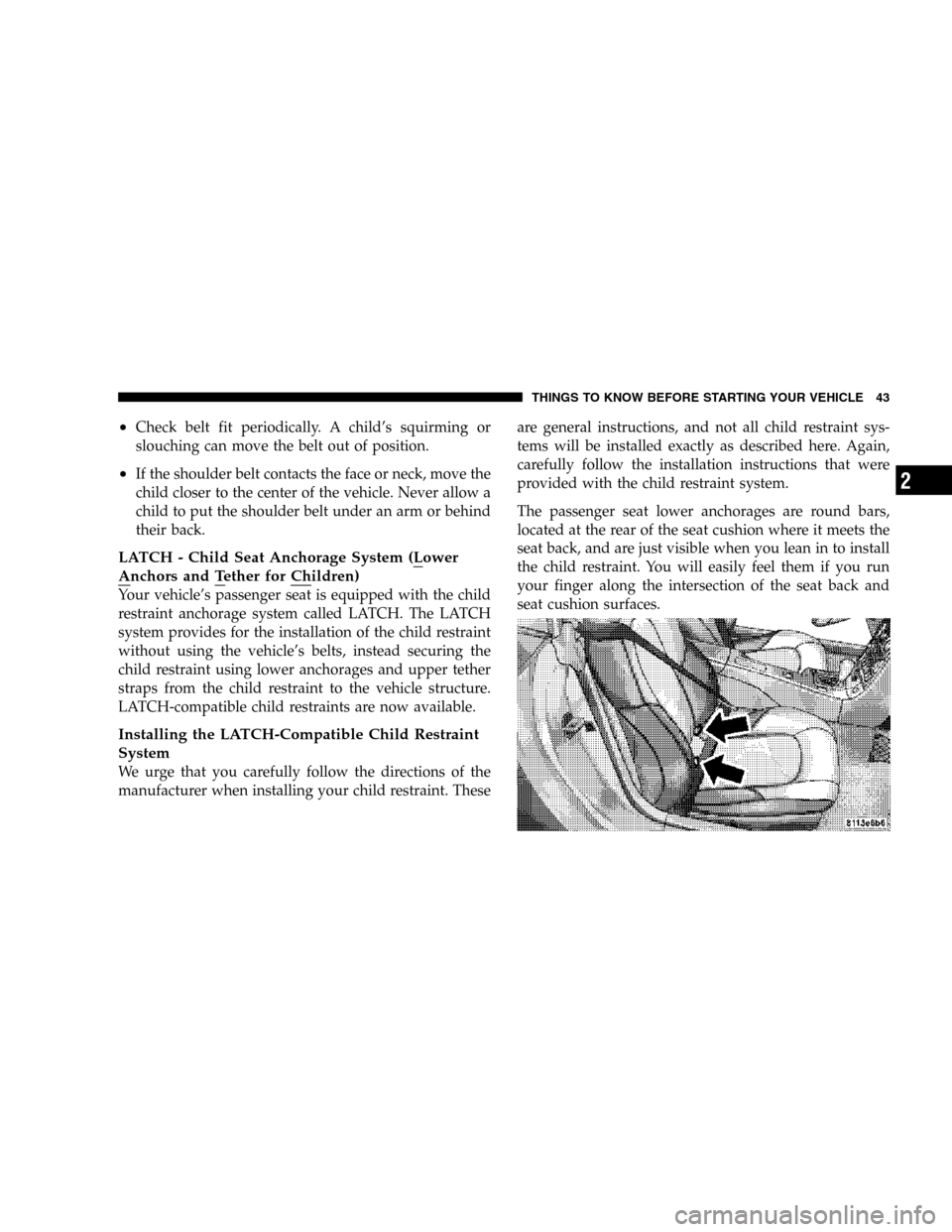
The passenger seat lower anchorages are round bars,
located at the rear of the seat cushion where it meets the
seat back, and are just visible when you lean in to install
the child restraint. You will easily feel them if you run
your finger along the intersection of the seat back and
seat cushion surfaces.
THINGS TO KNOW BEFORE STARTING YOUR VEHICLE 43
2
Page 45 of 296
WARNING!
Improper installation of a child restraint to the
LATCH anchorages can lead to failure of an infant or
child restraint. The child could be badly injured or
killed. Follow the manufacturer’s directions exactly
when installing an infant or child restraint.
Installing Child Restraints Using the Vehicle Seat
Belt
Child restraints can be securely fastened in the passenger
seat using the seat belts. For this purpose, the passenger
seat belt retractor provides two modes of operation -
normal emergency locking and automatic locking. For
child restraint installation, the retractor switches to auto-
matic locking when the belt is pulled out to the full extent
of its travel. As the belt retracts, the retractor locks to
prevent the belt from being pulled out again. Pulling the
belt snugly over the child restraint toward the retractor
secures the restraint in place. When the belt retracts fully
after child restraint removal, normal (emergency locking)retractor action is restored. Any seat belt system will
loosen with time, so check the belt occasionally and pull
it tight if necessary.
If your child restraint is equipped with a tether strap,
attach it to the vehicle by first moving the seat back fully
forward. Next, route the child restraint tether directly
over the top of the seat, through the strap near the top of
the seat back, and attach the hook to the anchor bar.
Recline the seat back and move the passenger seat as far
rearward as possible. Remove slack in the tether strap as
you push the child restraint downward and rearward,
following the child restraint manufacturer’s instructions.
Child Restraint Tether Anchor - General
Information
Child restraints having tether straps and hooks for con-
nection to tether anchors have been available for some
time. In fact, many child restraint manufacturers will
provide add-on tether strap kits for certain of their older
products. There is a tether strap anchor behind the
passenger seat.
THINGS TO KNOW BEFORE STARTING YOUR VEHICLE 45
2
Page 46 of 296
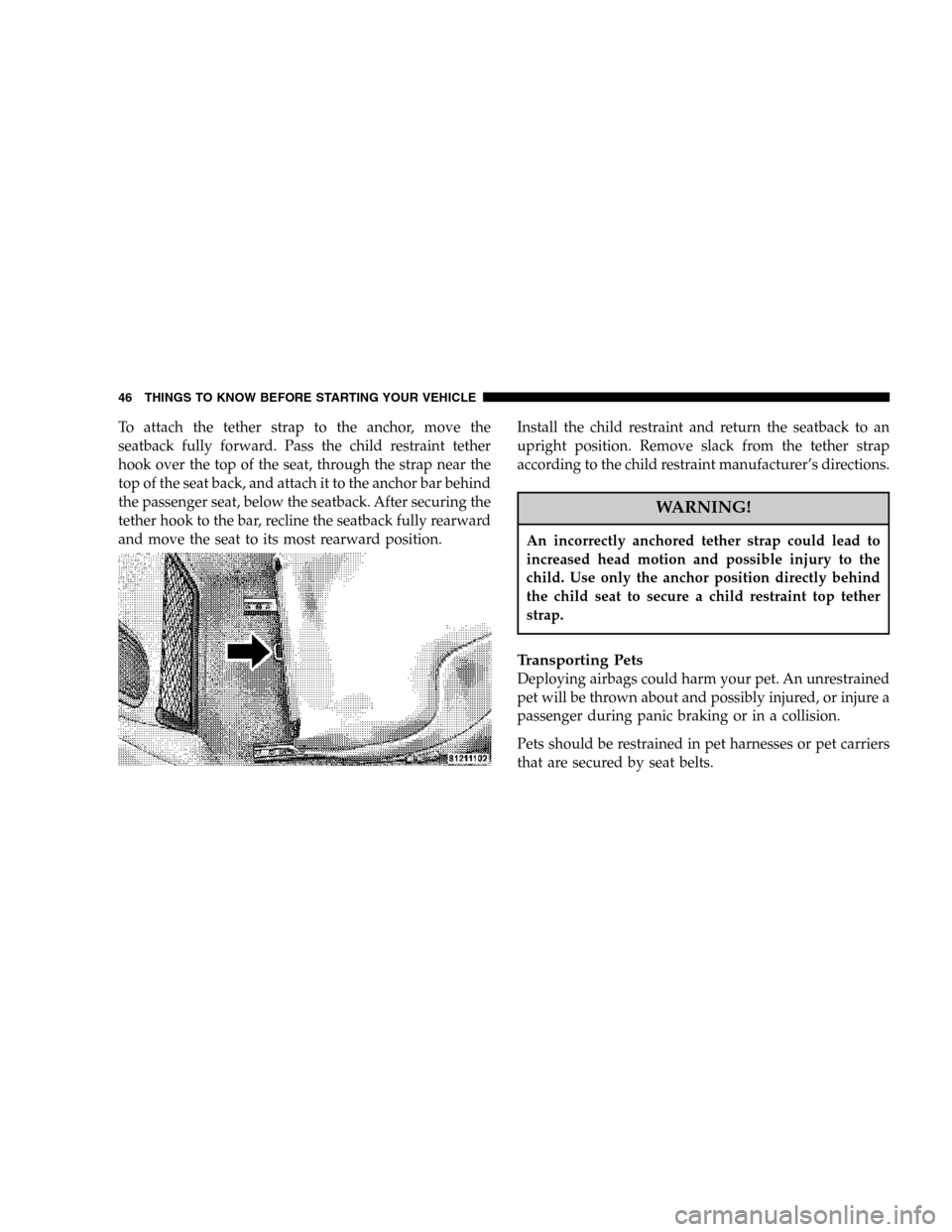
To attach the tether strap to the anchor, move the
seatback fully forward. Pass the child restraint tether
hook over the top of the seat, through the strap near the
top of the seat back, and attach it to the anchor bar behind
the passenger seat, below the seatback. After securing the
tether hook to the bar, recline the seatback fully rearward
and move the seat to its most rearward position.Install the child restraint and return the seatback to an
upright position. Remove slack from the tether strap
according to the child restraint manufacturer’s directions.
WARNING!
An incorrectly anchored tether strap could lead to
increased head motion and possible injury to the
child. Use only the anchor position directly behind
the child seat to secure a child restraint top tether
strap.
Transporting Pets
Deploying airbags could harm your pet. An unrestrained
pet will be thrown about and possibly injured, or injure a
passenger during panic braking or in a collision.
Pets should be restrained in pet harnesses or pet carriers
that are secured by seat belts.
46 THINGS TO KNOW BEFORE STARTING YOUR VEHICLE
Page 48 of 296

Safety Checks You Should Make Inside the Vehicle
Seat Belts
Inspect the belt system periodically, checking for cuts,
frays and loose parts. Damaged parts must be replaced
immediately. Do not disassemble or modify the system.
Seat belt assemblies must be replaced after an accident if
they have been damaged (bent retractor, torn webbing,
etc.). If there is any question regarding belt or retractor
condition, see your authorized dealer.
Airbag Light
The light should come on and remain on for
four seconds as a bulb check when the ignition
switch is first turned ON. If the bulb is not lit
during starting, have it replaced. If the light
stays on or comes on while driving, have the system
checked by an authorized dealer.
Defrosters
Check operation by pressing the A/C control button,
selecting the defrost mode and placing the blower control
on high speed. You should be able to feel the air directed
against the windshield.
Periodic Safety Checks You Should Make Outside
the Vehicle
Tires
Examine tires for excessive tread wear or uneven wear
patterns. Check for stones, nails, glass, or other objects
lodged in the tread. Inspect for tread cuts or sidewall
cracks. Check wheel nuts for tightness and tires for
proper pressure.
Lights
Have someone observe the operation of exterior lights
while you work the controls. Check turn signal and high
beam indicator lights on the instrument panel.
Fluid Leaks
Check area under vehicle after overnight parking for fuel,
water, oil, or other fluid leaks. Also, if gasoline fumes are
present, the cause should be corrected immediately.
NOTE:Use of the air conditioning may cause puddles
of water to form under the vehicle.
48 THINGS TO KNOW BEFORE STARTING YOUR VEHICLE
Page 52 of 296
CONVERTIBLE TOP OPERATION
WARNING!
The convertible top does not provide the structural
protection that a reinforced metal roof does and the
fabric top cannot be expected to prevent the ejection
of the occupants of a vehicle in a collision. There-
fore, it is important that all occupants wear their seat
belts at all times when riding in a convertible.
Studies have shown that it is generally safer to
remain inside a vehicle during a collision than to be
ejected from the vehicle.
For safety reasons, the convertible top should only be
opened and closed when the vehicle is standing still. Top
operation is allowed up to a maximum of 9 mph (15
km/h). Above this speed, top operation will cease and an
audible warning will sound. The top operation can be
resumed after the vehicle is below the maximum speed
by pressing the convertible top switch again.
WARNING!
Before operating the switch for the convertible top,
make sure that no persons can be injured by the
moving parts (convertible top frame and tonneau
cover).
Hands must never be placed near the sport bar,
convertible top frame, upper windshield area, shelf
behind sport bar, or convertible top storage compart-
ment while the convertible top is being raised or
lowered. Serious personal injury may occur.
If potential danger exists, release the convertible top
switch. This immediately interrupts the raising or
lowering procedure. You then can operate the con-
vertible top switch to raise or lower the convertible
top away from the danger zone.
52 UNDERSTANDING THE FEATURES OF YOUR VEHICLE