belt CHRYSLER CROSSFIRE 2006 1.G Owner's Manual
[x] Cancel search | Manufacturer: CHRYSLER, Model Year: 2006, Model line: CROSSFIRE, Model: CHRYSLER CROSSFIRE 2006 1.GPages: 296, PDF Size: 1.6 MB
Page 69 of 296

Vanity Mirrors
A vanity mirror is on each sun visor. To use the mirror,
rotate the sun visor down and slide open the mirror
cover.
SEATS
Your vehicle’s seats can be adjusted either manually or
electrically, depending on how your vehicle is equipped.
WARNING!
•Adjusting a seat while the vehicle is moving is
dangerous. The sudden movement of the seat
could cause you to lose control. The seat belt
might not be properly adjusted and you could be
injured. Adjust the seat only while the vehicle is
parked.
•Do not ride with the seatback reclined so that the
shoulder belt is no longer resting against your
chest. In a collision you could slide under the seat
belt and be seriously or even fatally injured. Use
the recliner only when the vehicle is parked.
UNDERSTANDING THE FEATURES OF YOUR VEHICLE 69
3
Page 111 of 296

The indicator light will come on when the exterior light
fails. If a brake light fails, the light outage indicator will
come on when applying the brake and stays on until the
engine is turned off.
NOTE:If additional lighting equipment is installed
(e.g., auxiliary headlights, etc.) be certain to connect into
the fuse before the failure indicator monitoring unit in
order to avoid damaging the system.
12. Antilock Warning Indicator Light
The ABS warning indicator light comes on
with the key in the ignition switch turned to
the ON/RUN position, and should go out
with the engine running.
If the ABS warning indicator light comes on while the
engine is running, it indicates that the ABS has detected
a malfunction and has switched off. In this case, the brake
system functions in the usual manner, but without an-
tilock assistance.
If the ABS light is on, have the system checked at your
authorized dealer as soon as possible.
13. Brake Assist Indicator Light
The indicator light for the Brake Assist Sys-
tem (BAS) is combined with the Electronic
Stability Program (ESP). This yellow indica-
tor light in the instrument cluster comes on with the
key in the ignition switch turned to the ON/RUN
position. The BAS/ESP warning indicator light also
comes on when a malfunction is detected in either the
Brake Assist System or the Electronic Stability Pro-
gram. It should go out with the engine running. If the
BAS/ESP indicator light comes on continuously, see
an authorized dealer as soon as possible.
14. Seat Belt Indicator Light
With the key in the ignition, the light comes
on, and a warning sounds for a short time if
the driver’s seat belt is not fastened.
After starting the engine, the seat belt indicator light
blinks and a chime sounds periodically for up to 90
seconds to remind the driver and passenger to fasten the
seat belts. Fastening the seat belts will extinguish the
light and silence the chime.
UNDERSTANDING YOUR INSTRUMENT PANEL 111
4
Page 112 of 296

The seat belt indicator light will remain lit until the seat
belts are fastened.
15. Charging System Indicator Light
Should the charging system indicator light
fail to come on prior to starting when the key
is in the ignition switch in the ON/RUN
position, or should it fail to go out after
starting or during operation, it indicates a malfunction
that must be repaired immediately at an authorized
dealer.
If the charging system indicator light comes on, or a loss
of power steering assistance is noticeable while the
engine is running, this may indicate that the accessory
drive belt has broken. Should this condition occur, the
belt must be replaced before continuing to operate the
vehicle.
CAUTION!
The accessory drive belt also drives the water pump.
Operating the vehicle with a failed belt can cause
engine overheating and possible severe engine dam-
age.
16. High Beam Indicator Light
This indicator will illuminate when the
headlights are in the high beam setting.
To activate the high beams, push the multifunction
control lever past the point of resistance, toward the
instrument panel.
17. Electronic Digital Clock
A digital readout in the instrument cluster shows the
time in hours and minutes whenever the ignition switch
is in the ON/RUN or ACC position.
When the ignition switch is in the OFF/LOCK position,
timekeeping is accurately maintained.
112 UNDERSTANDING YOUR INSTRUMENT PANEL
Page 189 of 296

3. Turn off the heater, radio and all unnecessary electrical
loads.
4. Connect one end of a jumper cable to the positive
jump-start attachment of the booster battery. Connect the
other end of the same cable to the positive jump-start
attachment of the discharged battery.
5. Connect the other cable, first to the negative jump-
start attachment of the booster battery and then to the
engine of the vehicle with the discharged battery. Make
sure you have good contact on the engine.6. Start the engine in the vehicle which has the booster
battery, let the engine idle a few minutes, then start the
engine in the vehicle with the discharged battery.
7. When removing the jumper cables, reverse the above
sequence exactly. Be careful of the moving belts and fans.
NOTE:If engine does not run after several unsuccessful
starting attempts, have it checked at the nearest autho-
rized dealer.
DRIVING ON SLIPPERY SURFACES
WARNING!
Rapid acceleration on slippery surfaces is danger-
ous. You could lose control of the vehicle and possi-
bly have an accident. Accelerate slowly and carefully
whenever there is likely to be poor traction (ice,
snow, rain, mud, loose sand, etc.).
WHAT TO DO IN EMERGENCIES 189
6
Page 213 of 296

Drive Belts - Check Condition and Tension
At the distance shown in the maintenance schedules,
check all drive belts for condition and proper tension.
Improper belt tension can cause belt slippage and failure.
Inspect the drive belts for evidence of cuts, cracks, or
glazing and replace them if there is any sign of damage
which could result in belt failure. If adjustment is re-
quired, adjust the belts according to the specifications
and procedures shown in the Service Manual.
Special tools are required to properly measure tension
and to restore belt tension to factory specifications. Also,
check belt routing to make sure there is no interference
between the belts and other engine components.
Spark Plugs
Spark plugs must fire properly to assure engine perfor-
mance and emission control. New plugs should be in-
stalled at the distance specified in the appropriate main-
tenance chart. The entire set should be replaced if there is
any malfunction due to a faulty spark plug. Check the
specifications section for the proper type of spark plug
for use in your vehicle.
Engine Air Cleaner Filter
Under normal driving conditions, replace the air filter at
each interval called out by FSS.
WARNING!
The air cleaner can provide a measure of protection
in the case of engine backfire. Do not remove the air
cleaner unless such removal is necessary for repair or
maintenance. Make sure that no one is near the
engine compartment before starting the vehicle with
the air cleaner removed. Failure to do so can result in
serious personal injury.
Engine Fuel Filter
A plugged fuel filter can cause hard starting or limit the
speed at which a vehicle can be driven. Should an
excessive amount of dirt accumulate in the fuel tank,
frequent filter replacement may be necessary. See your
authorized dealer for service.
MAINTAINING YOUR VEHICLE 213
7
Page 234 of 296

Cleaning Plastic Instrument Cluster Lenses
The lenses in front of the instruments in the vehicle are
molded in clear plastic. When cleaning the lenses, care
must be taken to avoid scratching the plastic.
•Clean with a wet soft rag. A mild soap solution may be
used, but do not use high alcohol content or abrasive
cleaners. If soap is used, wipe clean with a clean damp
rag.
•Dry with a soft tissue.
Seat Belt Maintenance
Do not bleach, dye or clean the belts with chemical
solvents or abrasive cleaners. This will weaken the fabric.
If the belts need cleaning, use a mild soap solution or
lukewarm water. Do not remove the belts from the
vehicle to wash them.
Replace the belts if they appear frayed or worn or if the
buckles do not work properly.
CONVERTIBLE TOP CARE
CAUTION!
Due not use sharp-edged instruments to remove
snow or ice from the soft top.
NOTE:Place a suitable cover over the top if you are
going to park the vehicle outside for a extended period of
time.
Immediate removal of any contaminant is recommended.
Regular washing of the top will enhance its life and
appearance, and make successive cleanings easier. Do not
subject the top to excessive heat. Frequently vacuum the
top and cargo compartment divider.
234 MAINTAINING YOUR VEHICLE
Page 249 of 296
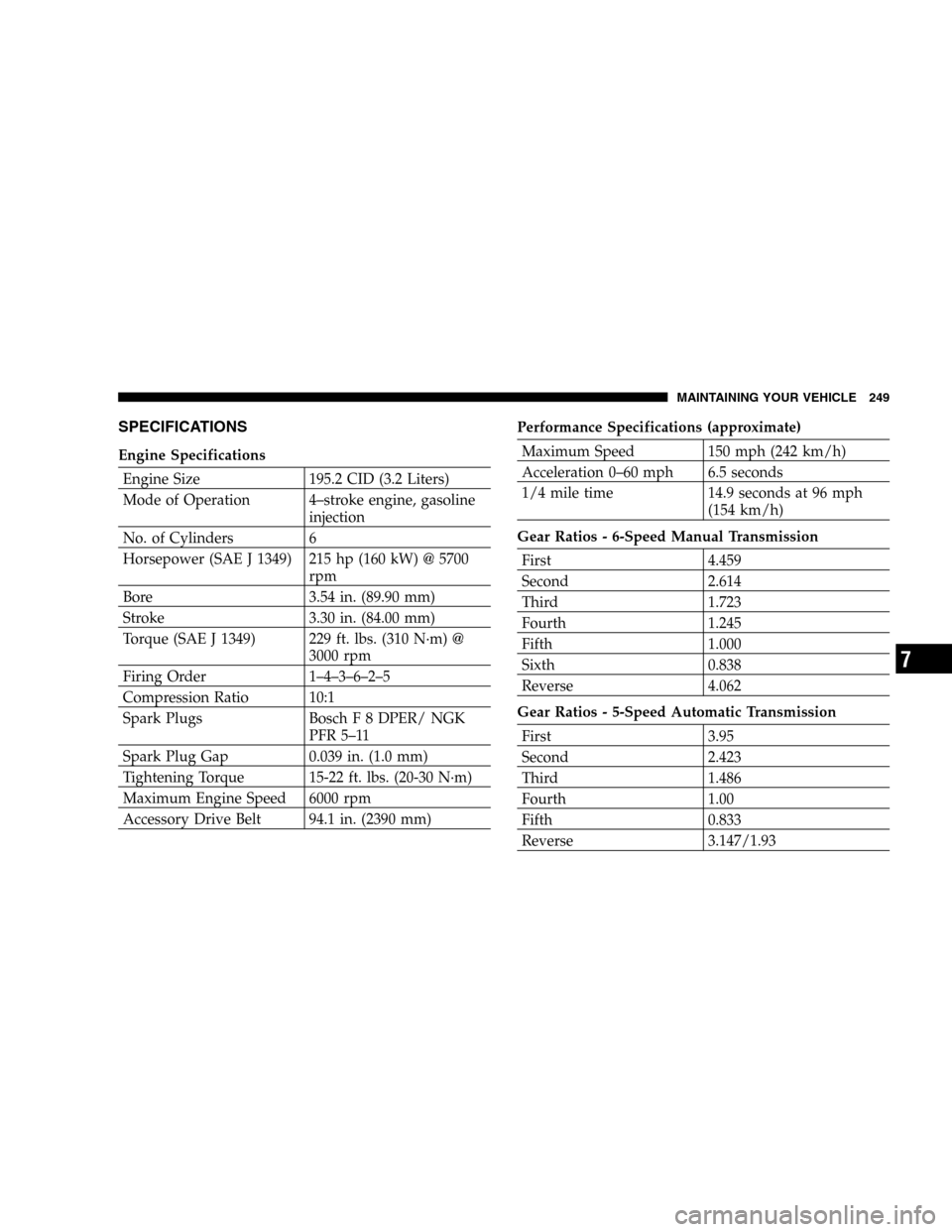
SPECIFICATIONS
Engine Specifications
Engine Size 195.2 CID (3.2 Liters)
Mode of Operation 4–stroke engine, gasoline
injection
No. of Cylinders 6
Horsepower (SAE J 1349) 215 hp (160 kW) @ 5700
rpm
Bore 3.54 in. (89.90 mm)
Stroke 3.30 in. (84.00 mm)
Torque (SAE J 1349) 229 ft. lbs. (310 N·m) @
3000 rpm
Firing Order 1–4–3–6–2–5
Compression Ratio 10:1
Spark Plugs Bosch F 8 DPER/ NGK
PFR 5–11
Spark Plug Gap 0.039 in. (1.0 mm)
Tightening Torque 15-22 ft. lbs. (20-30 N·m)
Maximum Engine Speed 6000 rpm
Accessory Drive Belt 94.1 in. (2390 mm)Performance Specifications (approximate)
Maximum Speed 150 mph (242 km/h)
Acceleration 0–60 mph 6.5 seconds
1/4 mile time 14.9 seconds at 96 mph
(154 km/h)
Gear Ratios - 6-Speed Manual Transmission
First 4.459
Second 2.614
Third 1.723
Fourth 1.245
Fifth 1.000
Sixth 0.838
Reverse 4.062
Gear Ratios - 5-Speed Automatic Transmission
First 3.95
Second 2.423
Third 1.486
Fourth 1.00
Fifth 0.833
Reverse 3.147/1.93
MAINTAINING YOUR VEHICLE 249
7
Page 259 of 296

SCOPE OF WORK FOR “B” SCHEDULE
MAINTENANCE SERVICE
Oil Change
•Change oil and replace filter
Maintenance
•Rotate tires
•Replace dust filter (if equipped)
•Lubricate hood hinges, latch, and secondary latch
•Reset FSS Display
Function Check
•Horn, hazard warning flashers, turn signals, and indi-
cator lamps
•Headlamps and exterior lighting
•Windshield wipers and washer system
•Check seat belts for damage and proper function
•Test hydraulic brakes and check parking brake func-
tionInspection
•Check front and rear brake pads for lining thickness
•Check condition of front and rear brake discs
•Check tires for damage and general condition
•Check tire inflation pressures and correct if necessary
•Check major underbody components for leakage or
damage (if there are signs of leakage, determine cause
and repair)
•Check condition of front axle ball joints and rubber
boots
•Check condition of steering components and rubber
boots
•Check underhood components for leakage or damage
(if there are signs of leakage determine cause and
repair)
•Check condition of accessory drive belt
•Check headlamp aiming, adjust if necessary
•Check windshield wiper blades, replace if necessary
MAINTENANCE SCHEDULES 259
8
M
A
I
N
T
E
N
A
N
C
E
S
C
H
E
D
U
L
E
S
Page 282 of 296

ABS (Anti-Lock Brake) System............. 111
Adding Engine Coolant (Antifreeze)......... 223
Adding Fuel.......................... 173
Aiming Headlights...................... 246
Air Cleaner, Engine (Engine Air Cleaner Filter) . 213
Air Conditioning....................128,216
Air Conditioning Filter................... 264
Air Conditioning Refrigerant.............. 216
Air Conditioning System................. 216
Air Pressure, Tires...................... 160
Airbag................................ 29
Airbag Deployment...................... 33
Airbag Light........................32,116
Airbag Maintenance...................... 39
Airbag On/Off Switch..................37,41
Alignment and Balance.................. 165
Antenna.............................. 127
Antifreeze (Engine Coolant)............... 251
Anti-Lock Warning Light................. 111
Appearance Care....................... 230
Ashtrays and Lighter..................... 64
Automatic Door Locks.................... 13
Automatic Transmission...............141,228Fluid and Filter Changes................ 228
Fluid Level Check..................... 228
Fluid Type.......................... 228
Special Additives..................... 229
Autostick............................. 145
Ball Joints............................ 218
Battery............................ 112,215
Saving Feature (Protection)............... 75
Belts, Drive........................... 213
Belts, Seat............................. 22
Body Mechanism Lubrication.............. 218
Brake Assist System...................... 89
Brake, Parking......................... 148
Brake System.......................150,225
Anti-Lock........................... 150
Hoses.............................. 226
Master Cylinder...................... 227
Break-In Recommendations, New Vehicle . . . 47,158
Bulbs, Light........................... 243
Capacities, Fluid....................... 249
Capacity, Cargo Weight.................. 175
282 INDEX
Page 284 of 296

Disposal
Engine Oil.......................... 212
Door Locks, Automatic................... 13
Drive Belts............................ 213
Drive Shaft Universal Joints............... 218
Driving
On Slippery Surfaces.................. 189
Electronic Speed Control.................. 94
Electronic Stability Program................ 91
Emergency, In Case of
Hazard Warning Flasher................ 178
Jump Starting........................ 187
Overheating......................... 178
Towing............................. 191
Emergency Trunk Release................. 19
Emission Control System Maintenance....207,257
Engine
Break-In Recommendations............... 47
Checking Oil Level.................... 209
Compartment........................ 205
Oil .............................209,251
Oil Change Interval................... 211Oil Selection......................... 212
Exhaust Gas Caution..................... 47
Exhaust System........................ 221
Exterior Lights......................... 243
Filters
Air Cleaner.......................... 213
Air Conditioning..................... 264
Engine Fuel......................... 213
Engine Oil.......................... 212
Fluid Capacities.....................249,251
Fluid Leaks............................ 48
Fluid Level Checks
Manual Transmission.................. 229
Fluids, Lubricants and Genuine Parts........ 252
Four-Way Hazard Flasher................. 178
Freeing A Stuck Vehicle.................. 190
Fuel................................. 171
Adding............................. 173
Additives........................... 172
Filler Cap........................... 173
Filter.............................. 213
Octane Rating........................ 171
284 INDEX