battery CHRYSLER CROSSFIRE 2007 1.G User Guide
[x] Cancel search | Manufacturer: CHRYSLER, Model Year: 2007, Model line: CROSSFIRE, Model: CHRYSLER CROSSFIRE 2007 1.GPages: 299, PDF Size: 8.26 MB
Page 105 of 299
Using Speed Control On Hills
Your vehicle is equipped with interactive speed control.
This feature activates when driving up or down hills with
the speed control engaged and the driver's foot off the
accelerator.
WARNING!
Speed control can be dangerous where the system
can't maintain a constant speed. Your vehicle could
go too fast for the conditions, and you could lose
control. An accident could be the result. Don't use
speed control in heavy traffic or on roads that are
winding, icy, snow-covered, or slippery.
For vehicles with automatic transmission:
On a downgrade or an upgrade, downshifting will occur
automatically to allow the engine's braking power to
maintain the set speed. When more level roadway is
reached, the transmission will automatically upshift to
fifth gear.For vehicles with manual transmission:
The set speed control is switched off when declutching
exceeds four seconds during downshifting. In some
cases, you may have to step on the brake pedal to slow
down sufficiently to achieve the desired speed.
NOTE:On very steep hills, a greater speed loss or gain
may occur. It may be preferable to drive without speed
control.
GARAGE DOOR OPENER (If Equipped)
The HomeLinktUniversal Transceiver replaces up to
three remote controls (hand-held transmitters) that oper-
ate devices such as garage door openers, motorized
gates, or home lighting. The transceiver triggers these
devices at the push of a button. The transceiver operates
off your vehicle's battery and charging system: no bat-
teries are needed.
For additional information on HomeLinkt, call 1±800±
355±3515, or on the internet at www.homelink.com.
UNDERSTANDING THE FEATURES OF YOUR VEHICLE 105
3
Page 106 of 299
WARNING!
A moving garage door can cause injury to people and
pets in the path of the door. People or pets could be
seriously or fatally injured. Only use this transceiver
with a garage door opener that has a ªstop and
reverseº feature, as required by federal safety stan-
dards. This includes most garage door opener models
manufactured after 1982. Do not use a garage door
opener without these safety features, as it could
cause injury or death. Call toll-free 1±800±355±3515
or, on the internet at www.homelink.com for safety
information and assistance.
Programming The Universal Transceiver
For best results, install a new battery in the hand-held
transmitter before programming. If your garage door
opener (located in the garage) is equipped with an
antenna, make sure that the antenna is hanging straight
down.
1. Turn off the engine.
WARNING!
Vehicle exhaust contains carbon monoxide, a danger-
ous gas. Do not run the vehicle's engine while
programming the transceiver. Exhaust gas can cause
serious injury or death.
WARNING!
Your motorized door or gate will open and close
while you are programming the universal trans-
ceiver. Do not program the transceiver if people or
pets are in the path of the door or gate. A moving
door or gate can cause serious injury or death to
people and pets or damage to objects.
2. Turn the ignition to the ON/RUN position.
106 UNDERSTANDING THE FEATURES OF YOUR VEHICLE
Page 122 of 299

or while driving when reaching the service warning
threshold. It can be canceled manually by pressing the
knob/button.
Once the suggested term has passed, the message plus
either the symbol for Service A or the symbol for
Service B preceded by a ± (minus symbol) blinks for
approximately 30 seconds and a signal sounds every
time when turning the key to the ON/RUN position.
The FSS display can also be called up for approxi-
mately 10 seconds with the display illuminated by
pressing the knob/button twice within one second.
Following a completed A or B service your authorized
dealer sets the counter to 7,000 miles (Canada: 11,000
km).
NOTE:When disconnecting vehicle battery for one or
more days at a time, such days will not be counted. Any
such days not counted by FSS can be added by your
authorized dealer.
The interval between services is determined by the type
of vehicle operation. Driving at extreme speeds, and coldstarts combined with short distance driving in which the
engine does not reach normal operating temperature,
reduce the interval between services.
However you choose to set your reference numbers, the
scheduled services as posted in the Service Booklet must
be followed to properly care for your vehicle.
23. Outside Temperature Display
The temperature display is located on the left side of the
instrument cluster, below the fuel and engine tempera-
ture gauges.
The sensor for the outside temperature indicator is
located in the front fascia area. Due to its location, the
sensor can be affected by road or engine heat during
idling or slow driving. This means that the accuracy of
the displayed temperature can only be verified by com-
parison to a thermometer placed next to the sensor, not
by comparison to external displays (e.g., bank signs, etc.).
Adaptation to ambient temperature takes place in steps
and depends on the prevailing driving conditions (stop-
and- go or moderate, constant driving) and amount of
temperature change.
122 UNDERSTANDING YOUR INSTRUMENT PANEL
Page 139 of 299

Climate Control - OFF
To switch the climate control off, set the air volume
control switch to position 0. The fresh air supply to the
vehicle interior is shut off. While driving, use this setting
only temporarily, otherwise the windshield could fog up.
Rear Window Defroster
Turn the key in the ignition switch to the
ON/RUN position. To select, press the rear
window defroster button once and release. The
indicator light in the switch should illuminate.
To cancel, press the rear window defroster button again
and release.
NOTE:Heavy accumulation of snow and ice should be
removed before activating the defroster. The rear win-
dow defroster uses a large amount of power. To keep the
battery drain to a minimum, turn off the defroster as soon
as the window is clear. The defroster is automatically
turned off after a maximum of 12 minutes of operation.
If several components in the vehicle are consuming
power simultaneously, or the battery is only partially
charged, it is possible that the defroster will automati-
cally turn itself off. When this happens, the indicator lightinside the switch starts blinking. As soon as the battery
has sufficient voltage, the defroster automatically turns
itself back on.
CAUTION!
To avoid damaging the electrical conductors, do not
use scrapers, sharp instruments, or abrasive window
cleaners on the interior surface of the rear window.
Labels can be peeled off by soaking with warm
water.
Air Recirculation/REST
This mode can be selected to temporarily re-
duce the entry of annoying odors or dust into
the vehicle's interior. Outside air does not flow
into the vehicle's interior. To select, press the
recirculation button. To cancel, press the recirculation
button again.
The system will automatically switch from recirculated
air to fresh air after approximately five minutes at
outside temperatures below approximately 40ÉF (5ÉC);
UNDERSTANDING YOUR INSTRUMENT PANEL 139
4
Page 140 of 299

after approximately 30 minutes, at outside temperatures
above approximately 40ÉF (5ÉC); after approximately five
minutes, if the A/C button is pressed.
At high outside temperatures, the system automatically
engages the recirculated air mode for approximately 30
minutes, thereby increasing the cooling capacity perfor-
mance. Press the recirculation button again to extend the
recirculated air mode.
Residual Engine Heat Utilization (REST)
With the engine switched off, it is possible to
continue heating the interior for a short while.
Air volume is controlled automatically. Select a
temperature for each side of the passenger
compartment. Set the air distribution control switch to
the desired position.
To select, turn the key in the ignition switch to the ACC
or the OFF/LOCK position or remove. Press the recircu-
lation button. The indicator light in the button illumi-
nates. This function selection will not activate if the
battery charge level is insufficient.To cancel, press the recirculation button. The indicator
light in the button goes out. The system will automati-
cally shut off if you turn the key in the ignition switch to
the ON/RUN position, after approximately 30 minutes,
or if the battery voltage drops.
NOTE:This vehicle is equipped with an air conditioner
system that uses R-134a (HFC: hydrofluorocarbon) as a
refrigerant. Repairs should always be performed by a
qualified technician, and refrigerant should be collected
in a recovery system for recycling.
Dust Filter (If Equipped)
Nearly all dust particles and pollen are filtered out before
outside air enters the passenger compartment through
the air distribution system.
NOTE:Keep the air intake grille in front of windshield
free of snow and debris.
140 UNDERSTANDING YOUR INSTRUMENT PANEL
Page 146 of 299
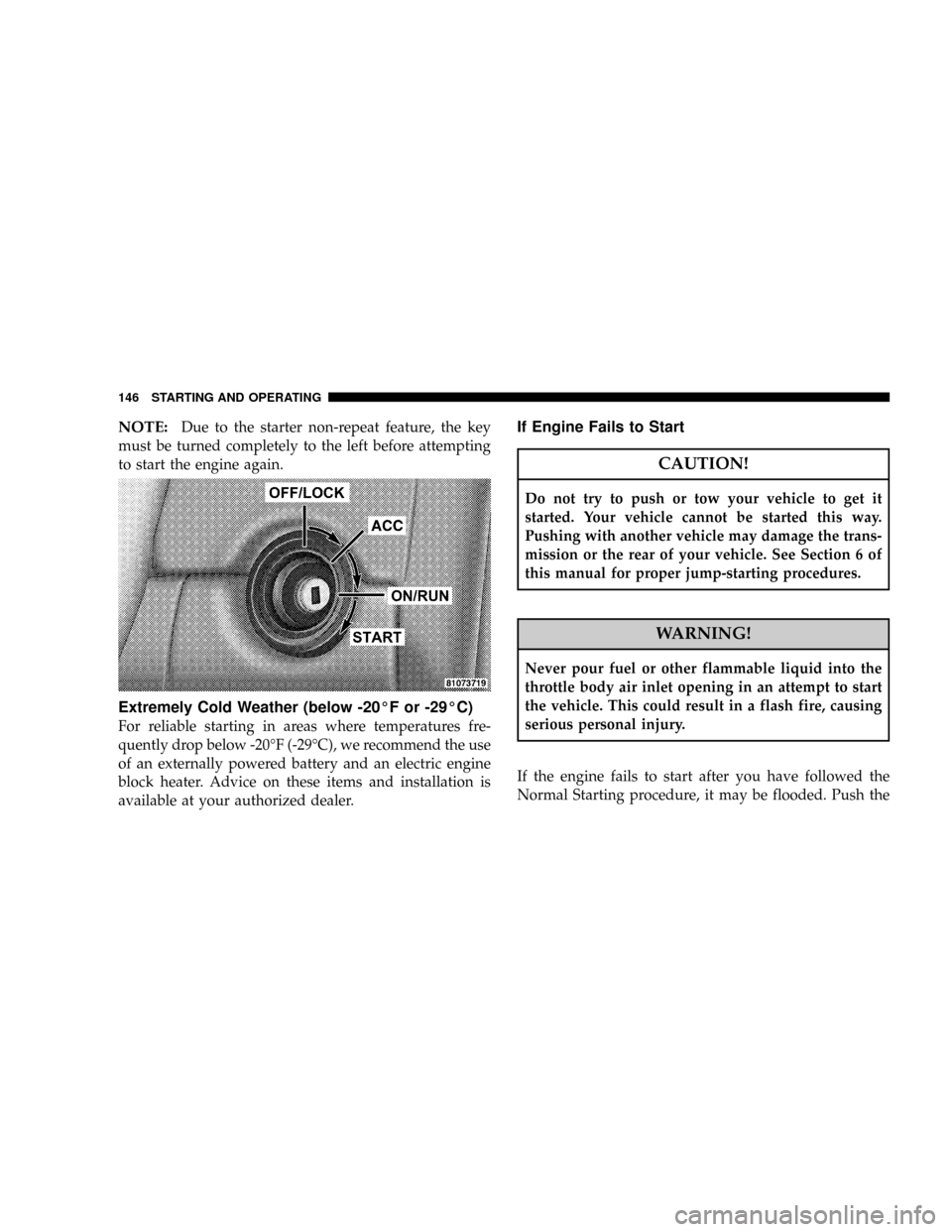
NOTE:Due to the starter non-repeat feature, the key
must be turned completely to the left before attempting
to start the engine again.
Extremely Cold Weather (below -20ÉF or -29ÉC)
For reliable starting in areas where temperatures fre-
quently drop below -20ÉF (-29ÉC), we recommend the use
of an externally powered battery and an electric engine
block heater. Advice on these items and installation is
available at your authorized dealer.
If Engine Fails to Start
CAUTION!
Do not try to push or tow your vehicle to get it
started. Your vehicle cannot be started this way.
Pushing with another vehicle may damage the trans-
mission or the rear of your vehicle. See Section 6 of
this manual for proper jump-starting procedures.
WARNING!
Never pour fuel or other flammable liquid into the
throttle body air inlet opening in an attempt to start
the vehicle. This could result in a flash fire, causing
serious personal injury.
If the engine fails to start after you have followed the
Normal Starting procedure, it may be flooded. Push the
146 STARTING AND OPERATING
Page 161 of 299

Synchronizing ESP
If the power supply was interrupted (battery discon-
nected or discharged), the BAS/ESP malfunction indica-
tor light may be illuminated with the engine running. To
re-synchronize the ESP, and cancel the malfunction indi-
cator light, the steering angle sensor will need to be
recalibrated.
1. Turn the ignition switch to the ON/RUN position.
2. Rotate the steering wheel to the center position.
3. Rotate the steering wheel completely to the left, and
then rotate the steering wheel completely to the right.
4. Bring the steering wheel back to the center position.
5. The BAS/ESP malfunction indicator light will go out.
If the BAS/ESP malfunction indicator light is still illumi-
nated, the vehicle should be serviced at an authorized
dealer.
ESP Control switch
The ESP control switch is located in the center console.
When the ESP is switched off, the warning light in the
instrument cluster comes on. When the ESP is switched
on, the warning light goes out.
To improve the vehicle's traction when driving with
snow chains, or starting off in deep snow, sand, or gravel,
switch off the ESP by pressing the upper half of the ESP
switch. The ESP warning light will then be continuously
STARTING AND OPERATING 161
5
Page 193 of 299

WHAT TO DO IN EMERGENCIES
CONTENTS
mHazard Warning Flasher.................194
mIf Your Engine Overheats................194
mTIREFIT Tire Repair And Jacking..........195
NTIREFIT............................195
NPreparations For Jacking................198
NJack Location And Instructions............200
mJump-Starting The Battery...............203
mDriving On Slippery Surfaces.............205NTraction............................205
mFreeing A Stuck Vehicle.................206
mTowing A Disabled Vehicle...............206
NTowing Eyes.........................208
NTow-Away Alarm.....................210
mConvertible Top Emergency Operation......211
NRelieving Hydraulic Pressure.............212
NOpening a Locked Decklid...............217
6
Page 194 of 299

HAZARD WARNING FLASHER
The flasher switch is located in the console. Push in
the flasher switch and all front and rear directional
signals will flash. Press the flasher switch a second
time to turn the flashers off.
Do not use this emergency warning system when the
vehicle is in motion. Use it when your vehicle is disabled
and is creating a safety hazard for other motorists.
If it is necessary to leave the vehicle to go for service, the
flasher system will continue to operate with the ignition
key removed and the vehicle locked.
NOTE:With extended use, the flasher may run down
your battery.
IF YOUR ENGINE OVERHEATS
During severe operating conditions and stop-and-go city
traffic, the coolant temperature may rise close to the red
area on the gauge.
The engine should not be operated with the coolant
temperature in the red area. Doing so may cause serious
damage which is not covered by the DaimlerChrysler
Limited Warranty.
In any of the following situations, you can reduce the
potential for overheating by taking the appropriate ac-
tion.
²On the highways ±Slow down and use the highest
gear possible.
²In city traffic ±While stopped, put the transmission in
Neutral, but do not increase engine idle speed.
²In city traffic ±While moving, shift into the highest
gear possible to reduce engine RPM.
194 WHAT TO DO IN EMERGENCIES
Page 203 of 299

JUMP-STARTING THE BATTERY
WARNING!
Take care to avoid the radiator cooling fan whenever
the hood is raised. It can start any time the ignition
switch is on. You can be hurt by the fan.
CAUTION!
Do not try to push or tow your vehicle to get it
started. Your vehicle cannot be started this way.
Pushing with another vehicle may damage the trans-
mission or the rear of your vehicle. If your vehicle
has a discharged (dead) battery, booster cables may
be used to obtain a start from another vehicle. This
type of start can be dangerous if done improperly, so
follow the procedure carefully.
WARNING!
Battery fluid is a corrosive acid solution; do not allow
battery fluid to contact eyes, skin or clothing. Don't
lean over battery when attaching clamps or allow the
clamps to touch each other. If acid splashes in eyes or
on skin, flush contaminated area immediately with
large quantities of water.
A battery generates hydrogen gas that is flammable
and explosive. Keep flame or spark away from the
vent holes. Do not use a booster battery or any other
booster source with an output that exceeds 12 volts.
WHAT TO DO IN EMERGENCIES 203
6