engine oil CHRYSLER CROSSFIRE 2007 1.G User Guide
[x] Cancel search | Manufacturer: CHRYSLER, Model Year: 2007, Model line: CROSSFIRE, Model: CHRYSLER CROSSFIRE 2007 1.GPages: 299, PDF Size: 8.26 MB
Page 243 of 299
NOTE:Inspection of brake hoses should be done
whenever the brake system is serviced and at every
engine oil change.
WARNING!
Worn brake hoses can burst and cause brake failure.
You could have an accident. If you see any signs of
cracking, scuffing, or worn spots, have the brake
hoses replaced immediately.
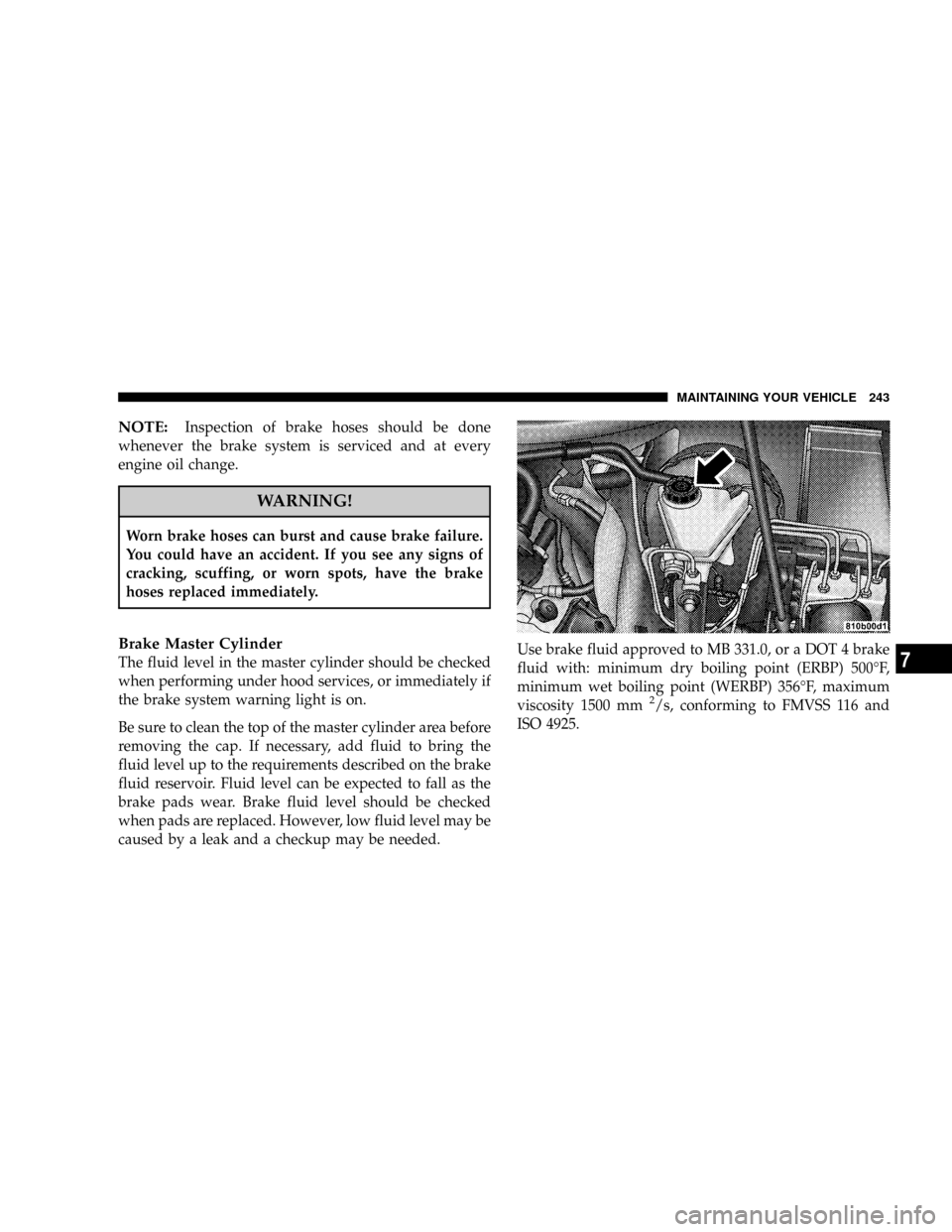
Brake Master Cylinder
The fluid level in the master cylinder should be checked
when performing under hood services, or immediately if
the brake system warning light is on.
Be sure to clean the top of the master cylinder area before
removing the cap. If necessary, add fluid to bring the
fluid level up to the requirements described on the brake
fluid reservoir. Fluid level can be expected to fall as the
brake pads wear. Brake fluid level should be checked
when pads are replaced. However, low fluid level may be
caused by a leak and a checkup may be needed.Use brake fluid approved to MB 331.0, or a DOT 4 brake
fluid with: minimum dry boiling point (ERBP) 500ÉF,
minimum wet boiling point (WERBP) 356ÉF, maximum
viscosity 1500 mm
2/s, conforming to FMVSS 116 and
ISO 4925.
MAINTAINING YOUR VEHICLE 243
7
Page 245 of 299
CAUTION!
Using a transmission fluid other than the fluid rec-
ommended by DaimlerChrysler Corporation may
cause deterioration in transmission shift quality
and/or torque converter shudder. Using a transmis-
sion fluid other than that recommended by the
DaimlerChrysler Corporation will result in more
frequent fluid and filter changes. Refer to the Rec-
ommended Fluids, Lubricants and Genuine Parts
section for correct fluid type.
Fluid Level Check
Regular automatic transmission fluid level checks and
changes are not required. For this reason the dipstick is
omitted.
If you notice fluid loss or gear shift malfunction, have
your authorized dealer check the transmission fluid level.
Fluid and Filter Changes
Automatic transmission fluid and filter should be
changed at 80,000 miles (129,000 km). The fluid is then
filled for life.
NOTE:Refer to Section 8 of this manual for Mainte-
nance Schedules.
Manual Transmission
Selection of Lubricant
No fluid service is required. Use only fluid approved to
MB 236.2. SAE 5W-20 engine oil, meeting API SL or GF-3,
may be substituted. Refer to the Recommended Fluids,
Lubricants and Genuine Parts section for the correct fluid
type.
Fluid Level Check
Check the fluid level by removing the fill plug. The fluid
level should be between the bottom of the fill hole and a
point not more than 3/16 inch (4.76 mm) below the
bottom of the hole.
MAINTAINING YOUR VEHICLE 245
7
Page 263 of 299
the vehicle and then readjust the headlights to the
original position. If any further adjustments are neces-
sary contact your manufacturer's dealer. A detailed ser-
vice procedure is contained in the manufacturer's Service
Manual. Information on purchasing a Service Manual can
be found at the back of this Owner's Manual.
VEHICLE STORAGE
We recommend that you follow these guidelines before
storing your Crossfire for extended periods.
²Fill the gas tank. This will prevent water condensation
inside the tank. If you plan on storing your vehicle
more than two months, add an anti-oxidant fuel
stabilizer to the gas tank.
²Change the oil to remove any corrosive combustion-
related acids in the crankcase.
²Wash and wax the vehicle to protect the finish.
²Cover the vehicle whenever possible to prevent acci-
dental damage to the finish.
²Store the vehicle in a dry, well-ventilated location.
²If the vehicle will be subjected to freezing tempera-
tures, remove the battery and store it in a dry, well-
ventilated place. If the vehicle is not going to be driven
in the next three weeks, follow the battery recharge
procedure in the Service Manual, then disconnect the
battery at the negative terminal.
CAUTION!
Use care when disconnecting the remote positive
cable. It is connected to the battery and can short out
to any metal on the vehicle. Always tape or wrap the
exposed cable end to prevent electrical shorts.
Disconnecting the battery causes the engine control sys-
tem to lose memory of some ªlearnedº functions. The
engine may run rough when first started after a battery
disconnect until the control module ªrelearnsº these
functions.
Check the battery every four to six weeks to ensure that
the voltage is above 12.40. Voltage will drop more rapidly
MAINTAINING YOUR VEHICLE 263
7
Page 267 of 299
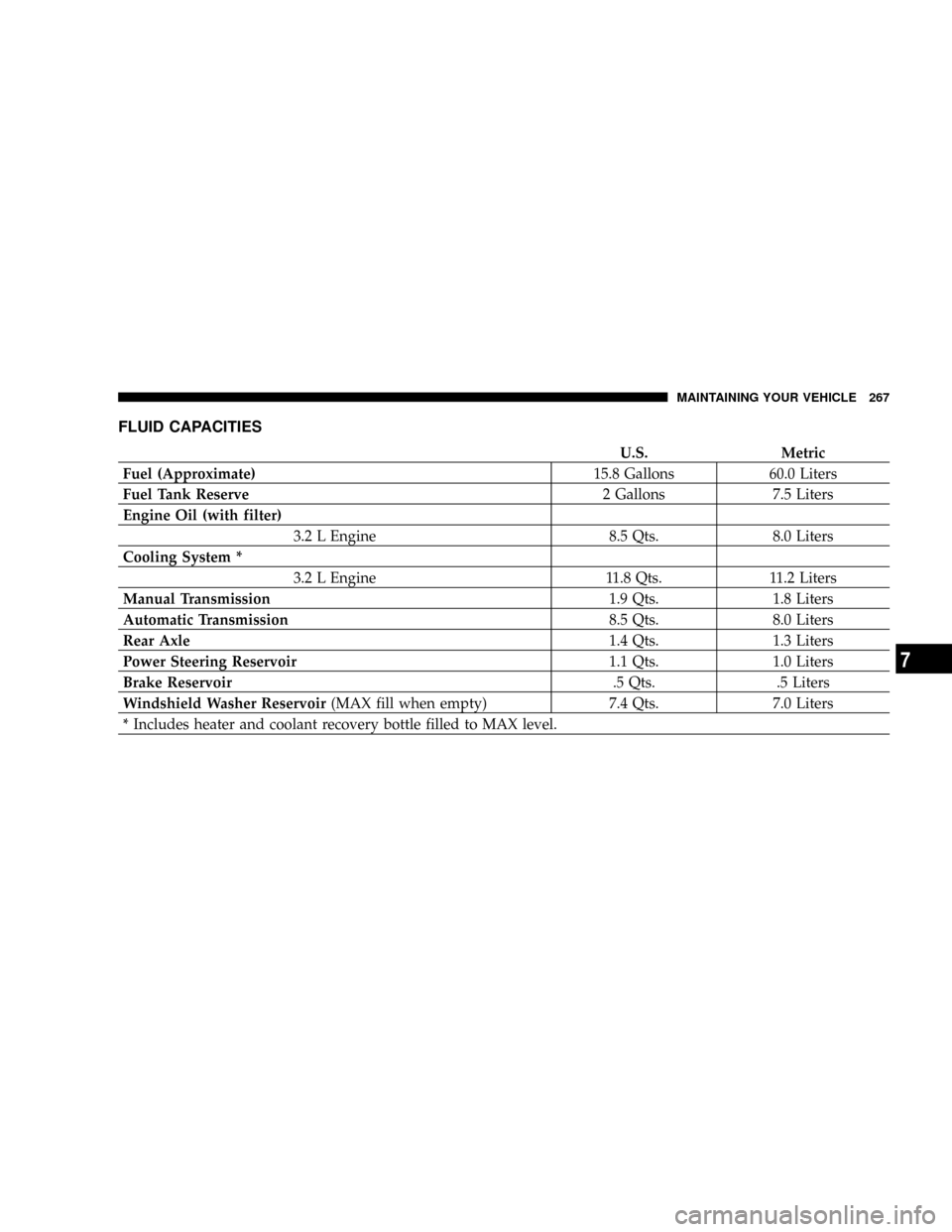
FLUID CAPACITIES
U.S. Metric
Fuel (Approximate)15.8 Gallons 60.0 Liters
Fuel Tank Reserve2 Gallons 7.5 Liters
Engine Oil (with filter)
3.2 L Engine 8.5 Qts. 8.0 Liters
Cooling System *
3.2 L Engine 11.8 Qts. 11.2 Liters
Manual Transmission1.9 Qts. 1.8 Liters
Automatic Transmission8.5 Qts. 8.0 Liters
Rear Axle1.4 Qts. 1.3 Liters
Power Steering Reservoir1.1 Qts. 1.0 Liters
Brake Reservoir.5 Qts. .5 Liters
Windshield Washer Reservoir(MAX fill when empty) 7.4 Qts. 7.0 Liters
* Includes heater and coolant recovery bottle filled to MAX level.
MAINTAINING YOUR VEHICLE 267
7
Page 268 of 299
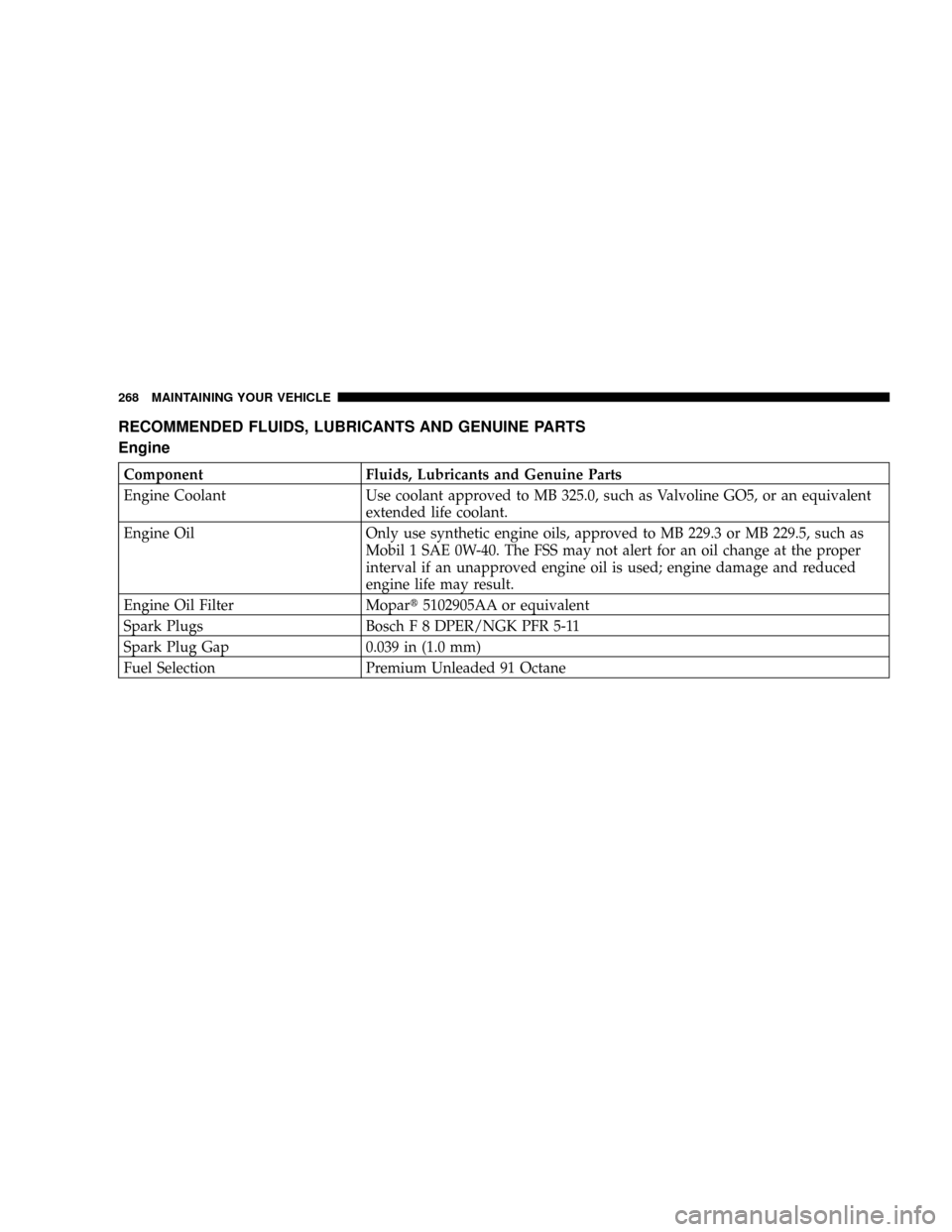
RECOMMENDED FLUIDS, LUBRICANTS AND GENUINE PARTS
Engine
Component Fluids, Lubricants and Genuine Parts
Engine Coolant Use coolant approved to MB 325.0, such as Valvoline GO5, or an equivalent
extended life coolant.
Engine Oil Only use synthetic engine oils, approved to MB 229.3 or MB 229.5, such as
Mobil 1 SAE 0W-40. The FSS may not alert for an oil change at the proper
interval if an unapproved engine oil is used; engine damage and reduced
engine life may result.
Engine Oil Filter Mopart5102905AA or equivalent
Spark Plugs Bosch F 8 DPER/NGK PFR 5-11
Spark Plug Gap 0.039 in (1.0 mm)
Fuel Selection Premium Unleaded 91 Octane
268 MAINTAINING YOUR VEHICLE
Page 269 of 299
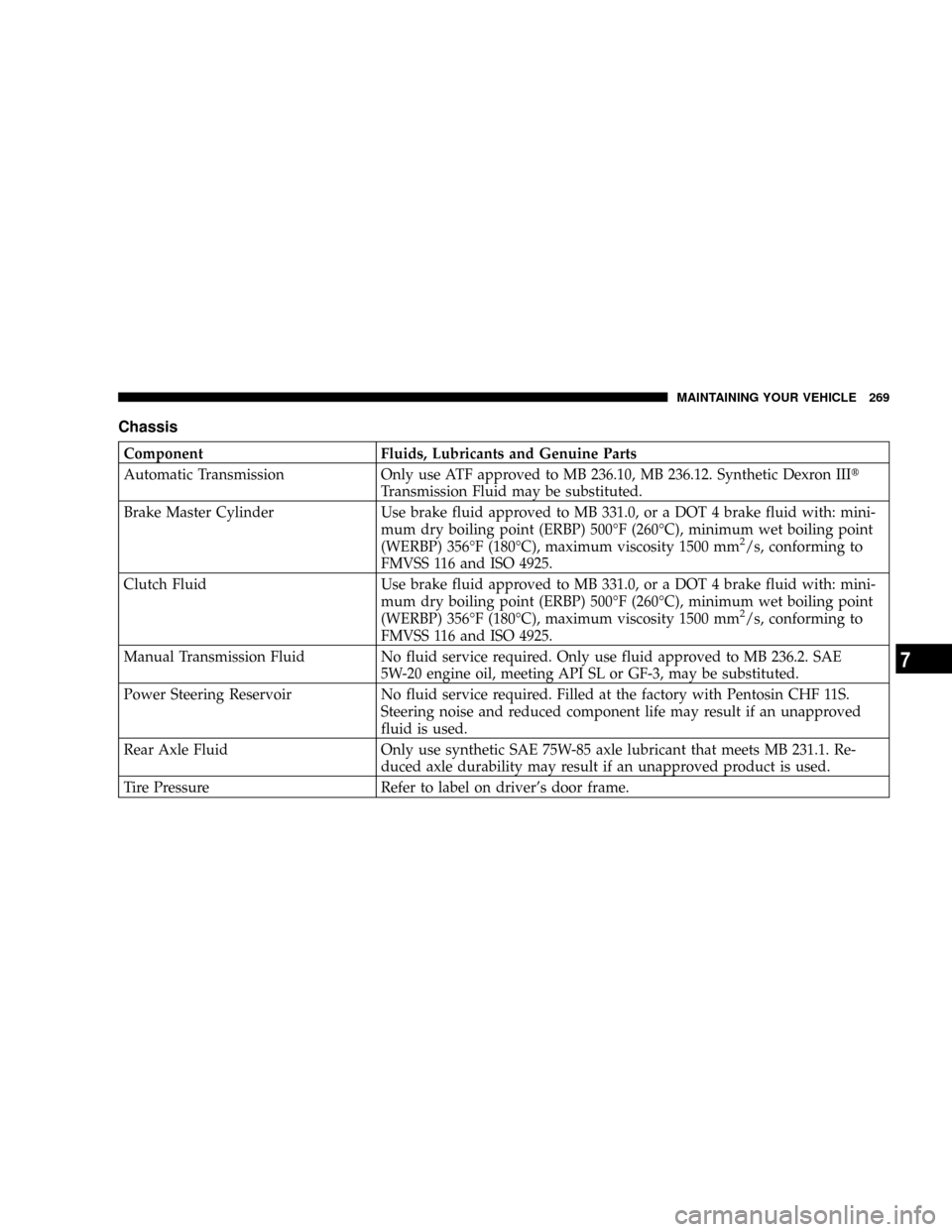
Chassis
Component Fluids, Lubricants and Genuine Parts
Automatic Transmission Only use ATF approved to MB 236.10, MB 236.12. Synthetic Dexron IIIt
Transmission Fluid may be substituted.
Brake Master Cylinder Use brake fluid approved to MB 331.0, or a DOT 4 brake fluid with: mini-
mum dry boiling point (ERBP) 500ÉF (260ÉC), minimum wet boiling point
(WERBP) 356ÉF (180ÉC), maximum viscosity 1500 mm
2/s, conforming to
FMVSS 116 and ISO 4925.
Clutch Fluid Use brake fluid approved to MB 331.0, or a DOT 4 brake fluid with: mini-
mum dry boiling point (ERBP) 500ÉF (260ÉC), minimum wet boiling point
(WERBP) 356ÉF (180ÉC), maximum viscosity 1500 mm
2/s, conforming to
FMVSS 116 and ISO 4925.
Manual Transmission Fluid No fluid service required. Only use fluid approved to MB 236.2. SAE
5W-20 engine oil, meeting API SL or GF-3, may be substituted.
Power Steering Reservoir No fluid service required. Filled at the factory with Pentosin CHF 11S.
Steering noise and reduced component life may result if an unapproved
fluid is used.
Rear Axle Fluid Only use synthetic SAE 75W-85 axle lubricant that meets MB 231.1. Re-
duced axle durability may result if an unapproved product is used.
Tire Pressure Refer to label on driver's door frame.
MAINTAINING YOUR VEHICLE 269
7
Page 271 of 299
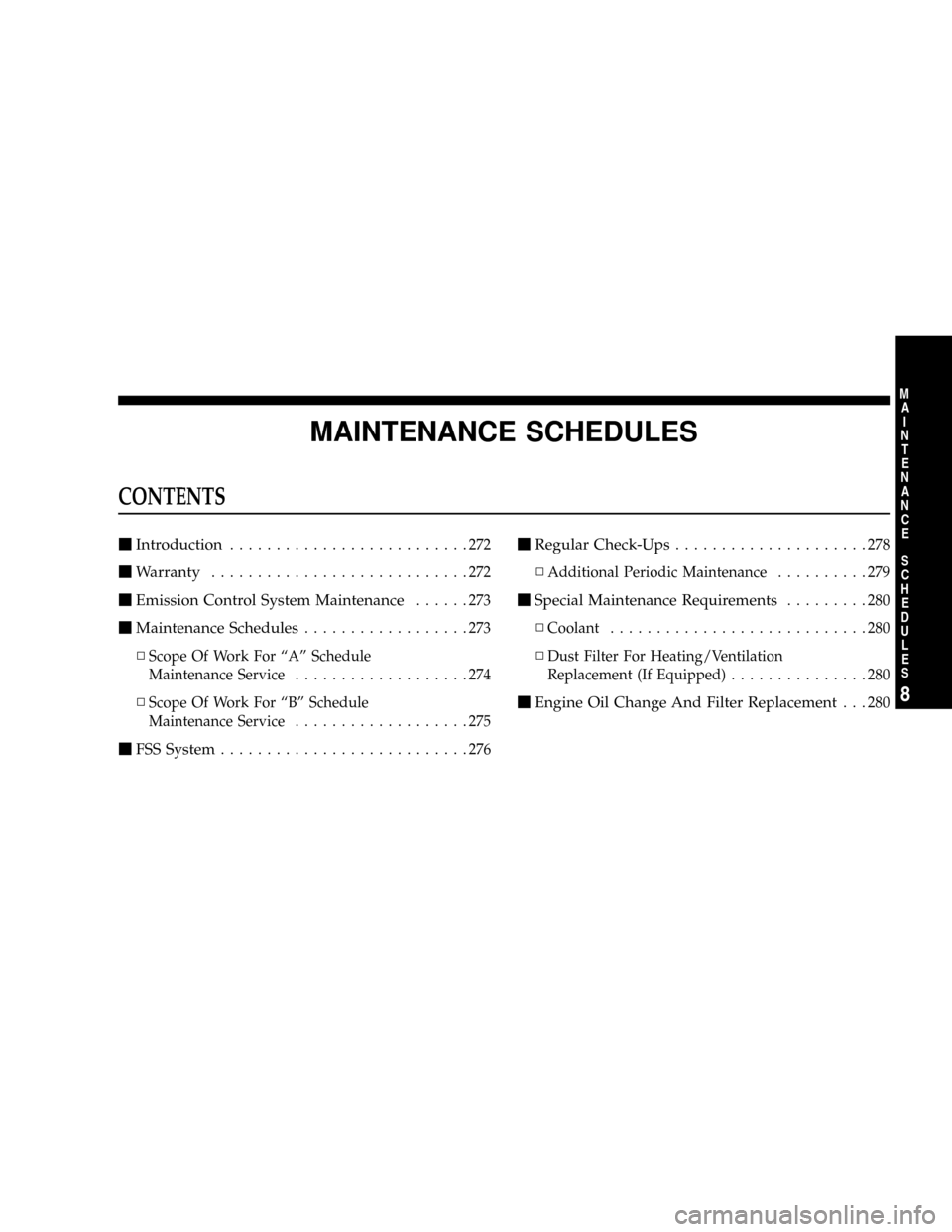
MAINTENANCE SCHEDULES
CONTENTS
mIntroduction..........................272
mWarranty............................272
mEmission Control System Maintenance......273
mMaintenance Schedules..................273
NScope Of Work For ªAº Schedule
Maintenance Service...................274
NScope Of Work For ªBº Schedule
Maintenance Service...................275
mFSS System...........................276
mRegular Check-Ups.....................278
NAdditional Periodic Maintenance..........279
mSpecial Maintenance Requirements.........280
NCoolant............................280
NDust Filter For Heating/Ventilation
Replacement (If Equipped)...............280
mEngine Oil Change And Filter Replacement...2808
M
A
I
N
T
E
N
A
N
C
E
S
C
H
E
D
U
L
E
S
Page 274 of 299
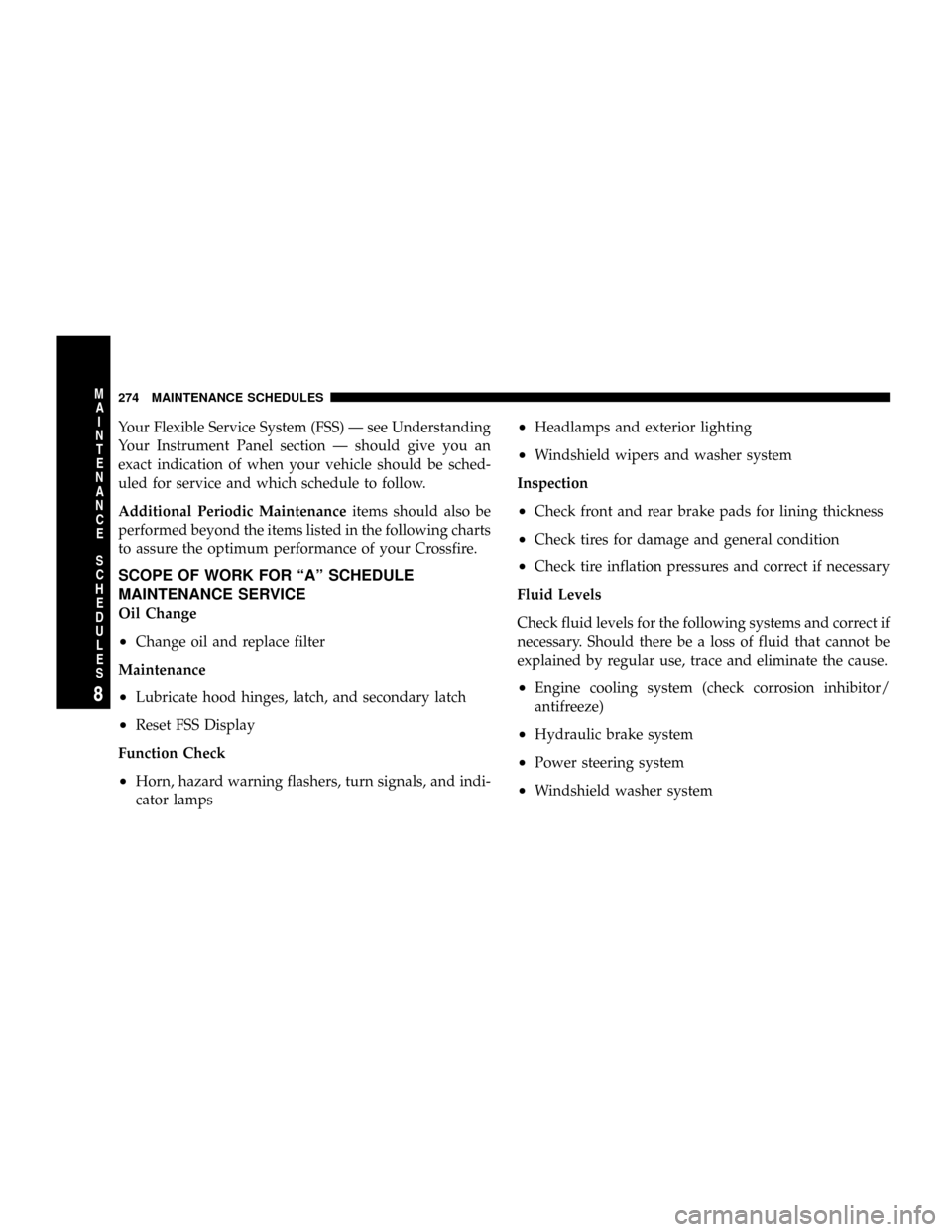
Your Flexible Service System (FSS) Ð see Understanding
Your Instrument Panel section Ð should give you an
exact indication of when your vehicle should be sched-
uled for service and which schedule to follow.
Additional Periodic Maintenanceitems should also be
performed beyond the items listed in the following charts
to assure the optimum performance of your Crossfire.
SCOPE OF WORK FOR ªAº SCHEDULE
MAINTENANCE SERVICE
Oil Change
²Change oil and replace filter
Maintenance
²Lubricate hood hinges, latch, and secondary latch
²Reset FSS Display
Function Check
²Horn, hazard warning flashers, turn signals, and indi-
cator lamps
²Headlamps and exterior lighting
²Windshield wipers and washer system
Inspection
²Check front and rear brake pads for lining thickness
²Check tires for damage and general condition
²Check tire inflation pressures and correct if necessary
Fluid Levels
Check fluid levels for the following systems and correct if
necessary. Should there be a loss of fluid that cannot be
explained by regular use, trace and eliminate the cause.
²Engine cooling system (check corrosion inhibitor/
antifreeze)
²Hydraulic brake system
²Power steering system
²Windshield washer system
274 MAINTENANCE SCHEDULES
8
M
A
I
N
T
E
N
A
N
C
E
S
C
H
E
D
U
L
E
S
Page 276 of 299
Fluid Levels
Check fluid levels for the following systems and correct if
necessary. Should there be a loss of fluid that cannot be
explained by regular use, trace and eliminate the cause.
²Engine cooling system (check corrosion inhibitor/
antifreeze)
²Hydraulic brake system
²Power steering system
²Windshield washer system
FSS SYSTEM
The Flexible Service System (FSS) permits a flexible
service schedule that is directly related to the operating
conditions of the vehicle. See the Understanding Your
Instrument Panel section for details on how to use the
FSS.
The oil change interval for your Crossfire is initially set at
7,000 miles (Canada: 11,000 km). Very light duty driving
cycles (most trips more than 10 miles [16 km] at moderate
speeds in moderate temperature conditions) can extendthe service interval beyond 7,000 miles (Canada: 11,000
km). IfANYof the following apply to your driving, the
oil change interval can be reduced significantly:
þDay or night temperatures are below 32ÉF (0ÉC).
þStop and go driving.
þExtensive engine idling.
þDriving in dusty conditions.
þShort trips of less than 10 miles (16 km).
þMore than 50% of your driving is at sustained high
speeds during hot weather, above 90ÉF (32ÉC).
There are two symbols which will appear in the main
odometer display field prior to the next suggested ser-
vice.
This symbol represents Service A.
276 MAINTENANCE SCHEDULES
8
M
A
I
N
T
E
N
A
N
C
E
S
C
H
E
D
U
L
E
S
Page 278 of 299
REGULAR CHECK-UPS
To maintain the safe operation of your vehicle, it is
recommended that you perform the following tasks on a
regular basis (i.e., weekly or whenever the vehicle is
refueled).
CAUTION!
Failure to perform the required maintenance items
may result in damage to the vehicle.
At Each Stop for Fuel
²
Check the engine oil level about 5 minutes after a fully
warmed engine is shut off. Checking the oil level while
the vehicle is on level ground will improve the accu-
racy of the oil level reading. See the procedure de-
scribed in Checking Your Engine Oil in the Under-
standing Your Instrument Panel section or under
Engine Oil in the Maintaining Your Vehicle section.
Add oil only when the level is at or below the ADD or
MIN mark.
²Check the windshield washer solvent and add if
required.
²Inspect wiper blade condition.
²Check operation of lighting systems.
²Inspect tires for unusual wear, damage, and pressure
(at least every 14 days).
²Mechanical assemblies (e.g., engine, transmission, etc.)
- check for leaks.
Once a Month
²
Inspect the battery and clean and tighten the terminals
as required.
²Check the fluid levels of coolant reservoir, brake
master cylinder and power steering and add as
needed.
²Check all lights and all other electrical items for correct
operation.
278 MAINTENANCE SCHEDULES
8
M
A
I
N
T
E
N
A
N
C
E
S
C
H
E
D
U
L
E
S