instrument panel CHRYSLER CROSSFIRE 2007 1.G User Guide
[x] Cancel search | Manufacturer: CHRYSLER, Model Year: 2007, Model line: CROSSFIRE, Model: CHRYSLER CROSSFIRE 2007 1.GPages: 299, PDF Size: 8.26 MB
Page 60 of 299

NHeated Seats (If Equipped)...............83
mTo Open And Close The Hood.............84
mInterior Lights.........................85
NFront Map/Reading Lights...............85
NBattery Saver Feature...................85
NInstrument Panel Lighting................86
NNight Security Illumination...............86
mExterior Lights.........................86
NHeadlights And Parking Lights............86
NDaytime Running Lights (Where Applicable) . . .87
NFog Lights (If Equipped).................87
NStanding Lights.......................87
mMultifunction Control Lever...............88
NTurn Signals..........................88
NHeadlight Dimmer Switch................89
NPassing Light.........................90NWindshield Wipers And Washer............90
NMist Function.........................91
mTelescoping Steering Column..............92
mTire Pressure Monitor System (If Equipped)...93
mRear Spoiler...........................96
mBrake Assist System (BAS)................98
mElectronic Stability Program (ESP)...........99
NSynchronizing ESP....................101
mElectronic Speed Control.................102
NTo Vary The Speed Setting...............103
NTo Deactivate........................104
NTo Resume Speed.....................104
NUsing Speed Control On Hills............105
mGarage Door Opener (If Equipped).........105
NProgramming The Universal Transceiver.....106
NGate Operator/Canadian Programming.....108
60 UNDERSTANDING THE FEATURES OF YOUR VEHICLE
Page 75 of 299

Coin Holder
With the ashtray open, folding down the cover plate
reveals the coin holder, which can accommodate nine
coins in various sizes up to a U.S. quarter. The coin slots
are shaped to retain the coins, and the cover plate ensures
that the coins remain in the coin holder.
Power Outlet/Cigar Lighter
The dual-purpose power outlet is located in the console,
next to the passenger airbag off warning light. The power
outlet can accommodate a lighter or electrical accessoriesup to a maximum of 15 amps. The outlet is protected by
a 15 amp fuse, located behind the fuse cover on the left
end of the instrument panel.
The lighter will operate only when the ignition switch is
in the ON/ACC position. It heats up when pushed in and
pops out automatically when ready for use. To preserve
the heating element, do not hold the lighter in the heating
position.
UNDERSTANDING THE FEATURES OF YOUR VEHICLE 75
3
Page 83 of 299

Passenger Four-Way Power Seat (If Equipped)
The switches to adjust the passenger seat are also on the
outboard side of the seat. The passenger seat provides
four-way adjustment - horizontal and back angle.
Heated Seats (If Equipped)
This feature heats the driver and passenger seats. The
controls for the heated seats are located on the instrument
panel, below the radio.After turning the ignition switch ON, you can choose the
HI, LO, or OFF setting. Indicators on the switches show
which setting has been selected.
The heated seats setting will automatically switch from
HI to LO after approximately 5 minutes.
UNDERSTANDING THE FEATURES OF YOUR VEHICLE 83
3
Page 84 of 299
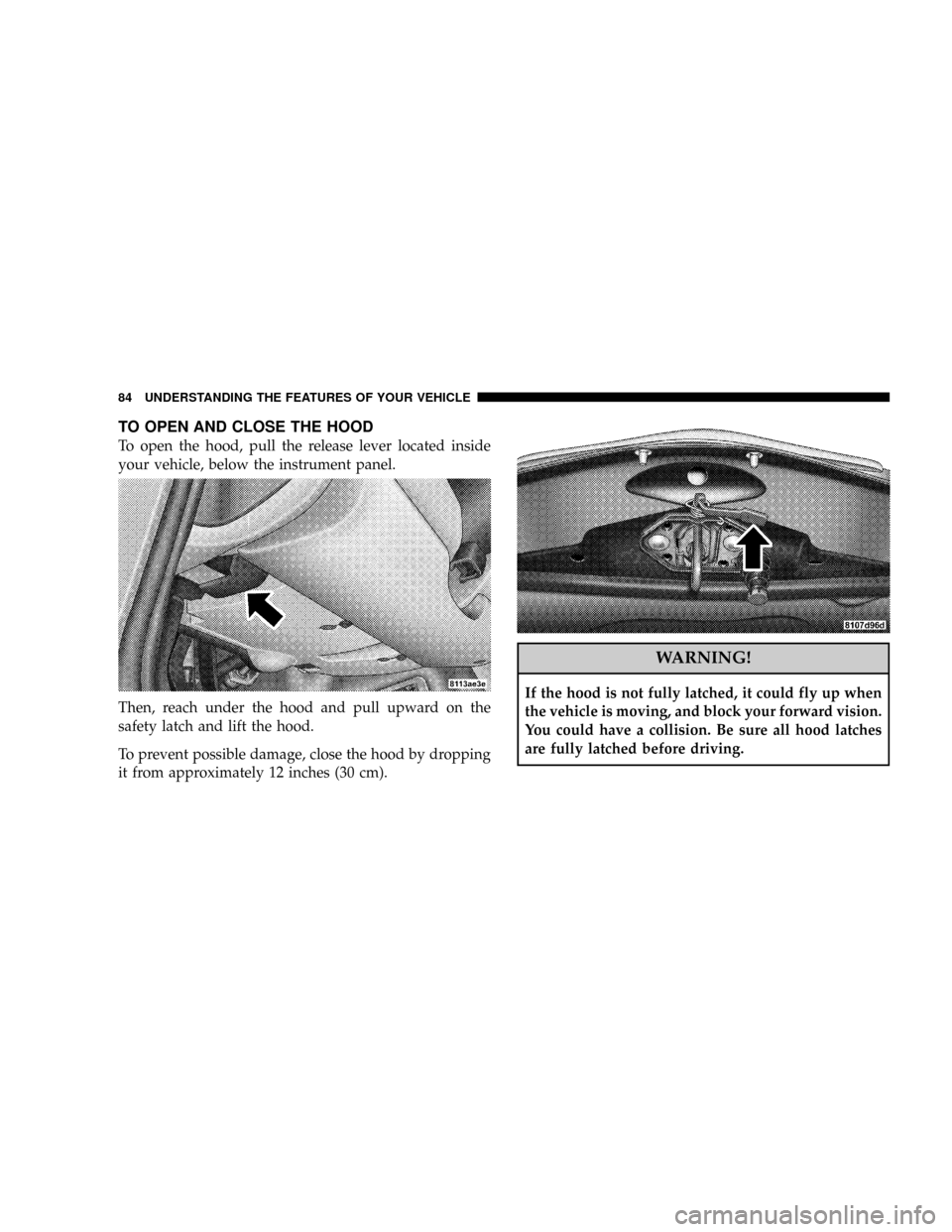
TO OPEN AND CLOSE THE HOOD
To open the hood, pull the release lever located inside
your vehicle, below the instrument panel.
Then, reach under the hood and pull upward on the
safety latch and lift the hood.
To prevent possible damage, close the hood by dropping
it from approximately 12 inches (30 cm).
WARNING!
If the hood is not fully latched, it could fly up when
the vehicle is moving, and block your forward vision.
You could have a collision. Be sure all hood latches
are fully latched before driving.
84 UNDERSTANDING THE FEATURES OF YOUR VEHICLE
Page 86 of 299

Instrument Panel Lighting
With the parking lights or headlights on, rotate the
dimmer control to the left of the speedometer to increase
or decrease brightness of the instrument panel.
Night Security Illumination
For added security when exiting the vehicle after driving
with the exterior lights on, the lights will switch on again
for approximately 30 seconds after closing the last door.
The lights-on timing can be changed at your authorized
dealer.
EXTERIOR LIGHTS
Headlights and Parking Lights
When the headlight switch is turned clockwise from OFF
to the first position, the parking lights, taillights, side
marker lights, license plate lights and instrument panel
lights are all illuminated.
The headlights turn on when the switch is turned to the
second position.
86 UNDERSTANDING THE FEATURES OF YOUR VEHICLE
Page 111 of 299

UNDERSTANDING YOUR INSTRUMENT PANEL
CONTENTS
mInstruments And Controls................112
mInstrument Cluster.....................113
mInstrument Cluster Description............114
mªInfinity Modulusº AM/FM Stereo Radio With
Single-Disc CD Player And GPS Navigation
. . 126
mAM/FM Stereo Radio With Single-Disc
CD Player
...........................126
NInfinity Modulus Entertainment Systems.....126
NCD Player Operation...................130
NUser Menu..........................132
NUser Memory (User ± 1, 2, 3).............132
NMono/Stereo........................133NDriver ± L/R........................133
NTelephone Mute Characteristics...........133
mCompact Disc Maintenance...............134
mRadio Antenna........................134
mRadio Operation And Cellular Phones.......135
mClimate Controls......................135
NTemperature Control...................136
NFan Control.........................136
NBasic Setting - Heater..................136
NBasic Setting - Air Conditioner............137
NDust Filter (If Equipped)................140
NOperating Tips.......................141
4
Page 112 of 299

INSTRUMENTS AND CONTROLS
112 UNDERSTANDING YOUR INSTRUMENT PANEL
Page 113 of 299

INSTRUMENT CLUSTER
The instrument cluster displays are activated by either
opening the door, pressing the left button within thecluster, or turning the key in the ignition switch to the
ON/RUN position.
UNDERSTANDING YOUR INSTRUMENT PANEL 113
4
Page 114 of 299
INSTRUMENT CLUSTER DESCRIPTION
1. Low Windshield Washer System Fluid Level
Warning Light
With the key in the ignition switch turned to
the ON/RUN position, the indicator light
comes on. It should go out when the engine
is running.
If the indicator light does not go out after starting the
engine, or if it comes on while driving, the fluid reservoir
is less than
1¤4filled.
The reservoir should be refilled at the next opportunity
with commercially available premixed windshield
washer solvent/antifreeze or water, depending on ambi-
ent temperature.
The reservoir for the windshield washer system is located
in the engine compartment and the cap is marked with
the above symbol.
WARNING!
Do not overfill the washer reservoir. Do not attempt
to fill to the top of the filler neck. Fluid may leak out
onto the floor or driveway causing a potential slip
and fall hazard. When the indicator light first illumi-
nates, the maximum fill amount is 1 Gallon (4 Liters).
2. Tire Pressure Monitoring Telltale Lamp
The tire pressure monitor system (TPMS)
uses wireless technology to monitor tire
pressure levels. Sensors, mounted to each
wheel as part of the valve stem, transmit tire
pressure readings to a receiver located in the vehicle.
If the light is illuminated, the pressure in one of the tires
on the vehicle has dropped to at least 25% below the
recommended pressure on the vehicle's tire label. Addi-
tionally, the indicator light will illuminate if a fault has
been detected in the TPMS.
114 UNDERSTANDING YOUR INSTRUMENT PANEL
Page 115 of 299

CAUTION!
The TPMS is designed to monitor your tire pressure
and will not function as a tire pressure gauge. After
adjusting the air pressure in a tire, there will be a
delay before the system updated the display
NOTE:The TPMS can inform you about a low tire
pressure condition, but it does not replace normal tire
maintenance. The TPMS is not intended to provide you
with notification of a rapid pressure loss.
NOTE:The pressure in your tires changes with tem-
perature. A significant decrease in temperature could
reduce cold inflation pressure below the TPMS setpoint.
ALWAYS check pressure in your tires if the TPMS telltale
lamp is illuminated.
3. Coolant Indicator Light
This indicator illuminates when the engine
coolant has dropped below the requiredlevel in the reservoir or the coolant temperature is too
high (see the Temperature gauge section).
To check the coolant level, the vehicle must be parked on
level ground and the engine stopped.
Check coolant level only when the coolant is cold.
WARNING!
You or others can be badly burned by hot coolant or
steam from your radiator. If you see or hear steam
coming from under the hood, don't open the hood
until the radiator has had time to cool. Never try to
open a cooling system pressure cap when the radiator
or coolant bottle is hot.
4. Engine Coolant Temperature Gauge
This gauge shows engine coolant temperature. Any read-
ing between the Hot and Cold gauge marks show that the
engine cooling system is operating properly. The gauge
pointer may show a higher temperature when driving in
hot weather, up mountain grades, or in heavy stop-and-
go-traffic.
UNDERSTANDING YOUR INSTRUMENT PANEL 115
4