maintenance CHRYSLER CROSSFIRE 2007 1.G User Guide
[x] Cancel search | Manufacturer: CHRYSLER, Model Year: 2007, Model line: CROSSFIRE, Model: CHRYSLER CROSSFIRE 2007 1.GPages: 299, PDF Size: 8.26 MB
Page 223 of 299

EMISSIONS INSPECTION AND MAINTENANCE
PROGRAMS
In some localities, it may be a legal requirement to pass
an inspection of your vehicle's emissions control system.
Failure to pass could prevent vehicle registration.
For states which have an I/M (Inspection and
Maintenance) requirement, this check verifies
the following: the CHECK ENGINE Light is functioning
and is not on when the engine is running, and that the
OBD (Onboard Diagnostic) system is ready for testing.
Normally, the OBD system will be ready. The OBD
system maynotbe ready if your vehicle was recently
serviced, if you recently had a dead battery, or a battery
replacement. If the OBD system should be determined
not ready for the I/M test, your vehicle may fail the test.
Your vehicle has a simple ignition key actuated test
which you can use prior to going to the test station. To
check if your vehicle's OBD system is ready, you must do
the following:
1. Insert your ignition key into the ignition switch.2. Turn the ignition to the ON/RUN position, but do not
crank or start the engine.
3. If you crank or start the engine, you will have to start
this test over.
4. As soon as you turn your key to the ON/RUN
position, you will see your CHECK ENGINE light come
on as part of a normal bulb check.
5. Approximately 15 seconds later, one of two things will
happen:
a. The CHECK ENGINE light will flash for about 10
seconds and then return to being fully illuminated
until you turn off the ignition key or start the
engine. This means that your vehicle's OBD system
isnot readyand you shouldnotproceed to the I/M
station.
b. The CHECK ENGINE light will not flash at all
and will remain fully illuminated until you turn off
the ignition key or start the engine. This means that
your vehicle's OBD system isreadyand you can
proceed to the I/M station.
MAINTAINING YOUR VEHICLE 223
7
Page 224 of 299

If your OBD system isnot ready,you should see your
authorized dealer or repair facility. If your vehicle was
recently serviced or had a battery failure or replacement,
you may need to do nothing more than drive your
vehicle as you normally would in order for your OBD
system to update. A recheck with the above test routine
may then indicate that the system is now ready.
Regardless of whether your vehicle's OBD system is
ready or not ready, if the CHECK ENGINE light is
illuminated during normal vehicle operation, you should
have your vehicle serviced before going to the I/M
station. The I/M station can fail your vehicle because the
CHECK ENGINE light is on with the engine running.REPLACEMENT PARTS
Use of genuine Mopartparts for normal/scheduled
maintenance and repairs is highly recommended to in-
sure the designed performance. Damage or failures
caused by the use of non-Mopartparts for maintenance
and repairs will not be covered by the warranty offered
by DaimlerChrysler Corporation.
DEALER SERVICE
Your dealer has the qualified service personnel, special
tools and equipment to perform all service operations in
an expert manner. Service Manuals are available which
include detailed service information for your Crossfire.
Refer to these manuals before attempting any procedure
yourself.
NOTE:Intentional tampering with emissions control
systems can result in civil penalties being assessed
against you.
224 MAINTAINING YOUR VEHICLE
Page 225 of 299
WARNING!
You can be badly injured working on or around a
motor vehicle. Do only that service work for which
you have the knowledge and the proper equipment.
If you have any doubt about your ability to perform
a service job, take your vehicle to a competent
technician.
MAINTENANCE PROCEDURES
The pages that follow contain the maintenance service
recommended by the engineers who designed your ve-
hicle.
Besides the maintenance items for which there are fixed
maintenance intervals, there are other items that should
operate satisfactorily without periodic maintenance.However, if a malfunction of these items does occur, it
could adversely affect the engine or vehicle performance.
These items should be inspected if a malfunction is
observed or suspected.
Engine Oil
Checking Oil Level
To assure proper engine lubrication, the engine oil must
be maintained at the correct level. Check the oil level at
regular intervals, such as every fuel stop.
You can check the oil level using the procedure described
in Checking Engine Oil Level in the Understanding Your
Instrument Panel section, or by checking the engine oil
dipstick.
MAINTAINING YOUR VEHICLE 225
7
Page 227 of 299

Change Engine Oil
The oil change interval for your Crossfire is initially set at
7,000 miles (Canada: 11,000 km).
The Flexible Service System (FSS) in your vehicle evalu-
ates engine temperature, oil level, vehicle speed, engine
speed, distance driven, and the time elapsed since your
last service. It determines when your vehicle needs
maintenance service and alerts you in advance. The next
necessary service is indicated by the FSS in your instru-
ment cluster.
NOTE:Also see the FSS system details in the Under-
standing Your Instrument Panel section of this manual.
Very light duty driving cycles (most trips more than 10
miles [16 km] at moderate speeds in moderate tempera-
ture conditions) can extend the service interval beyond
7,000 miles (Canada: 11,000 km).
IfANYof the following apply to your driving, the oil
change interval can be reduced significantly:
²Day and night temperatures are below 32ÉF (0ÉC)
²Stop-and-go driving
²Extensive engine idling
²Driving in dusty conditions
²Short trips of less than 10 miles (16 km)
²More than 50% of your driving is at sustained high
speeds during hot weather, above 90ÉF (32ÉC)
²Taxi, Police, or delivery service (commercial service)
Observe the oil change interval indicated by your FSS
system. This system will monitor the driving conditions
seen by your vehicle, and will recommend the best
interval for servicing your vehicle to maintain it in top
condition.
CAUTION!
Overfilling or underfilling the crankcase will cause
oil aeration or loss of oil pressure. This could damage
your engine.
MAINTAINING YOUR VEHICLE 227
7
Page 229 of 299
Drive Belts - Check Condition and Tension
At the distance shown in the maintenance schedules,
check all drive belts for condition and proper tension.
Improper belt tension can cause belt slippage and failure.
Inspect the drive belts for evidence of cuts, cracks, or
glazing and replace them if there is any sign of damage
which could result in belt failure. If adjustment is re-
quired, adjust the belts according to the specifications
and procedures shown in the Service Manual.
Special tools are required to properly measure tension
and to restore belt tension to factory specifications. Also,
check belt routing to make sure there is no interference
between the belts and other engine components.
Spark Plugs
Spark plugs must fire properly to assure engine perfor-
mance and emission control. New plugs should be in-
stalled at the distance specified in the appropriate main-
tenance chart. The entire set should be replaced if there is
any malfunction due to a faulty spark plug. Check the
specifications section for the proper type of spark plug
for use in your vehicle.
Engine Air Cleaner Filter
Under normal driving conditions, replace the air filter at
each interval called out by FSS.
WARNING!
The air cleaner can provide a measure of protection
in the case of engine backfire. Do not remove the air
cleaner unless such removal is necessary for repair or
maintenance. Make sure that no one is near the
engine compartment before starting the vehicle with
the air cleaner removed. Failure to do so can result in
serious personal injury.
Engine Fuel Filter
A plugged fuel filter can cause hard starting or limit the
speed at which a vehicle can be driven. Should an
excessive amount of dirt accumulate in the fuel tank,
frequent filter replacement may be necessary. See your
authorized dealer for service.
MAINTAINING YOUR VEHICLE 229
7
Page 230 of 299
Catalytic Converter
The catalytic converter requires the use of unleaded fuel
only. Leaded gasoline will destroy the effectiveness of the
catalyst as an emission control device.
Under normal operating conditions, the catalytic con-
verter will not require maintenance. However, it is im-
portant to keep the engine properly serviced to assure
proper catalyst operation and prevent possible catalyst
damage.
If the CHECK ENGINE light is flashing, immediate
service is required.CAUTION!
Damage to the catalytic converter can result if your
vehicle is not kept in proper operating condition. In
the event of engine malfunction, particularly involv-
ing engine misfire or other apparent loss of perfor-
mance, have your vehicle serviced promptly. Contin-
ued operation of your vehicle with a severe
malfunction could cause the converter to overheat,
resulting in possible damage to the converter and the
vehicle.
WARNING!
A hot exhaust system can start a fire if you park over
materials that can burn. Such materials might be
grass or leaves coming into contact with your exhaust
system. Do not park or operate your vehicle in areas
where your exhaust system can contact anything that
can burn.
230 MAINTAINING YOUR VEHICLE
Page 231 of 299

In unusual situations involving grossly malfunctioning
engine operation, a scorching odor may suggest severe
and abnormal catalyst overheating. If this occurs, stop
the vehicle, turn off the engine and allow it to cool.
Service, including a tune up to DaimlerChrysler Corpo-
ration's specifications, should be obtained immediately.
To minimize the possibility of catalyst damage:
²Do not shut off the engine or interrupt the ignition
when the transmission is in gear and the vehicle is in
motion.
²Do not try to start the engine by pushing or towing the
vehicle.
²Do not idle the engine with any spark plug wires
disconnected for a prolonged period.
Ignition Wiring System
The ignition cables should be kept clean and properly
connected. Terminals should be fully seated. Cracked,
damaged, or faulty cables should be replaced.
Crankcase Emission Control System
Proper operation of this system depends on freedom
from sticking or plugging due to deposits.
Check ventilation hose for indication of damage or
plugging deposits. Replace if necessary.
Maintenance-Free Battery
The top of the maintenance-free battery is permanently
sealed. You will never have to add water, nor is periodic
maintenance required.
MAINTAINING YOUR VEHICLE 231
7
Page 233 of 299
NOTE:If your air conditioning performance seems
lower than expected, check the front of the A/C con-
denser for an accumulation of dirt or insects. Clean with
a gentle water spray from behind the radiator and
through the condenser as required. Fabric front fascia
protectors may reduce air flow to the condenser, reducing
air conditioning performance.
WARNING!
The air conditioning system contains refrigerant un-
der high pressure. To avoid risk of personal injury or
damage to the system, adding refrigerant or any
repair requiring lines to be disconnected should be
done by an experienced repair person.
Refrigerant Recovery And Recycling
The air conditioning system of your vehicle contains
R-134a, a refrigerant that does not deplete the ozone layer
in the upper atmosphere. The DaimlerChrysler Corpora-
tion recommends that air conditioning service be done by
facilities using refrigerant recycling and recovery equip-
ment that meets SAE standard J1991.
Power Steering Fluid
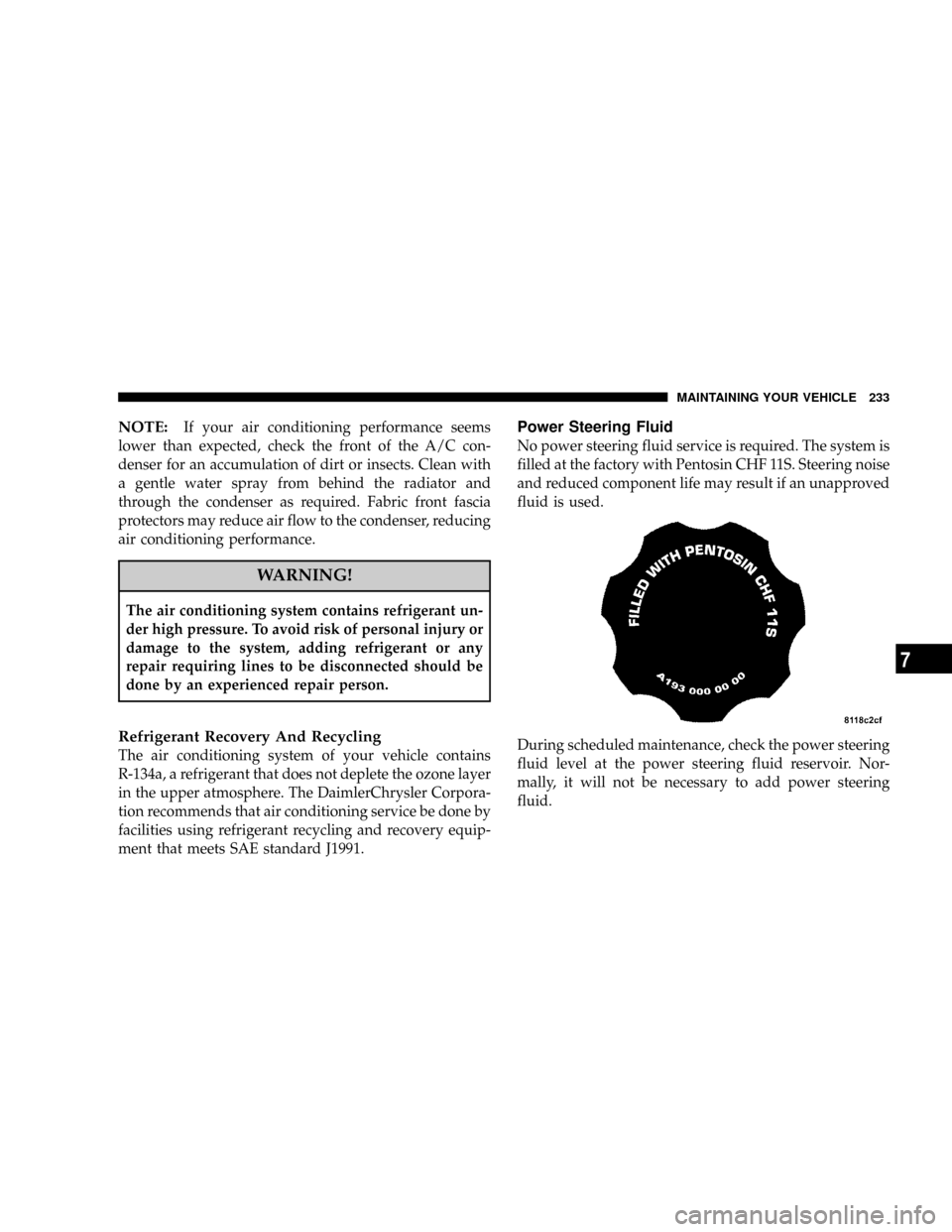
No power steering fluid service is required. The system is
filled at the factory with Pentosin CHF 11S. Steering noise
and reduced component life may result if an unapproved
fluid is used.
During scheduled maintenance, check the power steering
fluid level at the power steering fluid reservoir. Nor-
mally, it will not be necessary to add power steering
fluid.
MAINTAINING YOUR VEHICLE 233
7
Page 234 of 299

Before removing the reservoir cap, wipe the outside of
the cap and reservoir so that no dirt can fall into the
reservoir.
The power steering pump has a dipstick. Fluid level
should be maintained at the proper level indicated on the
dipstick. If the indicated level of power steering fluid is
low, see your authorized dealer. With a clean cloth, wipe
any spilled fluid from all surfaces.Chassis Lubrication
Front Suspension Ball Joints
There are two front suspension lower ball joints that are
permanently lubricated. Inspect these ball joints when-
ever under-vehicle service is done.
Steering Linkage
Inspect tie rod ends whenever the vehicle is serviced.
They are permanently lubricated and do not require
periodic lubrication.
Drive Shaft Universal Joints
Your vehicle has four constant velocity universal joints.
Periodic lubrication of these joints is not required. How-
ever, the joint boots should be inspected for external
leakage or damage when other maintenance is per-
formed.
If leakage or damage is evident, replace the universal
joint boot and grease immediately.
Continued operation could result in failure of the univer-
sal joint due to water and dirt contamination of the
grease. This would require complete replacement of the
joint assembly.
234 MAINTAINING YOUR VEHICLE
Page 238 of 299

Cooling System
WARNING!
²When working near the radiator cooling fan, dis-
connect the fan motor lead or turn the ignition
switch to the OFF position. The fan is temperature
controlled and can start at any time the ignition
key is in the ON position.
²You or others can be badly burned by hot coolant
or steam from your radiator. If you see or hear
steam coming from under the hood, don't open the
hood until the radiator has had time to cool. Never
try to open a cooling system pressure cap when the
radiator is hot.
Coolant Checks
Check coolant protection every 12 months (before the
onset of freezing weather, where applicable). If the cool-
ant is dirty or rusty in appearance, the system should be
drained, flushed and refilled with fresh coolant.Check the front of the radiator and condenser for an
accumulation of bugs, leaves, etc. Clean the radiator and
condenser by gently spraying water from a garden hose
at the back of the radiator core.
Check the recovery bottle tank tubing for condition and
tightness of connection at the bottle and radiator. Inspect
the entire system for leaks.
Cooling System - Drain, Flush and Refill
At the intervals shown on the Maintenance Schedules,
the system should be drained, flushed and refilled.
238 MAINTAINING YOUR VEHICLE