air condition CHRYSLER CROSSFIRE 2007 1.G Owner's Manual
[x] Cancel search | Manufacturer: CHRYSLER, Model Year: 2007, Model line: CROSSFIRE, Model: CHRYSLER CROSSFIRE 2007 1.GPages: 299, PDF Size: 8.26 MB
Page 232 of 299
WARNING!
Battery posts, terminals and related accessories con-
tain lead and lead compounds. Wash hands after
handling.
Battery fluid is a corrosive acid solution and can burn
or even blind you. Don't allow battery fluid to
contact your eyes, skin or clothing. Don't lean over a
battery when attaching clamps. If acid splashes in
eyes or on skin, flush the area immediately with
large amounts of water.
Battery gas is flammable and explosive. Keep flame
or sparks away from the battery. Don't use a booster
battery or any other booster source with an output
greater than 12 volts. Don't allow cable clamps to
touch each other.
CAUTION!
It is essential when replacing the cables on the
battery that the positive cable is attached to the
positive post and the negative cable is attached to the
negative post. Battery posts are marked positive (+)
and negative (-) and identified on the battery case.
Cable clamps should be tight on the terminal posts
and free of corrosion. Apply grease to posts and
clamps after tightening.
If a ªfast chargerº is used while the battery is in the
vehicle, disconnect both vehicle battery cables before
connecting the charger to battery. Do not use a ªfast
chargerº to provide starting voltage as battery dam-
age can result.
Air Conditioner
Check the air conditioning system at the start of the
warm weather season.
232 MAINTAINING YOUR VEHICLE
Page 233 of 299
NOTE:If your air conditioning performance seems
lower than expected, check the front of the A/C con-
denser for an accumulation of dirt or insects. Clean with
a gentle water spray from behind the radiator and
through the condenser as required. Fabric front fascia
protectors may reduce air flow to the condenser, reducing
air conditioning performance.
WARNING!
The air conditioning system contains refrigerant un-
der high pressure. To avoid risk of personal injury or
damage to the system, adding refrigerant or any
repair requiring lines to be disconnected should be
done by an experienced repair person.
Refrigerant Recovery And Recycling
The air conditioning system of your vehicle contains
R-134a, a refrigerant that does not deplete the ozone layer
in the upper atmosphere. The DaimlerChrysler Corpora-
tion recommends that air conditioning service be done by
facilities using refrigerant recycling and recovery equip-
ment that meets SAE standard J1991.
Power Steering Fluid
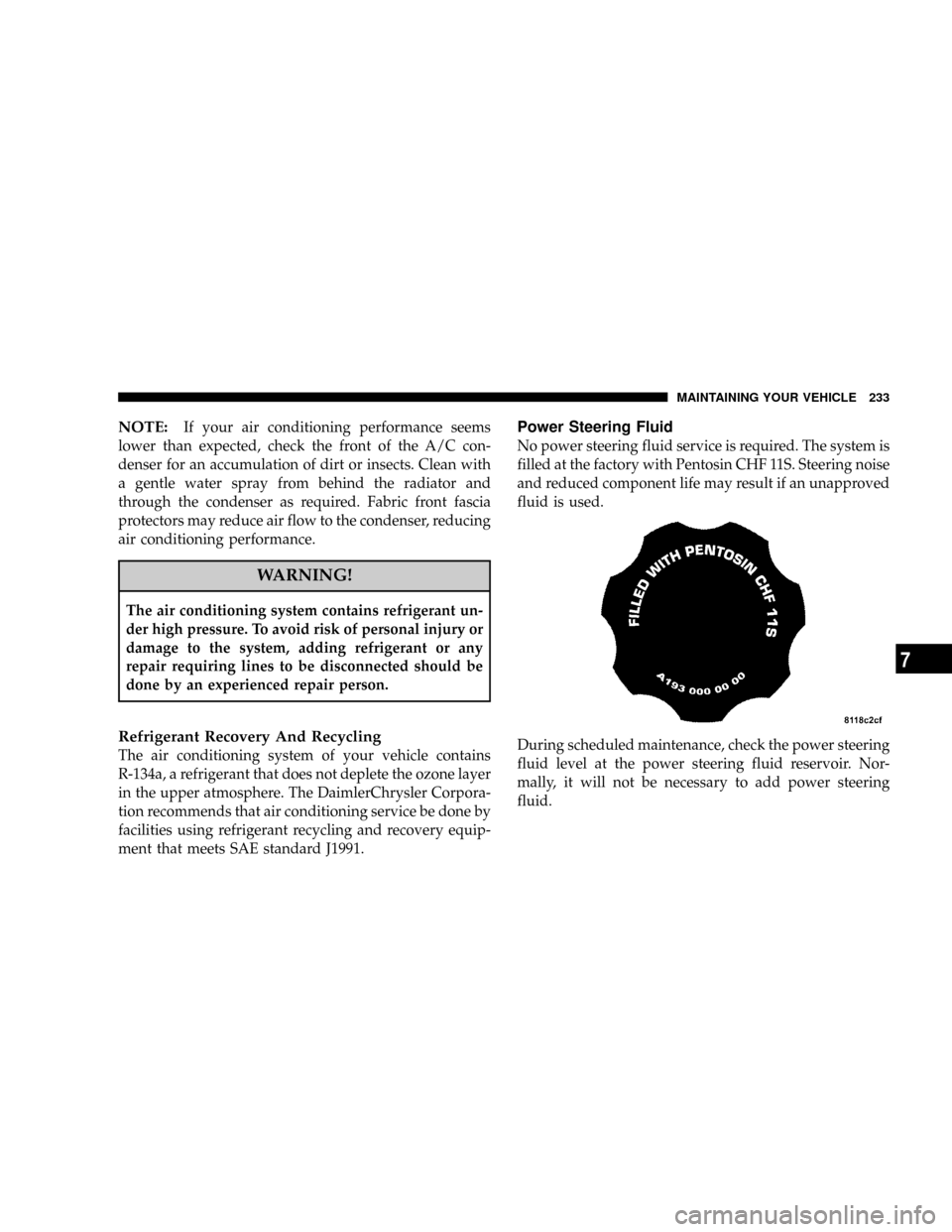
No power steering fluid service is required. The system is
filled at the factory with Pentosin CHF 11S. Steering noise
and reduced component life may result if an unapproved
fluid is used.
During scheduled maintenance, check the power steering
fluid level at the power steering fluid reservoir. Nor-
mally, it will not be necessary to add power steering
fluid.
MAINTAINING YOUR VEHICLE 233
7
Page 241 of 299

Points to Remember
NOTE:
When the vehicle is stopped after a few miles/
kilometers of operation, you may observe vapor coming
from the front of the engine compartment. This is nor-
mally a result of moisture from rain, snow, or high
humidity accumulation on the radiator and being vapor-
ized when the thermostat opens, allowing hot water to
enter the radiator.
If an examination of your engine compartment shows no
evidence of radiator or hose leaks, the vehicle may be
safely driven. The vapor will soon dissipate.
²Do not overfill the coolant bottle.
²Check coolant freeze point in the system.
²If frequent coolant additions are required, or if the
level in the recovery bottle does not drop when the
engine cools, the cooling system should be pressure
tested for leaks.
²Maintain a coolant concentration of a minimum of 50%
ethylene glycol Extended Life Coolant and high qual-
ity water with recommended antifreeze for proper
corrosion protection of your engine cooling system
that contains aluminum components.
²Make sure that the radiator and coolant bottle hoses
are not kinked or obstructed.
²Keep the front of the radiator clean. If your vehicle has
air conditioning, keep the front of the condenser clean,
also.
²Do not change the thermostat for summer or winter
operation. If replacement is ever necessary, install
ONLY the correct type thermostat. Other designs may
result in unsatisfactory coolant performance, poor fuel
economy, and increased emissions.
Hoses And Vacuum/Vapor Harnesses
Inspect surfaces of hoses and nylon tubing for evidence
of heat and mechanical damage. Hard or soft spots,
brittle rubber, cracking, checking, tears, cuts, abrasions,
and excessive swelling indicate deterioration of the rub-
ber.
Pay particular attention to the hoses nearest to high heat
sources such as the exhaust manifold. Inspect hose rout-
ing to be sure hoses do not touch any heat source or
moving component that may cause heat damage or
mechanical wear.
MAINTAINING YOUR VEHICLE 241
7
Page 246 of 299

CAUTION!
Do not overfill. Dirt and water in the transmission
can cause serious damage. To prevent dirt and water
from entering the transmission after checking or
replenishing fluid, make certain that the dipstick cap
is seated properly.
Add fluid, if necessary, to maintain the proper level.
Frequency of Fluid Change
Under normal operation conditions, the fluid installed at
the factory will give satisfactory lubrication for the life of
the vehicle. Fluid changes are not necessary unless the
lubricant has become contaminated with water. If con-
taminated with water, the fluid should be changed im-
mediately.
Special Additives
Do not add any fluid additives to the transmission. The
only exception to this policy is the use of special dyes toaid in detecting fluid leaks. The use of transmission
sealers should be avoided as this may adversely affect
seals.
Appearance Care and Protection from Corrosion
Protection of Body and Paint from Corrosion
Vehicle body protection requirements vary according to
geographic locations and usage. Chemicals that make
roads passable in snow and ice, and those that are
sprayed on trees and road surfaces during other seasons,
are highly corrosive to the metal in your vehicle. Outside
parking, which exposes your vehicle to airborne contami-
nants, road surfaces on which the vehicle is operated,
extreme hot or cold weather and other extreme condi-
tions will have an adverse effect on paint, metal trim, and
underbody protection.
The following maintenance recommendations will enable
you to obtain maximum benefit from the corrosion
resistance built into your vehicle.
What Causes Corrosion?
Corrosion is the result of deterioration or removal of
paint and protective coatings from your vehicle.
246 MAINTAINING YOUR VEHICLE
Page 273 of 299

The use of Special lubricant additives is not recom-
mended. The use of such additives may affect your
warranty rights. With regard to legal stipulations con-
cerning emissions control, please note that engines have
to be serviced and adjusted in accordance with special
instructions and using special measuring equipment.
Modifications to or interference with the emissions con-
trol systems are not permissible.
All DaimlerChrysler Corporation dealers are familiar
with the relevant and applicable regulations.
EMISSION CONTROL SYSTEM MAINTENANCE
The ªScheduledº maintenance services, listed inbold
typemust be done at the times or mileages specified to
assure the continued proper functioning of the emission
control system. These, and all other maintenance services
included in this manual, should be done to provide best
vehicle performance and reliability. More frequent main-
tenance may be needed for your Crossfire in severe
operating conditions such as dusty areas and very short
trip driving.Inspection and service also should be done any time a
malfunction is suspected.
NOTE:Maintenance, replacement, or repair of the
emission control devices and systems on your vehicle
may be performed by any automotive repair establish-
ment or individual using any automotive part which has
been certified pursuant to U.S. EPA or, in the State of
California, California Air Resources Board regulations.
MAINTENANCE SCHEDULES
There are two maintenance schedules that show the
requiredservice for your vehicle.
Schedule ªAº typically rotates with Schedule ªB.º Follow
Schedule ªAº after the first service interval, Schedule ªBº
after the second service interval, and so on. In some cases
where the service interval has been extended due to very
light duty driving, a Schedule ªBº service may be indi-
cated following a previous Schedule ªBº service. There
are additional service tasks required under Schedule ªB.º
MAINTENANCE SCHEDULES 273
8
M
A
I
N
T
E
N
A
N
C
E
S
C
H
E
D
U
L
E
S
Page 275 of 299

SCOPE OF WORK FOR ªBº SCHEDULE
MAINTENANCE SERVICE
Oil Change
²Change oil and replace filter
Maintenance
²Rotate tires
²Replace dust filter (if equipped)
²Lubricate hood hinges, latch, and secondary latch
²Reset FSS Display
Function Check
²Horn, hazard warning flashers, turn signals, and indi-
cator lamps
²Headlamps and exterior lighting
²Windshield wipers and washer system
²Check seat belts for damage and proper function
²Test hydraulic brakes and check parking brake func-
tionInspection
²Check front and rear brake pads for lining thickness
²Check condition of front and rear brake discs
²Check tires for damage and general condition
²Check tire inflation pressures and correct if necessary
²Check major underbody components for leakage or
damage (if there are signs of leakage, determine cause
and repair)
²Check condition of front axle ball joints and rubber
boots
²Check condition of steering components and rubber
boots
²Check underhood components for leakage or damage
(if there are signs of leakage determine cause and
repair)
²Check condition of accessory drive belt
²Check headlamp aiming, adjust if necessary
²Check windshield wiper blades, replace if necessary
MAINTENANCE SCHEDULES 275
8
M
A
I
N
T
E
N
A
N
C
E
S
C
H
E
D
U
L
E
S
Page 279 of 299
Additional Periodic Maintenance
The following maintenance items should be performed
during the scheduled maintenance nearest the time
elapsed and/or distance shown. Follow the interval that
occurs first.
Every 2 years:
²Inspect body for paint damage.
²Check chassis and supporting body parts for damage
and corrosion.
At approximately every 50,000 miles (80,000 km) or 4
years:
²Check condition of driveshaft flex discs.
²Retighten locking bolts for steering (observe torque).
At approximately every 60,000 miles (96,000 km) or 4
years:
²Replace fuel filter.
²Replace air cleaner filter element.
At approximately 80,000 miles (129,000 km):
²Change the automatic transmission fluid and filter.
Use the recommended automatic transmission fluid.
After this change it is filled for life. The manual
transmission comes filled for life from the factory.
At approximately every 100,000 miles (161,000 km) or 5
years:
²Replace spark plugs.
Every 100,000 miles (161,000 km) or 5 years:
²Replace engine coolant using coolant approved to MB
325.0, such as Valvoline GO5, or an equivalent ex-
tended life coolant.
WARNING!
You can be badly injured working on or around a
motor vehicle. Do only that service work for which
you have the knowledge and the right equipment. If
you have any doubt about your ability to perform a
maintenance service, take your vehicle to a compe-
tent technician.
MAINTENANCE SCHEDULES 279
8
M
A
I
N
T
E
N
A
N
C
E
S
C
H
E
D
U
L
E
S
Page 290 of 299

ABS (Anti-Lock Brake System)............. 118
Adding Engine Coolant (Antifreeze)......... 239
Adding Fuel.......................... 189
Aiming Headlights...................... 262
Air Cleaner, Engine
(Engine Air Cleaner Filter)................ 229
Air Conditioning....................135,232
Air Conditioning Filter................... 280
Air Conditioning Refrigerant.............. 233
Air Conditioning System................. 232
Air Pressure, Tires...................... 176
Airbag................................ 30
Airbag Deployment...................... 36
Airbag Light........................35,123
Airbag Maintenance...................... 46
Airbag On/Off Switch..................43,48
Alignment and Balance.................. 181
Antenna.............................. 134
Antifreeze (Engine Coolant)............... 267
Anti-Lock Warning Light................. 118
Appearance Care....................... 246
Ashtrays and Lighter..................... 74
Automatic Door Locks.................... 13Automatic Transmission...............149,244
Fluid and Filter Changes................ 245
Fluid Level Check..................... 245
Fluid Type.......................... 244
Special Additives..................... 246
Autostick............................. 152
Ball Joints............................ 234
Battery............................ 119,231
Saving Feature (Protection)............... 85
Belts, Drive........................... 229
Belts, Seat............................. 23
Body Mechanism Lubrication.............. 235
Brake Assist System...................... 98
Brake, Parking......................... 156
Brake System.......................157,242
Anti-Lock (ABS)...................... 157
Hoses.............................. 242
Master Cylinder...................... 243
Break-In Recommendations, New Vehicle . . . 55,166
Bulbs, Light........................... 259
Capacities, Fluid....................... 265
290 INDEX
Page 292 of 299

Defroster, Windshield..................... 56
Disposal
Engine Oil.......................... 228
Door Locks, Automatic................... 13
Drive Belts............................ 229
Drive Shaft Universal Joints............... 234
Driving
On Slippery Surfaces.................. 205
Electronic Speed Control (Cruise Control)..... 102
Electronic Stability Program (ESP)........... 99
Emergency, In Case of
Hazard Warning Flasher................ 194
Jump Starting........................ 203
Overheating......................... 194
Towing............................. 206
Emergency Trunk Release................. 20
Emission Control System Maintenance....223,273
Engine
Break-In Recommendations............... 55
Checking Oil Level.................... 225
Compartment........................ 221
Oil .............................225,267Oil Change Interval................... 227
Oil Selection......................... 228
Exhaust Gas Caution..................... 55
Exhaust System........................ 237
Exterior Lights......................... 259
Filters
Air Cleaner.......................... 229
Air Conditioning..................... 280
Engine Fuel......................... 229
Engine Oil.......................... 228
Fluid Capacities.....................265,267
Fluid Leaks............................ 57
Fluid Level Checks
Manual Transmission.................. 245
Fluids, Lubricants and Genuine Parts........ 268
Four-Way Hazard Flasher................. 194
Freeing A Stuck Vehicle.................. 206
Fuel................................. 186
Adding............................. 189
Additives........................... 188
Filler Cap (Gas Cap)................... 189
Filter.............................. 229
292 INDEX
Page 299 of 299
INTRODUCTION INTRODUCTION HOW TO USE THIS MANUAL WARNINGS AND CAUTIONS VEHICLE IDENTIFICATION NUMBER THINGS TO KNOW BEFORE STARTING YOUR VEHICLE A WORD ABOUT YOUR KEYS KeysObtaining Replacement KeysIgnition
Key RemovalKey-In-Ignition ReminderGLOVE COMPARTMENT LOCK DOOR LOCKS Central Locking SwitchAutomatic Central LockingGeneral Notes On the Central Locking SystemEmergency Unlocking FeatureStart LockoutREMOTE KEYLESS ENTRY To Unlock the
DoorsTo Lock The DoorsPanic AlarmTo Use the Panic AlarmGeneral InformationTransmitter Battery ServiceSECURITY ALARM SYSTEM Tow-Away AlarmDECKLID INTERNAL EMERGENCY RELEASE - ROADSTER POWER WINDOWS Power Window Operation With
The Convertible Top Switch (Roadster Only)REAR LIFTGATE/DECKLID RELEASE OCCUPANT RESTRAINTS Lap/Shoulder BeltsSeat Belts and Pregnant WomenSeat Belt ExtenderSupplemental Restraint System (SRS) - Airbag Child RestraintENGINE BREAK-IN
RECOMMENDATIONS SAFETY TIPS Exhaust GasSafety Checks You Should Make Inside the VehiclePeriodic Safety Checks You Should Make Outside the VehicleUNDERSTANDING THE FEATURES OF YOUR VEHICLE CONVERTIBLE TOP OPERATION To Lower
The TopTo Raise The TopConvertible Top Lamp and Audible Signal ChartCONSOLE FEATURES Storage Compartments (If Equipped)AshtrayCoin HolderPower Outlet/Cigar LighterGlove CompartmentCUPHOLDER (If Equipped) MIRRORS Inside Day/Night MirrorExterior
Mirrors Folding FeatureHeated Remote Control Mirrors (If Equipped)Outside MirrorsPower Remote Control Outside MirrorsVanity Mirrors SEATS Manual Seat Adjustments (If Equipped)Driver Eight-Way Power Seat (If Equipped)Passenger Four-Way Power Seat (If Equipped)
Heated Seats (If Equipped)TO OPEN AND CLOSE THE HOOD INTERIOR LIGHTS Front Map/Reading LightsBattery Saver FeatureInstrument Panel LightingNightSecurity IlluminationEXTERIOR LIGHTS Headlights and Parking LightsDaytime Running Lights (Where
Applicable)Fog Lights (If Equipped)Standing LightsMULTIFUNCTION CONTROL LEVER Turn SignalsHeadlight Dimmer SwitchPassing LightWindshield Wipers And WasherMist FunctionTELESCOPING STEERING COLUMN TIRE PRESSURE MONITOR SYSTEM (if
equipped) REAR SPOILER BRAKE ASSIST SYSTEM (BAS) ELECTRONIC STABILITY PROGRAM (ESP) Synchronizing ESPELECTRONIC SPEED CONTROL To Vary The Speed SettingTo DeactivateTo Resume SpeedUsing Speed Control On HillsGARAGE DOOR
OPENER (If Equipped) Programming The Universal TransceiverGate Operator/Canadian ProgrammingUsing the Universal TransceiverErasing Universal Transceiver ButtonsReprogramming a Single ButtonSecurityUMBRELLA HOOK UNDERSTANDING YOUR
INSTRUMENT PANEL INSTRUMENTS AND CONTROLS INSTRUMENT CLUSTER INSTRUMENT CLUSTER DESCRIPTION INFINITY MODULUS AM/FM STEREO RADIO WITH SINGLE-DISC CD PLAYER AND GPS NAVIGATION AM/FM STEREO RADIO WITH
SINGLE-DISC CD PLAYER INFINITY MODULUS Entertainment SystemsCD Player OperationUser MenuUser Memory (USER - 1, 2, 3)Mono/StereoDriver - L/RTelephone mute characteristicsCOMPACT DISC MAINTENANCE RADIO ANTENNA RADIO OPERATION AND
CELLULAR PHONES CLIMATE CONTROLS Temperature ControlFan ControlBasic Setting - HeaterBasic Setting - Air ConditionerDust Filter (If Equipped)Operating Tips STARTING AND OPERATING STARTING PROCEDURES Normal StartingExtremely Cold Weather
(below -20 degrees F or -29 degrees C)If Engine Fails to StartAfter StartingTRANSMISSION SHIFTING Manual Transmission Recommended Shift SpeedsAutomatic Transmission StoppingManeuveringPark PositionReverseNeutralDriveAutoStick Gear selectionGear Ranges
Program mode selector switchEmergency Operation (Limp Home Mode)PARKING BRAKE BRAKE SYSTEM Brake Assist System (BAS)Electronic Stability Program (ESP)Synchronizing ESPESP Control switchAnti-Lock Brake System (ABS)Brake Pad Break-InPOWER
STEERING TIRE SAFETY INFORMATION Tire Markings Tire Identification Number (TIN)Tire Loading and Tire PressureTIRES-GENERAL INFORMATION Tire PressureTire Inflation PressuresRadial-Ply TiresTire SpinningTread Wear IndicatorsReplacement TiresAlignment
And BalanceTIRE PRESSURE MONITOR SYSTEM (If Equipped) General InformationTIRE CHAINS ORIGINAL EQUIPMENT TIRES SNOW TIRES TIRE ROTATION RECOMMENDATIONS FUEL REQUIREMENTS Reformulated GasolineGasoline/Oxygenate BlendsMMT
in GasolineMaterials Added to FuelSulfur in GasolineADDING FUEL Fuel Filler Cap (Gas Cap)VEHICLE LOADING Roof Luggage RackTRAILER TOWING WHAT TO DOIN EMERGENCIES HAZARD WARNING FLASHER IF YOUR ENGINE OVERHEATS TIREFIT TIRE
REPAIR AND JACKING TIREFITPreparations for JackingJack Location and Instructions JUMP-STARTING THE BATTERY DRIVING ON SLIPPERY SURFACES Traction FREEING A STUCK VEHICLE TOWING A DISABLED VEHICLE Towing EyesTow-Away Alarm
CONVERTIBLE TOP EMERGENCY OPERATION Relieving Hydraulic PressureOpening a Locked DecklidMAINTAINING YOUR VEHICLE 3.2L ENGINE ONBOARD DIAGNOSTIC SYSTEM (OBD II) EMISSIONS INSPECTION AND MAINTENANCE PROGRAMS
REPLACEMENT PARTS DEALER SERVICE MAINTENANCE PROCEDURES Engine OilIgnition Wiring SystemCrankcase Emission Control SystemMaintenance-Free BatteryAir ConditionerPower Steering FluidChassis LubricationBody LubricationWindshield Wiper Blades
Windshield Wiper Blade ReplacementWindshield Washer ReservoirExhaust SystemCooling SystemHoses And Vacuum/Vapor HarnessesBrakesAutomatic TransmissionManual TransmissionAppearance Care and Protection from CorrosionCONVERTIBLE TOP CARE
WashingGeneral CleaningWeather Strip CareFUSES Underhood Accessory Fuse Block FusesRelay Control Module Fuses Interior Fuses REPLACEMENT BULBSInterior Light BulbsExterior Light BulbsEXTERIOR LIGHT BULB SERVICE HeadlightsFront Turn Signal and
Parking/Standing LightsFront and Rear Sidemarker LightsTail, Stop, Back Up and Turn Signal LightsLicense Plate LightHeadlight AimingVEHICLE STORAGE SPECIFICATIONS FLUID CAPACITIES RECOMMENDED FLUIDS, LUBRICANTS AND GENUINE PARTS Engine
ChassisBodyMAINTENANCE SCHEDULES INTRODUCTION WARRANTY EMISSION CONTROL SYSTEM MAINTENANCE MAINTENANCE SCHEDULES SCOPE OF WORK FOR A SCHEDULE MAINTENANCE SERVICESCOPE OF WORK FOR B SCHEDULE
MAINTENANCE SERVICEFSS SYSTEM REGULAR CHECK-UPS Additional Periodic MaintenanceSPECIAL MAINTENANCE REQUIREMENTS CoolantDust Filter for Heating/Ventilation Replacement (If Equipped)ENGINE OIL CHANGE AND FILTER REPLACEMENT IF
YOU NEED CONSUMER ASSISTANCE SUGGESTIONS FOR OBTAINING SERVICE FOR YOUR VEHICLE Prepare For The AppointmentPrepare A ListBe Reasonable With RequestsIF YOU NEED ASSISTANCE WARRANTY INFORMATION MOPAR PARTS REPORTING
SAFETY DEFECTS In CanadaPUBLICATION ORDER FORMS DEPARTMENT OF TRANSPORTATION UNIFORM TIRE QUALITY GRADES TreadwearTraction GradesTemperature GradesINDEX