warning CHRYSLER CROSSFIRE 2008 1.G Owners Manual
[x] Cancel search | Manufacturer: CHRYSLER, Model Year: 2008, Model line: CROSSFIRE, Model: CHRYSLER CROSSFIRE 2008 1.GPages: 358, PDF Size: 4.7 MB
Page 236 of 358
WARNING!
A hot cooling system is dangerous. You or others
could be badly burned by steam or boiling coolant. If
your temperature gauge pointer is in the red area,
turn OFF the engine immediately. You may want to
call an authorized dealer for service. If you decide to
look under the hood yourself, see Section 7 of this
manual. Follow the warnings under the Cooling
System Pressure Cap paragraph.
TIREFIT TIRE REPAIR AND JACKING
TIREFIT
Small punctures, particularly those in the tread, can be
sealed with TIREFIT. Foreign objects (e.g., screws or
nails) should not be removed from the tire. TIREFIT can
be used in outside temperatures down to approximately
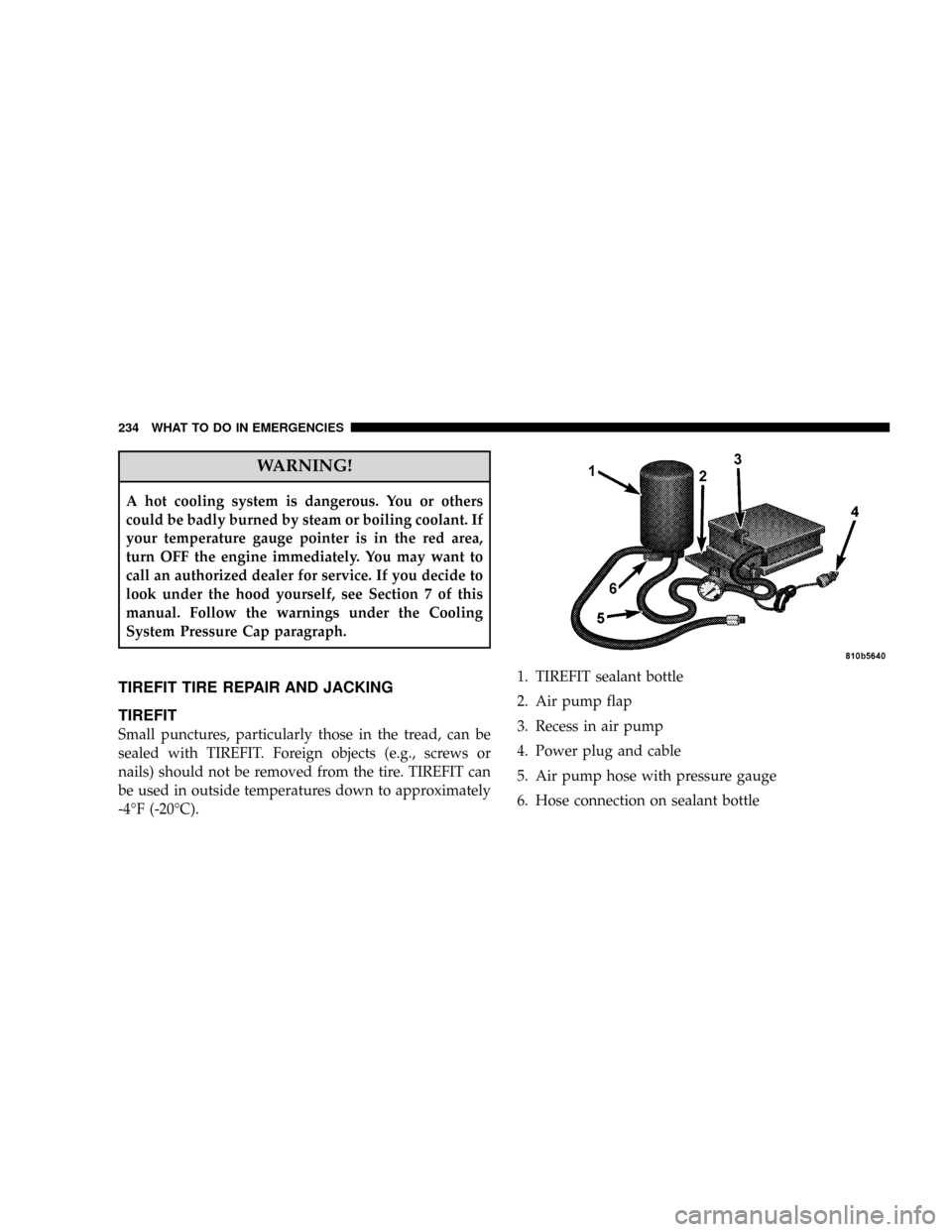
-4ÉF (-20ÉC).1. TIREFIT sealant bottle
2. Air pump flap
3. Recess in air pump
4. Power plug and cable
5. Air pump hose with pressure gauge
6. Hose connection on sealant bottle
234 WHAT TO DO IN EMERGENCIES
Page 237 of 358
WARNING!
Cuts or punctures larger than approximately 0.16 in. (4 mm),
tire damage caused by driving with extremely low tire
pressure or on a flat tire, or a damaged wheel can pose a
hazard while driving. TIREFIT should not be used in such
circumstances. Do not drive the vehicle under such circum-
stances. Contact your nearest authorized dealer for assis-
tance.
Take care not to allow the contents of TIREFIT to come in
contact with hair, eyes or clothing. TIREFIT is harmful if
inhaled, swallowed or absorbed through the skin: It causes
skin, eye and respiratory irritation. Any contact with eyes
or skin should be flushed immediately with plenty of
water. If clothing comes in contact with TIREFIT, change
clothing as soon as possible.
In case of allergic reaction or rash, consult a physician
immediately. Keep TIREFIT out of reach of children. If
swallowed, rinse mouth immediately with plenty of water
and drink plenty of water. Do not induce vomiting! Consult
a physician immediately.
Keep away from open flame or heat source.
Sealing tire with TIREFIT
1. Set the parking brake and turn on the hazard warning
flashers.
2. Move the transmission selector lever to the PARK
position (manual transmission to FIRST or REVERSE
gear) and turn off the engine.
3. Remove the TIREFIT kit and electric air pump from
the area below the cargo compartment carpet.
4. Open flap (2) on the electric air pump.
5. Pull the power plug (4) and air hose (5) along with the
pressure gauge out of the air pump housing.
6. Screw the air hose (5) onto the hose connection on the
TIREFIT sealant bottle (1).
7. Holding the sealant bottle by the top, insert it down-
wards into the recess (3) on the air pump.
WHAT TO DO IN EMERGENCIES 235
6
Page 239 of 358
NOTE:Do not exceed 50 mph (80 km/h) until the tire
has been inspected.
NOTE:If a pressure of at least 19 psi (130 kPa) cannot be
maintained in the tire, the tire is too badly damaged. Do
not attempt to drive the vehicle further, and call for
assistance.
NOTE:Do not operate the electric air pump for more
than eight minutes to avoid overheating. The air pump
may be used again once it has cooled down.
NOTE:Replace the TIREFIT sealant bottle once every
four years to assure optimum operation of the system.
NOTE:If TIREFIT is liquid, clean water and a damp
cloth will remove the material from the vehicle or tire and
wheel components. Once TIREFIT sealing material has
dried, it can easily be peeled off and properly discarded.Preparations for Jacking
WARNING!
Getting under a jacked-up vehicle is dangerous. The
vehicle could slip off the jack and fall on you. You
could be crushed. Never get any part of your body
under a vehicle that is on a jack. Never start or run
the engine while the vehicle is on a jack. If you need
to get under a raised vehicle, take it to a service
facility where it can be raised on a lift.
WARNING!
Do not attempt to repair a tire on the side of the
vehicle close to traffic. Pull far enough off the road to
avoid the danger of being hit when operating the
jack or repairing a tire.
WHAT TO DO IN EMERGENCIES 237
6
Page 240 of 358
Jacking the vehicle should only be necessary in the event
that a tire has been severely damaged, and must be
replaced. (See TIREFIT Tire Repair section for a descrip-
tion of cuts and punctures that may be repairable with
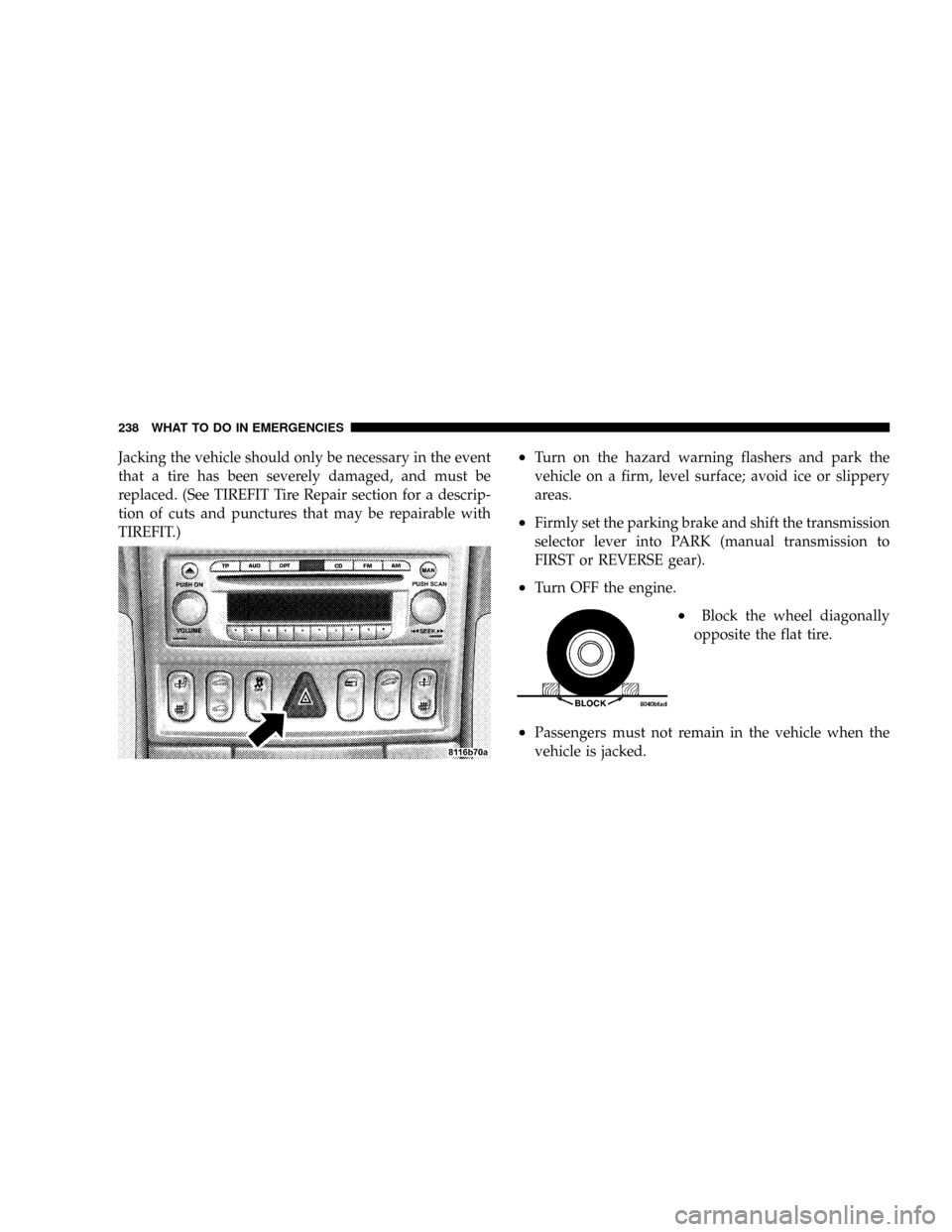
TIREFIT.)²Turn on the hazard warning flashers and park the
vehicle on a firm, level surface; avoid ice or slippery
areas.
²Firmly set the parking brake and shift the transmission
selector lever into PARK (manual transmission to
FIRST or REVERSE gear).
²Turn OFF the engine.
²Block the wheel diagonally
opposite the flat tire.
²Passengers must not remain in the vehicle when the
vehicle is jacked.
238 WHAT TO DO IN EMERGENCIES
Page 243 of 358
parked on an incline. Raise the vehicle only until the tire
just clears the surface. Minimum tire lift provides maxi-
mum stability.
4. Replace the tire.
5. Lower the vehicle by cranking the handle counter-
clockwise, then remove the jack assembly.
NOTE:Before storing the jack, it should be fully col-
lapsed.
6. Ensure proper tire pressure.
WARNING!
Raising the vehicle higher than necessary can make
the vehicle less stable. It could slip off the jack and
hurt someone near it. Raise the vehicle only enough
to make the necessary repair.
WARNING!
A loose jack or tool thrown forward in a collision or
hard stop could endanger the occupants of the ve-
hicle. Always stow the jack parts and tools in the
places provided.
JUMP-STARTING THE BATTERY
WARNING!
Take care to avoid the radiator cooling fan whenever
the hood is raised. It can start any time the ignition
switch is ON. You can be hurt by the fan.
WHAT TO DO IN EMERGENCIES 241
6
Page 244 of 358
CAUTION!
Do not try to push or tow your vehicle to get it
started. Your vehicle cannot be started this way.
Pushing with another vehicle may damage the trans-
mission or the rear of your vehicle. If your vehicle
has a discharged (dead) battery, booster cables may
be used to obtain a start from another vehicle. This
type of start can be dangerous if done improperly, so
follow the procedure carefully.
WARNING!
Battery fluid is a corrosive acid solution; do not allow
battery fluid to contact eyes, skin or clothing. Don't
lean over battery when attaching clamps or allow the
clamps to touch each other. If acid splashes in eyes or
on skin, flush contaminated area immediately with
large quantities of water.
A battery generates hydrogen gas that is flammable
and explosive. Keep flame or spark away from the
vent holes. Do not use a booster battery or any other
booster source with an output that exceeds 12 volts.
242 WHAT TO DO IN EMERGENCIES
Page 253 of 358
3. Turn the ignition OFF and continue to push down on
the switch for five seconds.
4. After five seconds the hydraulic system pressure will
be relieved.
WARNING!
It is important that a second person assist you to close
the convertible top manually to prevent injuries.
1. Lower the windows and open the doors.
2. Turn the ignition key OFF.
CAUTION!
Ensure that the decklid is closed while raising the
convertible top manually to prevent the possibility of
contact between the decklid and the tonneau cover.
WARNING!
Do not place your hands near the convertible top
frame, upper windshield area, or the convertible top
storage compartment while the convertible top is
being raised and locked. Serious personal injury may
occur.
WHAT TO DO IN EMERGENCIES 251
6
Page 255 of 358
WARNING!
Do not place your hands in the convertible top frame
areas. Serious personal injury may occur.
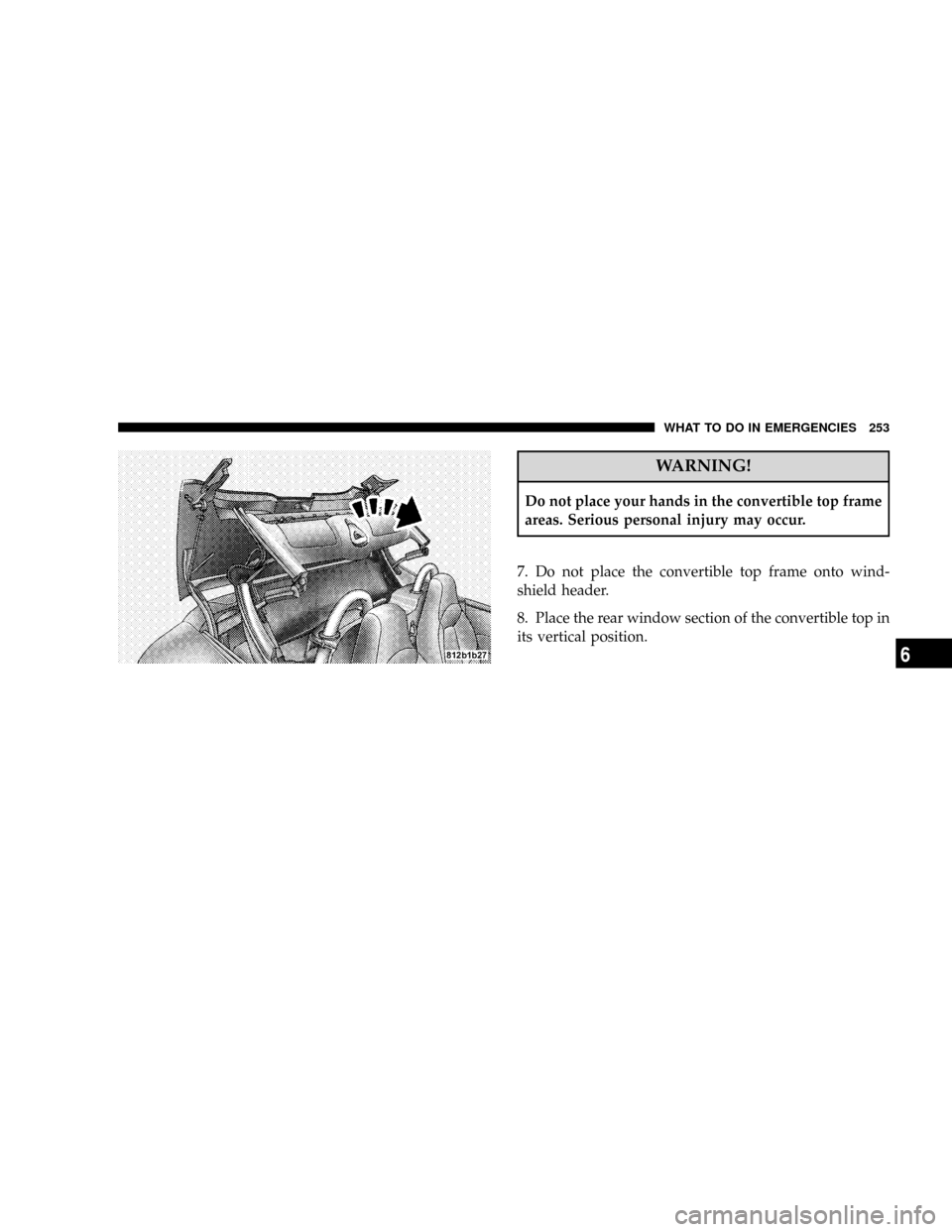
7. Do not place the convertible top frame onto wind-
shield header.
8. Place the rear window section of the convertible top in
its vertical position.
WHAT TO DO IN EMERGENCIES 253
6
Page 266 of 358
NOTE:Intentional tampering with emissions control
systems can result in civil penalties being assessed
against you.
WARNING!
You can be badly injured working on or around a
motor vehicle. Do only that service work for which
you have the knowledge and the proper equipment.
If you have any doubt about your ability to perform
a service job, take your vehicle to a competent
technician.
MAINTENANCE PROCEDURES
The pages that follow contain the maintenance service
recommended by the engineers who designed your ve-
hicle.
Besides the maintenance items for which there are fixed
maintenance intervals, there are other items that should
operate satisfactorily without periodic maintenance.
However, if a malfunction of these items does occur, it
could adversely affect the engine or vehicle performance.
These items should be inspected if a malfunction is
observed or suspected.
Engine Oil
Checking Oil Level
To assure proper engine lubrication, the engine oil must
be maintained at the correct level. Check the oil level at
regular intervals, such as every fuel stop.
264 MAINTAINING YOUR VEHICLE
Page 271 of 358
there is any malfunction due to a faulty spark plug.
Check the specifications section for the proper type of
spark plug for use in your vehicle.
Engine Air Cleaner Filter
Under normal driving conditions, replace the air filter at
each interval called out by FSS.
WARNING!
The air cleaner can provide a measure of protection
in the case of engine backfire. Do not remove the air
cleaner unless such removal is necessary for repair or
maintenance. Make sure that no one is near the
engine compartment before starting the vehicle with
the air cleaner removed. Failure to do so can result in
serious personal injury.
Engine Fuel Filter
A plugged fuel filter can cause hard starting or limit the
speed at which a vehicle can be driven. Should an
excessive amount of dirt accumulate in the fuel tank,
frequent fuel filter replacement may be necessary. See
your authorized dealer for service.
Catalytic Converter
The catalytic converter requires the use of unleaded fuel
only. Leaded gasoline will destroy the effectiveness of the
catalyst as an emission control device.
Under normal operating conditions, the catalytic con-
verter will not require maintenance. However, it is im-
portant to keep the engine properly serviced to assure
proper catalyst operation and prevent possible catalyst
damage.
If the CHECK ENGINE light is flashing, immediate
service is required.
MAINTAINING YOUR VEHICLE 269
7