warning CHRYSLER CROSSFIRE 2008 1.G Repair Manual
[x] Cancel search | Manufacturer: CHRYSLER, Model Year: 2008, Model line: CROSSFIRE, Model: CHRYSLER CROSSFIRE 2008 1.GPages: 358, PDF Size: 4.7 MB
Page 172 of 358
WARNING!
Never pour fuel or other flammable liquid into the
throttle body air inlet opening in an attempt to start
the vehicle. This could result in a flash fire, causing
serious personal injury.
If the engine fails to start after you have followed the
Normal Starting procedure, it may be flooded. Push the
accelerator pedal all the way to the floor and hold it there
while cranking the engine. This should clear any excess
fuel in case the engine is flooded.
CAUTION!
To prevent damage to the starter, do not crank the
engine for more than 15 seconds at a time. Wait 10 to
15 seconds before trying again.If the engine has been flooded, it may start to run, but not
have enough power to continue running when the key is
released. If this occurs, continue cranking with the accel-
erator pedal pushed all the way to the floor. Release the
accelerator pedal and the key once the engine is running
smoothly.
If the engine shows no sign of starting after two 15-
second periods of cranking with the accelerator pedal
held to the floor, the Normal Starting procedure should
be repeated.
After Starting
The idle speed will automatically decrease as the engine
warms up.
170 STARTING AND OPERATING
Page 175 of 358
WARNING!
When leaving the vehicle, always remove the key
from the ignition switch, and lock the vehicle. Do not
leave children unattended in the vehicle, or with
access to an unlocked vehicle. Children could move
the gearshift lever, which could result in an accident
or serious injury.
WARNING!
Skipping more than one gear while downshifting
could cause you to lose control of your vehicle. You
could have an accident.
CAUTION!
If you skip more than one gear while downshifting
or downshift at too high an engine speed, you could
damage the engine, transmission, or clutch.
STARTING AND OPERATING 173
5
Page 177 of 358
WARNING!
It is dangerous to shift the shift lever out of PARK or
NEUTRAL if the engine speed is higher than idle
speed. If your foot is not firmly on the brake pedal,
the vehicle could accelerate quickly forward or in
reverse. You could lose control of the vehicle and hit
someone or something. Only shift into gear when the
engine is idling normally and when your foot is
firmly on the brake pedal.
Stopping
For brief stops, leave the transmission in gear and hold
the vehicle with the brake pedal. For longer stops with
the engine idling, shift into the NEUTRAL or PARK
position and hold the vehicle with the parking brake.When stopping the vehicle uphill, do not hold it with the
accelerator; use the brake. This avoids unnecessary trans-
mission heat build-up.
Maneuvering
To maneuver in tight areas, control the vehicle speed by
gradually releasing the brakes. Accelerate gently and
never abruptly step on the accelerator.
To rock a vehicle out of soft ground (mud or snow),
alternately shift from FORWARD to REVERSE, while
applying only slight acceleration. Rocking a vehicle free
in this manner may cause the ABS or traction system
malfunction indicator light to come on. Turn off the
engine and restart the engine to clear the malfunction
indication.
STARTING AND OPERATING 175
5
Page 181 of 358
WARNING!
On slippery road surfaces, never downshift in order
to obtain braking action. This could result in drive
wheel slip and reduced vehicle control. Your vehi-
cle's ABS will not prevent this type of loss of control.
You could lose control of your vehicle and have an
accident.
NOTE:With transmission in gear ªD,º ª4,º or ª3,º
upshifting from FIRST to SECOND to THIRD gear may
be delayed, depending on vehicle speed and engine
temperature. This allows the catalytic converter to heat
up more quickly to operating temperatures.
The delayed upshift is effective with vehicle speeds
below 31 mph (50 km/h) at partial throttle and engine
temperatures below 95ÉF (35ÉC). To prevent the engine
from laboring at low RPM when driving uphill or withyour vehicle heavily loaded, the automatic transmission
will downshift when necessary to maintain engine RPM
within the best torque range.
Gear Ranges
PARK
NOTE:If the key is in the ON/RUN position, you must
press the brake pedal to shift out of the PARK position.
PARK supplements the parking brake by locking the
transmission. The engine can be started in this range.
Never attempt to use PARK while the vehicle is in
motion.
Apply the parking brake when leaving the vehicle in this
range.
REVERSE
Shift into this range only after the vehicle has come to a
complete stop.
STARTING AND OPERATING 179
5
Page 184 of 358
6. Move the shift lever to the DRIVE position (for SEC-
OND gear), or move the shift lever to the REVERSE
position (for REVERSE gear).
Have the transmission checked at your authorized dealer
as soon as possible.
DRIVING ON SLIPPERY SURFACES
WARNING!
Rapid acceleration on slippery surfaces is dangerous.
You could lose control of the vehicle and possibly
have an accident. Accelerate slowly and carefully
whenever there is likely to be poor traction (ice,
snow, rain, mud, loose sand, etc.).
Traction
When driving on wet or slushy roads, it is possible for a
wedge of water to build up between the tire and road
surface. This is hydroplaning and may cause partial or
complete loss of vehicle control and stopping ability. To
reduce this possibility, the following precautions should
be observed:
1. Slow down during rainstorms or when roads are
slushy.
2. Slow down if the road has standing water or puddles.
3. Replace tires when tread wear indicators first become
visible.
4. Keep tires properly inflated.
5. Maintain enough distance between your vehicle and
the vehicle in front to avoid a collision in a sudden stop.
182 STARTING AND OPERATING
Page 185 of 358
DRIVING THROUGH WATER
Driving through water more than a few inches/
centimeters deep will require extra caution to ensure
safety and prevent damage to your vehicle.
Flowing/Rising Water
WARNING!
Do not drive on, or cross, a road or a path where
water is flowing and/or rising (as in storm run-off).
Flowing water can wear away the road or path's
surface and cause your vehicle to sink into deeper
water. Furthermore, flowing and/or rising water can
carry your vehicle away swiftly. Failure to follow this
warning may result in injuries that are serious or
fatal to you, your passengers, and others around you.
Shallow Standing Water
Although your vehicle is capable of driving through
shallow standing water, consider the following Caution
and Warning before doing so.
CAUTION!
²Always check the depth of the standing water
before driving through it. Never drive through
standing water that is deeper than the bottom of
the tire rims mounted on the vehicle.
²Determine the condition of the road or the path
that is under water, and if there are any obstacles
in the way, before driving through the standing
water.
²Do not exceed 5 mph (8 km/h) when driving
through standing water. This will minimize wave
effects.
STARTING AND OPERATING 183
5
Page 186 of 358
CAUTION!
²Driving through standing water may cause dam-
age to your vehicle's drivetrain components. Al-
ways inspect your vehicle's fluids (i.e., engine oil,
transmission, axle, etc.) for signs of contamination
(i.e., fluid that is milky or foamy in appearance)
after driving through standing water. Do not con-
tinue to operate the vehicle if any fluid appears
contaminated, as this may result in further dam-
age. Such damage is not covered by the New
Vehicle Limited Warranty.
²Getting water inside your vehicle's engine can
cause it to lock up and stall out, and cause serious
internal damage to the engine. Such damage is not
covered by the New Vehicle Limited Warranty.
WARNING!
²Driving through standing water limits your vehi-
cle's traction capabilities. Do not exceed 5 mph (8
km/h) when driving through standing water.
²Driving through standing water limits your vehi-
cle's braking capabilities, which increases stop-
ping distances. Therefore, after driving through
standing water, drive slowly and lightly press on
the brake pedal several times to dry the brakes.
²Getting water inside your vehicle's engine can
cause it to lock up and stall out, and leave you
stranded.
²Failure to follow these warnings may result in
injuries that are serious or fatal to you, your
passengers, and others around you.
184 STARTING AND OPERATING
Page 187 of 358
PARKING BRAKE
When you apply the parking brake with engine
running, the brake system warning light in the
instrument cluster will come on.
NOTE:This light, when illuminated with parking brake
application, shows only that the parking brake is on. It
does not show the degree of brake application.
NOTE:If the light remains on with the parking brake
released, a brake system malfunction is indicated. Have
the brake system serviced by an authorized dealer im-
mediately.
Before leaving the vehicle, make sure that the parking
brake is fully applied. For manual transmission vehicles,
place the shift lever in REVERSE. For vehicles equipped
with automatic transmissions, place the shift lever in the
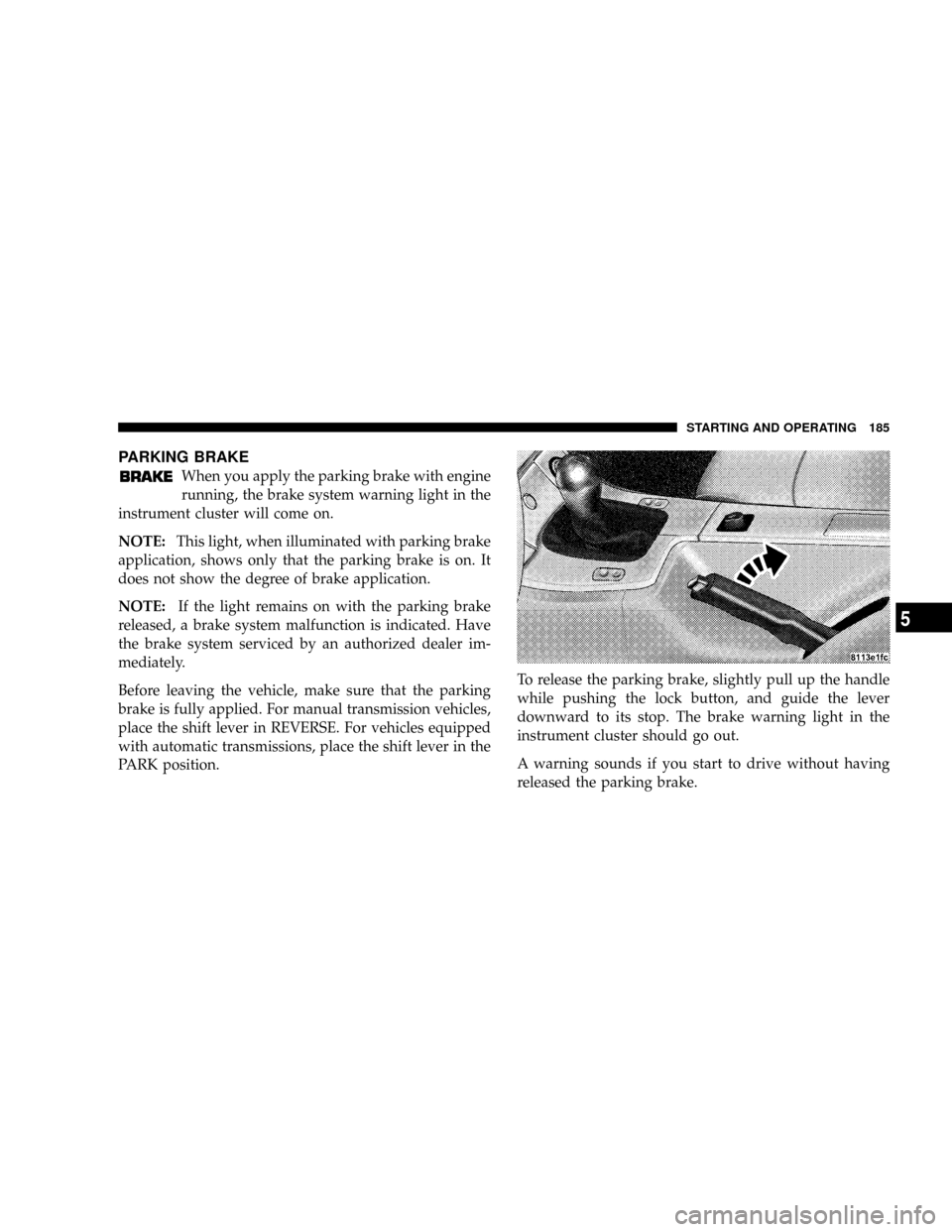
PARK position.To release the parking brake, slightly pull up the handle
while pushing the lock button, and guide the lever
downward to its stop. The brake warning light in the
instrument cluster should go out.
A warning sounds if you start to drive without having
released the parking brake.
STARTING AND OPERATING 185
5
Page 188 of 358
When parking on a hill, you must set the parking brake
beforeplacing the shift lever in PARK. If you don't, the
load on the transmission locking mechanism may make it
difficult to move the shift lever out of PARK. As an added
precaution, turn the front wheels toward the curb on a
downhill grade and away from the curb on an uphill
grade.
The parking brake should always be applied when the
driver is not in the vehicle.
WARNING!
Be sure the parking brake is fully disengaged before
driving; failure to do so can lead to brake failure and
an accident.
WARNING!
Do not leave children unattended in a vehicle. A
child could be injured, or could injure others, if left
unattended.
BRAKE SYSTEM
Your vehicle is equipped with power brakes as standard
equipment. In the event power assist is lost for any
reason (for example, repeated brake applications with the
engine off), the brakes will still function. The effort
required to brake the vehicle will be much greater than
that required with the power system operating.
If either the front or rear hydraulic system loses normal
capability, the remaining system will still function with
some loss of overall braking effectiveness. This will be
evident by increased pedal travel during application,
186 STARTING AND OPERATING
Page 189 of 358
greater pedal force required to slow or stop, and activa-
tion of the brake warning light during brake use.
Brake Assist System (BAS)
The BAS is designed to maximize the vehicle's braking
capability during emergency braking maneuvers. Maxi-
mum power boost is applied to the brakes more quickly
in emergency braking conditions. This can help reduce
braking distances relative to what ordinary driving and
braking style might do.
The BAS complements the antilock brake system (ABS).
Applying the brakes very quickly results in maximum
BAS assistance. To receive the benefit of the system you
must apply continuous, full braking power during the
stopping sequence. Do not reduce brake pedal pressure.
WARNING!
BAS cannot prevent the natural laws of physics from
acting on the vehicle, nor can it increase braking
efficiency beyond that afforded by the condition of
the vehicle brakes and tires or the traction afforded.
The BAS cannot prevent accidents, including those
resulting from excessive speed in turns, following
another vehicle too closely, or hydroplaning. Only a
safe, attentive, and skillful driver can prevent acci-
dents. The capabilities of a BAS-equipped vehicle
must never be exploited in a reckless or dangerous
manner which could jeopardize the user's safety or
the safety of others.
Once the brake pedal is released, the BAS is deactivated.
STARTING AND OPERATING 187
5