belt CHRYSLER CROSSFIRE 2008 1.G User Guide
[x] Cancel search | Manufacturer: CHRYSLER, Model Year: 2008, Model line: CROSSFIRE, Model: CHRYSLER CROSSFIRE 2008 1.GPages: 358, PDF Size: 4.7 MB
Page 37 of 358
NOTE:The passenger front airbag may not deploy even
when the driver front airbag has deployed if the Occu-
pant Classification System (refer to ªOccupant Classifi-
cation Systemº in this section) has determined the seat is
empty or is occupied by someone that is classified in the
ªchildº category. This could be a child, a teenager, or
even a small adult. The side airbags on the crash side of
the vehicle is triggered in moderate to severe side colli-
sions. However even in collisions where the airbags
work, you need the seat belts to keep you in the right
position for the airbags to protect you properly.
The seat belts are designed to protect you in many types
of collisions. The front airbags deploy only in moderate
to severe front collisions. In certain types of collisions,
both the front and side airbags may be triggered.
Here are some simple steps you can take to minimize
the risk of harm from a deploying airbag.1. Infants in rear-facing child safety seats shouldNEVER
ride in the front seat of a vehicle with a passenger frontal
airbag unless the airbag is shut OFF. See ªPassenger
Airbag On/Off Switchº and ªTo Shut Off the Passenger
Airbag.º The rear-facing seat places them too close to the
passenger air bag in the event of a crash. An airbag
deployment can cause severe injury or death to infants in
this position.
Children that are not big enough to properly wear the
vehicle seat belt (see section on ªChild Restraintº) should
be secured in child safety seats or booster seats that are
appropriate for the child's age, height, and weight.
Older children who do not use child safety seats or
booster seats should ride properly buckled. Never allow
children to place the shoulder belt behind them or under
the arm.
THINGS TO KNOW BEFORE STARTING YOUR VEHICLE 35
2
Page 38 of 358
If a child from 1 to 12 years old must ride in the vehicle,
move the seat as far back as possible, shut off the
passenger airbag, and use the proper child restraint. See
the section on ªChild Restraint.º
You should read the instructions provided with your
child restraint or belt-positioning booster seat to make
sure that you are using it properly.
2. All occupants should wear their lap and shoulder belts
properly.
3. The driver and passenger seats should be moved back
as far as practical to allow the front airbags room to
inflate.
4. Do not lean against the door, as the side airbags will
inflate forcefully into the space between you and the
door. (See the section on ªSide Airbagsº)WARNING!
After installing a child safety seat or booster seat on the
passenger seat, do not adjust the back rest forward. This
could cause a higher load being perceived by the OCS
system which in turn could lead to the passenger airbag
being turned on. Failure to follow this warning could
result in serious or fatal injury. It is always recom-
mended to turn off the passenger front air bags using
the passenger front airbags on/off switch located at the
right end of the instrument panel when the passenger is:
²an infant (less than 1 year old),
²a child, age 1 to 12,
²an adult with a medical condition which makes
passenger airbags inflation (deployment) a greater
risk for the passenger than the risk of hitting the
dashboard (instrument panel) or windshield in a
crash.
The on/off switch is accessible by opening the passen-
ger door.
36 THINGS TO KNOW BEFORE STARTING YOUR VEHICLE
Page 39 of 358
WARNING!
²Relying on the airbags alone could lead to more
severe injuries in a collision. The airbags work
with your seat belt to restrain you properly. In
some collisions the airbags won't deploy at all.
Always wear your seat belts even though you have
airbags.
²Being too close to the steering wheel or instrument
panel during airbag deployment could cause seri-
ous injury.
²Airbags need room to inflate. Sit back, comfort-
ably extending your arms to reach the steering
wheel or instrument panel.
²The side airbags also need room to inflate. Do not
lean against the door. Sit upright in the center of
the seat.
Airbag System Components
The airbag system consists of the following:
²Occupant Restraint Controller
²Airbag Warning Light
²Driver and passenger frontal airbag/inflator units
²Driver and passenger side airbag/inflator units
²Driver and Passenger Inflatable Knee Blocker
²Driver and Front Passenger Seat Belt Pretensioners
²Side impact sensors
²Front Passenger Seat Occupant Classification System
(OCS)
How the Front Airbag System Works
²
TheOccupant Restraint Controller (ORC)determines
if a frontal collision is severe enough to require the
THINGS TO KNOW BEFORE STARTING YOUR VEHICLE 37
2
Page 41 of 358
WARNING!
Do not put anything on or around the airbag covers
or attempt to manually open them. You may damage
the airbags and you could be injured because the
airbags are not there to protect you. These protective
covers are designed to open only when the airbags
are inflated.
²TheDriver and Passenger Airbag/Inflator Unitsare
located in the center of the steering wheel and the right
side of the instrument panel. When the ORC detects a
collision requiring the airbags, it signals the inflator
units. A large quantity of nontoxic gas is generated to
inflate the front airbags. Different airbag inflation rates
may be possible based on collision severity and occu-
pant size. The steering wheel hub trim cover and theupper right side of the instrument panel separate and
fold out of the way as the bags inflate to their full size.
The bags fully inflate in about 50±70 milliseconds. This
is about half of the time it takes to blink your eyes. The
bags then quickly deflate while helping to restrain the
driver and front passenger. The driver 's front airbag
gas is vented through vent holes in the sides of the
airbag. The passenger 's front airbag gas is vented
through vent holes in the sides of the airbag. In this
way the airbags do not interfere with your control of
the vehicle.
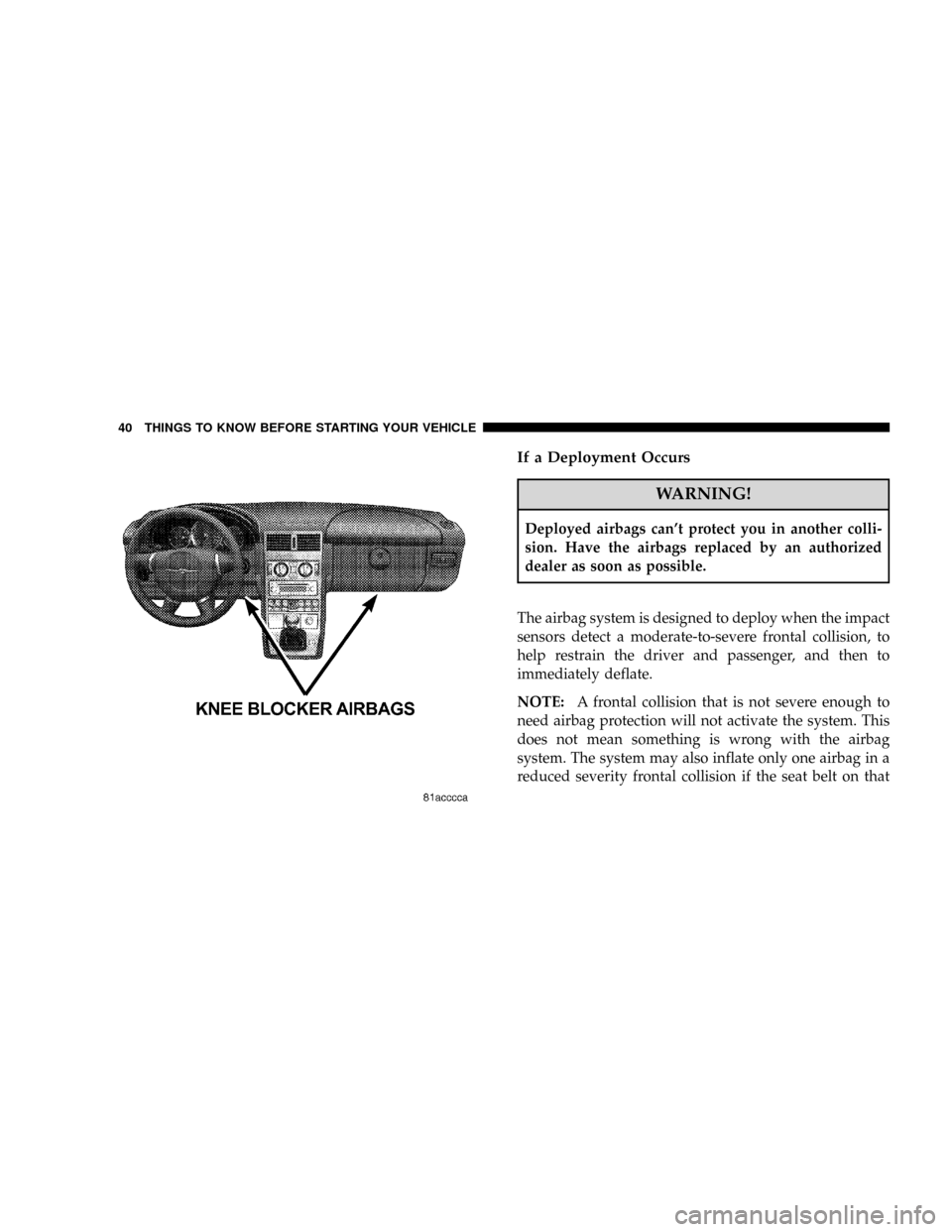
²The Knee Blocker Airbag helps protect the knees and
working with the seat belts, position you for the best
interaction with the airbags.
THINGS TO KNOW BEFORE STARTING YOUR VEHICLE 39
2
Page 42 of 358
If a Deployment Occurs
WARNING!
Deployed airbags can't protect you in another colli-
sion. Have the airbags replaced by an authorized
dealer as soon as possible.
The airbag system is designed to deploy when the impact
sensors detect a moderate-to-severe frontal collision, to
help restrain the driver and passenger, and then to
immediately deflate.
NOTE:A frontal collision that is not severe enough to
need airbag protection will not activate the system. This
does not mean something is wrong with the airbag
system. The system may also inflate only one airbag in a
reduced severity frontal collision if the seat belt on that
40 THINGS TO KNOW BEFORE STARTING YOUR VEHICLE
Page 48 of 358
²Do not replace the seat cover with an aftermarket seat
cover.
²Do not add a secondary seat cover other than those
approved by DaimlerChrysler/Mopart.
²At no time should any supplemental restraint system
(SRS) component or SRS related component or fas-
tener be modified or replaced with any part except
those which are approved by DaimlerChrysler/
Mopart.
How the Occupant Classification Module (OCM)
Works
The Occupant Classification Module (OCM) is located
beneath the passenger seat. The OCM classifies the
occupant into one of three size categories based on the
input from the Bladder Assembly and a Belt Tension
Sensor. The size categories include empty, child, and
adult. The OCM sends the Occupant Classification to theORC to determine if a front passenger airbag is allowed.
If a fault is present, the AIRBAG warning light is illumi-
nated.
How the Passenger Airbag Disabled (PAD)
Indicator Light Works
The Passenger Airbag Disabled (PAD) Indicator Light
indicates to the driver and passenger when the airbag is
turned OFF. In the presence of a properly seated occu-
pant, when the PAD indicator light is illuminated, the
airbag is OFF. Also, when the Occupant Classification
System detects either an empty seat or a weight less than
the predetermined threshold, the ORC will not illuminate
the PAD indicator light even though the airbag is turned
OFF.
How the Belt Tension Sensor (BTS) Works
The Belt Tension Sensor (BTS) is located at the outboard
passenger lap belt anchor. The BTS creates a signal based
on outboard lap belt tension. This signal is sent to the
46 THINGS TO KNOW BEFORE STARTING YOUR VEHICLE
Page 49 of 358
OCM to ensure that the resultant bladder pressure in-
crease due to applied lap belt tension does not cause a
small occupant to be classified as a larger occupant
How the Bladder Mat and Pressure Sensor Works
The Bladder Mat and Pressure Sensor are located beneath
the seat cushion foam. The pressure sensor sends a signal
to the OCM. The passenger seat assembly contains criti-
cal components that affect the passenger airbag deploy-
ment. Correctly functioning passenger seat components
are critical for the Occupant Classification System (OCS)
to properly classify the passenger and calculate the
proper airbag deployment. Do not make any modifica-
tions to the passenger seat components, assembly, or to
the seat cover.
How the Driver/Passenger Inflatable Knee
Blockers Works
When the ORC and the impact sensors detect a collision
requiring the Driver/Passenger Inflatable Knee Blockers,it signals the inflator unit. A quantity of nontoxic gas is
generated to inflate the Driver/Passenger Inflatable Knee
Blockers. The Driver/Passenger Inflatable Knee Blockers
inflates rearward towards the driver 's knees to help
protect the knees and position you for the best interaction
with the front airbag. The Driver/Passenger Inflatable
Knee Blockers fully inflates in about 50 milliseconds, this
is only about half of the time it takes you to blink your
eyes. It then quickly deflates while helping to protect the
driver 's knees.
The Knee Impact Blockers help protect the knees and
position the occupant.
Passenger Front Airbag On/Off Switch
The ON/OFF switch is located at the right end of the
instrument panel and is accessible by opening the pas-
senger door.
THINGS TO KNOW BEFORE STARTING YOUR VEHICLE 47
2
Page 54 of 358
Child Restraint
Everyone in your vehicle needs to be buckled up all the
time, including babies and children. Every state in the
United States and all Canadian provinces require that
small children ride in proper restraint systems. This is the
law, and you can be prosecuted for ignoring it.
WARNING!
In a collision, an unrestrained child, even a tiny baby,
can become a missile inside the vehicle. The force
required to hold even an infant on your lap could
become so great that you could not hold the child, no
matter how strong you are. The child and others
could be badly injured. Any child riding in your
vehicle should be in a proper restraint for the child's
size.
Infants and Child Restraints
There are different sizes and types of restraints for
children from newborn size to the child almost large
enough for an adult safety belt. Always check the child
seat Owner's Manual to ensure you have the right seat
for your child. Use the restraint that is correct for your
child:
²Safety experts recommend that children ride
rearward-facing in the vehicle until they are at least
one year old and weigh at least 20 lbs (9 kg). Two types
of child restraints can be used rearward-facing: infant
carriers and convertible child seats.
²The infant carrier is only used rearward-facing in the
vehicle. It is recommended for children who weigh up
to about 20 lbs (9 kg). Convertible child seats can be
used either rearward-facing or forward-facing in the
vehicle. Convertible child seats often have a higher
weight limit in the rearward-facing direction than
52 THINGS TO KNOW BEFORE STARTING YOUR VEHICLE
Page 55 of 358
infant carriers do, so they can be used rearward-facing
by children who weigh more than 20 lbs (9 kg) but are
less than one year old. Both types of child restraints are
held in the vehicle by the lap/shoulder belt or the
Lower Anchors and Tether for Children (LATCH)
child restraint anchorage system. (See the LATCH -
Child Seat Anchorage System section.)
²Rearward-facing child seats mustNEVERbe used in
the front seat of a vehicle with the front passenger
airbag unless the airbag is turned off. An airbag
deployment could cause severe injury or death to
infants in this position.
WARNING!
²A rearward facing infant restraint must not be
used unless the passenger airbag has been shut
off.A rearward facing infant restraint may be
struck by a deploying passenger airbag which may
cause severe or fatal injury to the infant.
²Improper installation can lead to failure of a child
restraint. It could come loose in a collision. The
child could be badly injured or killed. Follow the
manufacturer's directions exactly when installing
a child restraint.
THINGS TO KNOW BEFORE STARTING YOUR VEHICLE 53
2
Page 56 of 358
Here are some tips on getting the most out of your child
restraint:
²Before buying any restraint system, make sure that it
has a label certifying that it meets all applicable Safety
Standards. We also recommend that you make sure
that you can install the child restraint in the vehicle
where you will use it before you buy it.
²The restraint must be appropriate for your child's
weight and height. Check the label on the restraint for
weight and height limits.
²Carefully follow the instructions that come with the
restraint. If you install the restraint improperly, it may
not work when you need it.
²Buckle the child into the seat according to the seat
manufacturer's directions.
²When your child restraint is not in use, secure it in the
vehicle with the seat belt or remove it from the vehicle.Do not leave it loose in the vehicle. In a sudden stop or
collision, it could strike the occupants and cause
serious personal injury.
NOTE: For additional information refer to
www.seatcheck.org or call 1±866±SEATCHECK.
Older Children and Child Restraints
Children who weigh more than 20 lbs (9 kg) and who are
older than one year can ride forward-facing in the
vehicle. Forward-facing child seats and convertible child
seats used in the forward-facing direction are for children
who weigh 20 to 40 lbs (9 to 18 kg) and who are older
than one year. These child seats are also held in the
vehicle by the lap/shoulder belt or the LATCH child
restraint anchorage system. (See LATCH - Child Seat
Anchorage System section.)
The belt-positioning booster seat is for children weighing
more than 40 lbs (18 kg), but who are still too small to fit
the vehicle's seat belts properly. If the child cannot sit
54 THINGS TO KNOW BEFORE STARTING YOUR VEHICLE