belt CHRYSLER CROSSFIRE 2008 1.G Owner's Manual
[x] Cancel search | Manufacturer: CHRYSLER, Model Year: 2008, Model line: CROSSFIRE, Model: CHRYSLER CROSSFIRE 2008 1.GPages: 358, PDF Size: 4.7 MB
Page 57 of 358
with knees bent over the vehicle's seat cushion while the
child's back is against the seatback, they should use a
belt-positioning booster seat. The child and belt-
positioning booster seat are held in the vehicle by the
lap/shoulder belt.
Children Too Large For Booster Seats
Children who are large enough to wear the shoulder belt
comfortably, and whose legs are long enough to bend
over the front of the seat when their back is against the
seatback, should use the lap/shoulder belt.
²Make sure that the child is upright in the seat.
²The lap portion should be low on the hips and as snug
as possible.
²Check belt fit periodically. A child's squirming or
slouching can move the belt out of position.
²If the shoulder belt contacts the face or neck, move the
child closer to the center of the vehicle. Never allow a
child to put the shoulder belt under an arm or behind
their back.
LATCH - Child Seat Anchorage System (Lower
Anchors and Tether for Children)
Your vehicle's passenger seat is equipped with the child
restraint anchorage system called LATCH. The LATCH
system provides for the installation of the child restraint
without using the vehicle's belts, instead securing the
child restraint using lower anchorages and upper tether
straps from the child restraint to the vehicle structure.
LATCH-compatible child restraints are now available.
THINGS TO KNOW BEFORE STARTING YOUR VEHICLE 55
2
Page 60 of 358
WARNING!
After installing a child safety seat or booster seat on the
passenger seat, do not adjust the back rest forward. This
could cause a higher load being perceived by the OCS
system which in turn could lead to the passenger airbag
being turned on. Failure to follow this warning could
result in serious or fatal injury. It is always recom-
mended to turn off the passenger front air bags using
the passenger front airbags on/off switch located at the
right end of the instrument panel when the passenger is:
²an infant (less than 1 year old),
²a child, age 1 to 12,
²an adult with a medical condition which makes
passenger airbags inflation (deployment) a greater
risk for the passenger than the risk of hitting the
dashboard (instrument panel) or windshield in a
crash.
The on/off switch is accessible by opening the passen-
ger door.
WARNING!
Improper installation of a child restraint to the
LATCH anchorages can lead to failure of an infant or
child restraint. The child could be badly injured or
killed. Follow the manufacturer's directions exactly
when installing an infant or child restraint.
Installing Child Restraints Using the Vehicle Seat
Belt
Child restraints can be securely fastened in the passenger
seat using the seat belts. For this purpose, the passenger
seat belt retractor provides two modes of operation -
normal emergency locking and automatic locking. For
child restraint installation, the retractor switches to auto-
matic locking when the belt is pulled out to the full extent
of its travel. As the belt retracts, the retractor locks to
prevent the belt from being pulled out again. Pulling the
58 THINGS TO KNOW BEFORE STARTING YOUR VEHICLE
Page 61 of 358
belt snugly over the child restraint toward the retractor
secures the restraint in place. When the belt retracts fully
after child restraint removal, normal (emergency locking)
retractor action is restored. Any seat belt system will
loosen with time, so check the belt occasionally and pull
it tight if necessary.
If your child restraint is equipped with a tether strap,
attach it to the vehicle by first moving the seatback fully
forward. Next, route the child restraint tether directly
over the top of the seat, through the strap near the top of
the seatback, and attach the hook to the anchor bar.
Recline the seatback and move the passenger seat as far
rearward as possible. Remove slack in the tether strap as
you push the child restraint downward and rearward,
following the child restraint manufacturer's instructions.Child Restraint Tether Anchor - General
Information
Child restraints having tether straps and hooks for con-
nection to tether anchors have been available for some
time. In fact, many child restraint manufacturers will
provide add-on tether strap kits for certain of their older
products. There is a tether strap anchor behind the
passenger seat.
To attach the tether strap to the anchor, move the
seatback fully forward. Pass the child restraint tether
hook over the top of the seat, through the strap near the
top of the seatback, and attach it to the anchor bar behind
THINGS TO KNOW BEFORE STARTING YOUR VEHICLE 59
2
Page 62 of 358
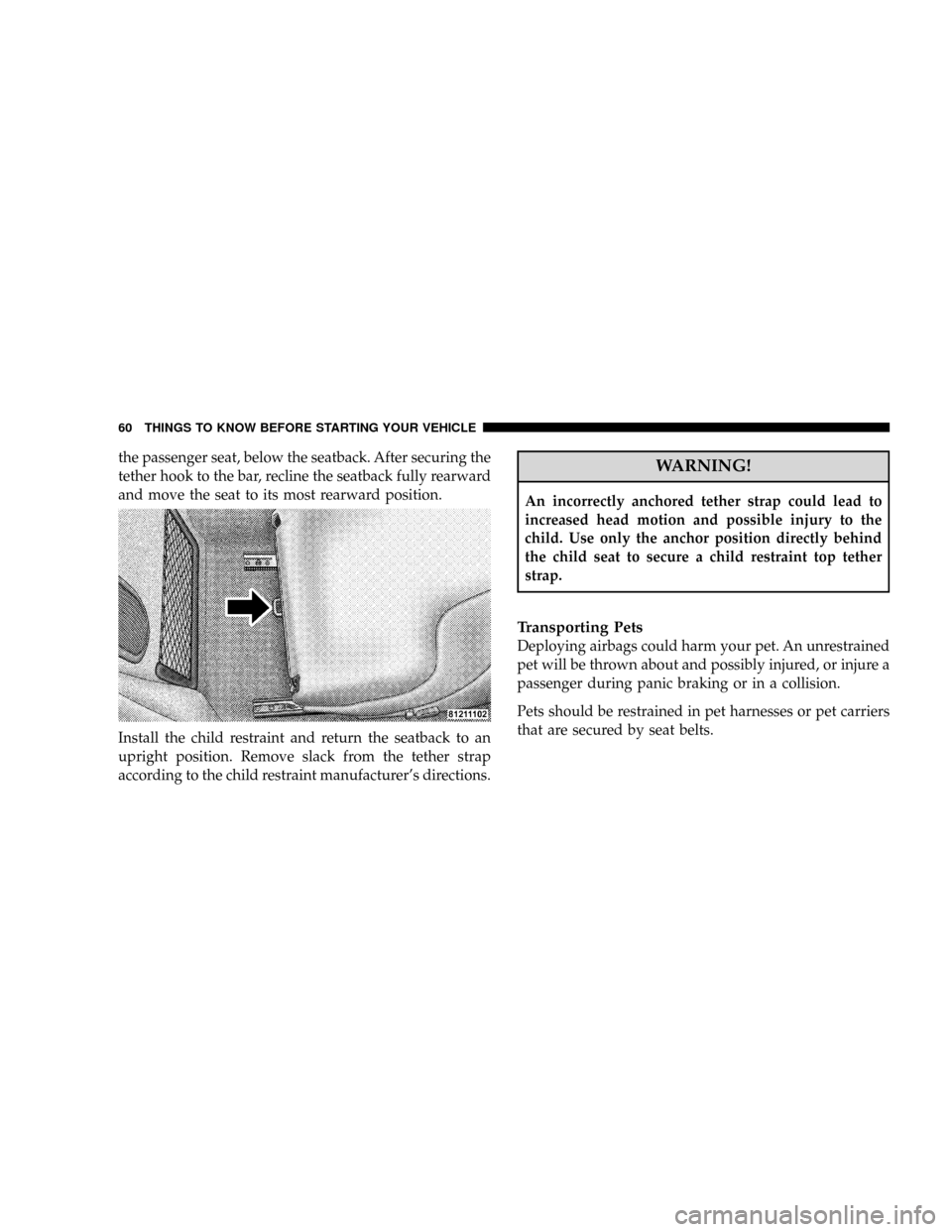
the passenger seat, below the seatback. After securing the
tether hook to the bar, recline the seatback fully rearward
and move the seat to its most rearward position.
Install the child restraint and return the seatback to an
upright position. Remove slack from the tether strap
according to the child restraint manufacturer's directions.WARNING!
An incorrectly anchored tether strap could lead to
increased head motion and possible injury to the
child. Use only the anchor position directly behind
the child seat to secure a child restraint top tether
strap.
Transporting Pets
Deploying airbags could harm your pet. An unrestrained
pet will be thrown about and possibly injured, or injure a
passenger during panic braking or in a collision.
Pets should be restrained in pet harnesses or pet carriers
that are secured by seat belts.
60 THINGS TO KNOW BEFORE STARTING YOUR VEHICLE
Page 64 of 358
²To avoid drawing exhaust gases into the vehicle, close
the rear liftgate/decklid while driving. However, if for
some reason it must remain open, close all windows.
Adjust the heating or cooling system to force outside
air into the vehicle. Set the blower at high speed.
Safety Checks You Should Make Inside the
Vehicle
Seat Belts
Inspect the seat belt system periodically, checking for
cuts, frays and loose parts. Damaged parts must be
replaced immediately. Do not disassemble or modify the
system.
Seat belt assemblies must be replaced after an accident if
they have been damaged (bent retractor, torn webbing,
etc.). If there is any question regarding seat belt or
retractor condition, see your authorized dealer.
Airbag Light
The light should come on and remain on for
four seconds as a bulb check when the ignition
switch is first turned ON. If the bulb is not lit
during starting, have it replaced. If the light
stays on or comes on while driving, have the system
checked by an authorized dealer.
Defrosters
Check operation by pressing the A/C control button,
selecting the defrost mode and placing the blower control
on high speed. You should be able to feel the air directed
against the windshield. See your authorized dealer for
service if your defroster is inoperable.
62 THINGS TO KNOW BEFORE STARTING YOUR VEHICLE
Page 70 of 358
CONVERTIBLE TOP OPERATION
WARNING!
The convertible top does not provide the structural
protection that a reinforced metal roof does and the
fabric top cannot be expected to prevent the ejection of
the occupants of a vehicle in a collision. Therefore, it is
important that all occupants wear their seat belts at all
times when riding in a convertible. Studies have shown
that it is generally safer to remain inside a vehicle
during a collision than to be ejected from the vehicle.
For safety reasons, the convertible top should only be
opened and closed when the vehicle is standing still. Top
operation is allowed up to a maximum of 9 mph (15
km/h). Above this speed, top operation will cease and an
audible warning will sound. The top operation can be
resumed after the vehicle is below the maximum speed
by pressing the convertible top switch again.
WARNING!
Before operating the switch for the convertible top,
make sure that no persons can be injured by the
moving parts (convertible top frame and tonneau
cover).
Hands must never be placed near the sport bar,
convertible top frame, upper windshield area, shelf
behind sport bar, or convertible top storage compart-
ment while the convertible top is being raised or
lowered. Serious personal injury may occur.
If potential danger exists, release the convertible top
switch. This immediately interrupts the raising or
lowering procedure. You then can operate the con-
vertible top switch to raise or lower the convertible
top away from the danger zone.
68 UNDERSTANDING THE FEATURES OF YOUR VEHICLE
Page 90 of 358
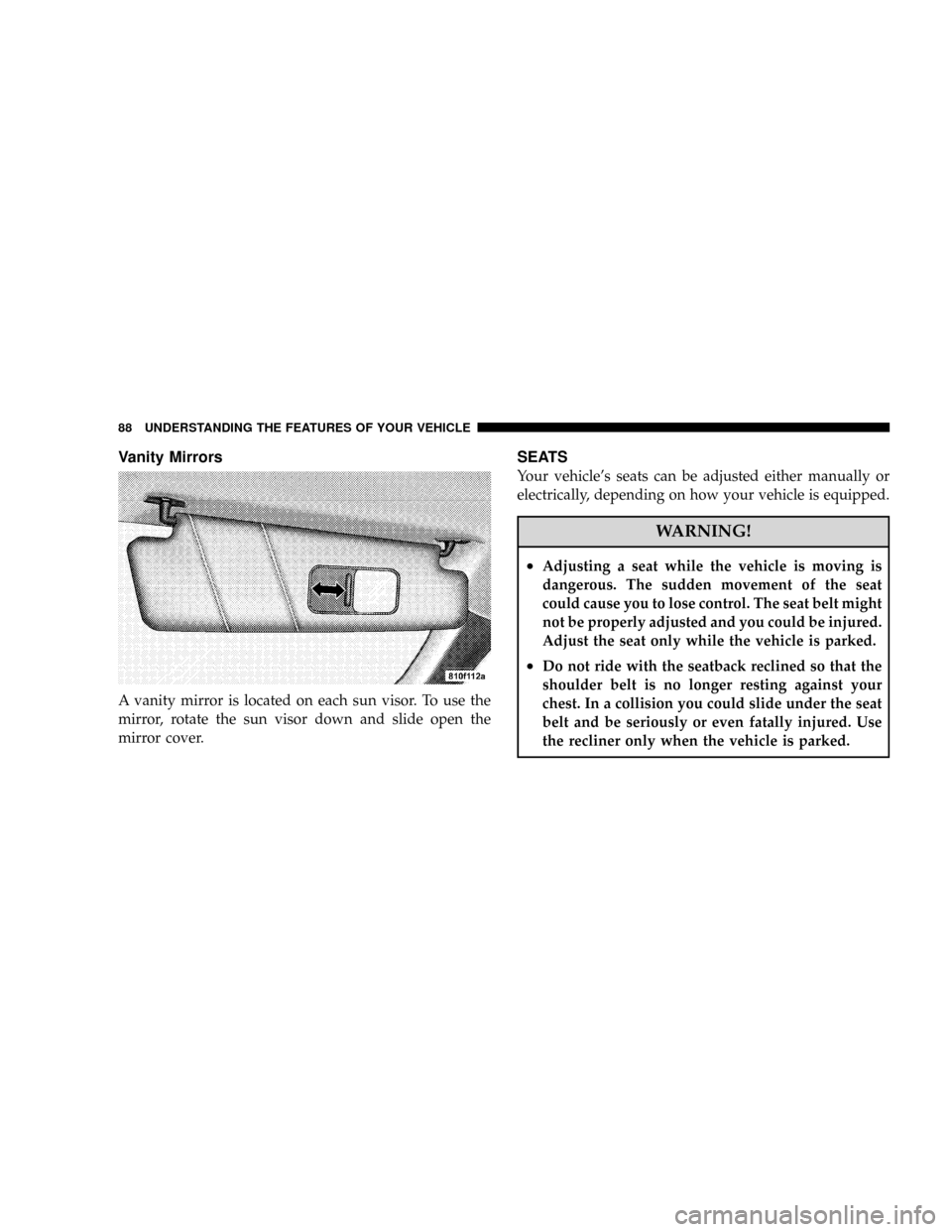
Vanity Mirrors
A vanity mirror is located on each sun visor. To use the
mirror, rotate the sun visor down and slide open the
mirror cover.
SEATS
Your vehicle's seats can be adjusted either manually or
electrically, depending on how your vehicle is equipped.
WARNING!
²Adjusting a seat while the vehicle is moving is
dangerous. The sudden movement of the seat
could cause you to lose control. The seat belt might
not be properly adjusted and you could be injured.
Adjust the seat only while the vehicle is parked.
²Do not ride with the seatback reclined so that the
shoulder belt is no longer resting against your
chest. In a collision you could slide under the seat
belt and be seriously or even fatally injured. Use
the recliner only when the vehicle is parked.
88 UNDERSTANDING THE FEATURES OF YOUR VEHICLE
Page 137 of 358
BAS/ESP warning indicator light also comes on when a
malfunction is detected in either the Brake Assist System
or the Electronic Stability Program. It should go out with
the engine running. If the BAS/ESP indicator light comes
on continuously, see an authorized dealer as soon as
possible.
14. Seat Belt Indicator Light
With the key in the ignition, the light comes on,
and a warning sounds for a short time if the
driver's seat belt is not fastened.
After starting the engine, the seat belt indicator light
blinks and a chime sounds periodically for up to 90
seconds to remind the driver and passenger to fasten the
seat belts. Fastening the seat belts will extinguish the
light and silence the chime.The seat belt indicator light will remain lit until the seat
belts are fastened.
15. Charging System Indicator Light
Should the charging system indicator light fail
to come on prior to starting when the key is in
the ignition switch in the ON/RUN position,
or should it fail to go out after starting or
during operation, it indicates a malfunction that must be
repaired immediately at an authorized dealer.
If the charging system indicator light comes on, or a loss
of power steering assistance is noticeable while the
engine is running, this may indicate that the accessory
drive belt has broken. Should this condition occur, the
belt must be replaced before continuing to operate the
vehicle.
UNDERSTANDING YOUR INSTRUMENT PANEL 135
4
Page 138 of 358
CAUTION!
The accessory drive belt also drives the water pump.
Operating the vehicle with a failed belt can cause
engine overheating and possible severe engine
damage.
16. High Beam Indicator Light
This indicator will illuminate when the head-
lights are in the high beam setting.
To activate the high beams, push the multifunction
control lever past the point of resistance, toward the
instrument panel.17. Electronic Digital Clock
A digital readout in the instrument cluster shows the
time in hours and minutes whenever the ignition switch
is in the ON/RUN or ACC position.
When the ignition switch is in the OFF/LOCK position,
timekeeping is accurately maintained.
The display can be adjusted with the knob/button lo-
cated to the left of the clock.
18. Gear Indicator
For automatic transmission vehicles, the current gear
shift selector range is indicated in the gear range indica-
tor display.
19. Push Button for Time Setting
To adjust the time display, turn the key in the ignition
switch to the ON/RUN or ACC position. The knob/
button located just to the left of the clock is used to
136 UNDERSTANDING YOUR INSTRUMENT PANEL
Page 246 of 358
4. Connect one end of a jumper cable to the positive
jump-start attachment of the booster battery. Connect the
other end of the same cable to the positive jump-start
attachment of the discharged battery.
5. Connect the other cable, first to the negative jump-
start attachment of the booster battery and then to the
engine of the vehicle with the discharged battery. Make
sure you have good contact on the engine.
6. Start the engine in the vehicle which has the booster
battery, let the engine idle a few minutes, then start the
engine in the vehicle with the discharged battery.
7. When removing the jumper cables, reverse the above
sequence exactly. Be careful of the moving belts and fans.
NOTE:If engine does not run after several unsuccessful
starting attempts, have it checked at the nearest autho-
rized dealer.FREEING A STUCK VEHICLE
In order to free a stuck vehicle you must turn off the
Electronic Stability Program (ESP) before attempting to
ªrockº the vehicle.
If your vehicle becomes stuck in mud, sand or snow, it
can often be moved by a rocking motion. Turn your
steering wheel right and left to clear the area around the
front wheels. Then shift back and forth between RE-
VERSE and DRIVE. Usually the least accelerator pedal
pressure to maintain the rocking motion without spin-
ning the wheels is most effective.
NOTE:ESP should be turned on again after freeing the
vehicle from a stuck condition.
244 WHAT TO DO IN EMERGENCIES