warning light CHRYSLER CROSSFIRE 2008 1.G User Guide
[x] Cancel search | Manufacturer: CHRYSLER, Model Year: 2008, Model line: CROSSFIRE, Model: CHRYSLER CROSSFIRE 2008 1.GPages: 358, PDF Size: 4.7 MB
Page 92 of 358
Forward/Rearward
²
Pull up on handle 4.
²Move the seat forward or backward to your desired
position which allows you to reach the pedals com-
fortably.
²Let go of handle 4. The seat should make an audible
click when positioned properly.
²Check for proper engagement before driving.
Backrest Tilt
²
Turn handwheel 2 forward or backward to adjust the
backrest tilt to your desired position which allows
your arms to slightly bend when holding the steering
wheel.
Head Restraint Height
WARNING!
For your protection, drive only with properly posi-
tioned head restraints.
Adjust head restraint to support the back of the head
approximately at ear level.
Do not drive the vehicle without the seat head
restraints. Head restraints are intended to help re-
duce injuries during and accident.
²Adjust the height of the head restraints by pulling
them upwards manually.
²For a lower position, press release button 1 and push
down on the head restraints manually.
90 UNDERSTANDING THE FEATURES OF YOUR VEHICLE
Page 96 of 358
WARNING!
If the hood is not fully latched, it could fly up when
the vehicle is moving, and block your forward vision.
You could have a collision. Be sure all hood latches
are fully latched before driving.
INTERIOR LIGHTS
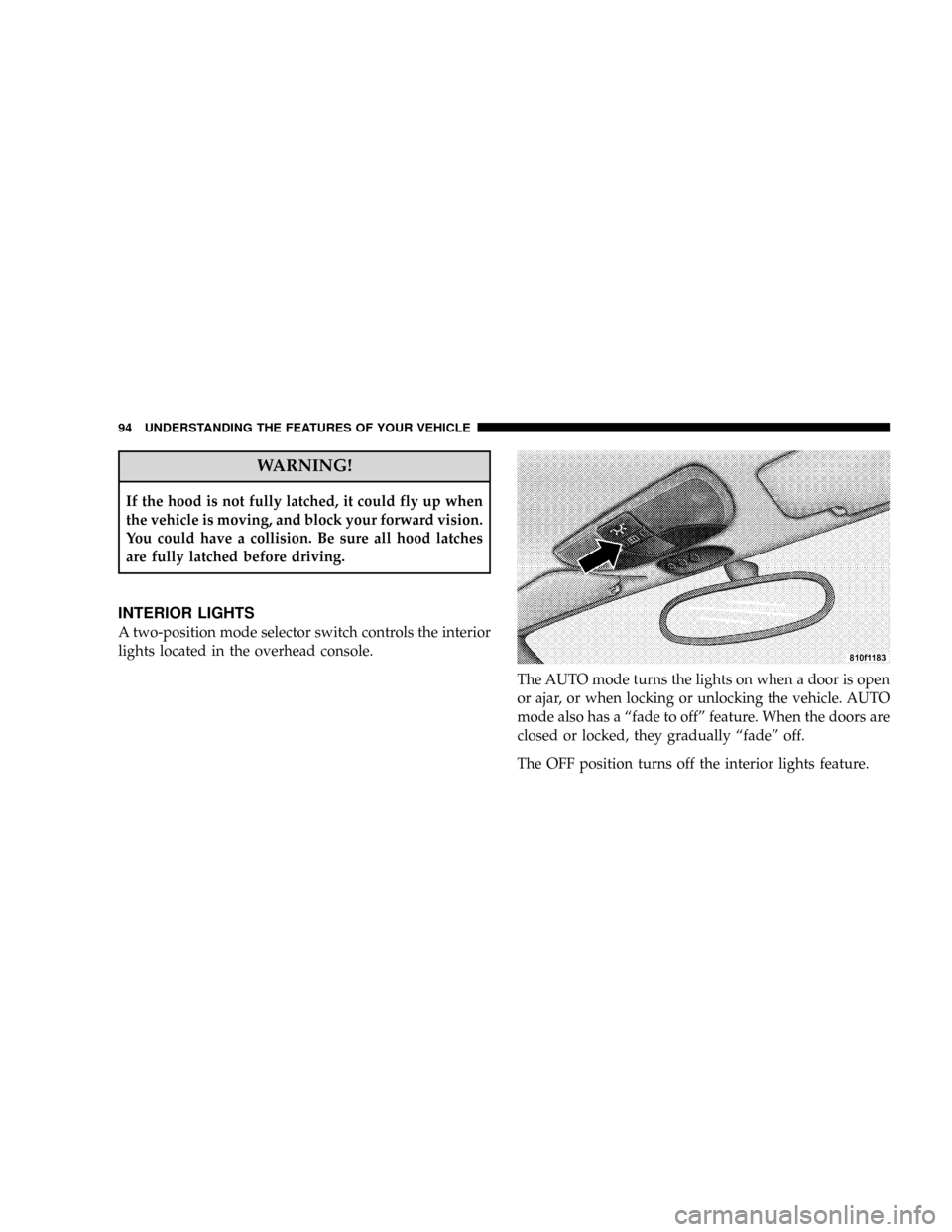
A two-position mode selector switch controls the interior
lights located in the overhead console.
The AUTO mode turns the lights on when a door is open
or ajar, or when locking or unlocking the vehicle. AUTO
mode also has a ªfade to offº feature. When the doors are
closed or locked, they gradually ªfadeº off.
The OFF position turns off the interior lights feature.
94 UNDERSTANDING THE FEATURES OF YOUR VEHICLE
Page 99 of 358
EXTERIOR LIGHTS
Headlights and Parking Lights
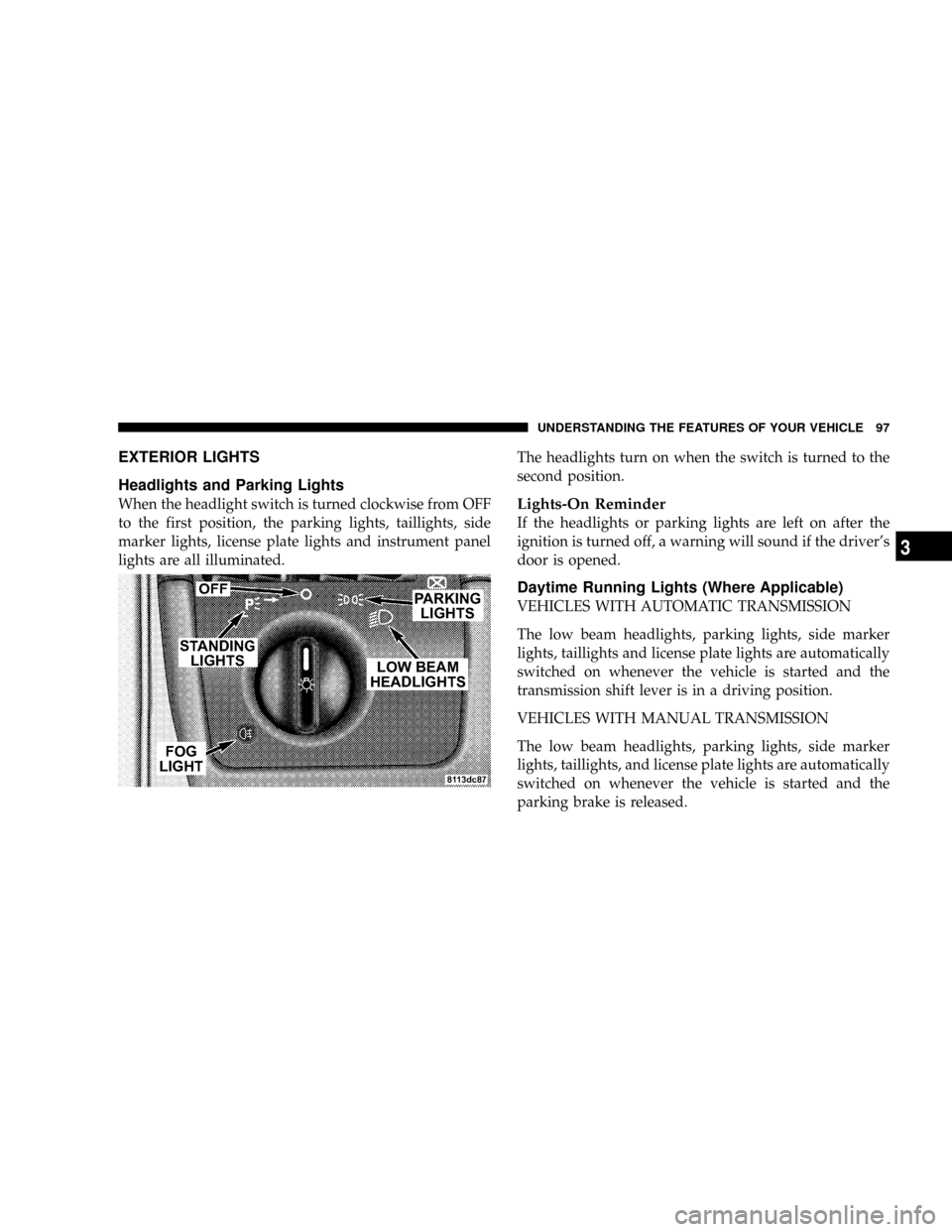
When the headlight switch is turned clockwise from OFF
to the first position, the parking lights, taillights, side
marker lights, license plate lights and instrument panel
lights are all illuminated.The headlights turn on when the switch is turned to the
second position.Lights-On Reminder
If the headlights or parking lights are left on after the
ignition is turned off, a warning will sound if the driver's
door is opened.
Daytime Running Lights (Where Applicable)
VEHICLES WITH AUTOMATIC TRANSMISSION
The low beam headlights, parking lights, side marker
lights, taillights and license plate lights are automatically
switched on whenever the vehicle is started and the
transmission shift lever is in a driving position.
VEHICLES WITH MANUAL TRANSMISSION
The low beam headlights, parking lights, side marker
lights, taillights, and license plate lights are automatically
switched on whenever the vehicle is started and the
parking brake is released.
UNDERSTANDING THE FEATURES OF YOUR VEHICLE 97
3
Page 107 of 358
WARNING!
Do not adjust the steering wheel while driving. The
telescoping adjustment must be locked while driv-
ing. Adjusting the steering wheel while driving, or
driving without the telescoping adjustment locked
could cause the driver to lose control of the vehicle.
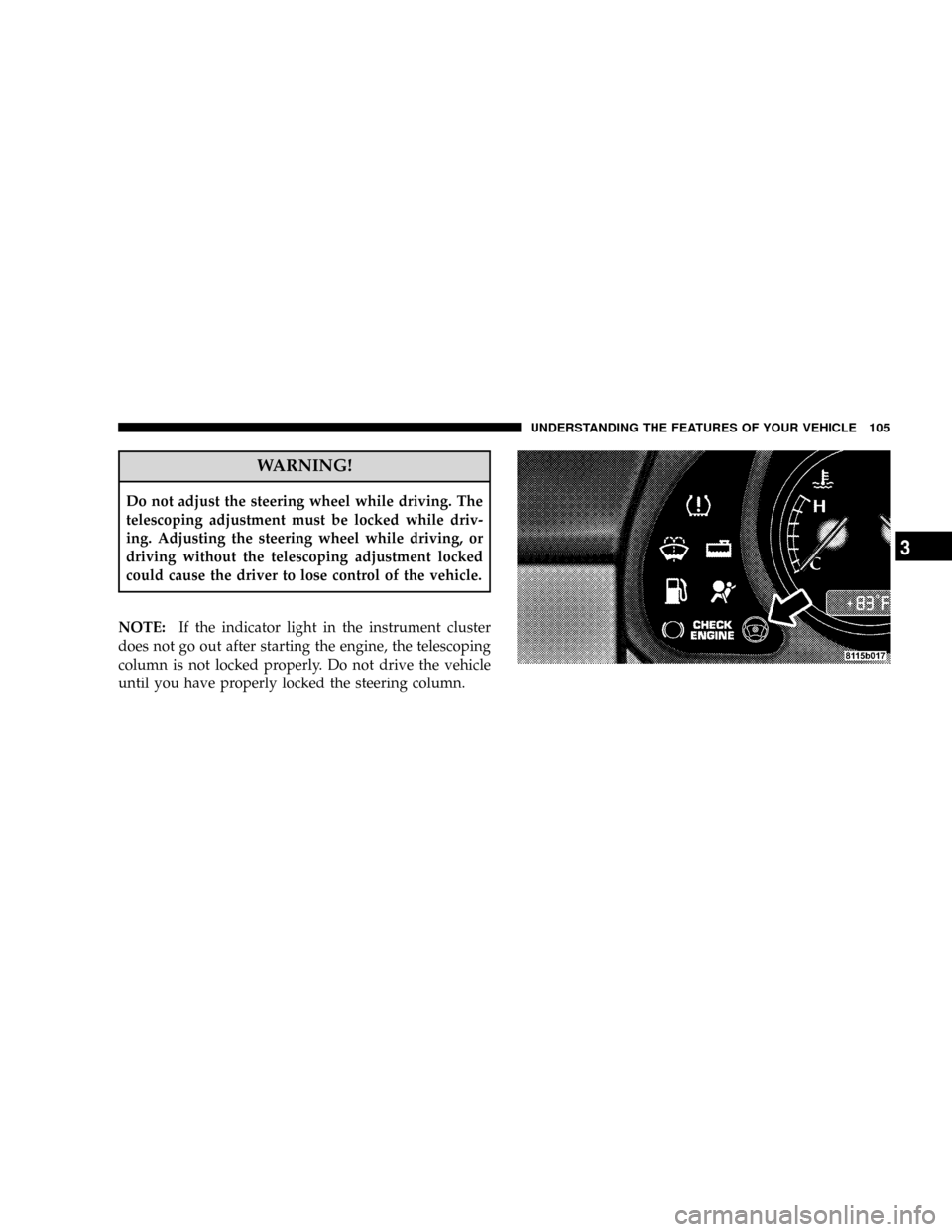
NOTE:If the indicator light in the instrument cluster
does not go out after starting the engine, the telescoping
column is not locked properly. Do not drive the vehicle
until you have properly locked the steering column.
UNDERSTANDING THE FEATURES OF YOUR VEHICLE 105
3
Page 109 of 358
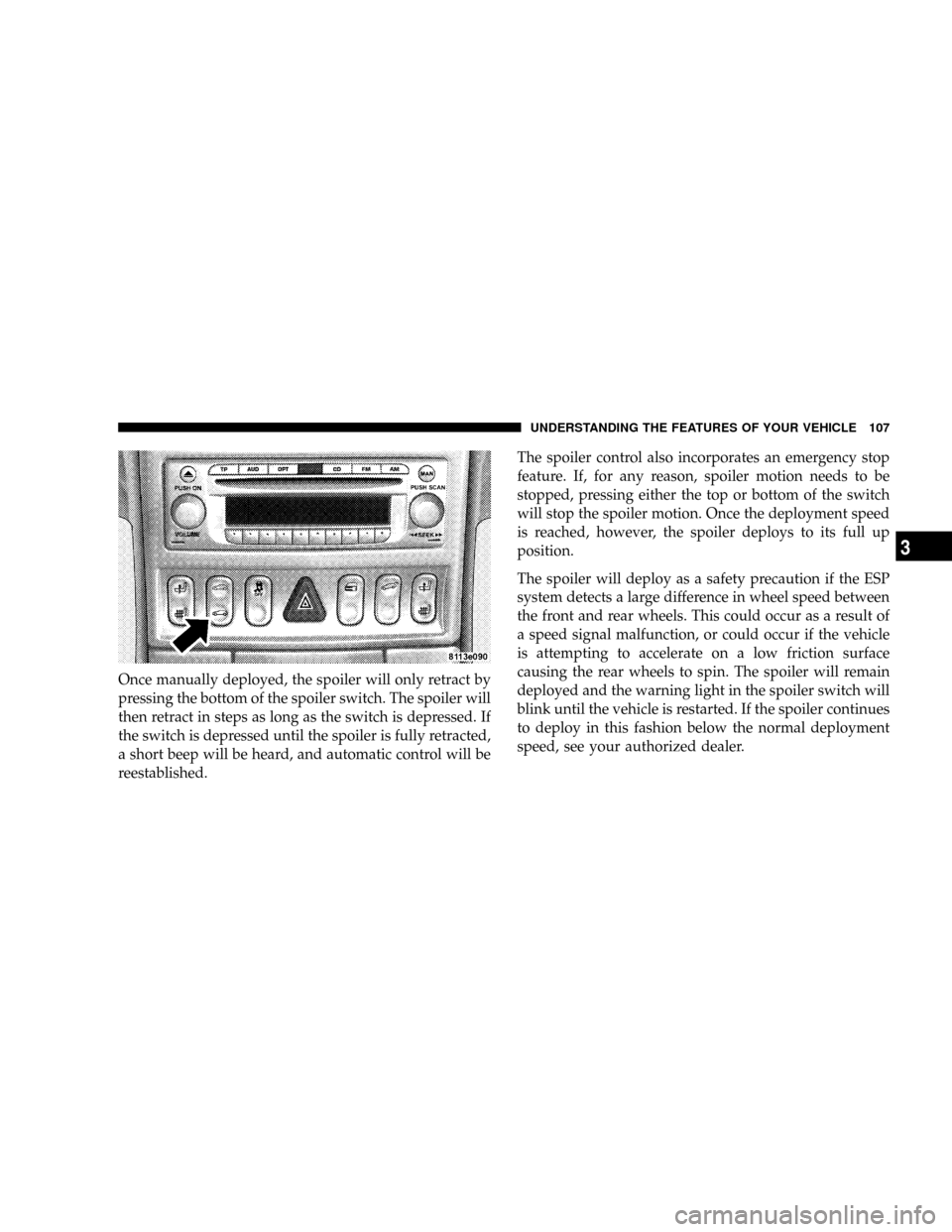
Once manually deployed, the spoiler will only retract by
pressing the bottom of the spoiler switch. The spoiler will
then retract in steps as long as the switch is depressed. If
the switch is depressed until the spoiler is fully retracted,
a short beep will be heard, and automatic control will be
reestablished.The spoiler control also incorporates an emergency stop
feature. If, for any reason, spoiler motion needs to be
stopped, pressing either the top or bottom of the switch
will stop the spoiler motion. Once the deployment speed
is reached, however, the spoiler deploys to its full up
position.
The spoiler will deploy as a safety precaution if the ESP
system detects a large difference in wheel speed between
the front and rear wheels. This could occur as a result of
a speed signal malfunction, or could occur if the vehicle
is attempting to accelerate on a low friction surface
causing the rear wheels to spin. The spoiler will remain
deployed and the warning light in the spoiler switch will
blink until the vehicle is restarted. If the spoiler continues
to deploy in this fashion below the normal deployment
speed, see your authorized dealer.
UNDERSTANDING THE FEATURES OF YOUR VEHICLE 107
3
Page 110 of 358
Should a malfunction occur that prevents the spoiler
from deploying automatically, a red warning light will
illuminate in the override switch and an audible warning
will sound.
WARNING!
Do not drive the vehicle at speeds above 62 mph (100
km/h) if the red spoiler warning indicator is illumi-
nated. You could have reduced vehicle stability and
control.
WARNING!
Keep hands and fingers away from the spoiler and
spoiler linkage when the spoiler is deploying or
retracting. The linkage could pinch your fingers and
cause serious injury.
BRAKE ASSIST SYSTEM (BAS)
WARNING!
BAS cannot prevent the natural laws of physics from
acting on the vehicle, nor can it increase braking
efficiency beyond that afforded by the condition of
the vehicle brakes and tires or the traction afforded.
The BAS cannot prevent accidents, including those
resulting from excessive speed in turns, following
another vehicle too closely, or hydroplaning. Only a
safe, attentive, and skillful driver can prevent acci-
dents. The capabilities of a BAS-equipped vehicle
must never be exploited in a reckless or dangerous
manner which could jeopardize the user's safety or
the safety of others.
108 UNDERSTANDING THE FEATURES OF YOUR VEHICLE
Page 112 of 358
The malfunction indicator lamp for the Electronic Stabil-
ity Program (ESP) is combined with the BAS. The yellow
BAS/ESP malfunction indicator light in the instrument
cluster and the yellow ESP warning light in the speed-
ometer dial come on with the key in the ignition switch
turned to the ON/RUN position. They should go out
with the engine running. If the BAS/ESP malfunction
indicator light comes on continuously with the engine
running, a malfunction has been detected in either sys-
tem.
If the malfunction indicator light stays illuminated, have
the BAS and ESP checked at your authorized dealer as
soon as possible.ELECTRONIC STABILITY PROGRAM (ESP)
WARNING!
ESP cannot prevent the natural laws of physics from
acting on the vehicle, nor can it increase the traction
afforded. The ESP cannot prevent accidents, includ-
ing those resulting from excessive speed in turns, or
hydroplaning. Only a safe, attentive, and skillful
driver can prevent accidents. The capabilities of an
ESP-equipped vehicle must never be exploited in a
reckless or dangerous manner which could jeopar-
dize the user's safety or the safety of others.
The ESP enhances directional control and reduces driving
wheel spin of the vehicle under various driving condi-
tions.
110 UNDERSTANDING THE FEATURES OF YOUR VEHICLE
Page 113 of 358
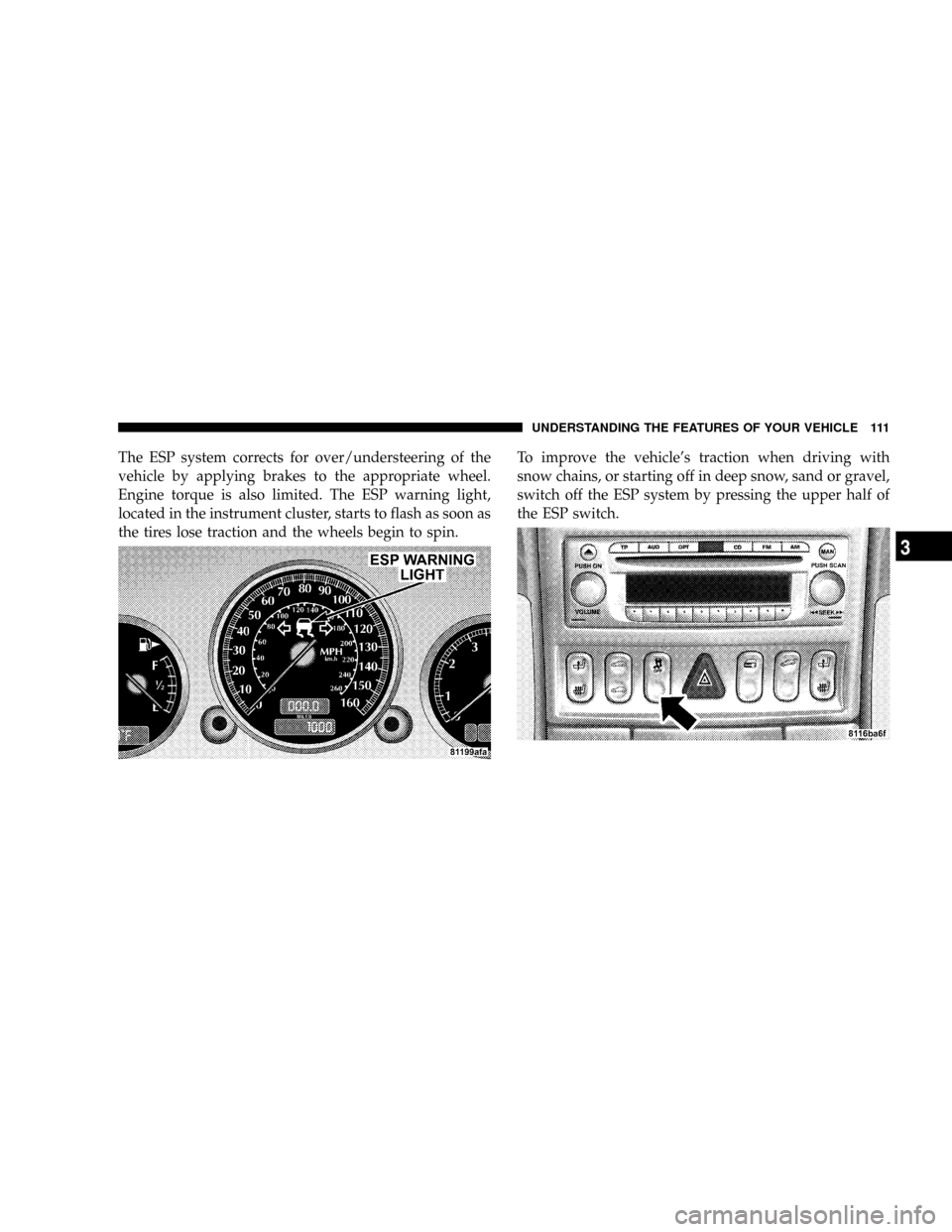
The ESP system corrects for over/understeering of the
vehicle by applying brakes to the appropriate wheel.
Engine torque is also limited. The ESP warning light,
located in the instrument cluster, starts to flash as soon as
the tires lose traction and the wheels begin to spin.To improve the vehicle's traction when driving with
snow chains, or starting off in deep snow, sand or gravel,
switch off the ESP system by pressing the upper half of
the ESP switch.
UNDERSTANDING THE FEATURES OF YOUR VEHICLE 111
3
Page 114 of 358
With the ESP system switched off, the engine torque
reduction feature is cancelled. Therefore, the enhanced
vehicle stability offered by ESP is unavailable. ESP al-
ways operates under braking, even with the switch in the
OFF position. If one drive wheel loses traction and begins
to spin, the brake is applied by the ESP system until the
wheel regains sufficient traction. The traction control
engages at approximately 24 mph (40 km/h), and
switches off at 50 mph (80 km/h).
If the ESP warning light begins to flash during accelera-
tion, ease up on the accelerator and apply as little throttle
as possible. Be sure to adapt your speed and driving to
the prevailing road conditions. When the ESP warning
light is illuminated continuously, the ESP is switched off.
To return to the enhanced vehicle stability offered by ESP,press the lower half of the switch (the ESP warning light
in the speedometer dial goes out). Avoid spinning one
drive wheel. This may cause serious damage to the drive
train and is not covered by the DaimlerChrysler war-
ranty.
CAUTION!
If the vehicle is towed with the front axle raised, the
engine must be shut off (key in the ignition switch to
the OFF/LOCK or ACC position). Otherwise the ESP
will immediately be engaged and will apply the rear
wheel brakes.
112 UNDERSTANDING THE FEATURES OF YOUR VEHICLE
Page 117 of 358
WARNING!
Leaving the electronic speed control system on when
not in use is dangerous. You could accidentally set
the system or cause it to go faster than you want. You
could lose control and have an accident. Always
leave the system OFF when you are not using it.
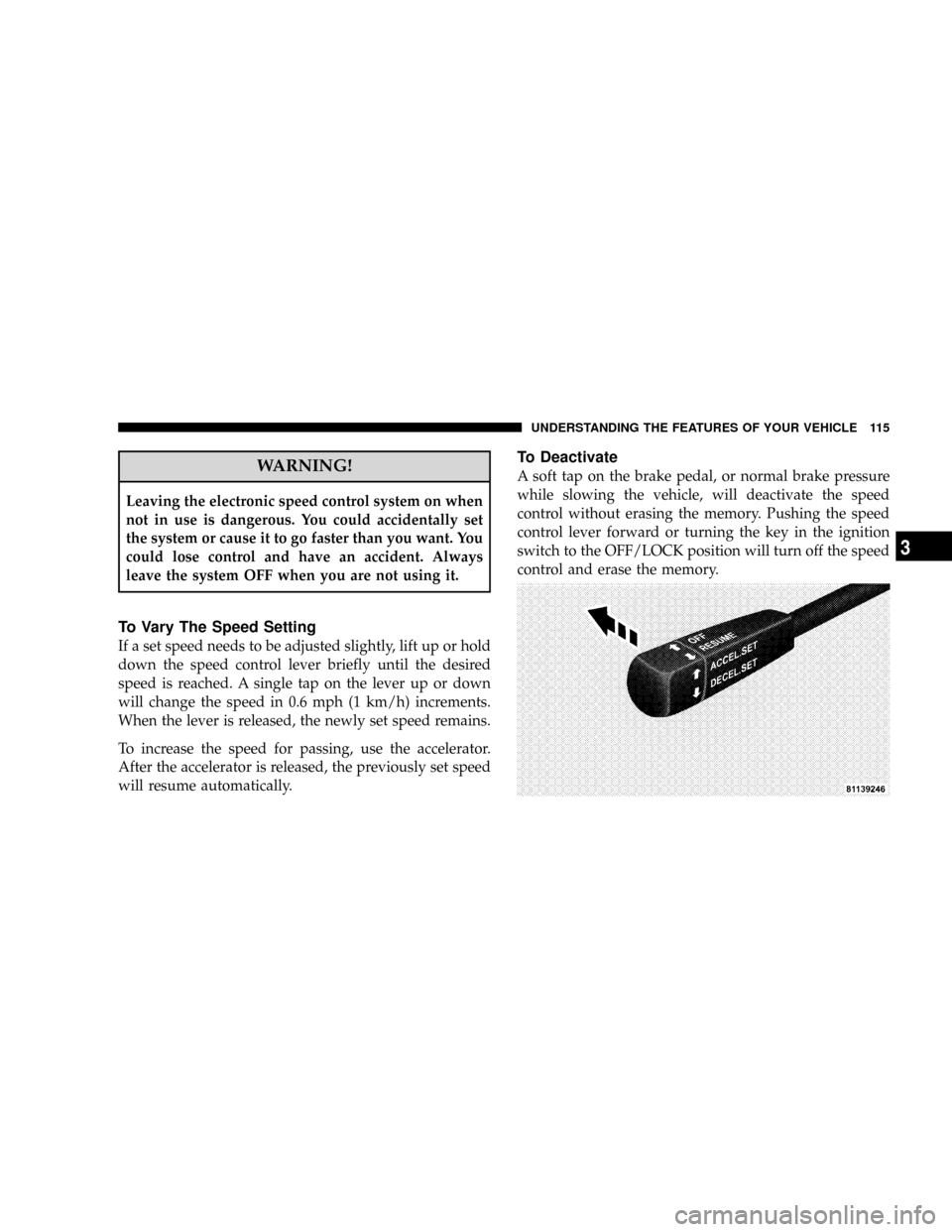
To Vary The Speed Setting
If a set speed needs to be adjusted slightly, lift up or hold
down the speed control lever briefly until the desired
speed is reached. A single tap on the lever up or down
will change the speed in 0.6 mph (1 km/h) increments.
When the lever is released, the newly set speed remains.
To increase the speed for passing, use the accelerator.
After the accelerator is released, the previously set speed
will resume automatically.
To Deactivate
A soft tap on the brake pedal, or normal brake pressure
while slowing the vehicle, will deactivate the speed
control without erasing the memory. Pushing the speed
control lever forward or turning the key in the ignition
switch to the OFF/LOCK position will turn off the speed
control and erase the memory.
UNDERSTANDING THE FEATURES OF YOUR VEHICLE 115
3