warning light CHRYSLER CROSSFIRE 2008 1.G Owner's Manual
[x] Cancel search | Manufacturer: CHRYSLER, Model Year: 2008, Model line: CROSSFIRE, Model: CHRYSLER CROSSFIRE 2008 1.GPages: 358, PDF Size: 4.7 MB
Page 121 of 358
WARNING!
Your motorized door or gate will open and close
while you are programming the universal trans-
ceiver. Do not program the transceiver if people or
pets are in the path of the door or gate. A moving
door or gate can cause serious injury or death to
people and pets or damage to objects.
2. Turn the ignition to the ON/RUN position.
3. Erase the factory test codes by pressing the two
outside buttons. Release the buttons when the light in the
overhead console display begins to flash (about 20 sec-
onds).
NOTE:Step 3 does not have to be followed to program
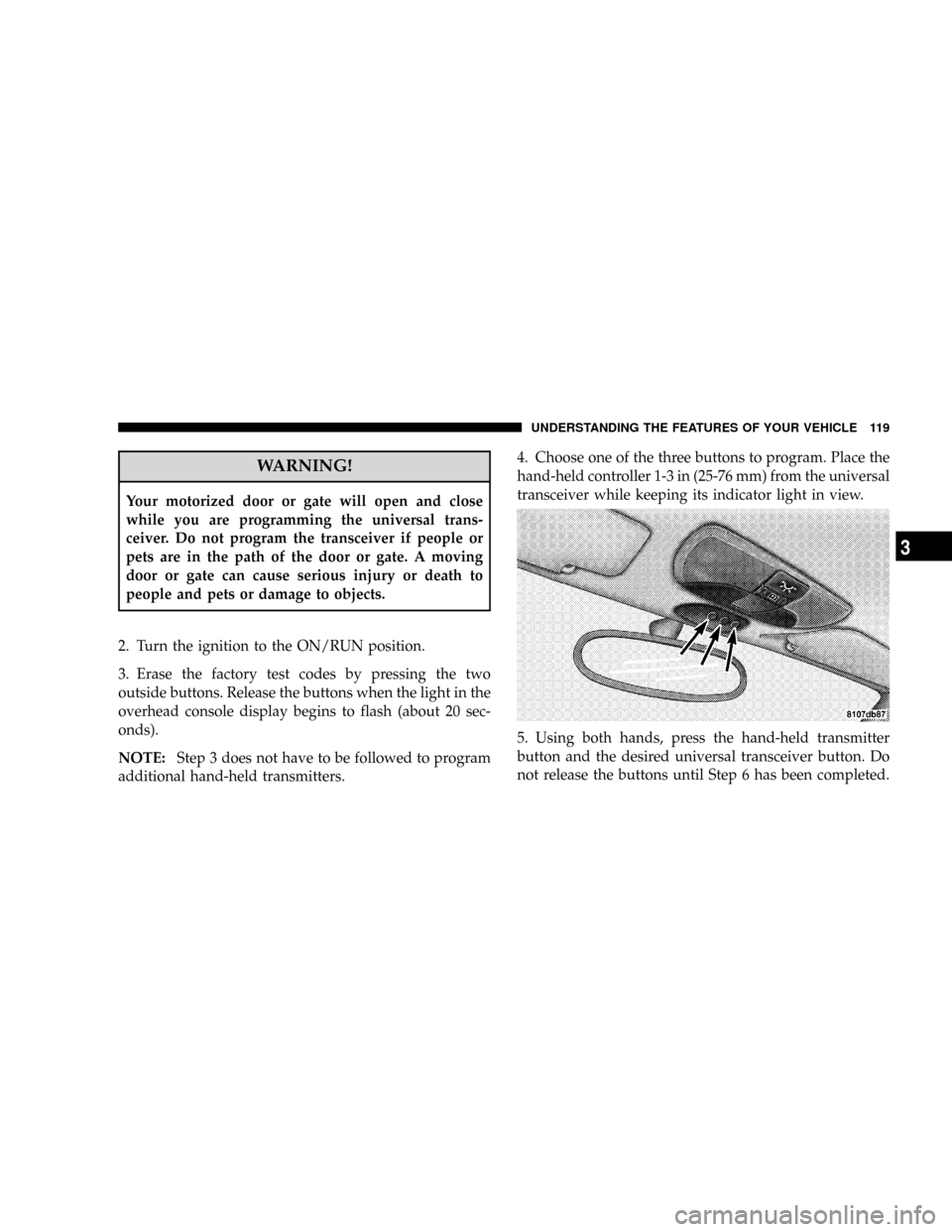
additional hand-held transmitters.4. Choose one of the three buttons to program. Place the
hand-held controller 1-3 in (25-76 mm) from the universal
transceiver while keeping its indicator light in view.
5. Using both hands, press the hand-held transmitter
button and the desired universal transceiver button. Do
not release the buttons until Step 6 has been completed.
UNDERSTANDING THE FEATURES OF YOUR VEHICLE 119
3
Page 131 of 358
INSTRUMENT CLUSTER DESCRIPTION
1. Low Windshield Washer System Fluid Level
Warning Light
With the key in the ignition switch turned to
the ON/RUN position, the indicator light
comes on. It should go out when the engine is
running.
If the indicator light does not go out after starting the
engine, or if it comes on while driving, the fluid reservoir
is less than
1¤4filled.
The reservoir should be refilled at the next opportunity
with commercially available premixed windshield
washer solvent/antifreeze or water, depending on ambi-
ent temperature.
The reservoir for the windshield washer system is located
in the engine compartment and the cap is marked with
the above symbol.
WARNING!
Do not overfill the washer reservoir. Do not attempt
to fill to the top of the filler neck. Fluid may leak out
onto the floor or driveway causing a potential slip
and fall hazard. When the indicator light first illumi-
nates, the maximum fill amount is 1 gal (4 L).
2. Tire Pressure Monitoring Indicator Light
Each tire, including the spare (if provided),
should be checked monthly when cold and
inflated to the inflation pressure recommended
by the vehicle manufacturer on the vehicle
placard or tire inflation pressure label. If your vehicle has
tires of a different size than the size indicated on the
vehicle placard or tire inflation pressure label, you should
determine the proper tire inflation pressure for those
tires.
UNDERSTANDING YOUR INSTRUMENT PANEL 129
4
Page 133 of 358
3. Coolant Indicator Light
This indicator illuminates when the engine
coolant has dropped below the required level
in the reservoir or the coolant temperature is
too high (see the Temperature gauge section).
To check the coolant level, the vehicle must be parked on
level ground and the engine stopped.
Check coolant level only when the coolant is cold.
WARNING!
You or others can be badly burned by hot coolant or
steam from your radiator. If you see or hear steam
coming from under the hood, don't open the hood
until the radiator has had time to cool. Never try to
open a cooling system pressure cap when the radiator
or coolant bottle is hot.4. Engine Coolant Temperature Gauge
This gauge shows engine coolant temperature. Any read-
ing between the Hot and Cold gauge marks show that the
engine cooling system is operating properly. The gauge
pointer may show a higher temperature when driving in
hot weather, up mountain grades, or in heavy stop-and-
go-traffic.
If the pointer rises to the red (Hot) area, stop the vehicle
and turn off the engine until the problem is corrected.
CAUTION!
Continuing to drive with an overheated engine cool-
ing system can cause damage to the engine or other
components.
UNDERSTANDING YOUR INSTRUMENT PANEL 131
4
Page 135 of 358
The red markings on the tachometer indicate excessive
engine speed. Ease off on the accelerator before reaching
the red area.
10. Brake System Warning Light
The dual brake system provides a reserve brak-
ing capability if a failure occurs in a portion of
the hydraulic system.
This light monitors both the brake fluid level and the
parking brake. If the light comes on, it indicates either
that the parking brake is on or there is a low fluid level in
the brake master cylinder. Since this vehicle is equipped
with Anti-Lock Brakes (ABS), the brake light may also
indicate reduced braking performance due to the loss of
electronic brake proportioning. If the parking brake is off
and the light remains on, have the brake system in-
spected as soon as possible.The warning light should be checked frequently to assure
that it is operating properly. This can be done by turning
the ignition switch to START. The light should come on.
If the red brake light does not come on when the ignition
is turned to the ON/RUN position, have the brake
warning light repaired promptly.
WARNING!
Driving a vehicle with the brake light on is danger-
ous. Part of the brake system may have failed. It will
take longer to stop the vehicle. You could have an
accident. Have the vehicle checked immediately.
NOTE:This light shows only that the parking brake is
on. It does not show the degree of brake application.
The brake warning light will come on if the ABS light is
not functioning and there is an ABS system malfunction.
UNDERSTANDING YOUR INSTRUMENT PANEL 133
4
Page 136 of 358
11. Light Outage Indicator
With the key in the ignition switch turned to
the ON/RUN position, an indicator light
comes on. It should go out when the engine is
running. If the indicator light does not go out
after starting the engine, or if it comes on while driving,
it indicates a failure in the parking light, taillight, stop-
light, low beam headlight, or other exterior lamps.
The indicator light will come on when the exterior light
fails. If a brake light fails, the light outage indicator will
come on when applying the brake and stays on until the
engine is turned off.
NOTE:If additional lighting equipment is installed
(e.g., auxiliary headlights, etc.) be certain to connect into
the fuse before the failure indicator monitoring unit in
order to avoid damaging the system.12. Antilock Warning Indicator Light
The ABS warning indicator light comes on with
the key in the ignition switch turned to the
ON/RUN position, and should go out with the
engine running.
If the ABS warning indicator light comes on while the
engine is running, it indicates that the ABS has detected
a malfunction and has switched off. In this case, the brake
system functions in the usual manner, but without an-
tilock assistance.
If the ABS light is on, have the system checked at your
authorized dealer as soon as possible.
13. Brake Assist Indicator Light
The indicator light for the Brake Assist System
(BAS) is combined with the Electronic Stability
Program (ESP). This yellow indicator light in
the instrument cluster comes on with the key in the
ignition switch turned to the ON/RUN position. The
134 UNDERSTANDING YOUR INSTRUMENT PANEL
Page 137 of 358
BAS/ESP warning indicator light also comes on when a
malfunction is detected in either the Brake Assist System
or the Electronic Stability Program. It should go out with
the engine running. If the BAS/ESP indicator light comes
on continuously, see an authorized dealer as soon as
possible.
14. Seat Belt Indicator Light
With the key in the ignition, the light comes on,
and a warning sounds for a short time if the
driver's seat belt is not fastened.
After starting the engine, the seat belt indicator light
blinks and a chime sounds periodically for up to 90
seconds to remind the driver and passenger to fasten the
seat belts. Fastening the seat belts will extinguish the
light and silence the chime.The seat belt indicator light will remain lit until the seat
belts are fastened.
15. Charging System Indicator Light
Should the charging system indicator light fail
to come on prior to starting when the key is in
the ignition switch in the ON/RUN position,
or should it fail to go out after starting or
during operation, it indicates a malfunction that must be
repaired immediately at an authorized dealer.
If the charging system indicator light comes on, or a loss
of power steering assistance is noticeable while the
engine is running, this may indicate that the accessory
drive belt has broken. Should this condition occur, the
belt must be replaced before continuing to operate the
vehicle.
UNDERSTANDING YOUR INSTRUMENT PANEL 135
4
Page 142 of 358
the displayed temperature can only be verified by com-
parison to a thermometer placed next to the sensor, not
by comparison to external displays (e.g., bank signs, etc.).
Adaptation to ambient temperature takes place in steps
and depends on the prevailing driving conditions (stop-
and- go or moderate, constant driving) and amount of
temperature change.
WARNING!
The outside temperature indicator is not designed to
serve as an ice-warning device and is unsuitable for
that purpose. Indicated temperatures just above the
freezing point do not guarantee that the road surface
is free of ice.24. Airbag Light
The operational readiness of the airbag system
is verified by the airbag indicator light in the
instrument cluster when turning the key in the
ignition switch to the ACC or ON/RUN posi-
tion. If no fault is detected, the light will go out after
approximately four seconds. After the lamp goes out, the
system continues to monitor the components and cir-
cuitry of the airbag system and will indicate a malfunc-
tion by coming on again.
The light will come on and remain on for four seconds as
a bulb check when the ignition switch is first turned ON.
If the bulb is not lit during starting, have it replaced. If
the light stays on, or comes on while driving, have the
system checked by an authorized dealer.
140 UNDERSTANDING YOUR INSTRUMENT PANEL
Page 143 of 358
WARNING!
In the event a malfunction of the airbag is indicated,
the airbag may not be operational. For your safety, we
strongly recommend that you visit an authorized
dealer immediately to have the system checked;
otherwise the airbag may not be activated when
needed in an accident, which could result in serious
or fatal injury, or it might deploy unexpectedly and
unnecessarily which could also result in injury.
25. Telescoping Wheel Indicator Light
With the key in the ignition and turned to the
ON/RUN position, the indicator light in the
instrument cluster comes on. It should go out
when the engine is running. If the indicator
light does not go out after starting the engine, the
telescoping steering column is not locked properly.
WARNING!
Do not drive the vehicle until you have properly
locked the steering column.
26. Check Engine Light
This light is part of an Onboard Diagnostic
system that monitors the emissions and engine
control systems. If a problem is detected in one of these
systems, the Check Engine light will come on. The light
comes on and stays on briefly as a bulb check when the
ignition is first turned ON.
Certain conditions, such as a loose or missing gas cap, or
poor fuel quality may illuminate the light after the engine
is started. Be sure the gas cap is tightened every time you
refuel.
UNDERSTANDING YOUR INSTRUMENT PANEL 141
4
Page 145 of 358
position, press the knob to the left of the speedometer
once and wait seven seconds. An ISO oil level icon
appears in the trip odometer window and a ªclockº icon
in the cumulative odometer display. Pressing the knob to
the left of the speedometer twice within one second
displays one of the following messages:
²OK
²-1.0 Q (-1.0L)
²-1.5 Q (-1.5L)
²-2.0 Q (-2.0L)
²HI
The indicated amount of oil must be added to the engine
if the message -2.0 Q (-2.0L) blinks and a signal sounds.
The HI message indicates that the excess oil must be
removed from the pan to avoid possible engine or
catalytic converter damage. If the ISO oil level icon andªclockº icon remain on when attempting to check oil
level and no message follows, or if the low engine oil
level warning lamp comes on, a malfunction in the
engine oil level system is indicated. A conveniently
located dipstick allows manual checking of the oil level.
If no leaks are noted, continue to drive to the nearest
service station where the engine oil should be topped to
the ªfullº mark on the dipstick with an approved oil.
29. Low Fuel Warning Light
When the fuel level drops to about 2 gal (7.5 L), this
symbol will light and remains lit until fuel is added.
ªINFINITY MODULUSº AM/FM STEREO RADIO
WITH SINGLE-DISC CD PLAYER AND GPS
NAVIGATION
(OPTIONAL - See separate User's Manual)
UNDERSTANDING YOUR INSTRUMENT PANEL 143
4
Page 177 of 358
WARNING!
It is dangerous to shift the shift lever out of PARK or
NEUTRAL if the engine speed is higher than idle
speed. If your foot is not firmly on the brake pedal,
the vehicle could accelerate quickly forward or in
reverse. You could lose control of the vehicle and hit
someone or something. Only shift into gear when the
engine is idling normally and when your foot is
firmly on the brake pedal.
Stopping
For brief stops, leave the transmission in gear and hold
the vehicle with the brake pedal. For longer stops with
the engine idling, shift into the NEUTRAL or PARK
position and hold the vehicle with the parking brake.When stopping the vehicle uphill, do not hold it with the
accelerator; use the brake. This avoids unnecessary trans-
mission heat build-up.
Maneuvering
To maneuver in tight areas, control the vehicle speed by
gradually releasing the brakes. Accelerate gently and
never abruptly step on the accelerator.
To rock a vehicle out of soft ground (mud or snow),
alternately shift from FORWARD to REVERSE, while
applying only slight acceleration. Rocking a vehicle free
in this manner may cause the ABS or traction system
malfunction indicator light to come on. Turn off the
engine and restart the engine to clear the malfunction
indication.
STARTING AND OPERATING 175
5