ECU CHRYSLER CROSSFIRE 2008 1.G Owner's Manual
[x] Cancel search | Manufacturer: CHRYSLER, Model Year: 2008, Model line: CROSSFIRE, Model: CHRYSLER CROSSFIRE 2008 1.GPages: 358, PDF Size: 4.7 MB
Page 228 of 358
service. If the gas cap is lost or damaged, be sure the
replacement cap has been designed for use with this
vehicle.
CAUTION!
Damage to the fuel system or emission control sys-
tem could result from using an improper gas cap. A
poorly fitting cap could let impurities into the fuel
system. The CHECK ENGINE light will come on if
the gas cap is not properly secured.
NOTE:The fuel tank filler tube has a restricting door
about 2 in (50 mm) down from the opening. If fuel is
poured from a portable container, the container should
have a flexible nozzle long enough to force open the
restricting door.
CAUTION!
To avoid fuel spillage and overfilling, do not ªtop
offº the fuel tank after filling.
With the key in the ignition switch turned to the ON/
RUN position, the fuel reserve warning light comes on. It
should go out immediately when the engine is running.
If the warning light does not go out after starting the
engine, or if it comes on while driving, it indicates that
the fuel level is down to the reserve quantity of approxi-
mately 2 gal (7.5 L).
Leaving the engine running and the fuel cap open can
cause the CHECK ENGINE light to illuminate.
NOTE:
²When the fuel nozzle ªclicksº or shuts off, the fuel
tank is full.
226 STARTING AND OPERATING
Page 229 of 358
²Tighten the gas cap until you hear a single click. This
is an indication that the gas cap is properly tightened.
The CHECK ENGINE light will come on if the gas cap
is not properly secured. Make sure that the gas cap is
tightened each time the vehicle is refueled.
WARNING!
²Never have any smoking materials lit in or near
the vehicle when the gas cap is removed or the
tank is filled.
²Never add fuel to the vehicle when the engine is
running.
²A fire may result if gasoline is pumped into a
portable container that is inside of a vehicle. You
could be burned. Always place gas containers on
the ground outside the vehicle while filling.
VEHICLE LOADING
The load carrying capacity of your vehicle is in the
following chart and on the tire pressure label attached to
the driver door pillar.
Vehicle Loading Capacities
Front Seat Occupants....................... 2
Cargo Capacity (with two persons).... 115lbs(52kg)
Rated Vehicle Capacity............ 415lbs(188 kg)
STARTING AND OPERATING 227
5
Page 230 of 358
Roof Luggage Rack
Convertible Top Vehicles
CAUTION!
To prevent damage to the convertible top, DO NOT
carry any loads on the convertible top.
Coupe Vehicles
External racks do not increase the total load carrying
capacity of the vehicle. Be sure that the total occupant
and luggage load inside the vehicle, plus the load on the
roof luggage rack, do not exceed the rated vehicle capac-
ity. The maximum recommended roof load for your
vehicle is 110 lbs (50 kg).
CAUTION!
²To prevent damage to the roof of your vehicle, DO NOT
carry any loads on the roof luggage rack which may come
in contact with the roof panel. The load should be secured
and placed on top of the rack, not directly on the roof. If it
is necessary to place some part of the load on the roof,
place a blanket or some other protection between the load
and the roof surface.
²To avoid damage to the roof luggage rack and vehicle, do
not exceed the rated load capacity of your roof luggage
rack system maximum load capacity. Always distribute
heavy loads as evenly as possible and secure the load
appropriately.
²Long loads which extend over the windshield, such as
wood panels or surfboards, should be carefully secured to
both the front and rear of the vehicle.
²Travel at reduced speeds and turn corners carefully when
carrying large or heavy loads on the roof luggage rack.
Wind forces, due to natural causes or nearby truck traffic,
can add sudden upward loads. This is especially true on
large flat loads and may result in damage to the cargo or
your vehicle.
228 STARTING AND OPERATING
Page 231 of 358
WARNING!
Cargo must be securely tied before driving your
vehicle. Improperly secured loads can fly off the
vehicle, particularly at high speeds, resulting in per-
sonal injury or property damage. Follow the roof
luggage rack ªCautionsº when carrying cargo on
your roof rack.
TRAILER TOWING
Trailer towing with your vehicle is not recommended.
STARTING AND OPERATING 229
5
Page 242 of 358
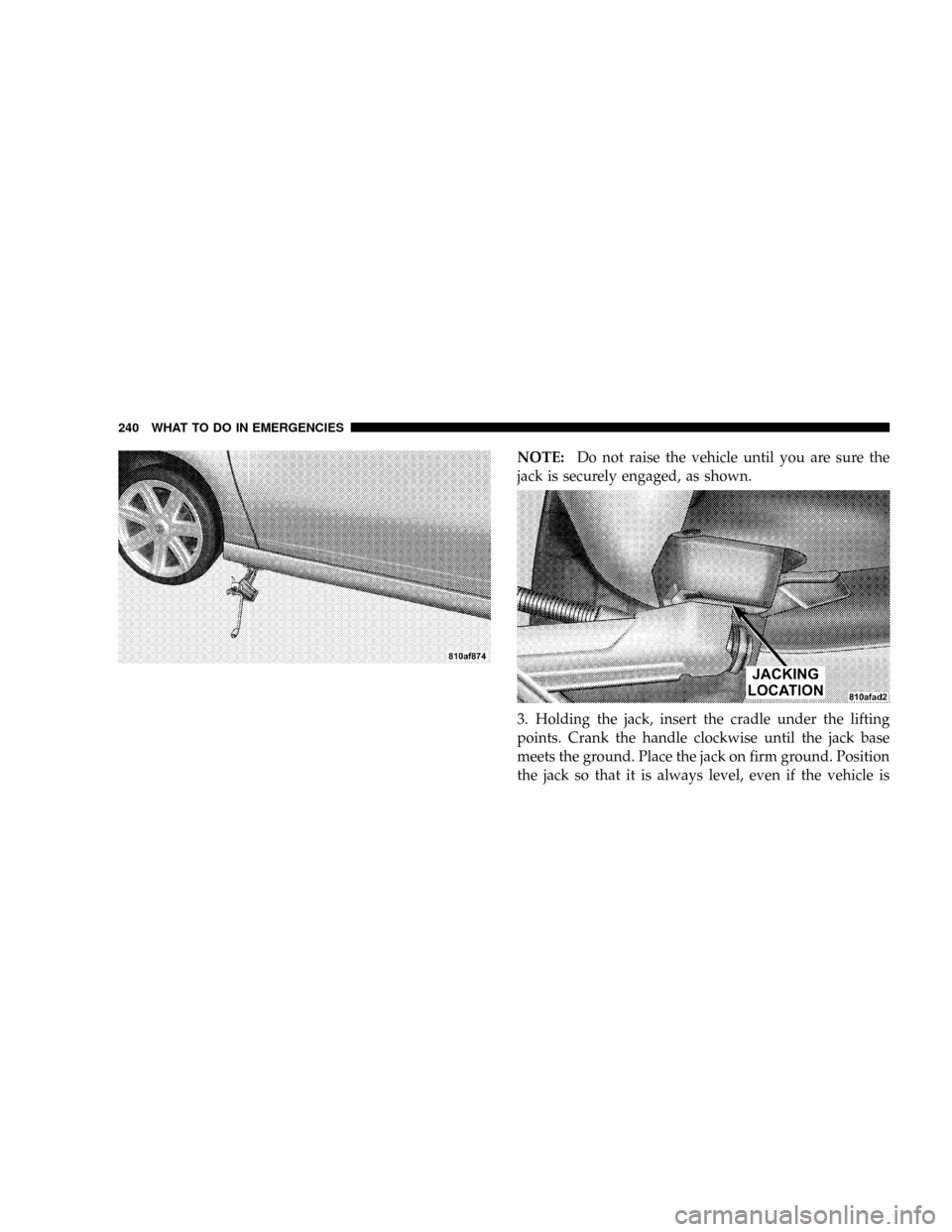
NOTE:Do not raise the vehicle until you are sure the
jack is securely engaged, as shown.
3. Holding the jack, insert the cradle under the lifting
points. Crank the handle clockwise until the jack base
meets the ground. Place the jack on firm ground. Position
the jack so that it is always level, even if the vehicle is
240 WHAT TO DO IN EMERGENCIES
Page 251 of 358
vehicle is immediately lowered. To cancel the alarm,
insert the key in the ignition switch or press the TRANS-
MIT button on the key fob.
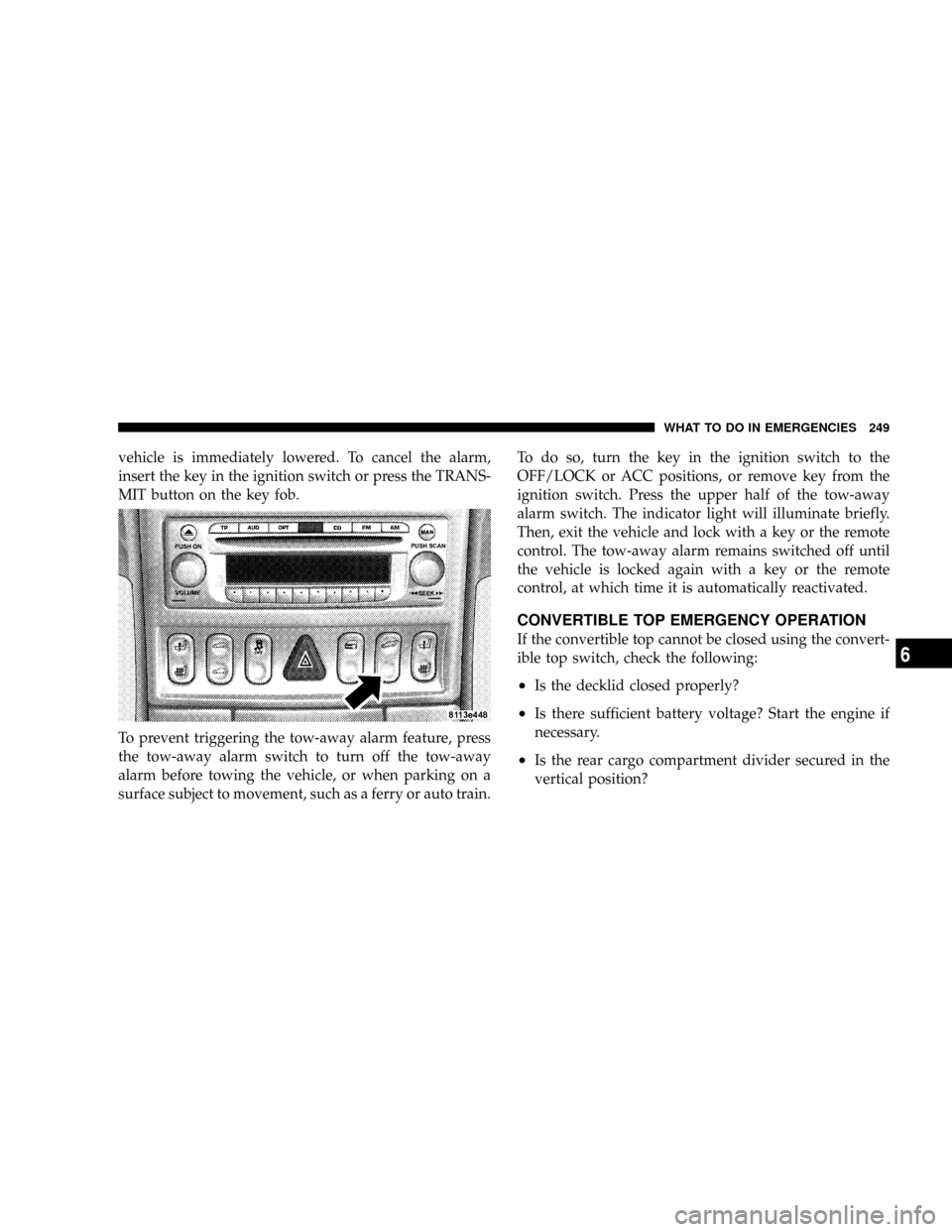
To prevent triggering the tow-away alarm feature, press
the tow-away alarm switch to turn off the tow-away
alarm before towing the vehicle, or when parking on a
surface subject to movement, such as a ferry or auto train.To do so, turn the key in the ignition switch to the
OFF/LOCK or ACC positions, or remove key from the
ignition switch. Press the upper half of the tow-away
alarm switch. The indicator light will illuminate briefly.
Then, exit the vehicle and lock with a key or the remote
control. The tow-away alarm remains switched off until
the vehicle is locked again with a key or the remote
control, at which time it is automatically reactivated.
CONVERTIBLE TOP EMERGENCY OPERATION
If the convertible top cannot be closed using the convert-
ible top switch, check the following:
²Is the decklid closed properly?
²Is there sufficient battery voltage? Start the engine if
necessary.
²Is the rear cargo compartment divider secured in the
vertical position?
WHAT TO DO IN EMERGENCIES 249
6
Page 254 of 358
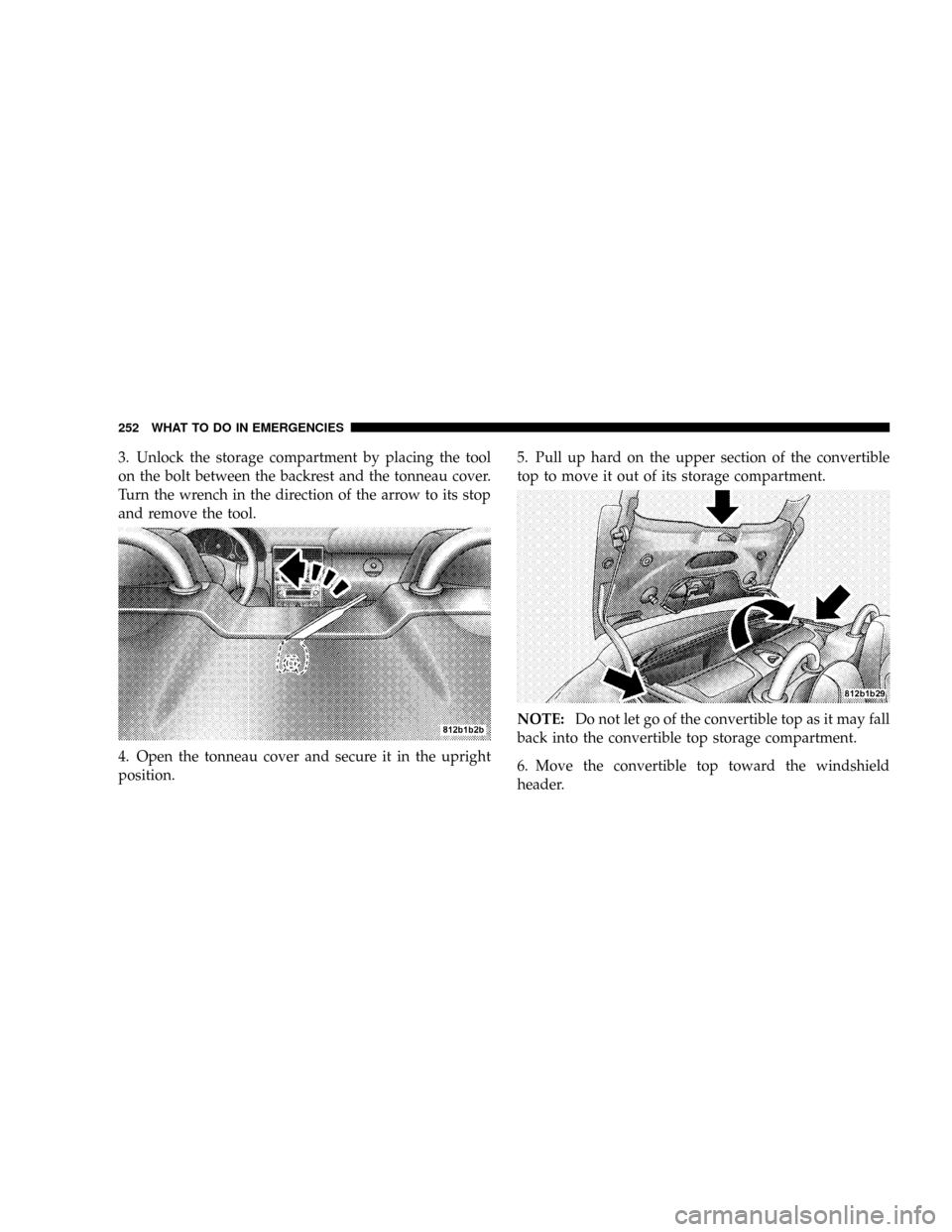
3. Unlock the storage compartment by placing the tool
on the bolt between the backrest and the tonneau cover.
Turn the wrench in the direction of the arrow to its stop
and remove the tool.
4. Open the tonneau cover and secure it in the upright
position.5. Pull up hard on the upper section of the convertible
top to move it out of its storage compartment.
NOTE:Do not let go of the convertible top as it may fall
back into the convertible top storage compartment.
6. Move the convertible top toward the windshield
header.
252 WHAT TO DO IN EMERGENCIES
Page 286 of 358
²Maintain a coolant concentration of a minimum of 50%
ethylene glycol Extended Life Coolant and high qual-
ity water with recommended antifreeze for proper
corrosion protection of your engine cooling system
that contains aluminum components.
²Make sure that the radiator and coolant bottle hoses
are not kinked or obstructed.
²Keep the front of the radiator clean. If your vehicle has
air conditioning, keep the front of the condenser clean,
also.
²Do not change the thermostat for Summer or Winter
operation. If replacement is ever necessary, install
ONLY the correct type thermostat. Other designs may
result in unsatisfactory coolant performance, poor fuel
economy, and increased emissions.
Hoses And Vacuum/Vapor Harnesses
Inspect surfaces of hoses and nylon tubing for evidence
of heat and mechanical damage. Hard or soft spots,
brittle rubber, cracking, checking, tears, cuts, abrasions,
and excessive swelling indicate deterioration of the rub-
ber.
Pay particular attention to the hoses nearest to high heat
sources such as the exhaust manifold. Inspect hose rout-
ing to be sure hoses do not touch any heat source or
moving component that may cause heat damage or
mechanical wear.
Ensure the nylon tubing in these areas has not melted or
collapsed. Inspect all hose connections such as clamps
and couplings to make sure they are secure and no leaks
are present. Components should be replaced immedi-
ately if there is any evidence of degradation that could
cause failure.
284 MAINTAINING YOUR VEHICLE
Page 287 of 358
Brakes
In order to assure brake system performance, all brake
system components should be inspected periodically.
Suggested service intervals can be found in the Mainte-
nance section.
WARNING!
Riding the brakes can lead to brake failure and
possibly an accident. Driving with your foot resting
or riding on the brake pedal can result in abnormally
high brake temperatures, excessive lining wear, and
possible brake damage. You wouldn't have your full
braking capacity in an emergency.
Brake and Power Steering System Hoses
When servicing the vehicle for scheduled maintenance,
inspect surface of hoses and nylon tubing for evidence of
heat and mechanical damage. Hard and brittle rubber,cracking, checking, tears, cuts, abrasions, and excessive
swelling suggest deterioration of the rubber. Particular
attention should be made to examining those hose sur-
faces nearest to high heat sources, such as the exhaust
manifold.
Inspect all hose clamps and couplings to make sure they
are secure and no leaks are present.
Ensure the nylon tubing in these areas has not melted or
collapsed.
NOTE:Often, fluids such as oil, power steering fluid,
and brake fluid are used during assembly plant opera-
tions to ease the assembly of hoses to couplings. There-
fore, oil wetness at the hose-coupling area is not neces-
sarily an indication of leakage. Actual dripping of hot
fluid when systems are under pressure (during vehicle
operation) should be noted before a hose is replaced
based on leakage.
MAINTAINING YOUR VEHICLE 285
7
Page 311 of 358
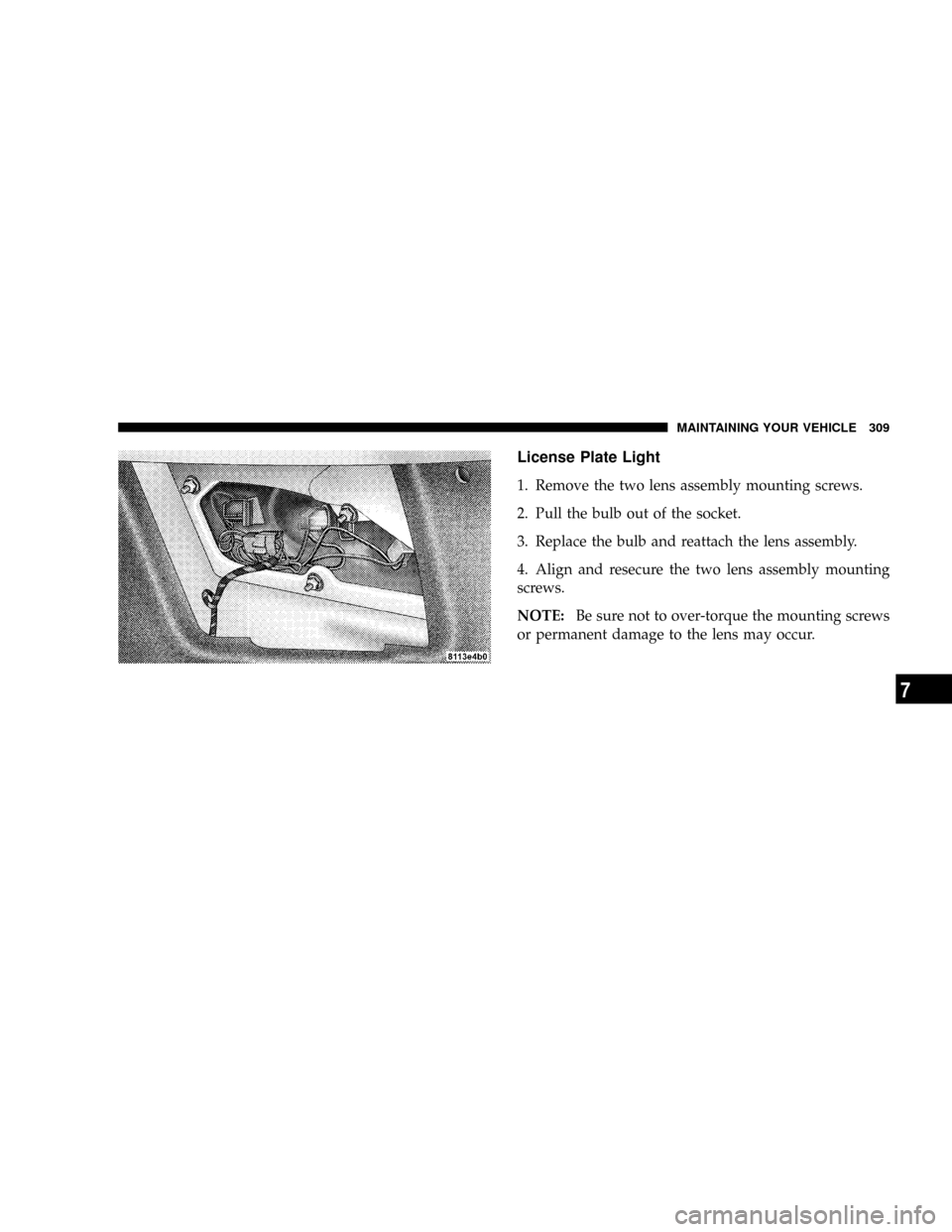
License Plate Light
1. Remove the two lens assembly mounting screws.
2. Pull the bulb out of the socket.
3. Replace the bulb and reattach the lens assembly.
4. Align and resecure the two lens assembly mounting
screws.
NOTE:Be sure not to over-torque the mounting screws
or permanent damage to the lens may occur.
MAINTAINING YOUR VEHICLE 309
7