tires CHRYSLER CROSSFIRE 2008 1.G Owner's Manual
[x] Cancel search | Manufacturer: CHRYSLER, Model Year: 2008, Model line: CROSSFIRE, Model: CHRYSLER CROSSFIRE 2008 1.GPages: 358, PDF Size: 4.7 MB
Page 213 of 358
Tire Spinning
When stuck in mud, sand, snow, or ice conditions, do not
spin your vehicle's wheels above 35 mph (55 km/h).
WARNING!
Fast spinning tires can be dangerous. Forces gener-
ated by excessive wheel speeds may cause tire dam-
age or failure. A tire could explode and injure some-
one. Do not spin your vehicle's wheels faster than 35
mph (55 km/h) when you are stuck, and do not let
anyone near a spinning wheel no matter what the
speed.
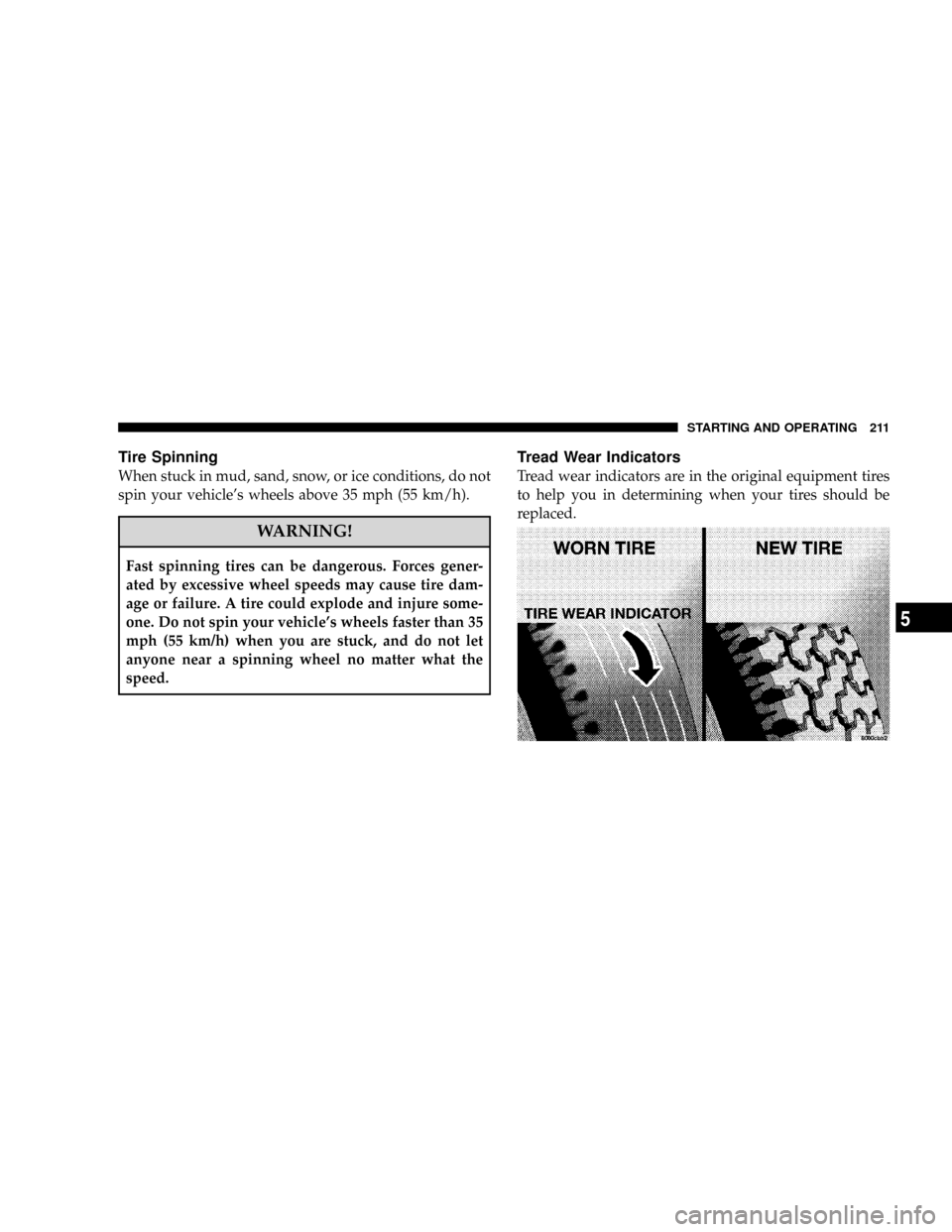
Tread Wear Indicators
Tread wear indicators are in the original equipment tires
to help you in determining when your tires should be
replaced.
STARTING AND OPERATING 211
5
Page 214 of 358
These indicators are molded into the bottom of the tread
grooves. They will appear as bands when the tread depth
becomes 1/16 in (2 mm). When the indicators appear in
two or more adjacent grooves, the tire should be re-
placed.
Many states have laws requiring tire replacement at this
point.
Life Of Tire
The service life of a tire is dependent upon various
factors including but not limited to:
²Driving style
²Tire pressure
²Distance driven
WARNING!
Tires and the spare tire should be replaced after six
years, regardless of the remaining tread. Failure to
follow this warning can result in sudden tire failure.
You could lose control and have an accident resulting
in serious injury or death.
Keep dismounted tires in a cool, dry place with as little
exposure to light as possible. Protect tires from contact
with oil, grease, and gasoline.
212 STARTING AND OPERATING
Page 215 of 358
Replacement Tires
The tires on your new vehicle provide a balance of many
characteristics. They should be inspected regularly for
wear and correct cold tire inflation pressure. The manu-
facturer strongly recommends that you use tires equiva-
lent to the originals in size, quality and performance
when replacement is needed. (Refer to the paragraph on
ªTread Wear Indicatorsº). Refer to the ªTire and Loading
Informationº placard for the size designation of your
tires. The service description and load identification will
be found on the original equipment tire. Failure to use
equivalent replacement tires may adversely affect the
safety, handling, and ride of your vehicle. We recommend
that you contact your original equipment or an autho-
rized tire dealer with any questions you may have on tire
specifications or capability.WARNING!
²Do not use a tire, wheel size or rating other than that
specified for your vehicle. Some combinations of
unapproved tires and wheels may change suspension
dimensions and performance characteristics, result-
ing in changes to steering, handling, and braking of
your vehicle. This can cause unpredictable handling
and stress to steering and suspension components.
You could lose control and have an accident resulting
in serious injury or death. Use only the tire and wheel
sizes with load ratings approved for your vehicle.
²Never use a tire with a smaller load index or capacity
than what was originally equipped on your vehicle.
Using a tire with a smaller load index could result in
tire overloading and failure. You could lose control
and have an accident.
²Failure to equip your vehicle with tires having ad-
equate speed capability can result in sudden tire
failure and loss of vehicle control.
STARTING AND OPERATING 213
5
Page 216 of 358
CAUTION!
Replacing original tires with tires of a different size
may result in false speedometer and odometer
readings.
Alignment And Balance
Poor suspension alignment may result in:
²Fast tire wear
²Uneven tire wear, such as feathering and one-sided
wear
²Vehicle pull to the left or right
Tires may also cause the vehicle to pull left or right.
Alignment will not correct this problem. See your autho-
rized dealer for proper diagnosis.Improper alignment will not cause vehicle vibration.
Vibration may be a result of tire and wheel out-of-
balance. Proper balancing will reduce vibration and
avoid tire cupping and spotty wear.
TIRE PRESSURE MONITOR SYSTEM
Each tire should be checked monthly when cold and
inflated to the inflation pressure recommended by the
vehicle manufacturer on the vehicle placard or tire infla-
tion pressure label. (If your vehicle has tires of a different
size than the size indicated on the vehicle placard or tire
inflation pressure label, you should determine the proper
tire inflation pressure for those tires.)
As an added safety feature, your vehicle has been
equipped with a Tire Pressure Monitoring System
(TPMS) that illuminates a low tire pressure indicator light
when one or more of your tires is significantly under-
inflated. When the low tire pressure indicator light
illuminates, you should stop and check your tires as soon
214 STARTING AND OPERATING
Page 218 of 358
CAUTION!
The TPM system is designed to monitor your tire
pressure and will not function as a tire pressure
gauge. After adjusting the air pressure in a tire, there
will be a delay before the system updates the display.
The system will automatically update and the Tire
Pressure Monitoring Indicator Light will turn off,
once the system receives the updated tire pressures.
The vehicle needs to be driven above 20 mph in order
for the TPMS to receive this information.The TPMS will cause the indicator light in the instrument
cluster to illuminate whenever the pressure in one tire
falls 25% below the recommended pressure shown on the
vehicle's tire label.
The TPMS will cause the indicator light to flash for
approximately one minute and then remain continuously
illuminated whenever the system detects a TPMS mal-
function.
NOTE:The pressure in your tires changes with tem-
perature. A significant decrease in temperature could
reduce cold inflation pressure below the TPMS set-point.
For example, tires inflated to the proper cold inflation
pressure on a warm day or in a warm garage could
illuminate the TPMS indicator light on the following day
216 STARTING AND OPERATING
Page 219 of 358
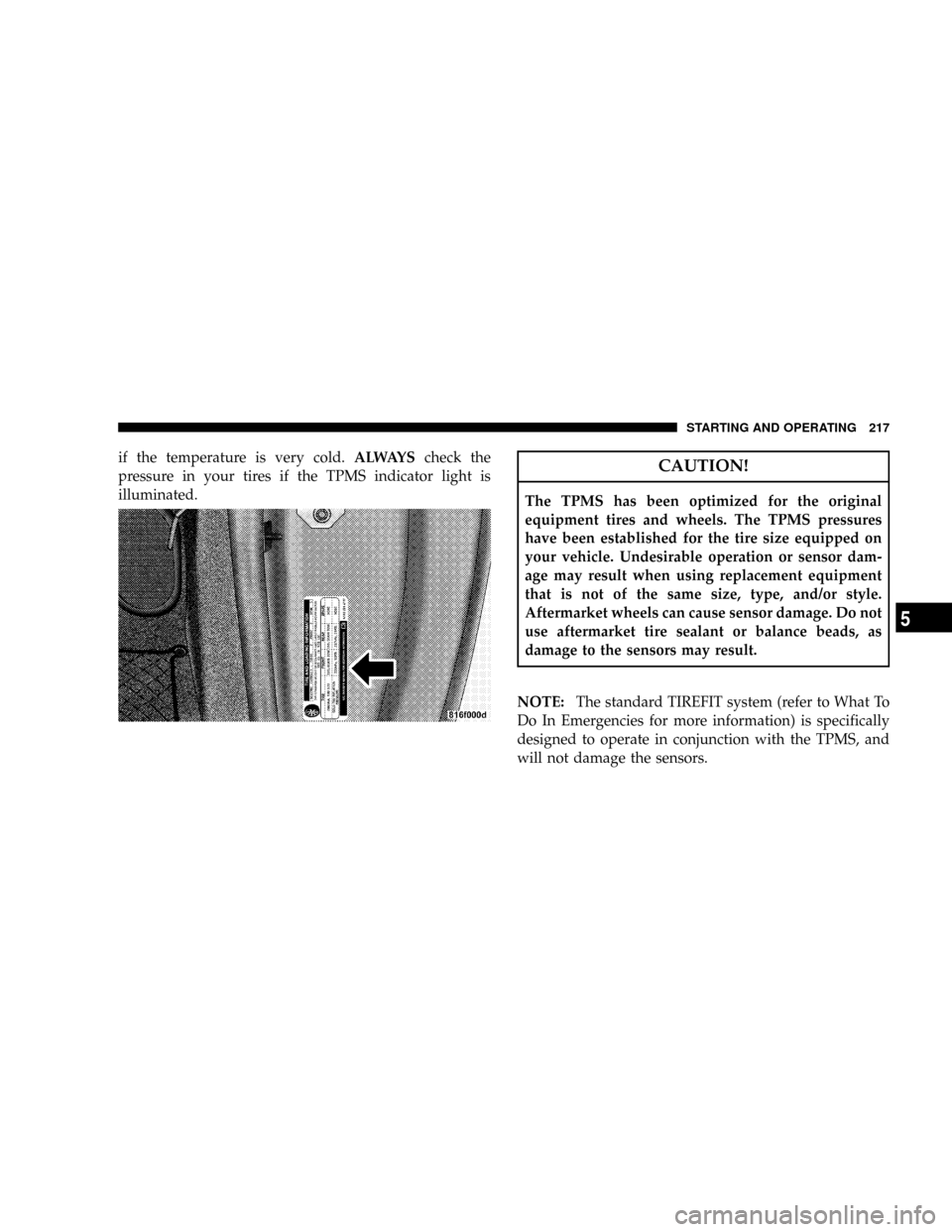
if the temperature is very cold.ALWAYScheck the
pressure in your tires if the TPMS indicator light is
illuminated.CAUTION!
The TPMS has been optimized for the original
equipment tires and wheels. The TPMS pressures
have been established for the tire size equipped on
your vehicle. Undesirable operation or sensor dam-
age may result when using replacement equipment
that is not of the same size, type, and/or style.
Aftermarket wheels can cause sensor damage. Do not
use aftermarket tire sealant or balance beads, as
damage to the sensors may result.
NOTE:The standard TIREFIT system (refer to What To
Do In Emergencies for more information) is specifically
designed to operate in conjunction with the TPMS, and
will not damage the sensors.
STARTING AND OPERATING 217
5
Page 220 of 358
If your tire pressure is low, you should correct your tire
inflation pressure as soon as possible and inspect all of
your tires. Low tire pressure will cause the tire pressure
light to illuminate. They will remain on for the rest of the
driving cycle, or until the tire pressure is corrected. If the
TPMS indicator light remains illuminated after the tire
pressure has been corrected, see your authorized dealer.
Your vehicle has also been equipped with a TPMS
malfunction indicator to indicate when the system is not
operating properly. The TPMS malfunction indicator is
combined with the low tire pressure indicator light.
When the system detects a malfunction, the indicator
light will flash for approximately one minute and then
remain continuously illuminated. This sequence will
continue upon subsequent vehicle start-ups as long as the
malfunction exists. When the malfunction indicator is
illuminated, the system may not be able to detect or
signal low tire pressure as intended. TPMS malfunctionsmay occur for a variety of reasons, including the instal-
lation of replacement or alternate tires or wheels on the
vehicle that prevent the TPMS from functioning properly.
Always check the TPMS malfunction indicator light after
replacing one or more tires or wheels on your vehicle to
ensure that the replacement or alternate tires and wheels
allow the TPMS to continue to function properly.
NOTE:Changes and modifications not expressly ap-
proved by the party responsible for compliance could
void the user's authority to operate the equipment.
General Information
This device complies with Part 15 of the FCC rules and
RSS 210 of Industry Canada. Operation is subject to the
following conditions:
²This device may not cause harmful interference.
218 STARTING AND OPERATING
Page 221 of 358
²This device must accept any interference received,
including interference that may cause undesired op-
eration.
The tire pressure sensors are covered under one of the
following licenses:
United States.....................KR5S120123
Canada........................2671-S120123
TIRE CHAINS
The RUD-matictDISC is the only tire chain system
approved for use on your vehicle.
Chains should only be used on the rear wheels and only
with the recommended winter mud and snow (M+S)
tires and wheels. Follow the manufacturer's mounting
instructions.Tire chains should only be driven on snow-covered roads
at speeds not to exceed 30 mph (48 km/h). Remove
chains as soon as possible when driving on roads without
snow.
When driving with tire chains, press the ESP control
switch to OFF.
CAUTION!
Damage to the vehicle may result if unapproved tire
chains are used.
STARTING AND OPERATING 219
5
Page 222 of 358
ORIGINAL EQUIPMENT TIRES
Your vehicle is equipped with either sport performance
tires or all-season performance tires. The sport perfor-
mance tires offer the maximum road handling capability
in dry and wet weather conditions. The all-season per-
formance tires, while offering slightly less road handling
capability, are able to provide traction capability in snow
and ice conditions. Both types of tires are rated for high
speed operation. It is important that you know what type
of tires your vehicle is equipped with so that you
understand their traction and handling characteristics for
various road conditions. Replacement tires should be of
the same size and speed rating to continue to provide the
same level of performance you are accustomed to.
SNOW TIRES
Some countries or regions require the use of snow tires
during winter. See the recommended snow type winter
tire applications in this section.
WARNING!
Your vehicle may be equipped with sport perfor-
mance tires that are optimized for driving in dry and
wet weather conditions. However, these tires have
reduced traction capability in snow and ice. When
driving your vehicle in these conditions with these
tires, you must take special care to maintain control
and avoid accidents. We recommend that you equip
your vehicle with ªSNOWº or ªALL SEASONº tires
on all four wheels for driving in snowy and icy
conditions.
220 STARTING AND OPERATING
Page 223 of 358
If you need snow tires, the recommended size for the
front and rear tires is the same size as the original
equipment front tires. This size tire on the rear allows the
use of tire chains on the rear wheels. Selection of this size
tire also requires the purchase of two additional wheels
with the same size specification as the original equip-
ment front wheels.
Snow tires may have a lower speed rating than factory
equipped tires and may not match the maximum vehicle
speed.
Snow tires should not be operated at sustained speeds
over 75 mph (120 km/h).TIRE ROTATION RECOMMENDATIONS
Tires on the front and rear axles of vehicles operate at
different loads and perform different steering, driving,
and braking functions. For these reasons, they wear at
unequal rates, and tend to develop irregular wear pat-
terns.
These effects can be reduced by timely rotation of tires.
The benefits of rotation are especially worthwhile with
aggressive tread designs such as those on all season type
tires. Rotation will increase tread life, help to maintain
mud, snow, and wet traction levels, and contribute to a
smooth, quiet ride.
Follow the recommended tire rotation frequency for your
type of driving found in the ªMaintenance Schedulesº
Section of this manual. More frequent rotation is permis-
sible if desired. The reasons for any rapid or unusual
wear should be corrected prior to rotation being per-
formed.
STARTING AND OPERATING 221
5