tires CHRYSLER CROSSFIRE 2008 1.G User Guide
[x] Cancel search | Manufacturer: CHRYSLER, Model Year: 2008, Model line: CROSSFIRE, Model: CHRYSLER CROSSFIRE 2008 1.GPages: 358, PDF Size: 4.7 MB
Page 192 of 358
The ESP warning light starts to flash at any vehicle speed
as soon as the tires lose traction and the wheels begin to
spin.
If the ESP warning light flashes during acceleration, ease
up on the accelerator and apply as little throttle as
possible. While driving, adapt your speed to the prevail-
ing road conditions.
CAUTION!
If the vehicle is towed with the front axle raised (see
the What To Do In Emergencies section in this
manual), the engine must be shut off (key in the
ignition switch turned to the OFF/LOCK or ACC
position). Otherwise, the ESP will immediately be
engaged and will apply the rear wheel brakes.NOTE:When the ESP warning light is illuminated
continuously, the ESP is switched off. Adapt your speed
and driving to the prevailing road conditions.
NOTE:Avoid spinning of one drive wheel. This may
cause serious damage to the drivetrain which is not
covered by the DaimlerChrysler Limited Warranty.
NOTE:If the ESP warning light flashes during accelera-
tion, ease up on the accelerator.
NOTE:ESP should not be switched off during normal
driving. Disabling of the system under normal operating
conditions will eliminate the benefits of the ESP system.
190 STARTING AND OPERATING
Page 194 of 358
To improve the vehicle's traction when driving with
snow chains, or starting off in deep snow, sand, or gravel,
switch off the ESP by pressing the upper half of the ESP
switch. The ESP warning light will then be continuously
illuminated. With the ESP system switched off, the en-
gine torque reduction feature is cancelled. Therefore, the
enhanced vehicle stability offered by ESP is unavailable.
CAUTION!
Snow chains should never be used without the
recommended mud and snow (M+S) rated radial-ply
tires. Damage to your vehicle may result from such
usage.
ESP always operates under braking, even with the switch
in the OFF position.If one drive wheel loses traction and begins to spin, the
ESP system will apply the brake at the affected wheel
until the wheel regains sufficient traction. The traction
control engages at approximately 24 mph (40 km/h), and
switches off at 50 mph (80 km/h).
To return to the enhanced vehicle stability offered by ESP,
press the lower half of the switch (the ESP warning light
goes out).Anti-Lock Brake System (ABS)
The ABS gives increased vehicle stability and brake
performance under most braking conditions. The system
automatically ªpumpsº the brakes during severe braking
conditions to prevent wheel lock-up. The system operates
to prevent wheel lock-up and help avoid skidding on
slippery surfaces.
NOTE:The ABS improves steering control of the vehicle
during hard braking maneuvers.
192 STARTING AND OPERATING
Page 195 of 358
The ABS prevents the wheels from locking up above a
vehicle speed of approximately 5 mph (8 km/h) indepen-
dent of road surface conditions.
At the instant one of the wheels is about to lock up, a
slight pulsation can be felt in the brake pedal, indicating
that the ABS is in the regulating mode.
Keep firm and steady pressure on the brake pedal while
experiencing the pulsation. Continuous, steady brake
pedal pressure results in optimal braking power while
maintaining the ability to steer the vehicle.
In the case of an emergency brake maneuver, keep
continuous full pressure on the brake pedal. In this
manner only can the ABS be most effective.
On slippery road surfaces, the ABS will respond even
with light brake pedal pressure because of the increased
likelihood of locking wheels. The pulsating brake pedalcan be an indication of hazardous road conditions and
functions as a reminder to take extra care while driving.
WARNING!
Significant over- or under-inflation of tires, or mix-
ing sizes of front or rear tires or wheels on the vehicle
can reduce braking effectiveness. Maintain proper
tire pressure and always use the tires and wheels
specified in this manual for your vehicle.
The anti-lock brake system conducts a low-speed self-test
at about 12 mph (20 km/h). If you have your foot lightly
on the brake while this test is occurring, you may feel
slight pedal movement. The movement can be more
apparent on ice and snow. The anti-lock brake system
pump motor makes a low humming noise during opera-
tion, which is normal.
STARTING AND OPERATING 193
5
Page 197 of 358
When the ABS malfunction indicator light in the instru-
ment cluster comes on while the engine is running, it
indicates that the ABS has detected a malfunction and has
switched off. In this case, the brake system functions in
the usual manner, but without antilock assistance. With
the ABS malfunctioning, the BAS and ESP are also
switched off. Both malfunction indicator lights come on
with the engine running. If the charging voltage falls
below 10 volts, the malfunction indicator light comes on
and the ABS is switched off. When the voltage is above
this value again, the malfunction indicator light should
go out and the ABS is operational. If the malfunction
indicator light stays illuminated, have the system
checked at your authorized dealer as soon as possible.WARNING!
ABS cannot prevent the natural laws of physics from
acting on the vehicle, nor can it increase braking or
steering efficiency beyond that afforded by the con-
dition of the vehicle brakes and tires or the traction
afforded. The ABS cannot prevent accidents, includ-
ing those resulting from excessive speed in turns,
following another vehicle too closely, or hydroplan-
ing. Only a safe, attentive, and skillful driver can
prevent accidents. The capabilities of an ABS-
equipped vehicle must never be exploited in a reck-
less or dangerous manner which could jeopardize the
user's safety or the safety of others.
STARTING AND OPERATING 195
5
Page 200 of 358
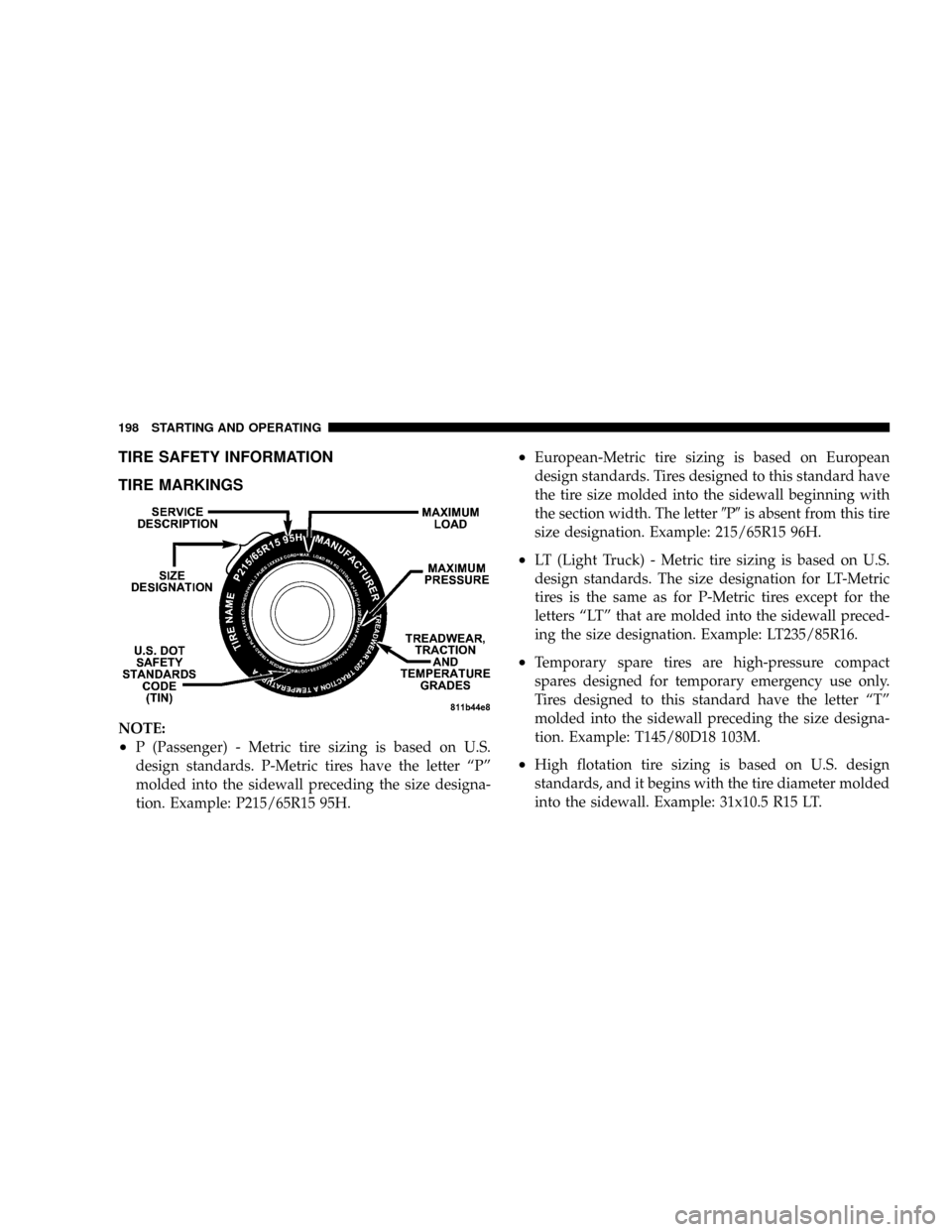
TIRE SAFETY INFORMATION
TIRE MARKINGS
NOTE:
²P (Passenger) - Metric tire sizing is based on U.S.
design standards. P-Metric tires have the letter ªPº
molded into the sidewall preceding the size designa-
tion. Example: P215/65R15 95H.
²European-Metric tire sizing is based on European
design standards. Tires designed to this standard have
the tire size molded into the sidewall beginning with
the section width. The letter9P9is absent from this tire
size designation. Example: 215/65R15 96H.
²LT (Light Truck) - Metric tire sizing is based on U.S.
design standards. The size designation for LT-Metric
tires is the same as for P-Metric tires except for the
letters ªLTº that are molded into the sidewall preced-
ing the size designation. Example: LT235/85R16.
²Temporary spare tires are high-pressure compact
spares designed for temporary emergency use only.
Tires designed to this standard have the letter ªTº
molded into the sidewall preceding the size designa-
tion. Example: T145/80D18 103M.
²High flotation tire sizing is based on U.S. design
standards, and it begins with the tire diameter molded
into the sidewall. Example: 31x10.5 R15 LT.
198 STARTING AND OPERATING
Page 203 of 358
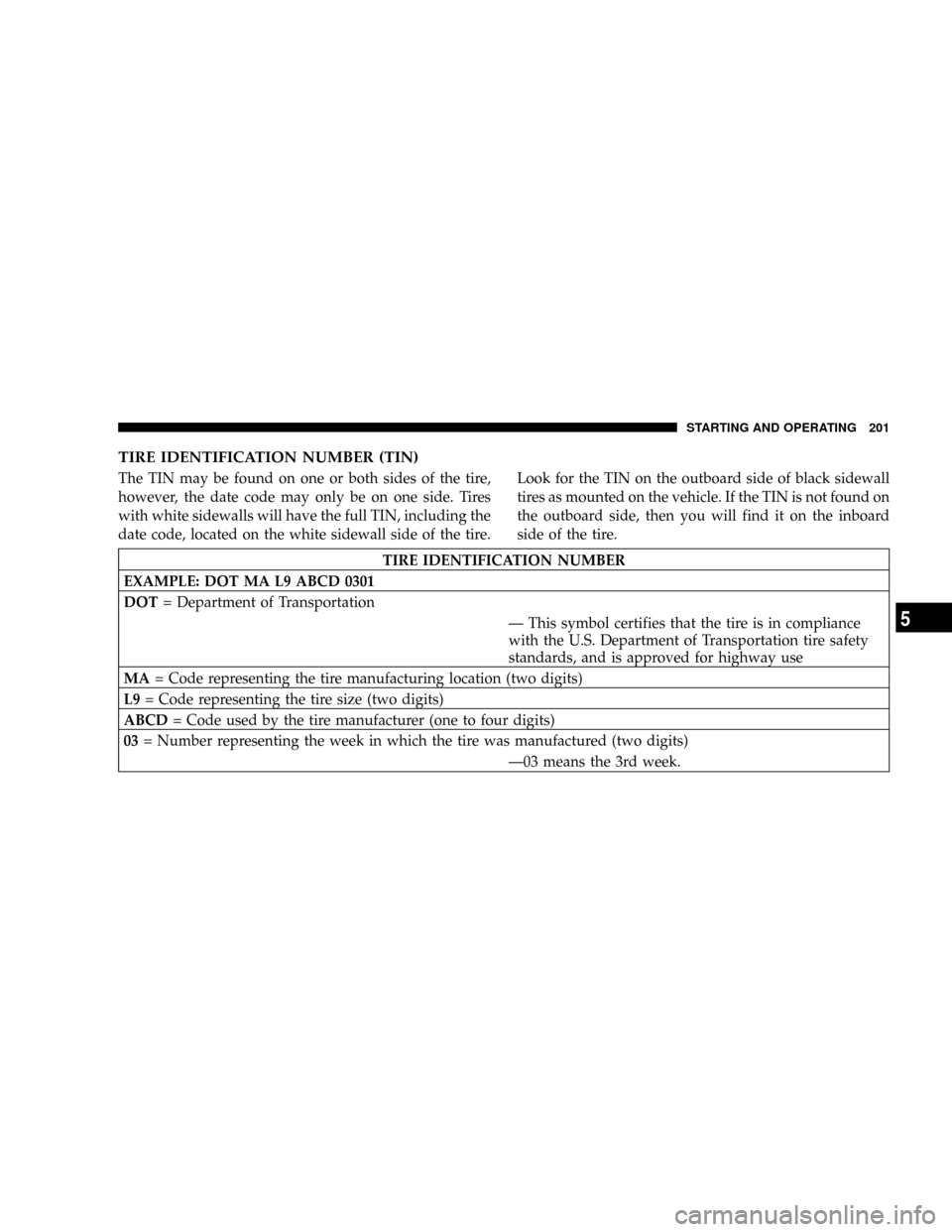
TIRE IDENTIFICATION NUMBER (TIN)
The TIN may be found on one or both sides of the tire,
however, the date code may only be on one side. Tires
with white sidewalls will have the full TIN, including the
date code, located on the white sidewall side of the tire.Look for the TIN on the outboard side of black sidewall
tires as mounted on the vehicle. If the TIN is not found on
the outboard side, then you will find it on the inboard
side of the tire.
TIRE IDENTIFICATION NUMBER
EXAMPLE: DOT MA L9 ABCD 0301
DOT= Department of Transportation
Ð This symbol certifies that the tire is in compliance
with the U.S. Department of Transportation tire safety
standards, and is approved for highway use
MA= Code representing the tire manufacturing location (two digits)
L9= Code representing the tire size (two digits)
ABCD= Code used by the tire manufacturer (one to four digits)
03= Number representing the week in which the tire was manufactured (two digits)
Ð03 means the 3rd week.
STARTING AND OPERATING 201
5
Page 205 of 358
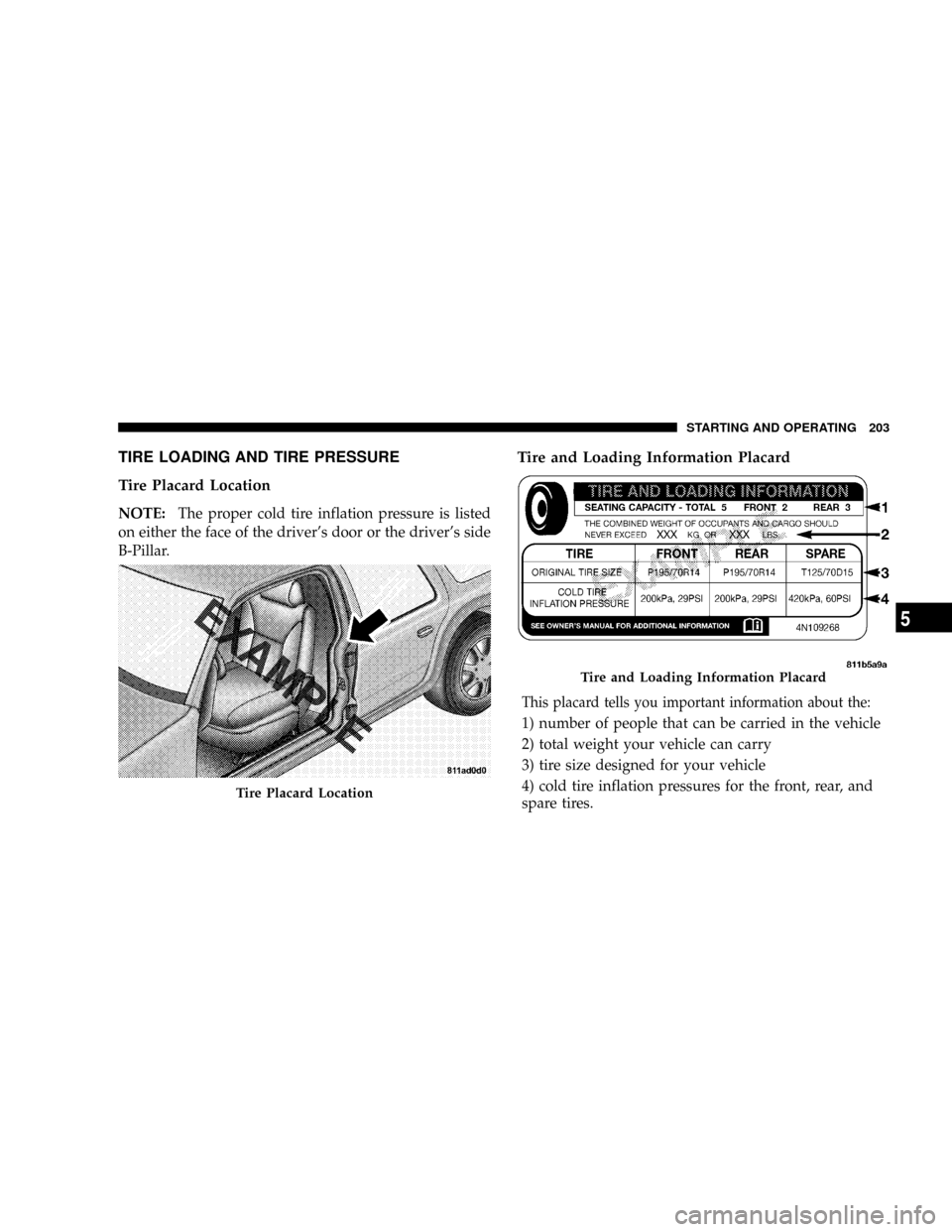
TIRE LOADING AND TIRE PRESSURE
Tire Placard Location
NOTE:The proper cold tire inflation pressure is listed
on either the face of the driver's door or the driver's side
B-Pillar.
Tire and Loading Information Placard
This placard tells you important information about the:
1) number of people that can be carried in the vehicle
2) total weight your vehicle can carry
3) tire size designed for your vehicle
4) cold tire inflation pressures for the front, rear, and
spare tires.
Tire Placard Location
Tire and Loading Information Placard
STARTING AND OPERATING 203
5
Page 209 of 358
WARNING!
Overloading of your tires is dangerous. Overloading
can cause tire failure, affect vehicle handling, and
increase your stopping distance. Use tires of the
recommended load capacity for your vehicle. Never
overload them.
TIRES Ð GENERAL INFORMATION
Tire Pressure
Proper tire inflation pressure is essential to the safe and
satisfactory operation of your vehicle. Three primary
areas are affected by improper tire pressure:
Safety
WARNING!
²Improperly inflated tires are dangerous and can cause
accidents.
²Underinflation increases tire flexing and can result in
tire failure.
²Overinflation reduces a tire's ability to cushion shock.
Objects on the road and chuckholes can cause damage
that result in tire failure.
²Unequal tire pressures can cause steering problems.
You could lose control of your vehicle.
²Overinflated or underinflated tires can affect vehicle
handling and can fail suddenly, resulting in loss of
vehicle control.
²Unequal tire pressures from one side of the vehicle to
the other can cause the vehicle to drift to the right or left.
²Always drive with each tire inflated to the recom-
mended cold tire inflation pressure.
STARTING AND OPERATING 207
5
Page 211 of 358
check tire pressure. Do not make a visual judgement
when determining proper inflation. Radial tires may look
properly inflated even when they are underinflated.
CAUTION!
After inspecting or adjusting the tire pressure, al-
ways reinstall the valve stem cap (if equipped). This
will prevent moisture and dirt from entering the
valve stem, which could damage it.
Inflation pressures specified on the placard are always
cold tire inflation pressure. Cold tire inflation pressure is
defined as the tire pressure after the vehicle has not been
driven for at least three hours, or driven less than 1 mi
(1.6 km) after a three-hour period. The cold tire inflation
pressure must not exceed the maximum inflation pres-
sure molded into the tire sidewall.Check tire pressures more often if subject to a wide range
of outdoor temperatures, as tire pressures vary with
temperature changes.
Tire pressures change by approximately 1 psi (7 kPa) per
12ÉF (7ÉC) of air temperature change. Keep this in mind
when checking tire pressure inside a garage, especially in
the winter.
Example: If garage temperature = 68ÉF (20ÉC) and the
outside temperature = 32ÉF (0ÉC) then the cold tire
inflation pressure should be increased by 3 psi (21 kPa),
which equals 1 psi (7 kPa) for every 12ÉF (7ÉC) for this
outside temperature condition.
Tire pressure may increase from 2 to 6 psi (13 to 40 kPa)
during operation. DO NOT reduce this normal pressure
build-up, or your tire pressure will be too low.
STARTING AND OPERATING 209
5
Page 212 of 358
Tire Pressures For High Speed Operation
The manufacturer advocates driving at safe speeds
within posted speed limits. Where speed limits or condi-
tions are such that the vehicle can be driven at high
speeds, maintaining correct tire inflation pressure is very
important. Increased tire pressure and reduced vehicle
loading may be required for high-speed vehicle opera-
tion. Refer to original equipment or an authorized tire
dealer for recommended safe operating speeds, loading
and cold tire inflation pressures.
WARNING!
High speed driving with your vehicle at or above
maximum load is dangerous. The added strain on
your tires could cause them to fail. You could have a
serious accident. Don't drive a vehicle loaded to the
maximum capacity at continuous speeds above 75
mph (120 km/h).
Radial-Ply Tires
WARNING!
Combining radial ply tires with other types of tires
on your vehicle will cause your vehicle to handle
poorly. The instability could cause an accident. Al-
ways use radial tires in sets of four. Never combine
them with other types of tires.
Cuts and punctures in radial tires are repairable only in
the tread area because of sidewall flexing. Consult your
authorized dealer for radial tire repairs.
210 STARTING AND OPERATING