transmission CHRYSLER CROSSFIRE 2008 1.G Owner's Manual
[x] Cancel search | Manufacturer: CHRYSLER, Model Year: 2008, Model line: CROSSFIRE, Model: CHRYSLER CROSSFIRE 2008 1.GPages: 358, PDF Size: 4.7 MB
Page 184 of 358
6. Move the shift lever to the DRIVE position (for SEC-
OND gear), or move the shift lever to the REVERSE
position (for REVERSE gear).
Have the transmission checked at your authorized dealer
as soon as possible.
DRIVING ON SLIPPERY SURFACES
WARNING!
Rapid acceleration on slippery surfaces is dangerous.
You could lose control of the vehicle and possibly
have an accident. Accelerate slowly and carefully
whenever there is likely to be poor traction (ice,
snow, rain, mud, loose sand, etc.).
Traction
When driving on wet or slushy roads, it is possible for a
wedge of water to build up between the tire and road
surface. This is hydroplaning and may cause partial or
complete loss of vehicle control and stopping ability. To
reduce this possibility, the following precautions should
be observed:
1. Slow down during rainstorms or when roads are
slushy.
2. Slow down if the road has standing water or puddles.
3. Replace tires when tread wear indicators first become
visible.
4. Keep tires properly inflated.
5. Maintain enough distance between your vehicle and
the vehicle in front to avoid a collision in a sudden stop.
182 STARTING AND OPERATING
Page 186 of 358
CAUTION!
²Driving through standing water may cause dam-
age to your vehicle's drivetrain components. Al-
ways inspect your vehicle's fluids (i.e., engine oil,
transmission, axle, etc.) for signs of contamination
(i.e., fluid that is milky or foamy in appearance)
after driving through standing water. Do not con-
tinue to operate the vehicle if any fluid appears
contaminated, as this may result in further dam-
age. Such damage is not covered by the New
Vehicle Limited Warranty.
²Getting water inside your vehicle's engine can
cause it to lock up and stall out, and cause serious
internal damage to the engine. Such damage is not
covered by the New Vehicle Limited Warranty.
WARNING!
²Driving through standing water limits your vehi-
cle's traction capabilities. Do not exceed 5 mph (8
km/h) when driving through standing water.
²Driving through standing water limits your vehi-
cle's braking capabilities, which increases stop-
ping distances. Therefore, after driving through
standing water, drive slowly and lightly press on
the brake pedal several times to dry the brakes.
²Getting water inside your vehicle's engine can
cause it to lock up and stall out, and leave you
stranded.
²Failure to follow these warnings may result in
injuries that are serious or fatal to you, your
passengers, and others around you.
184 STARTING AND OPERATING
Page 187 of 358
PARKING BRAKE
When you apply the parking brake with engine
running, the brake system warning light in the
instrument cluster will come on.
NOTE:This light, when illuminated with parking brake
application, shows only that the parking brake is on. It
does not show the degree of brake application.
NOTE:If the light remains on with the parking brake
released, a brake system malfunction is indicated. Have
the brake system serviced by an authorized dealer im-
mediately.
Before leaving the vehicle, make sure that the parking
brake is fully applied. For manual transmission vehicles,
place the shift lever in REVERSE. For vehicles equipped
with automatic transmissions, place the shift lever in the
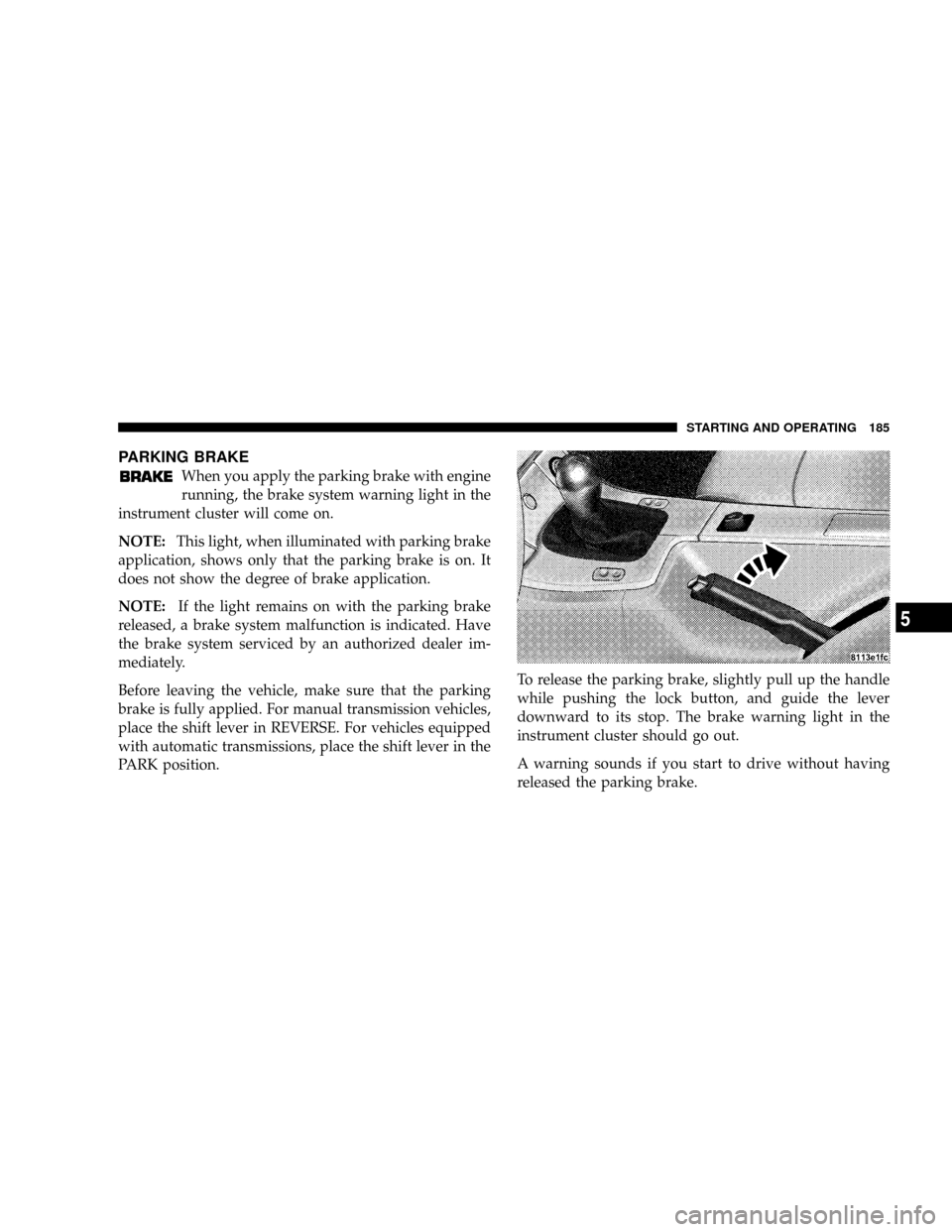
PARK position.To release the parking brake, slightly pull up the handle
while pushing the lock button, and guide the lever
downward to its stop. The brake warning light in the
instrument cluster should go out.
A warning sounds if you start to drive without having
released the parking brake.
STARTING AND OPERATING 185
5
Page 188 of 358
When parking on a hill, you must set the parking brake
beforeplacing the shift lever in PARK. If you don't, the
load on the transmission locking mechanism may make it
difficult to move the shift lever out of PARK. As an added
precaution, turn the front wheels toward the curb on a
downhill grade and away from the curb on an uphill
grade.
The parking brake should always be applied when the
driver is not in the vehicle.
WARNING!
Be sure the parking brake is fully disengaged before
driving; failure to do so can lead to brake failure and
an accident.
WARNING!
Do not leave children unattended in a vehicle. A
child could be injured, or could injure others, if left
unattended.
BRAKE SYSTEM
Your vehicle is equipped with power brakes as standard
equipment. In the event power assist is lost for any
reason (for example, repeated brake applications with the
engine off), the brakes will still function. The effort
required to brake the vehicle will be much greater than
that required with the power system operating.
If either the front or rear hydraulic system loses normal
capability, the remaining system will still function with
some loss of overall braking effectiveness. This will be
evident by increased pedal travel during application,
186 STARTING AND OPERATING
Page 198 of 358
WARNING!
To use your brakes and accelerator more safely, follow these
tips:
²Do not ªrideº the brakes by resting your foot on the pedal.
This could overheat the brakes and result in unpredictable
braking action, longer stopping distances, or brake dam-
age.
²When descending mountains or hills, repeated braking
can cause brake fade with loss of braking control. Avoid
repeated heavy braking by downshifting the transmission
whenever possible.
²Do not drive too fast for road conditions, especially when
roads are wet or slushy. A wedge of water can build up
between the tire tread and the road. This hydroplaning
action can cause loss of traction, braking ability, and
control.
²After going through deep water or a car wash, brakes may
become wet, resulting in decreased performance and un-
predictable braking action. Dry the brakes by gentle,
intermittent pedal action while driving at very slow
speeds.
Brake Pad Break-In
The brakes on your vehicle do not require a long break-in
period, but avoid repeated hard brake applications from
high speeds during initial break-in. Also avoid severe
brake loading such as may be encountered when de-
scending long mountain grades.
POWER STEERING
The standard power steering system will give you good
vehicle response and increased ease of maneuverability
in tight spaces. The system will provide mechanical
steering capability if power assist is lost.
If for some reason, the power assist is interrupted, it will
still be possible to steer your vehicle. Under these condi-
tions you will observe a substantial increase in steering
effort, especially at very low vehicle speeds and during
parking maneuvers.
196 STARTING AND OPERATING
Page 235 of 358
In any of the following situations, you can reduce the
potential for overheating by taking the appropriate ac-
tion.
²On the highways ±Slow down and use the highest
gear possible.
²In city traffic ±While stopped, put the transmission in
NEUTRAL, but do not increase engine idle speed.
²In city traffic ±While moving, shift into the highest
gear possible to reduce engine RPM.
NOTE:There are steps that you can take to slow down
an impending overheat condition. If your air conditioner
is on, turn it off. The air conditioning system adds heat to
the cooling system and turning off the A/C removes this
heat. You can also turn the temperature control to maxi-
mum heat, the mode control to floor, and the fan controlto HIGH. This allows the heater core to act as a supple-
ment to the radiator and aids in removing heat from the
cooling system.
CAUTION!
Driving with a hot cooling system could damage
your vehicle. If temperature gauge reads ªH,º pull
over and stop the vehicle. Idle the vehicle with the air
conditioner turned OFF until the pointer drops back
into the normal range. If the pointer remains on the
ªH,º turn the engine OFF immediately, and call for
service.
WHAT TO DO IN EMERGENCIES 233
6
Page 237 of 358
WARNING!
Cuts or punctures larger than approximately 0.16 in. (4 mm),
tire damage caused by driving with extremely low tire
pressure or on a flat tire, or a damaged wheel can pose a
hazard while driving. TIREFIT should not be used in such
circumstances. Do not drive the vehicle under such circum-
stances. Contact your nearest authorized dealer for assis-
tance.
Take care not to allow the contents of TIREFIT to come in
contact with hair, eyes or clothing. TIREFIT is harmful if
inhaled, swallowed or absorbed through the skin: It causes
skin, eye and respiratory irritation. Any contact with eyes
or skin should be flushed immediately with plenty of
water. If clothing comes in contact with TIREFIT, change
clothing as soon as possible.
In case of allergic reaction or rash, consult a physician
immediately. Keep TIREFIT out of reach of children. If
swallowed, rinse mouth immediately with plenty of water
and drink plenty of water. Do not induce vomiting! Consult
a physician immediately.
Keep away from open flame or heat source.
Sealing tire with TIREFIT
1. Set the parking brake and turn on the hazard warning
flashers.
2. Move the transmission selector lever to the PARK
position (manual transmission to FIRST or REVERSE
gear) and turn off the engine.
3. Remove the TIREFIT kit and electric air pump from
the area below the cargo compartment carpet.
4. Open flap (2) on the electric air pump.
5. Pull the power plug (4) and air hose (5) along with the
pressure gauge out of the air pump housing.
6. Screw the air hose (5) onto the hose connection on the
TIREFIT sealant bottle (1).
7. Holding the sealant bottle by the top, insert it down-
wards into the recess (3) on the air pump.
WHAT TO DO IN EMERGENCIES 235
6
Page 240 of 358
Jacking the vehicle should only be necessary in the event
that a tire has been severely damaged, and must be
replaced. (See TIREFIT Tire Repair section for a descrip-
tion of cuts and punctures that may be repairable with
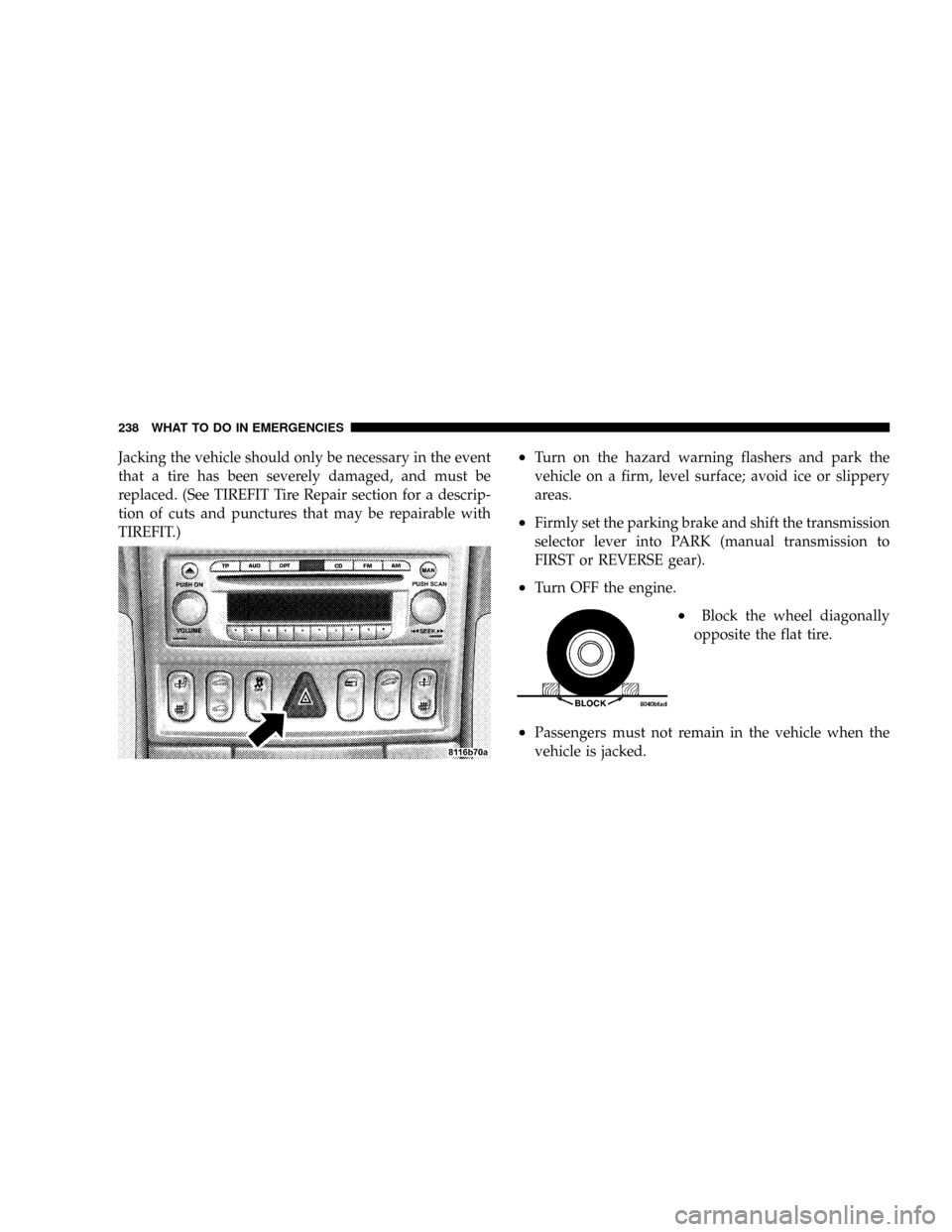
TIREFIT.)²Turn on the hazard warning flashers and park the
vehicle on a firm, level surface; avoid ice or slippery
areas.
²Firmly set the parking brake and shift the transmission
selector lever into PARK (manual transmission to
FIRST or REVERSE gear).
²Turn OFF the engine.
²Block the wheel diagonally
opposite the flat tire.
²Passengers must not remain in the vehicle when the
vehicle is jacked.
238 WHAT TO DO IN EMERGENCIES
Page 245 of 358
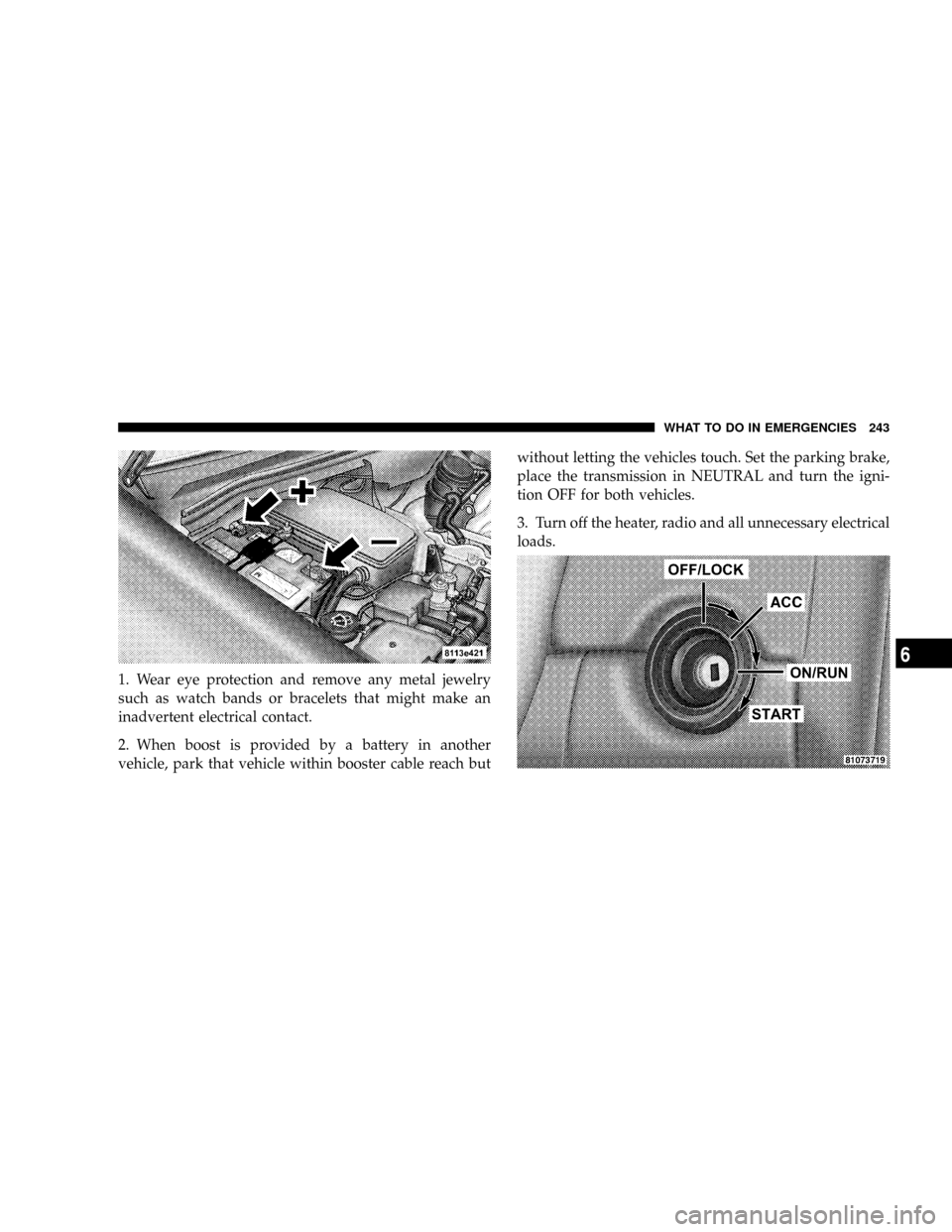
1. Wear eye protection and remove any metal jewelry
such as watch bands or bracelets that might make an
inadvertent electrical contact.
2. When boost is provided by a battery in another
vehicle, park that vehicle within booster cable reach butwithout letting the vehicles touch. Set the parking brake,
place the transmission in NEUTRAL and turn the igni-
tion OFF for both vehicles.
3. Turn off the heater, radio and all unnecessary electrical
loads.
WHAT TO DO IN EMERGENCIES 243
6
Page 247 of 358
CAUTION!
Racing the engine or spinning the wheels too fast
may lead to transmission/axle overheating and fail-
ure. It can also damage the tires. Do not spin the
wheels above 35 mph (55 km/h).
TOWING A DISABLED VEHICLE
We recommend that the vehicle be transported using flat
bed equipment. This method is preferable to other types
of towing.
CAUTION!
Important! If towing the vehicle, please note the
following: With the automatic central locking acti-
vated and the key in the ignition switch turned to the
ON/RUN position, the vehicle doors lock if the left
front wheel and the right rear wheel are turning at
vehicle speeds of approximately 9 mph (15 km/h) or
more. To prevent the vehicle door locks from locking,
deactivate the automatic central locking.
WHAT TO DO IN EMERGENCIES 245
6