transmission CHRYSLER CROSSFIRE 2008 1.G Owner's Guide
[x] Cancel search | Manufacturer: CHRYSLER, Model Year: 2008, Model line: CROSSFIRE, Model: CHRYSLER CROSSFIRE 2008 1.GPages: 358, PDF Size: 4.7 MB
Page 248 of 358
CAUTION!
If the vehicle is towed with the front wheels raised, the
engine must be shut off (key in the ignition switch
turned to the OFF/LOCK or ACC positions). Other-
wise, the ESP will immediately be engaged and will
apply the rear wheel brakes. Switch OFF the tow-away
alarm as well as the automatic central locking system.
Towing restrictions for vehicles with automatic transmis-
sion: The vehicle may be towed with all wheels on the
ground and the transmission shift lever in the NEUTRAL
position for distances up to 30 mi (48 km) and at a speed
not to exceed 30 mph (48 km/h). The key must be turned
to the ON/RUN position in the ignition. To be certain to
avoid a possibility of damage to the transmission; how-
ever, we recommend the drive shaft be disconnected at
the rear axle drive flange for any towing beyond a short
tow to a nearby garage.Always comply with applicable state or local towing
ordinances.
CAUTION!
²Do not attempt to tow this vehicle from the front
with sling-type towing equipment. Damage to the
front fascia will result.
²Always use wheel lift equipment when towing
from the front. The only other approved method of
towing is with a flatbed truck.
²Do not tow the vehicle from the rear. Damage to
the rear sheet metal and fascia will occur.
²Do not push or tow this vehicle with another
vehicle as damage to the bumper fascia and trans-
mission may result.
246 WHAT TO DO IN EMERGENCIES
Page 260 of 358
NExhaust System......................279
NCooling System.......................280
NHoses And Vacuum/Vapor Harnesses.......284
NBrakes.............................285
NAutomatic Transmission................288
NManual Transmission..................289
NAppearance Care And Protection From
Corrosion...........................290
mConvertible Top Care....................295
NWashing............................296
NGeneral Cleaning.....................296
NWeather Strip Care....................297
mFuses...............................297NUnderhood Accessory Fuse Block Fuses.....297
NRelay Control Module Fuses.............302
NInterior Fuses........................303
mReplacement Bulbs......................305
NInterior Light Bulbs....................305
NExterior Light Bulbs...................305
mExterior Light Bulb Service................306
NHeadlights..........................306
NFront Turn Signal And Parking/Standing
Lights.............................307
NFront And Rear Sidemarker Lights.........307
NTail, Stop, Back Up And Turn Signal Lights . . . 308
NLicense Plate Light....................309
258 MAINTAINING YOUR VEHICLE
Page 273 of 358
To minimize the possibility of catalyst damage:
²Do not shut off the engine or interrupt the ignition
when the transmission is in gear and the vehicle is in
motion.
²Do not try to start the engine by pushing or towing the
vehicle.
²Do not idle the engine with any spark plug wires
disconnected for a prolonged period.
Ignition Wiring System
The ignition cables should be kept clean and properly
connected. Terminals should be fully seated. Cracked,
damaged, or faulty cables should be replaced.
Crankcase Emission Control System
Proper operation of this system depends on freedom
from sticking or plugging due to deposits.
Check the ventilation hose for indication of damage or
plugging deposits. Replace if necessary.
Maintenance-Free Battery
The top of the maintenance-free battery is permanently
sealed. You will never have to add water, nor is periodic
maintenance required.
MAINTAINING YOUR VEHICLE 271
7
Page 290 of 358
Automatic Transmission
The fluid in the automatic transmission should be
changed at 80,000 mi (129 000 km), along with the
transmission fluid filter. After that, the transmission fluid
is filled for life.
Selection of Lubricant
It is important that the proper lubricant is used in the
transmission to assure optimum transmission perfor-
mance. Use only ATF approved to MB 236.10, MB 236.12.
Synthetic Dexron IIItAutomatic Transmission Fluid may
be substituted. Refer to the Recommended Fluids, Lubri-
cants and Genuine Parts section for the correct fluid type.
It is important that the transmission fluid be maintained
at the prescribed level using the recommended fluid.
CAUTION!
Using a transmission fluid other than the fluid rec-
ommended by DaimlerChrysler Corporation may
cause deterioration in transmission shift quality
and/or torque converter shudder. Using a transmis-
sion fluid other than that recommended by the
DaimlerChrysler Corporation will result in more
frequent fluid and filter changes. Refer to the Rec-
ommended Fluids, Lubricants and Genuine Parts
section for correct fluid type.
Fluid Level Check
Regular automatic transmission fluid level checks and
changes are not required. For this reason the dipstick is
omitted.
If you notice fluid loss or gear shift malfunction, have
your authorized dealer check the transmission fluid level.
288 MAINTAINING YOUR VEHICLE
Page 291 of 358
Fluid and Filter Changes
Automatic transmission fluid and filter should be
changed at 80,000 mi (129 000 km). The fluid is then filled
for life.
NOTE:Refer to Section 8 of this manual for Mainte-
nance Schedules.
Manual Transmission
Selection of Lubricant
No fluid service is required. Use only fluid approved to
MB 236.2. SAE 5W-20 engine oil, meeting API SL or GF-3,
may be substituted. Refer to the Recommended Fluids,
Lubricants and Genuine Parts section for the correct fluid
type.
Fluid Level Check
Check the fluid level by removing the fill plug. The fluid
level should be between the bottom of the fill hole and a
point not more than 3/16 in (4.76 mm) below the bottom
of the hole.
CAUTION!
Do not overfill. Dirt and water in the transmission
can cause serious damage. To prevent dirt and water
from entering the transmission after checking or
replenishing fluid, make certain that the dipstick cap
is seated properly.
Add fluid, if necessary, to maintain the proper level.
MAINTAINING YOUR VEHICLE 289
7
Page 292 of 358
Frequency of Fluid Change
Under normal operation conditions, the fluid installed at
the factory will give satisfactory lubrication for the life of
the vehicle. Fluid changes are not necessary unless the
lubricant has become contaminated with water. If con-
taminated with water, the fluid should be changed im-
mediately.
Special Additives
Do not add any fluid additives to the transmission. The
only exception to this policy is the use of special dyes to
aid in detecting fluid leaks. The use of transmission
sealers should be avoided as this may adversely affect
seals.
Appearance Care and Protection from Corrosion
Protection of Body and Paint from Corrosion
Vehicle body protection requirements vary according to
geographic locations and usage. Chemicals that make
roads passable in snow and ice, and those that aresprayed on trees and road surfaces during other seasons,
are highly corrosive to the metal in your vehicle. Outside
parking, which exposes your vehicle to airborne contami-
nants, road surfaces on which the vehicle is operated,
extreme hot or cold weather and other extreme condi-
tions will have an adverse effect on paint, metal trim, and
underbody protection.
The following maintenance recommendations will enable
you to obtain maximum benefit from the corrosion
resistance built into your vehicle.
What Causes Corrosion?
Corrosion is the result of deterioration or removal of
paint and protective coatings from your vehicle.
The most common causes are:
²Road salt, dirt and moisture accumulation.
²Stone and gravel impact.
290 MAINTAINING YOUR VEHICLE
Page 315 of 358
SPECIFICATIONS
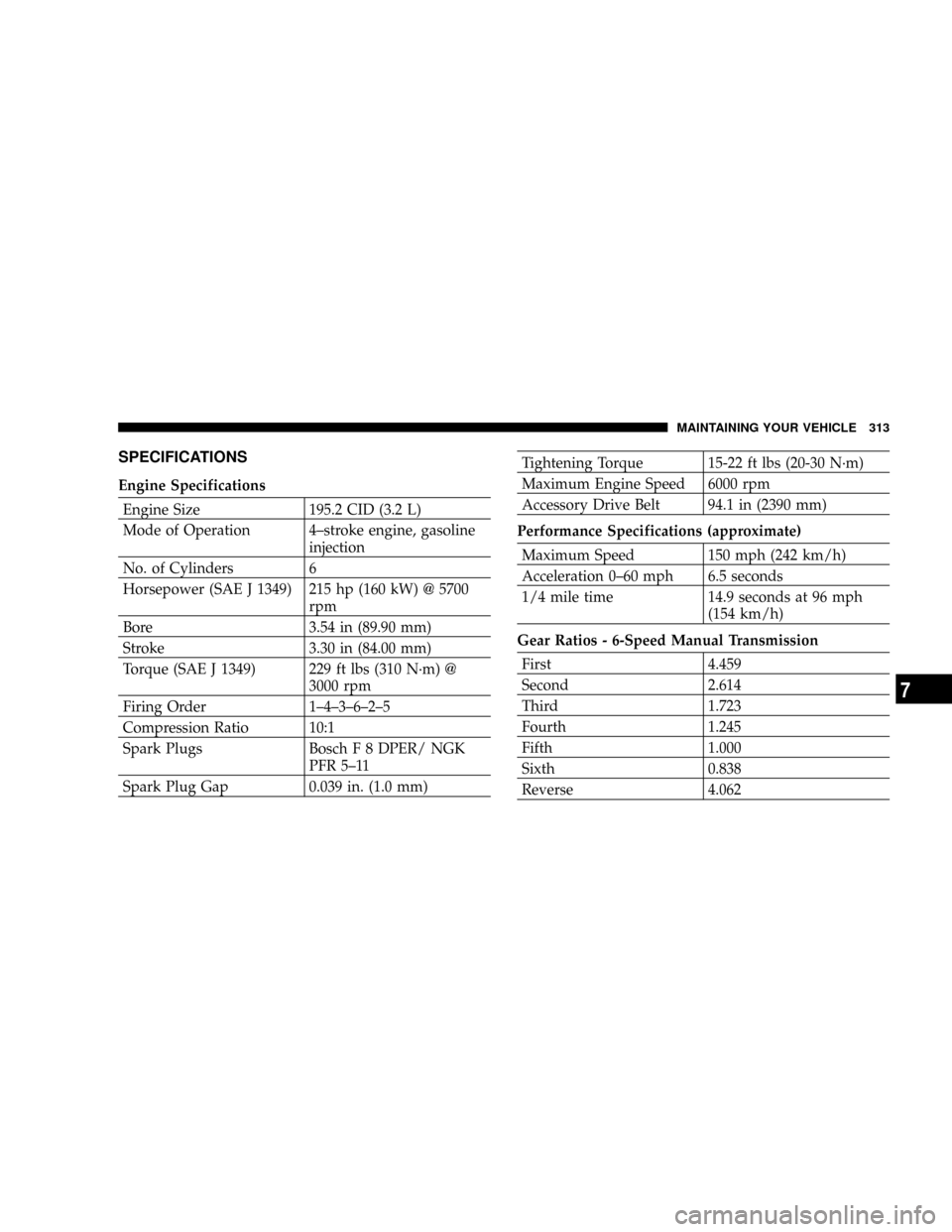
Engine Specifications
Engine Size 195.2 CID (3.2 L)
Mode of Operation 4±stroke engine, gasoline
injection
No. of Cylinders 6
Horsepower (SAE J 1349) 215 hp (160 kW) @ 5700
rpm
Bore 3.54 in (89.90 mm)
Stroke 3.30 in (84.00 mm)
Torque (SAE J 1349) 229 ft lbs (310 N´m) @
3000 rpm
Firing Order 1±4±3±6±2±5
Compression Ratio 10:1
Spark Plugs Bosch F 8 DPER/ NGK
PFR 5±11
Spark Plug Gap 0.039 in. (1.0 mm)
Tightening Torque 15-22 ft lbs (20-30 N´m)
Maximum Engine Speed 6000 rpm
Accessory Drive Belt 94.1 in (2390 mm)
Performance Specifications (approximate)
Maximum Speed 150 mph (242 km/h)
Acceleration 0±60 mph 6.5 seconds
1/4 mile time 14.9 seconds at 96 mph
(154 km/h)
Gear Ratios - 6-Speed Manual Transmission
First 4.459
Second 2.614
Third 1.723
Fourth 1.245
Fifth 1.000
Sixth 0.838
Reverse 4.062
MAINTAINING YOUR VEHICLE 313
7
Page 316 of 358
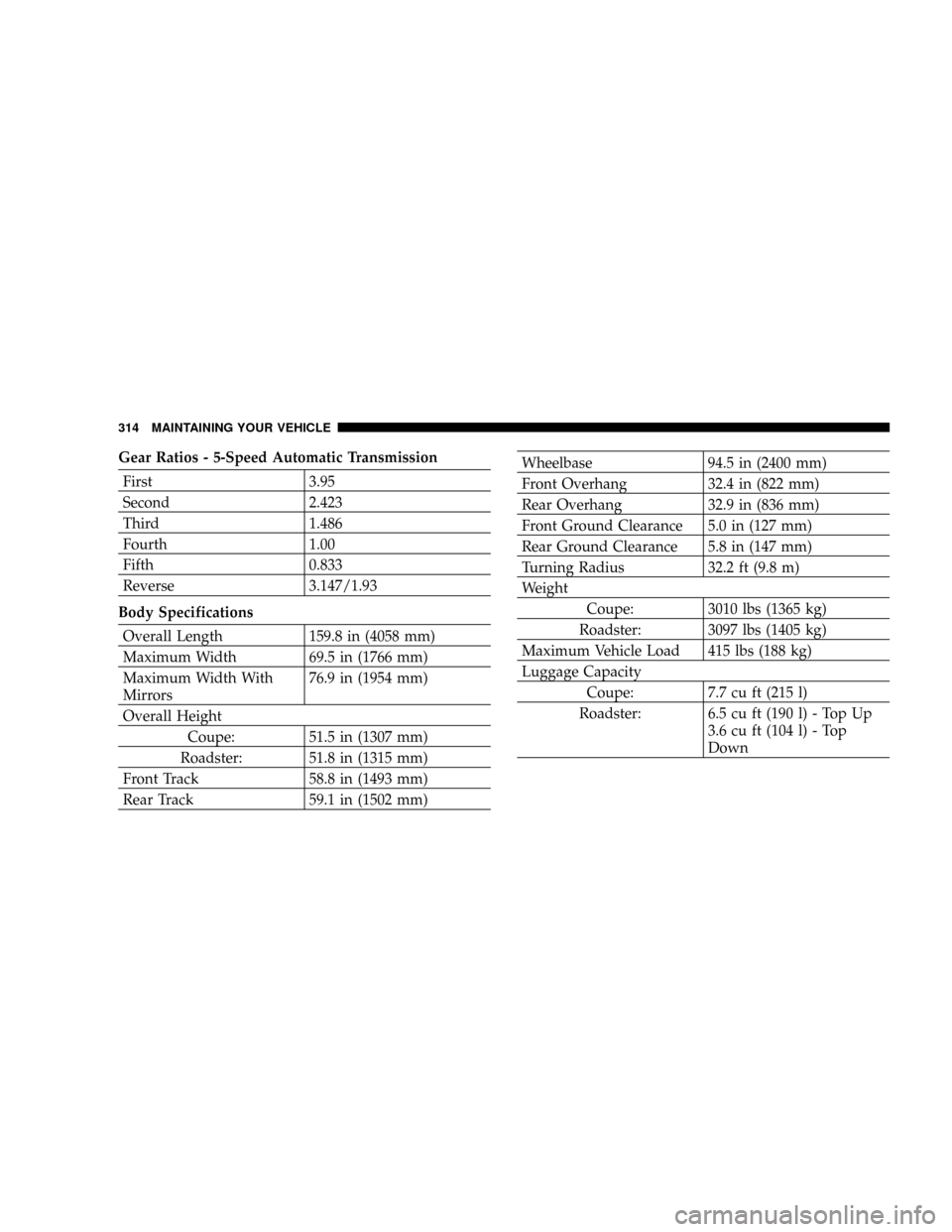
Gear Ratios - 5-Speed Automatic Transmission
First 3.95
Second 2.423
Third 1.486
Fourth 1.00
Fifth 0.833
Reverse 3.147/1.93
Body Specifications
Overall Length 159.8 in (4058 mm)
Maximum Width 69.5 in (1766 mm)
Maximum Width With
Mirrors76.9 in (1954 mm)
Overall Height
Coupe: 51.5 in (1307 mm)
Roadster: 51.8 in (1315 mm)
Front Track 58.8 in (1493 mm)
Rear Track 59.1 in (1502 mm)
Wheelbase 94.5 in (2400 mm)
Front Overhang 32.4 in (822 mm)
Rear Overhang 32.9 in (836 mm)
Front Ground Clearance 5.0 in (127 mm)
Rear Ground Clearance 5.8 in (147 mm)
Turning Radius 32.2 ft (9.8 m)
Weight
Coupe: 3010 lbs (1365 kg)
Roadster: 3097 lbs (1405 kg)
Maximum Vehicle Load 415 lbs (188 kg)
Luggage Capacity
Coupe: 7.7 cu ft (215 l)
Roadster: 6.5 cu ft (190 l) - Top Up
3.6 cu ft (104 l) - Top
Down
314 MAINTAINING YOUR VEHICLE
Page 317 of 358
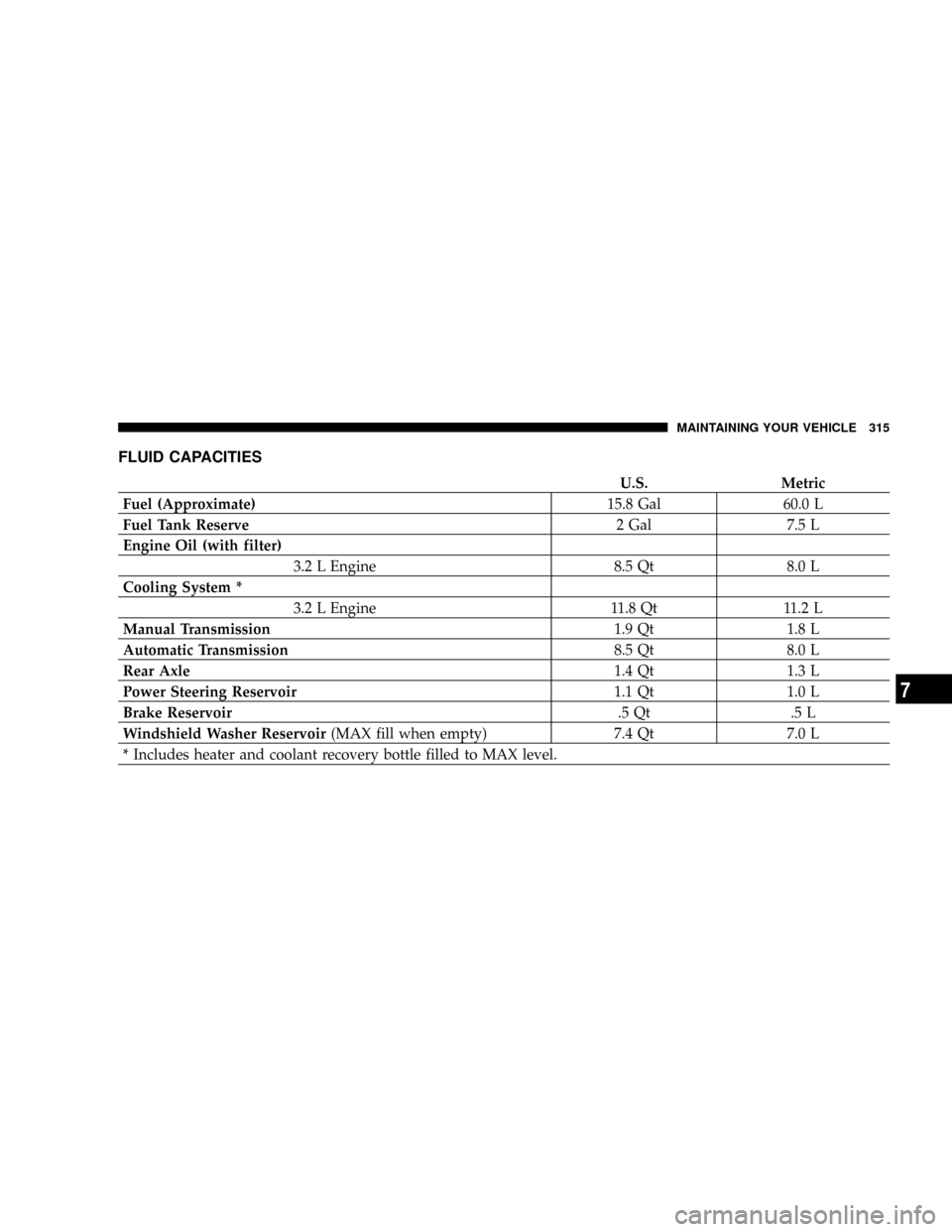
FLUID CAPACITIES
U.S. Metric
Fuel (Approximate)15.8 Gal 60.0 L
Fuel Tank Reserve2 Gal 7.5 L
Engine Oil (with filter)
3.2 L Engine 8.5 Qt 8.0 L
Cooling System *
3.2 L Engine 11.8 Qt 11.2 L
Manual Transmission1.9 Qt 1.8 L
Automatic Transmission8.5 Qt 8.0 L
Rear Axle1.4 Qt 1.3 L
Power Steering Reservoir1.1 Qt 1.0 L
Brake Reservoir.5 Qt .5 L
Windshield Washer Reservoir(MAX fill when empty) 7.4 Qt 7.0 L
* Includes heater and coolant recovery bottle filled to MAX level.
MAINTAINING YOUR VEHICLE 315
7
Page 319 of 358
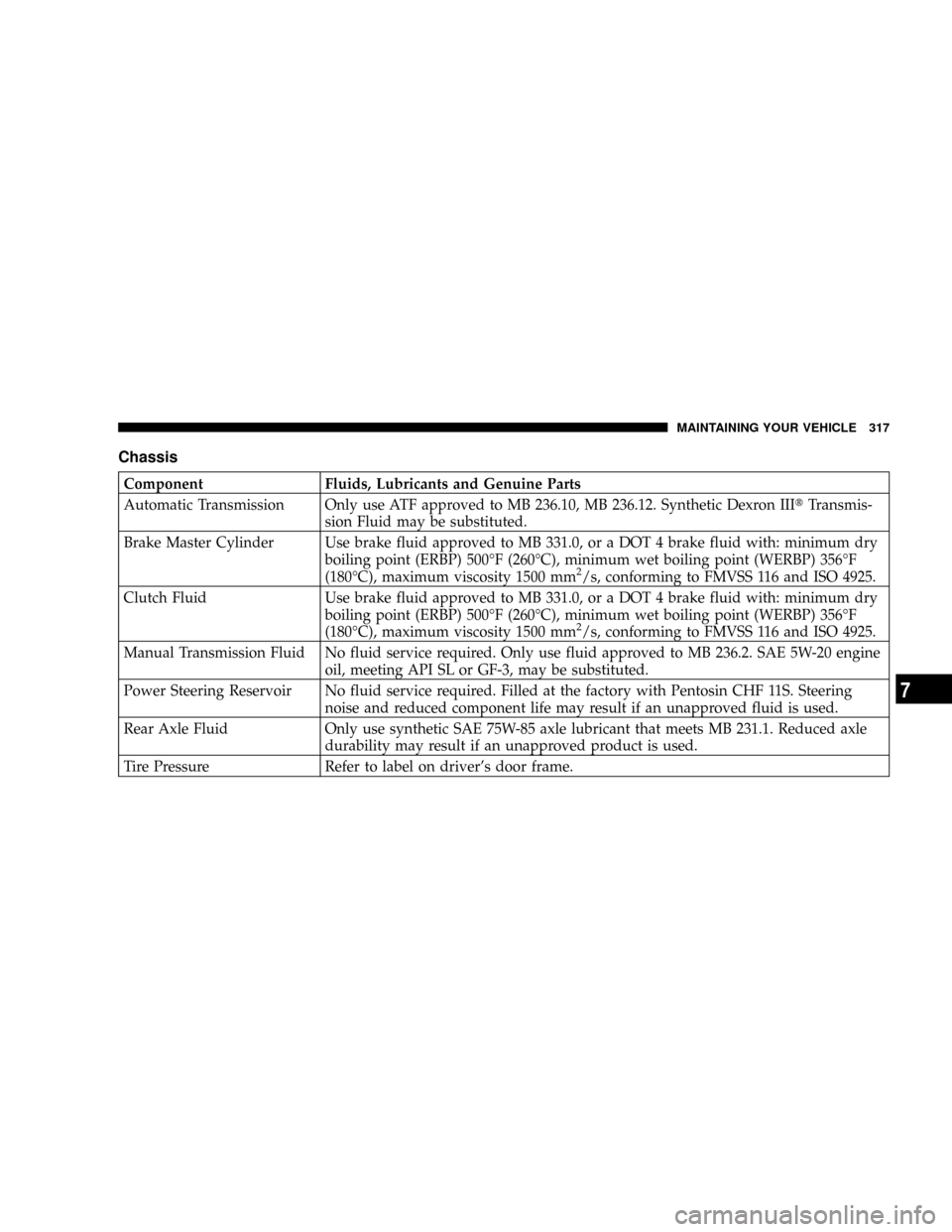
Chassis
Component Fluids, Lubricants and Genuine Parts
Automatic Transmission Only use ATF approved to MB 236.10, MB 236.12. Synthetic Dexron IIItTransmis-
sion Fluid may be substituted.
Brake Master Cylinder Use brake fluid approved to MB 331.0, or a DOT 4 brake fluid with: minimum dry
boiling point (ERBP) 500ÉF (260ÉC), minimum wet boiling point (WERBP) 356ÉF
(180ÉC), maximum viscosity 1500 mm
2/s, conforming to FMVSS 116 and ISO 4925.
Clutch Fluid Use brake fluid approved to MB 331.0, or a DOT 4 brake fluid with: minimum dry
boiling point (ERBP) 500ÉF (260ÉC), minimum wet boiling point (WERBP) 356ÉF
(180ÉC), maximum viscosity 1500 mm
2/s, conforming to FMVSS 116 and ISO 4925.
Manual Transmission Fluid No fluid service required. Only use fluid approved to MB 236.2. SAE 5W-20 engine
oil, meeting API SL or GF-3, may be substituted.
Power Steering Reservoir No fluid service required. Filled at the factory with Pentosin CHF 11S. Steering
noise and reduced component life may result if an unapproved fluid is used.
Rear Axle Fluid Only use synthetic SAE 75W-85 axle lubricant that meets MB 231.1. Reduced axle
durability may result if an unapproved product is used.
Tire Pressure Refer to label on driver's door frame.
MAINTAINING YOUR VEHICLE 317
7