warning CHRYSLER CROSSFIRE 2008 1.G Owner's Manual
[x] Cancel search | Manufacturer: CHRYSLER, Model Year: 2008, Model line: CROSSFIRE, Model: CHRYSLER CROSSFIRE 2008 1.GPages: 358, PDF Size: 4.7 MB
Page 46 of 358
How the Occupant Classification System (OCS)
System Works
The Occupant Classification System (OCS) will classify
an occupant in the front passenger seat into a size
category based on sensor readings from within the seat
cushion. Occupants should try to remain in a normally
seated position. If the occupant's weight is transferred to
another object in the vehicle (i.e. feet on the dashboard),
the OCS may not be able to properly approximate
occupant size. Furthermore, the occupant size may ap-
pear to increase or decrease due to objects hanging on the
seat, other passengers pushing on the seat, or objects
lodged underneath the seat. If there is a rapid change in
temperature or humidity, the OCS may not be able to
properly approximate occupant size. If your seat includ-
ing your trim cover and cushion needs to be serviced in
any way, take the vehicle to your authorized dealer. Only
manufacturer approved seat accessories may be used. If
there is a fault present in the system, the AIRBAGwarning light will light indicating that you should take
the vehicle to an authorized dealer. In the presence of an
occupant in the passenger seat, if both the Passenger
Airbag Disable (PAD) indicator light (located in the
center console) and AIRBAG warning light (located in
the instrument cluster) are illuminated the airbag will be
disabled. The Occupant Restraint Controller (ORC) will
not allow front airbag deployment in the event of a
collision for occupants classified into the empty or child
size categories. The PAD indicator light will illuminate
indicating that the Passenger Airbag is OFF when the
OCS has determined that the occupant size category is a
child. Also, when the seat is empty or an object that
weighs less than a predetermined threshold is placed on
the seat, the light will remain OFF. (The PAD indicator
light is an amber light located in the center console.) For
almost all sizes of properly seated adults, the passenger
frontal airbag will be enabled in the event of a collision.
For small teenagers and some small adults, depending on
44 THINGS TO KNOW BEFORE STARTING YOUR VEHICLE
Page 48 of 358
²Do not replace the seat cover with an aftermarket seat
cover.
²Do not add a secondary seat cover other than those
approved by DaimlerChrysler/Mopart.
²At no time should any supplemental restraint system
(SRS) component or SRS related component or fas-
tener be modified or replaced with any part except
those which are approved by DaimlerChrysler/
Mopart.
How the Occupant Classification Module (OCM)
Works
The Occupant Classification Module (OCM) is located
beneath the passenger seat. The OCM classifies the
occupant into one of three size categories based on the
input from the Bladder Assembly and a Belt Tension
Sensor. The size categories include empty, child, and
adult. The OCM sends the Occupant Classification to theORC to determine if a front passenger airbag is allowed.
If a fault is present, the AIRBAG warning light is illumi-
nated.
How the Passenger Airbag Disabled (PAD)
Indicator Light Works
The Passenger Airbag Disabled (PAD) Indicator Light
indicates to the driver and passenger when the airbag is
turned OFF. In the presence of a properly seated occu-
pant, when the PAD indicator light is illuminated, the
airbag is OFF. Also, when the Occupant Classification
System detects either an empty seat or a weight less than
the predetermined threshold, the ORC will not illuminate
the PAD indicator light even though the airbag is turned
OFF.
How the Belt Tension Sensor (BTS) Works
The Belt Tension Sensor (BTS) is located at the outboard
passenger lap belt anchor. The BTS creates a signal based
on outboard lap belt tension. This signal is sent to the
46 THINGS TO KNOW BEFORE STARTING YOUR VEHICLE
Page 52 of 358
To Turn On the Passenger Airbag:
²Place the ignition key in the on/off switch, turn the
key counterclockwise, and remove the key from the
switch. This will turn on the passenger airbag. The
Passenger Airbag Off light on the console will turn off,
or will not be illuminated when the ignition is turned
to the ON position.
WARNING!
The airbag may malfunction and serious injury could
result if key is left in the airbag shut off switch.
Always remove the key.
Maintaining Your Airbag System
WARNING!
²Unapproved modifications or service procedures to
the front passenger seat assembly, its related compo-
nents, or seat cover may inadvertently change the
airbag deployment in case of a frontal crash. This
could result in death or serious injury to the front seat
passenger if the vehicle is involved in an accident. A
modified vehicle may not comply with required Fed-
eral Motor Vehicle Safety Standards (FMVSS).
²You need proper knee impact protection in a collision.
Do not mount or locate any aftermarket equipment on
or behind the knee impact blocker.
²You can be injured if you are too close to either airbag
cover when the airbags inflate. It is dangerous to try
to repair any part of the airbag system yourself. Don't
try to repair the airbag system. Be sure to tell anyone
who works on your vehicle that it has airbags.
50 THINGS TO KNOW BEFORE STARTING YOUR VEHICLE
Page 54 of 358
Child Restraint
Everyone in your vehicle needs to be buckled up all the
time, including babies and children. Every state in the
United States and all Canadian provinces require that
small children ride in proper restraint systems. This is the
law, and you can be prosecuted for ignoring it.
WARNING!
In a collision, an unrestrained child, even a tiny baby,
can become a missile inside the vehicle. The force
required to hold even an infant on your lap could
become so great that you could not hold the child, no
matter how strong you are. The child and others
could be badly injured. Any child riding in your
vehicle should be in a proper restraint for the child's
size.
Infants and Child Restraints
There are different sizes and types of restraints for
children from newborn size to the child almost large
enough for an adult safety belt. Always check the child
seat Owner's Manual to ensure you have the right seat
for your child. Use the restraint that is correct for your
child:
²Safety experts recommend that children ride
rearward-facing in the vehicle until they are at least
one year old and weigh at least 20 lbs (9 kg). Two types
of child restraints can be used rearward-facing: infant
carriers and convertible child seats.
²The infant carrier is only used rearward-facing in the
vehicle. It is recommended for children who weigh up
to about 20 lbs (9 kg). Convertible child seats can be
used either rearward-facing or forward-facing in the
vehicle. Convertible child seats often have a higher
weight limit in the rearward-facing direction than
52 THINGS TO KNOW BEFORE STARTING YOUR VEHICLE
Page 55 of 358
infant carriers do, so they can be used rearward-facing
by children who weigh more than 20 lbs (9 kg) but are
less than one year old. Both types of child restraints are
held in the vehicle by the lap/shoulder belt or the
Lower Anchors and Tether for Children (LATCH)
child restraint anchorage system. (See the LATCH -
Child Seat Anchorage System section.)
²Rearward-facing child seats mustNEVERbe used in
the front seat of a vehicle with the front passenger
airbag unless the airbag is turned off. An airbag
deployment could cause severe injury or death to
infants in this position.
WARNING!
²A rearward facing infant restraint must not be
used unless the passenger airbag has been shut
off.A rearward facing infant restraint may be
struck by a deploying passenger airbag which may
cause severe or fatal injury to the infant.
²Improper installation can lead to failure of a child
restraint. It could come loose in a collision. The
child could be badly injured or killed. Follow the
manufacturer's directions exactly when installing
a child restraint.
THINGS TO KNOW BEFORE STARTING YOUR VEHICLE 53
2
Page 60 of 358
WARNING!
After installing a child safety seat or booster seat on the
passenger seat, do not adjust the back rest forward. This
could cause a higher load being perceived by the OCS
system which in turn could lead to the passenger airbag
being turned on. Failure to follow this warning could
result in serious or fatal injury. It is always recom-
mended to turn off the passenger front air bags using
the passenger front airbags on/off switch located at the
right end of the instrument panel when the passenger is:
²an infant (less than 1 year old),
²a child, age 1 to 12,
²an adult with a medical condition which makes
passenger airbags inflation (deployment) a greater
risk for the passenger than the risk of hitting the
dashboard (instrument panel) or windshield in a
crash.
The on/off switch is accessible by opening the passen-
ger door.
WARNING!
Improper installation of a child restraint to the
LATCH anchorages can lead to failure of an infant or
child restraint. The child could be badly injured or
killed. Follow the manufacturer's directions exactly
when installing an infant or child restraint.
Installing Child Restraints Using the Vehicle Seat
Belt
Child restraints can be securely fastened in the passenger
seat using the seat belts. For this purpose, the passenger
seat belt retractor provides two modes of operation -
normal emergency locking and automatic locking. For
child restraint installation, the retractor switches to auto-
matic locking when the belt is pulled out to the full extent
of its travel. As the belt retracts, the retractor locks to
prevent the belt from being pulled out again. Pulling the
58 THINGS TO KNOW BEFORE STARTING YOUR VEHICLE
Page 62 of 358
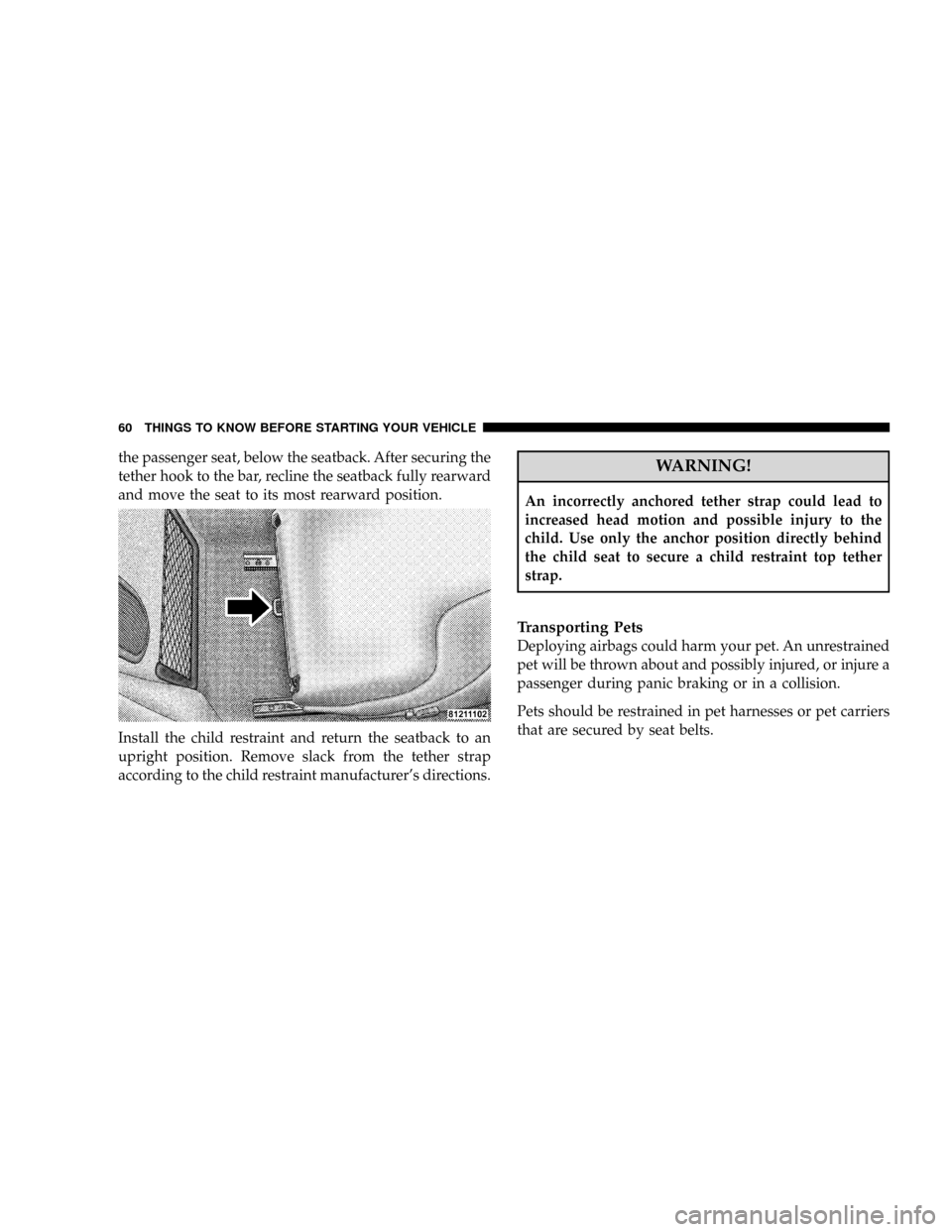
the passenger seat, below the seatback. After securing the
tether hook to the bar, recline the seatback fully rearward
and move the seat to its most rearward position.
Install the child restraint and return the seatback to an
upright position. Remove slack from the tether strap
according to the child restraint manufacturer's directions.WARNING!
An incorrectly anchored tether strap could lead to
increased head motion and possible injury to the
child. Use only the anchor position directly behind
the child seat to secure a child restraint top tether
strap.
Transporting Pets
Deploying airbags could harm your pet. An unrestrained
pet will be thrown about and possibly injured, or injure a
passenger during panic braking or in a collision.
Pets should be restrained in pet harnesses or pet carriers
that are secured by seat belts.
60 THINGS TO KNOW BEFORE STARTING YOUR VEHICLE
Page 63 of 358
ENGINE BREAK-IN RECOMMENDATIONS
The engine in your new vehicle does not require a long
break-in period. Following these few simple guidelines is
all that is necessary for a good break-in.
²Drive your vehicle at moderate vehicle and engine
speeds during the first 1,000 mi (1 600 km).
²Do not make any full throttle starts and avoid full
throttle acceleration.
²Use the proper transmission gear for your speed
range.
²Avoid excessive idling.
²Check the engine oil level at every fuel fill.
NOTE:A new engine may consume some oil during the
first few thousand miles of operation. This should be
considered as a normal part of the break-in and not an
indication of a problem.
SAFETY TIPS
Exhaust Gas
WARNING!
Exhaust gases can injure or kill. They contain carbon
monoxide (CO) which is colorless and odorless.
Breathing it can make you unconscious and can
eventually poison you. To avoid breathing CO follow
the safety tips below.
²Do not run the engine in a closed garage or in confined
areas any longer than needed to move your vehicle in
or out of the area.
²If it is necessary to sit in a parked vehicle with the
engine running, adjust your heating or cooling con-
trols to force outside air into the vehicle. Set the blower
at high speed.
THINGS TO KNOW BEFORE STARTING YOUR VEHICLE 61
2
Page 70 of 358
CONVERTIBLE TOP OPERATION
WARNING!
The convertible top does not provide the structural
protection that a reinforced metal roof does and the
fabric top cannot be expected to prevent the ejection of
the occupants of a vehicle in a collision. Therefore, it is
important that all occupants wear their seat belts at all
times when riding in a convertible. Studies have shown
that it is generally safer to remain inside a vehicle
during a collision than to be ejected from the vehicle.
For safety reasons, the convertible top should only be
opened and closed when the vehicle is standing still. Top
operation is allowed up to a maximum of 9 mph (15
km/h). Above this speed, top operation will cease and an
audible warning will sound. The top operation can be
resumed after the vehicle is below the maximum speed
by pressing the convertible top switch again.
WARNING!
Before operating the switch for the convertible top,
make sure that no persons can be injured by the
moving parts (convertible top frame and tonneau
cover).
Hands must never be placed near the sport bar,
convertible top frame, upper windshield area, shelf
behind sport bar, or convertible top storage compart-
ment while the convertible top is being raised or
lowered. Serious personal injury may occur.
If potential danger exists, release the convertible top
switch. This immediately interrupts the raising or
lowering procedure. You then can operate the con-
vertible top switch to raise or lower the convertible
top away from the danger zone.
68 UNDERSTANDING THE FEATURES OF YOUR VEHICLE
Page 72 of 358
To Lower The Top:
WARNING!
Top operation can be suspended for a maximum of 10
minutes. Thirty seconds before the end of this period an
audible warning will begin to sound continuously. At
the end of this period, hydraulic pressure will be
released and the top and tonneau cover will slowly
collapse. In order to re-initialize the top cycle, the
tonneau cover must first be moved and held in its full
open position manually. The convertible top should
then be carefully lowered into its storage compartment,
and the tonneau closed. Hands should be kept away
from moving parts of the top and top compartment
mechanisms to avoid injury during this operation and
as hydraulic pressure is reestablished. The hydraulic
pressure can be reestablished by turning the ignition to
the ON/RUN position and pushing down on the con-
vertible top switch twice. Refer to Convertible Top
Emergency Operation in the What To Do In Emergen-
cies section of this manual.
CAUTION!
To avoid possible damage to the tonneau cover and
convertible top, do not allow the convertible top to
remain in the suspended position. After approxi-
mately 10 minutes in the suspended position, the
hydraulic pressure will be released which will allow
the top and the tonneau cover to lower. The convert-
ible top switch can be pressed to cancel this
operation.
70 UNDERSTANDING THE FEATURES OF YOUR VEHICLE